
Short answer: Meta ROAS drops caused by agency latency happen when manual approval and reporting cycles take 24 to 72 hours while scaling ad spend. To solve this, transfer real-time budget scaling and loss-cutting actions to AI automation rules, shifting agency staff solely toward creative concept ideation and high-level marketing strategy.
Every growth-focused brand running Meta ads eventually experiences the same frustration: an ad set begins printing conversions, but your agency takes two full days to approve a budget increase. ROAS (return on ad spend) is the revenue generated for every unit of currency spent on advertising. Conversely, an underperforming ad creative might burn hundreds of liras across a weekend while your account manager is offline, destroying your blended profitability before anyone logs in to review the dashboard on Monday morning.
This operational friction happens because human account managers rely on manual dashboard checks, fragmented Slack communications, and slow client approval cycles. When auction dynamics shift inside Meta within hours, these administrative delays drain capital into exhausted creatives and prevent winning ad sets from capitalizing on momentum. Left unaddressed, agency latency constantly pushes campaigns back into the learning phase, inflates customer acquisition costs, and steadily erodes your bottom-line profit margins.
This guide explains how to eliminate agency latency by separating daily technical execution from high-level creative direction. You will learn the exact structural reasons why agency workflows stall, how to divide responsibilities between AI ad platforms and human strategists, how to deploy real-time budget scaling rules on a 5000 TL daily budget, and the specific metrics needed to verify that performance has fully recovered.
Key Takeaways
- Weekly agency reporting cadences cannot catch hour-by-hour performance dips during aggressive budget scaling.
- Delegate pause actions on losing ad sets to automated AI rules rather than waiting for email approvals.
- Reposition agency talent toward creative concepts and angles rather than repetitive campaign publishing tasks.
- Tools like Adsaify connect directly to your Meta account to remove manual operational bottlenecks.
How does agency latency cause ROAS drops in Meta ads?
Agency latency causes ROAS drops in Meta ads by delaying critical account interventions, allowing underperforming campaigns to exhaust daily budgets while high-performing sets starve for capital. Because Meta's auction operates in real time, manual operational delays of several hours or days turn profitable ad sets into unprofitable budget drains.
Hourly ROAS Volatility and Weekend Ad Fatigue
ROAS (return on ad spend) is a marketing metric that measures the gross revenue generated for every unit of currency spent on advertising. During aggressive scaling phases, ROAS fluctuates continuously throughout the day based on consumer purchasing patterns, auction liquidity, and automated pacing. When an ad account scales, Meta's delivery system rapidly distributes budget across broad audiences. Ad fatigue is a performance drop that occurs when target audiences see the same creative asset repeatedly, driving frequency up and click-through rates down. Because most agencies pause operational monitoring from Friday evening to Monday morning, fatigued ad sets run unmonitored for over sixty consecutive hours. Over the weekend, campaigns often burn significant budget on audience segments that have ceased converting, causing blended weekly returns to decline sharply.
Approval Chain Friction and Audience Bleed
Operational latency deepens when structural delays prevent fast campaign adjustments. In standard agency workflows, an account manager spots a drop in performance, messages the media buyer, drafts a proposed adjustment, seeks brand confirmation via email, and only then updates Meta Ads Manager. This multi-layered approval chain routinely takes between twenty-four and seventy-two hours. During this period, Meta's automated algorithms keep routing budget into unprofitable placements, such as Audience Network or low-intent feed placements. When media buyers finally inspect Meta Ads Manager using the "Breakdown" menu by Placement or Impression Device, they often discover that substantial daily spend was lost to non-converting segments before approval to exclude those placements was granted.
For example, consider a direct-to-consumer apparel brand running campaigns with a 15,000 TL daily budget across Advantage+ shopping campaigns. On a Saturday morning, an unexpected inventory stockout occurs on the primary hero product, causing the conversion rate to drop from 3.2% to 0.4% and the cost per purchase to climb from 120 TL to 480 TL. Because the agency team does not log into the account until Monday at 10:00 AM, the account spends 30,000 TL across the weekend at a negative return. Fixing this requires immediate operational intervention: pausing the specific ad creative featuring the out-of-stock item inside Ads Manager, reallocating spend to active inventory ad sets, and reviewing the "Breakdown by Product ID" report to verify that delivery redirected to in-stock inventory.
Would requesting daily performance reports from my agency eliminate this lag?
No, requesting daily performance reports from an agency does not eliminate operational lag because reporting is inherently backward-looking. A daily report merely summarizes the financial loss that occurred during the previous twenty-four hours; it does not alter delivery while spend occurs. Resolving agency latency requires automated rules that detect CPA (cost per acquisition) spikes and pause underperforming ads inside Meta Ads Manager instantly, rather than human account managers compiling historical spreadsheets hours after budget has already been wasted.
Why does operational latency happen in performance agencies?
Operational latency happens in performance agencies primarily because human media buyers manage too many complex accounts simultaneously without automated execution systems. Account managers spend significant working hours on administrative duties, reporting decks, and manual campaign setups, leaving inadequate time for continuous intraday bid adjustments, ad creative refreshes, and granular performance monitoring.
Buyer Workload Congestion and Administrative Overhead
Media buyer workload constraints represent the fundamental operational bottleneck in traditional agencies. A single agency media buyer is routinely assigned to manage eight to twelve client ad accounts simultaneously. Conducting proper media buying requires tracking attribution windows, setting bid caps, analyzing creative fatigue, and monitoring audience overlaps. Across eight or more accounts, an ad account receives less than forty-five minutes of focused operational analysis per workday. Furthermore, client status calls, retrospective presentation preparations, and administrative tasks consume the majority of agency working hours. Performance anomalies occurring while a buyer attends internal meetings or prepares monthly decks go unaddressed until significant spend has cleared the auction.
Manual Assembly Drag and Static Reporting
A major drain on agency productivity is the manual execution of repetitive campaign tasks in Meta Ads Manager. Media buyers spend hours drafting ad copy, manually resizing creative formats for 9:16 Stories and 1:1 Feeds, and duplicating ad sets to split-test audiences. Modern growth teams eliminate this friction by using Adsaify to analyze a website URL and draft complete campaigns, targeting, and creative concepts directly inside their Meta ad accounts. Without automated generation and algorithmic triggers, agencies remain reliant on retrospective weekly client reports, analyzing static data rather than acting on intraday auction shifts.
| Operational Area | Manual Agency Workflow | Automated Execution Systems |
|---|---|---|
| Intraday Spend Monitoring | Manual checks performed once or twice per workday. | Continuous algorithmic checks running hourly via automated rules. |
| Underperforming Ad Intervention | Ads paused after human review, taking 12 to 48 hours. | Ad sets paused automatically when CPA thresholds are breached. |
| Weekend Account Management | Accounts left unmonitored from Friday evening to Monday. | Algorithmic rules manage budget delivery seven days a week. |
| Campaign Drafting Workflow | Copywriting and asset assembly executed manually across hours. | Campaign drafts, targeting, and copy generated directly from site URLs. |
| Budget Scaling Decision | Budgets adjusted manually based on weekly retrospective data. | Spend increased systematically when real-time ROAS targets are met. |
Why do traditional agencies resist adopting automated ad execution software?
Traditional agencies resist automated execution software because standard agency business models rely on billable hours, dedicated headcount retainers, and the perception of proprietary manual optimization. Acknowledging that automated platforms can draft campaigns and adjust budgets more effectively than human buyers challenges retainers based on manual labor. Additionally, agency leadership often hesitates to hand execution control to software, choosing familiar manual workflows in Meta Ads Manager even when human latency consistently reduces client ROAS during high-spend auction shifts.
What does unaddressed agency latency cost an ad account?
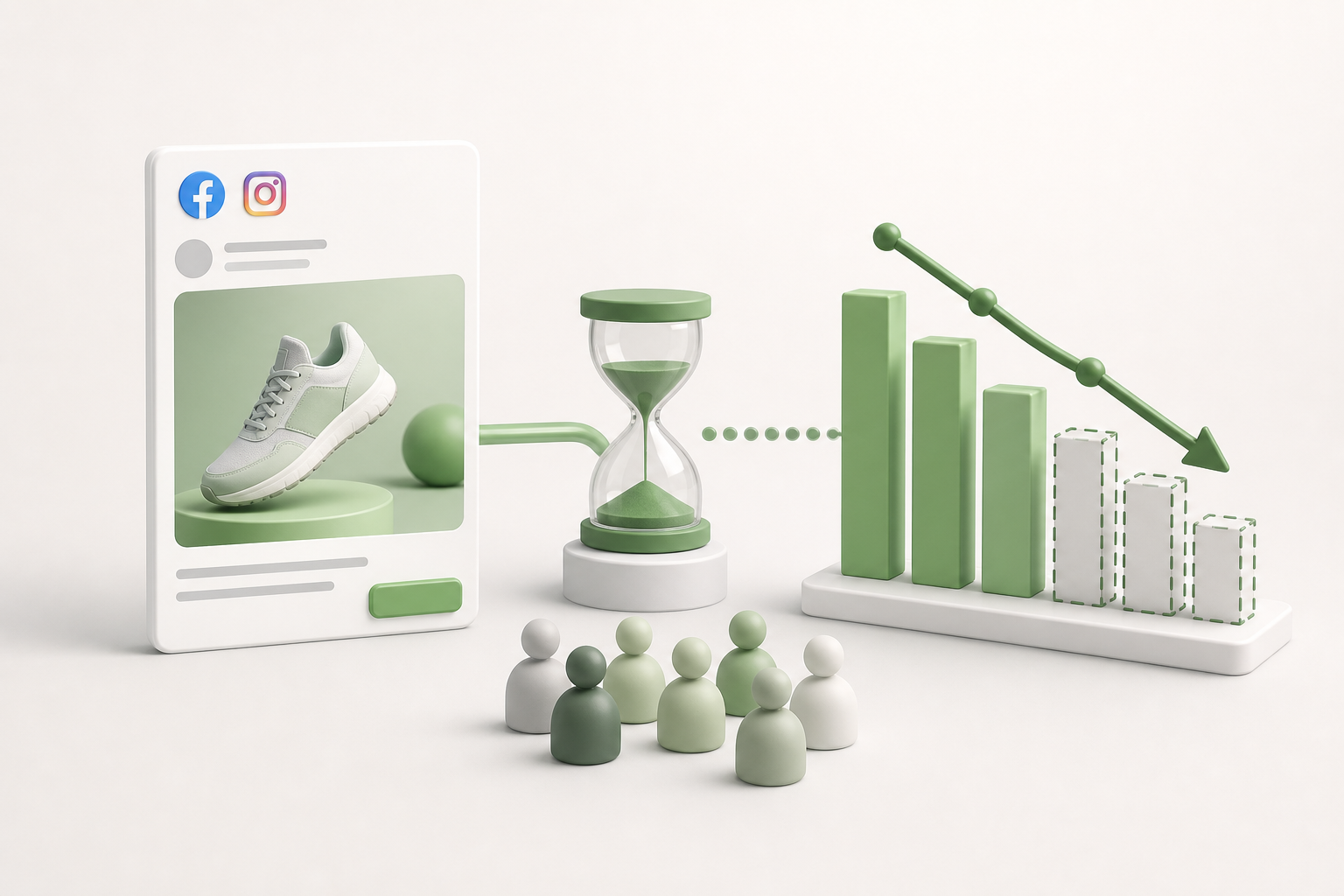
Unaddressed agency latency costs an ad account direct media spend, suppressed contribution margins, and forfeited scaling velocity. When agencies take days to pause fatigued ads or scale winning sets, Meta Ads Manager burns budget on unprofitable impressions, inflates acquisition costs, and drops campaign-level ROAS (return on ad spend, which is revenue generated divided by advertising spend).
Compound Margin Penalties and algorithmic Drift
When an ad creative experiences creative fatigue—a state where an audience sees an ad too often and stops converting—its CPA (cost per acquisition, which is the total ad spend divided by the number of purchases) surges rapidly. If an agency operates on standard 48-hour or 72-hour review cycles, that underperforming ad continues spending unchecked in Meta Ads Manager. For an e-commerce brand operating on tight net margins, absorbing two days of unchecked ad spend at a sub-break-even ROAS directly cannibalizes the profits generated by the account's top-performing ad sets.
Beyond the direct financial waste, delay damages auction delivery mechanics. When an agency delays budget allocation to an ad set demonstrating positive conversion momentum, Meta's delivery algorithm restricts impression delivery to the easiest-to-convert users within the target audience. If that ad set is not scaled while conversion velocity is high, the algorithmic momentum dissipates, forcing the ad set back into the learning phase once an agency finally increases the budget days later.
Prolonged Testing and Retainer Inefficiencies
Sluggish operational cycles extend creative testing intervals from days into weeks. While an agency account manager drafts a weekly report and requests approval for budget adjustments, agile competitors deploy fresh angles, bid aggressively in the auction, and capture lower CPM (cost per mille, which is the cost per one thousand ad impressions) inventory. Slower iteration cycles mean fewer total creative concepts tested per month, directly lowering the probability of finding breakout winners.
This dynamic creates a dual financial burden. Advertisers pay fixed monthly agency retainers for active media management, yet simultaneously absorb the hidden cost of wasted media spend caused by operational latency. Instead of paying for proactive optimization, brands effectively subsidize the agency's delayed reaction time.
Worked Example: The Latency Penalty in Apparel E-commerce
Consider, for example, a boutique apparel e-commerce store running a daily budget of 3,000 TL across three dynamic creative ad sets inside Meta Ads Manager. On Friday morning, Creative Set A experiences an unexpected drop in ROAS from 3.2 to 0.8 as inventory for key sizes runs out. The agency does not review the account until Monday at 11:00 AM.
- The Inaction: Creative Set A spends 1,000 TL daily for Friday, Saturday, and Sunday—burning 3,000 TL across 72 hours for only 2,400 TL in revenue, generating a 600 TL net loss on ad spend.
- The Optimization: At 11:00 AM Monday, the agency finally navigates to Meta Ads Manager, toggles the delivery switch on Creative Set A to "Off", and shifts the remaining budget to Creative Set B (which maintained a 3.5 ROAS).
- What to Review: Reviewing the "Breakdown by Day" report alongside the "Cost per Result" column reveals that an immediate pause on Friday morning would have preserved 3,000 TL of capital, which could have driven 10,500 TL in revenue if allocated instantly to Creative Set B. Brands can explore automated campaign setups to understand how instantaneous rules eliminate this gap.
Does this operational bleed only hurt brands with enterprise-level ad budgets?
No, operational latency harms emerging brands far more severely than enterprise advertisers. Large corporations possess substantial cash reserves and high overall spend volume to absorb several days of wasted ad spend. For a growing business operating on narrow gross margins, spending even 2,000 TL on an unprofitable ad set over a weekend can wipe out weekly net profits, trigger cash flow shortages, and restrict the account's capacity to purchase future inventory.
How do you divide execution between AI platforms and agencies?
You divide execution between AI platforms and agencies by assigning operational execution, real-time campaign pauses, and budget optimization to software, while reserving creative concepting, offer design, and strategic positioning for human agency strategists. This hybrid split eliminates communication bottlenecks and ensures ad accounts react instantly to shifting auction data.
The Hybrid Operating Model for Performance Marketing
In high-performing advertising accounts, human account managers should not spend billable hours adjusting daily budgets by 10 percent or clicking through Meta Ads Manager to turn off fatigued ad creatives. Operational decisions based purely on numerical triggers belong to software platforms. Connecting automated stop-loss and budget-ramping rules guarantees that campaigns react to data 24 hours a day without manual sign-offs.
Adsaify enables this structural separation by handling technical campaign deployment. By analyzing a business website URL or a short product description, Adsaify drafts campaign targeting audiences, suggested budgets, and ad copies. Advertisers can create an account on Adsaify to generate ad images and videos or promote existing Instagram posts, directly publishing them to their own Meta ad account. The platform provides automated rules—such as pausing ads when performance metrics decline—which frees human teams from manual monitoring.
When automated software takes over execution, the agency's role elevates from administrative account management to high-leverage strategic growth. Human specialists redirect their hours toward product offer architecture, customer avatar research, and landing page CRO (conversion rate optimization, which is the process of increasing the percentage of website visitors who complete a desired purchase).
Automated Execution and Strategic Oversight Workflow
- Website Input and Creative Concepting — Agency strategists define the seasonal offer and target audience hooks based on market research.
- Automated Campaign Drafting — Adsaify analyzes the landing page URL and generates audience segments, ad copy variations, and campaign structure suggestions.
- Asset Generation and Selection — Agency creatives generate video and image variations or select existing Instagram posts within Adsaify, publishing approved ads directly to the Meta ad account.
- Real-Time Performance Monitoring — Adsaify's automation rules continuously evaluate live ROAS and CPA against predefined stop-loss thresholds without human latency.
- Automated Stop-Loss Execution — The platform automatically pauses underperforming ads when ROAS drops below the target threshold, protecting account margin.
- Strategic Creative Refinement — Human agency specialists review the win-loss creative reporting once weekly to design the next creative iteration cycle.
Can an AI platform completely replace an agency team without human intervention?
No, an AI platform cannot completely replace human agency teams because software cannot conceptualize proprietary brand messaging, negotiate product margins, or overhaul an uncompetitive commercial offer. While AI tools execute ad creation, publishing, and real-time rule automation with precision, human strategists remain essential for qualitative market research, video production direction, and macro-level business strategy that algorithms cannot infer from conversion metrics alone.
If you would rather not set up each of these steps by hand, try it in Adsaify: your first ad is free, so there is nothing to lose. Create a free account.
What preparations are required before deploying AI ad automation?
Deploying AI ad automation requires establishing verified tracking signals, calculating explicit financial thresholds, standardizing account structures, and granting appropriate system permissions. Advertisers must audit their Meta Pixel and Conversions API tracking, determine exact break-even return on ad spend targets, and define daily spend guardrails within Meta Business Manager before activating rule-based controls.
Auditing Tracking Infrastructure and Data Hygiene
Reliable automation requires pristine conversion telemetry. Advertisers must open Meta Events Manager to verify that the Meta Pixel and Meta Conversions API (CAPI) report matching events with high deduplication accuracy. The Meta Conversions API is a server-side data channel that transmits customer actions directly from an advertiser's server to Meta. In Meta Events Manager, check the Event Quality Match score for the "Purchase" event; scores below 7.0 indicate that parameters such as hashed email, phone number, and IP address are missing, which compromises automated decision-making.
Establishing Financial Thresholds and Guardrails
Automation rules execute mechanical actions based on strict mathematical limits. Advertisers must calculate their precise break-even ROAS and maximum acceptable CPA. ROAS (return on ad spend) is the revenue generated for every currency unit spent on advertising. CPA (cost per acquisition) is the ad spend required to secure a single completed purchase or conversion. For example, if a store sells an item for 1000 TL with a product cost of 600 TL, the contribution margin is 400 TL. Therefore, the maximum allowable CPA is 400 TL, and the break-even ROAS is 2.5. Rules must use these exact thresholds to avoid pausing profitable ad sets.
Structuring Meta Business Manager for Automated Access
Ad accounts need clean structural hierarchies to prevent rule conflicts. Advertisers should enforce strict naming conventions in Meta Ads Manager (for example: [Campaign Objective]_[Target Audience]_[Creative Angle]). Navigate to Meta Business Settings to manage partner permissions. When linking external platforms, grant Advertiser-level access rather than full administrative control to maintain security. Through Adsaify registration, users can connect their Meta ad account to deploy AI campaign creation and rules while keeping overall governance inside their own Business Manager.
- Audit Meta Events Manager to ensure the Purchase event has an Event Quality Match score of 7.0 or higher.
- Enable Conversions API deduplication by passing identical
event_idparameters from both browser and server. - Calculate your exact break-even ROAS and acceptable CPA based on true product margins.
- Apply structured naming taxonomies across all active campaigns, ad sets, and ads in Meta Ads Manager.
- Assign Advertiser-level permissions to automation tools within Meta Business Settings.
- Establish daily account-level spending limits in Meta Billing and Payment settings as a backstop.
Will automation rules trigger false positives if my account lacks extensive historical data?
Yes, automation rules can trigger premature actions if threshold windows are set too narrowly on new accounts. Without historical data, conversion distribution exhibits higher variance, meaning an ad set might spend 1.5 times the target CPA before logging its first conversion. Advertisers should widen rule evaluation windows to 48 or 72 hours and incorporate secondary leading indicators, such as outbound click-through rates or add-to-cart events, until the pixel accumulates at least 50 weekly purchases.
How does real-time ROAS scaling work on a 5000 TL daily budget?
Real-time ROAS scaling on a 5000 TL daily budget works by continuously evaluating individual ad set efficiency and shifting spend from underperforming segments into top-performing assets within hours. Automated rules immediately pause lagging ad sets when early performance thresholds fail, preserving daily capital so winning variations receive maximum delivery without manual agency intervention.
Walkthrough of Dynamic Capital Reallocation
Consider an example of an e-commerce leather goods brand allocating a 5000 TL daily budget across three ad sets in Meta Ads Manager: Broad Targeting (2000 TL), Lookalike Audience (1500 TL), and Category Interests (1500 TL). Under normal agency management, all three ad sets would spend their assigned budgets through midnight, regardless of mid-day performance drops. With automated rules running, the system monitors outbound metrics alongside spend progression every hour.
CTR (click-through rate) is the percentage of total ad impressions that lead to a link click. Suppose that by 13:00, the Category Interests ad set spends 1000 TL but records zero purchases and an outbound CTR below 0.8%. An automation rule detects that the ad set has breached the maximum CPA threshold without converting and immediately pauses it. The remaining 500 TL allocated to that ad set is protected. The merchant can reallocate the unspent liquidity toward the Broad ad set, which is delivering a 3.8 ROAS, allowing the winning variation to capture afternoon peak buying hours.
Iterating New Creative Variations During Active Delivery
Halting an underperforming ad set frees up budget, but long-term account health requires constant creative testing. Once an automation rule pauses an unviable ad, the merchant must introduce replacement creative angles. By accessing Adsaify account login, the merchant can generate fresh ad images or draft alternative ad copy based on the initial website analysis. Because automation engines do not swap active creatives directly, the merchant manually publishes the newly drafted creative into the existing campaign structure, providing fresh inventory for algorithmic testing.
After reallocating the budget and appending the new visual variation, the merchant monitors the blended account ROAS in Meta Ads Manager the following morning. If the Broad ad set maintained its target efficiency while absorbing the additional spend, the daily budget can remain shifted, locking in higher net daily revenue.
Does aggressive rule pausing disrupt Meta's ad set learning phase prematurely?
Pausing an ad set entirely does not reset the learning phase of your remaining active ad sets, but it terminates optimization for that specific paused ad set. Meta requires roughly 50 optimization events per week per ad set to exit the "Learning" status. When automated rules pause an ad set after 1000 TL of unproductive spend, the goal is capital preservation rather than algorithm training. Do not continually toggle the same ad set on and off, as frequent status changes re-enter the learning phase and degrade delivery consistency.

What common mistakes occur when integrating agencies with AI?
Common mistakes when integrating agencies with AI include overlapping manual edits that override automated rules, configuring rule lookback attribution windows on volatile intraday hours, expecting automated budget adjustments to fix creative fatigue, and failing to define written protocols dividing operational execution from creative asset development.
Conflicting Manual Edits and Aggressive Rule Windows
The most disruptive operational friction occurs when human media buyers manually adjust campaigns that an automation platform is simultaneously managing. For example, if an agency buyer manually reactivates an ad set inside Meta Ads Manager that an automation rule paused for poor performance, the system enters an edit conflict that resets the ad set learning phase. In Meta Ads Manager, frequent status toggles prevent the delivery algorithm from stabilizing delivery across high-intent prospects.
A related error is setting automated evaluation windows too tight. When brands configure automation rules to evaluate ROAS (return on ad spend is the revenue generated divided by ad spend) over a two-hour window, normal intraday conversion delays trigger false alarms. Meta ad attribution often requires several hours for server-side events to populate through the Conversions API. Pausing campaigns during temporary midday conversion dips cuts off ad sets before daily performance averages out.
Creative Fatigue Assumptions and Ambiguous Governance
Automated rules efficiently cut budget to losing ads and preserve margins, but budget toggles cannot solve creative fatigue. When ad frequency climbs above 3.5 in a broad audience and click-through rates decline, adjusting budgets only delays performance drops. Automation platforms like Adsaify pause underperforming ads based on defined rules, but brands and agencies must continuously supply fresh angles, hooks, and creative formats to replace fatigued inventory.
Integrating third-party automation fails without a clear operating agreement. Brands must define whether the agency or the software manages bid adjustments, dayparting, and ad pauses. Without a signed protocol specifying that software executes real-time bid and pause rules while the agency focuses on creative strategy and reporting, team members duplicate tasks and blame the automated tool for unexpected campaign modifications.
| Integration Mistake | Observed Symptom | Operational Root Cause | Corrective Action |
|---|---|---|---|
| Dual-operator manual edits | Constant learning phase resets in Meta Ads Manager | Media buyers overriding automated rule triggers | Restrict manual status toggles in account governance settings |
| Hyper-reactive lookback windows | Premature ad pauses during midday traffic lulls | Rules set to evaluate 2-hour conversion data | Expand evaluation windows to minimum 24-hour or 3-day data |
| Over-reliance on budget shifts | Declining ROAS despite aggressive ad pausing | Ad creative fatigue left unaddressed by creative team | Produce new creative concepts and hook variations weekly |
| Ambiguous operational roles | Account discrepancies and uncoordinated campaigns | Lack of written protocol between brand and agency | Draft a service level agreement defining execution ownership |
How should I handle pushback if my agency resists integrating an automated platform?
Reframe the automation platform as an operational safety net rather than an agency replacement. Explain that automation handles repetitive monitoring and nighttime budget protection, which frees their media buyers to focus on audience research, creative scripting, and conversion rate optimization. Establish clear boundaries showing that automated rules enforce their agreed guardrails without stripping them of high-level strategic campaign direction.
How do you measure if agency latency is resolved and ROAS is recovered?
You measure agency latency resolution and ROAS recovery by tracking the hours elapsed before unprofitable ads are paused, monitoring weekly blended return on ad spend and Marketing Efficiency Ratio (MER), and calculating the reduction of wasted ad spend as a percentage of your total Meta advertising budget.
Benchmarking Reaction Time and Eliminating Wasted Spend
To confirm that agency latency is resolved, audit the Meta Ads Manager Activity History log to measure operational reaction time. Reaction time is the exact number of hours between an ad breaching an agreed threshold—such as a cost per acquisition (CPA) climbing above a breakeven limit—and the ad status changing to "Off". When manual agency workflows govern an account, this gap often spans 24 to 72 hours. With automated rules active, this delay drops to under two hours.
Next, quantify the reduction in wasted ad spend. Wasted ad spend represents all budget allocated to ad sets or creatives that generate zero conversions or perform below your minimum breakeven target over a rolling 7-day period. For example, in an account spending 50,000 TL per month, cutting the time to pause unprofitable ads from 48 hours to immediate rule execution typically reclaims thousands of liras in previously leaked ad capital.
Tracking Macro Efficiency and Implementation Velocity
Individual ad set metrics fluctuate, so long-term recovery must be tracked at the macro level over 30 days. Marketing Efficiency Ratio (MER) is total business revenue divided by total marketing ad spend across all channels. Tracking weekly blended ROAS alongside MER accounts for delayed attribution and offline conversions, confirming that automated protections translate into verifiable business profit.
Teams can establish an objective latency baseline by launching a parallel trial campaign via Adsaify registration to benchmark operational velocity. Running an automated workflow alongside your agency's standard operational cadence provides clear, empirical data on execution speed, creative turnaround times, and spend discipline.
- Audit Meta Ads Manager Activity History weekly to record the exact timestamp when underperforming ads were paused.
- Calculate the percentage of total monthly ad budget consumed by ad sets operating below breakeven ROAS.
- Monitor 7-day and 30-day rolling MER in your core analytics dashboard to track top-line efficiency.
- Review frequency metrics across top ad sets to detect creative fatigue before conversion rates deteriorate.
- Verify that automated pause rules fire consistently without manual overrides from internal team members.
- Log the average turnaround time between identifying a fatigued creative and publishing a replacement asset.
Once ROAS stabilizes, at what frequency should I scale the daily budget upward?
Scale daily budgets by 15 to 20 percent every 48 to 72 hours once ROAS remains consistently above target for three consecutive days. Adjusting budgets more frequently or in increments greater than 20 percent forces the Meta ad set back into the learning phase, which causes bid volatility and temporary conversion declines while the algorithm recalibrates delivery.
When Should You Balance Agency Strategy with AI Media Buying?
To recover Meta ROAS drops caused by agency latency, take back operational control through a structured process. First, audit your Meta Ads Manager to identify delayed budget adjustments and fatigued creatives that were paused days too late. Next, establish automated performance rules directly in your account to immediately halt unprofitable ads, cap ad spend during sudden conversion drop-offs, and protect your margins. Finally, align creative production so that replacement assets can be published the moment underperformers exit circulation.
Take immediate action today by testing automation directly on your Meta ad account. You can register on Adsaify to link your ad account, set threshold-based rules that pause underperforming ads, and publish a new campaign draft to compare execution speed against standard agency turnaround times.
Want to see this in your own account? Enter your website address and Adsaify drafts the campaign for you. The first ad is free. Try it now or log in.
Frequently Asked Questions (FAQ)
1. Can I use an AI tool like Adsaify while keeping an active contract with a media agency?
Yes, you can use Adsaify alongside an active agency contract. Adsaify connects directly to your Meta ad account, allowing you to run automated rules or publish specific campaigns alongside agency assets. To avoid conflicting bid adjustments and overlapping audiences, clearly designate which campaigns belong to your agency and which are managed through internal AI automation.
2. How much does AI campaign management save compared to traditional agency retainer fees?
AI campaign management replaces fixed monthly retainers and percentage-of-spend fees with direct platform usage. While agency contracts typically require fixed management fees regardless of ad performance, an AI tool eliminates that service overhead entirely. Exact savings depend on your media spend, but businesses save the entire agency fee margin while retaining full budget allocation inside Meta.
3. Does AI budget optimization continue protecting ad spend on weekends and public holidays?
Yes, AI budget optimization runs continuously, protecting ad spend across weekends, nights, and public holidays. Automated rules evaluate real-time Meta metrics against your performance thresholds 24/7. When ROAS drops or cost per acquisition spikes outside business hours, the automation pauses underperforming ads immediately, preventing the budget drain typical of unmonitored agency lag over non-working days.
4. Can I upload agency-produced creative assets directly into an AI media buying workflow?
Yes, you can upload agency-produced images and videos directly into your AI workflow. In Adsaify, you can draft campaigns using external visual assets, generate new AI variations, or promote existing Instagram posts. This enables you to combine professionally produced agency creative assets with faster, automated campaign drafting, audience targeting, and rule-based budget protection.
5. Is relying solely on an AI platform sufficient for small budgets instead of hiring an agency?
Yes, relying on an AI platform is practical for small budgets where agency retainer fees would consume a disproportionate share of total marketing capital. Tools like Adsaify analyze your website URL to generate targeting, copy, and budgets, enabling small advertisers to launch and protect Meta campaigns professionally without taking on fixed agency overhead costs.
6. Can automated rule triggers cause ad accounts to violate Meta advertising compliance policies?
No, automated rule triggers do not cause policy violations. Automated rules execute standard administrative actions, such as pausing an active ad, adjusting daily budget, or changing bid values. Meta advertising compliance policies evaluate ad copy, creative media, targeting parameters, and destination URLs, none of which are altered into policy-violating states simply by automated performance triggers.
7. Which key performance indicator best reflects campaign execution latency in agency workflows?
Cost per acquisition (CPA) inflation during performance drops is the clearest key performance indicator reflecting agency latency. When ad creative fatigues or conversion rates decline, delayed manual intervention leaves daily budgets running at a loss. Measuring the duration between a performance decline and ad pausing highlights the wasted spend directly caused by communication lag.
8. Does the AI platform automatically deploy new ads when pausing an underperforming ad?
No, Adsaify does not automatically deploy or swap new ads when an underperforming ad is paused. Automation rules act strictly on campaign performance thresholds to pause unprofitable assets. The advertiser must generate new creative assets within the platform or upload replacement creatives manually, then publish those updates to the running Meta campaign.
How can you try this with Adsaify?
The quickest way to apply the steps in this article to your own account is to try them. Adsaify analyses your business from your website address, drafts the campaign with an audience, ad copy, creative and a budget suggestion, and publishes it to your own Meta ad account once you approve.
- Your first ad is free: there is nothing to lose by trying.
- Your own ad account: the campaign runs in your Meta account and you stay in control.
- Images and video: generate ad creatives with AI or promote an existing Instagram post.
Create a free account and try your first ad · Already have an account? Log in.