Short answer: The generic AI ad copy problem occurs when AI models scrape generic site navigation and layout text rather than specific product benefits. You can solve it by supplying clean product landing URLs accompanied by concise, structured context covering the primary customer pain point, distinct core offer, and target audience profile.
Every performance marketer knows the frustration of feeding a product URL into an automated ad generator only to receive headlines like "Discover the Best Quality" or "Transform Your Life Today." When you launch these AI-drafted Meta ads into Facebook and Instagram feeds, they immediately blend into the background noise. Users scroll past the vague buzzwords, link click-through rates plunge, and your campaigns look identical to dozens of competing storefronts using the exact same generic prompts.
This bland messaging appears because automated scrapers frequently capture boilerplate website navigation, policy footers, and superficial layout text instead of extracting your distinct value proposition. Leaving this unaddressed quietly drains your advertising budget: Meta's delivery system penalizes ads with low user engagement by increasing CPM (cost per mille, the cost per one thousand ad impressions), forcing you to pay significantly more for fewer qualified clicks while driving up your cost per acquisition.
In this guide, you will discover how to fix weak AI ad copy across your Meta campaigns from the ground up. You will learn how to diagnose scraping flaws, supply structured customer context, construct high-converting ad angles step by step, and execute a repeatable weekly review routine that safeguards your return on ad spend.
Key Takeaways
- AI ad tools produce generic platitudes like 'premium quality' when raw landing page HTML lacks distinct positioning context.
- Supplying one core pain point and an explicit value hook enables AI tools to craft high-intent ad angles.
- Optimizing your product page H1 and feature highlights allows instant URL-to-ad workflows to extract winning hooks.
- Monitoring outbound CTR and cost per link click within the first 48 hours confirms whether AI copy resonates.
What is the generic AI copy problem in Meta ads and how do you spot it?
Generic AI ad copy in Meta ads refers to auto-generated advertising text saturated with industry platitudes, vague value propositions, and shallow praise. Advertisers spot generic copy when Meta Ads Manager displays declining outbound click-through rates and lower thumb-stop engagement, paired with rising CPMs because algorithms detect weak audience resonance and passive user responses.
Spotting Performance Bottlenecks and Passive Phrasing
Artificial intelligence tools often produce lines like "experience the difference" or "explore our premium collection." These passive slogans describe product categories rather than articulating how a product resolves specific customer pains. In high-velocity social feeds across Facebook and Instagram, prospective buyers scroll past these generic assertions because the ad fails to trigger differentiated curiosity.
In Meta Ads Manager, two primary metrics signal that copy has become too bland for the target audience:
- Outbound CTR (click-through rate): Outbound CTR is the percentage of ad impressions that resulted in an outbound click to an external website destination. When copy lacks a distinct offer or hook, outbound CTR regularly drops below account benchmarks even if initial impressions remain stable.
- CPM (cost per mille): CPM is the cost an advertiser pays for every one thousand impressions delivered by Meta. Meta prioritizes engaging ad units; when users refuse to read or interact with predictable AI text, Meta's auction bids up placements, causing CPMs to rise.
- Thumb-stop engagement: When introductory text lacks tension, users fail to stop scrolling, depressing video retention and interaction within the first three seconds of display.
Worked Example: Diagnosing and Fixing Bland Copy
For example, an ergonomic office chair retailer ran an acquisition campaign in Meta Ads Manager with an initial 800 TL daily budget. The automated system drafted copy stating: "Upgrade your workday with premium quality furniture designed for ultimate comfort and durability. Explore now." This ad produced a low outbound CTR of 0.45% and an inflated CPM of 115 TL.
The advertiser replaced the passive slogan with copy targeting specific customer friction: "Eliminate lower-back soreness during eight-hour desk shifts with dynamic lumbar support tested by physical therapists. Try it risk-free for thirty days." Over the following five days, the outbound CTR climbed to 1.30%, and the increased engagement allowed Meta's auction to lower the CPM to 72 TL. When building campaigns with tools like Adsaify, reviewing the initial generated hook ensures ad spend targets clear benefits rather than bland category descriptions.
How can I tell directly from Ads Manager whether my ad copy is too generic?
In Meta Ads Manager, navigate to the Ad level, select the Performance and Clicks column preset, and examine Outbound CTR alongside Cost per Outbound Click. If the general Link Click CTR remains acceptable while Outbound CTR falls under 0.80%, users see the creative but the primary text provides zero compelling reason to visit the website. When this pattern appears alongside rising CPM trends, the ad copy is failing to engage the audience, requiring an immediate rewrite focused on concrete customer friction points.
Why do AI ad tools generate bland and generic copy from product links?
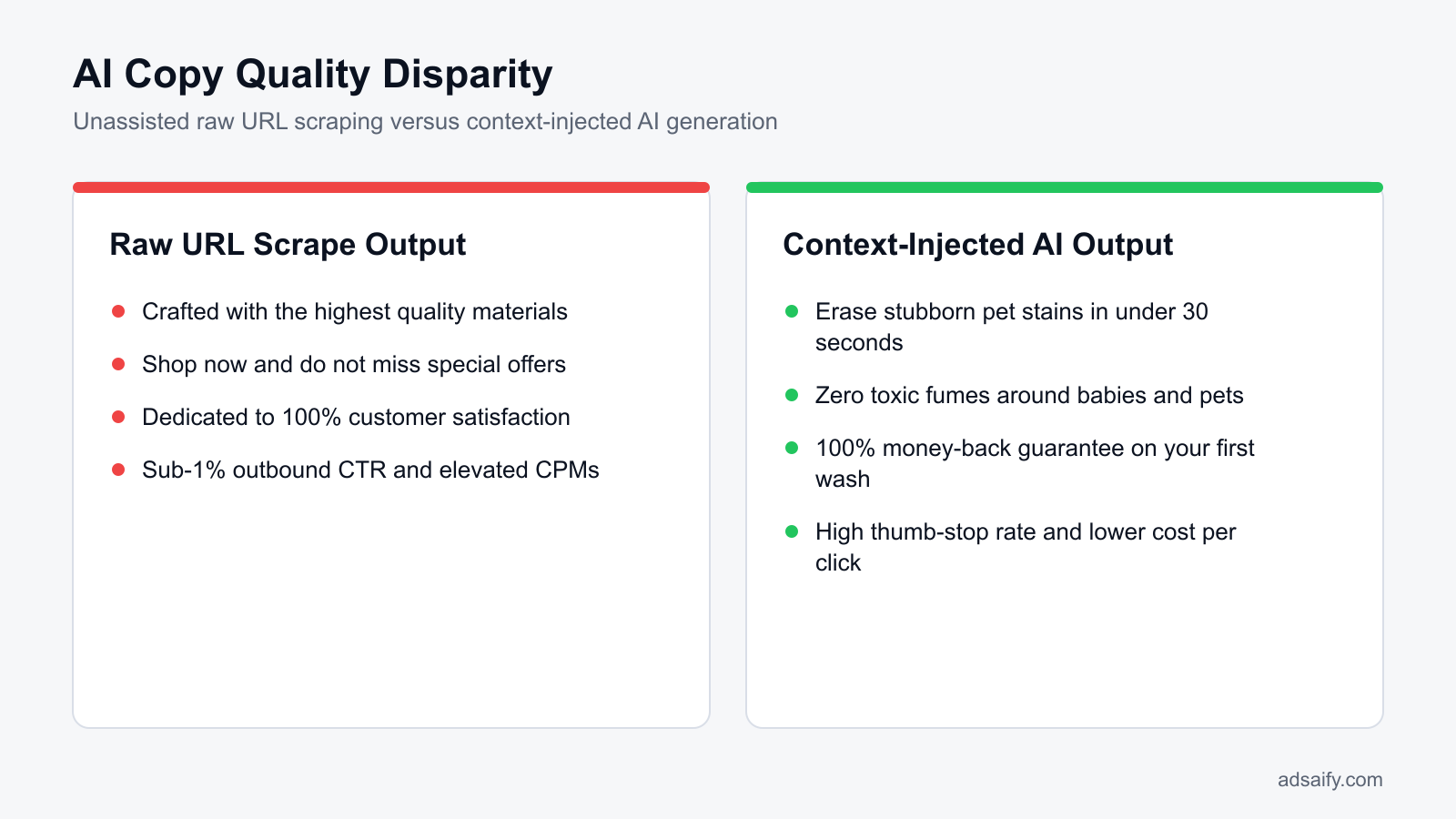
AI ad tools generate bland copy from product links because automated crawlers often mistake navigation headers, cookie notices, and footer links for unique value propositions. Without explicit prompt constraints identifying target buyer profiles, underlying large language models default to safe, consensus-driven marketing cliches that fail to highlight distinct product transformations or answer specific prospect hesitations.
Why Automated Scraping Misses Core Sales Triggers
When an artificial intelligence tool scans a product URL, automated web scrapers extract raw text without understanding visual hierarchy. Scrapers routinely ingest utility text, such as checkout notices, global shipping policies, and navigation menus, treating those strings with equal importance to product specifications. LLMs (large language models are artificial intelligence algorithms trained on massive text datasets to predict and generate human language) rely on probability distributions. By default, LLMs select safe, agreeable expressions like "premium quality" and "crafted for perfection" unless given precise constraints.
Furthermore, when product landing pages lack direct customer reviews, statistical proof points, or clear problem-and-solution narratives, the model must bridge information gaps independently. Without specific customer inputs, the algorithm invents generic filler copy that could apply to any competing brand in the same vertical.
Raw Scraped Data Versus Targeted Customer Inputs
The table below contrasts standard information scraped from product pages with the structured context needed to produce high-performing Meta ad text.
| Website Element Scraped | Generic Output from Link | Structured Input Required | High-Converting Copy Angle |
|---|---|---|---|
| Header Navigation Menu | "Explore our wide collection of trending styles." | Primary customer persona: Busy parents needing stain-resistant fabric | "Machine-washable fabrics designed to survive toddler spills without fading." |
| Product Description Banner | "Crafted with premium materials for maximum satisfaction." | Measurable product feature: 7075 aircraft-grade aluminum frame | "Built with 7075 aircraft aluminum to withstand 300 pounds on rugged trails." |
| Shipping & Return Policy | "Enjoy fast shipping and hassle-free returns today." | Specific risk reversal: 100-night in-home trial with prepaid labels | "Sleep on it for 100 nights. If back stiffness persists, return it for a full refund." |
| Generic Review Counter | "Loved by thousands of happy customers everywhere." | Voice-of-customer pain point: Chronic heel pain from plantar fasciitis | "Relieve morning heel pain within 14 days of walking, or keep the insoles for free." |
While platforms such as Adsaify streamline campaign setup by analyzing website URLs to draft audiences and copy suggestions, feeding the tool precise customer friction points prevents the scraper from defaulting to surface-level web text.
Can AI still output bland copy even if my e-commerce website looks highly professional?
Yes, artificial intelligence can produce bland copy from a visually stunning website because aesthetic design remains invisible to text-based scrapers. Modern e-commerce stores often rely on minimalist visual layouts, lifestyle photography, and concise slogans. When an AI crawler parses the underlying code, it finds minimal written context regarding customer pain points, specific use cases, or competitive advantages. Without detailed written sales arguments on the page, the language model fills the void with generic marketing cliches regardless of visual elegance.
How much does generic ad copy cost your business if left unaddressed?
Generic ad copy inflates acquisition costs by lowering ad relevance, forcing advertisers to pay higher prices for Meta ad impressions while converting fewer shoppers. When text lacks differentiation, Meta's auction assigns below-average quality rankings, which elevates cost per click, suppresses return on ad spend, and traps ad sets in the learning phase.
The auction tax: rising CPMs and declining ROAS
Meta uses an ad auction to determine which ads appear to users, weighing advertiser bids, estimated action rates, and ad quality. Ad quality is quantified in Meta Ads Manager through quality ranking, which assesses how desirable users find an ad compared to competing ads targeting the same audience. When AI produces generic text, users scroll past without engaging. Meta interprets low engagement as an indicator of poor user experience, penalizing the ad with higher CPM (cost per mille, which is the price an advertiser pays for one thousand impressions). As CPM increases, CPC (cost per click, meaning the fee an advertiser incurs for each link click) climbs rapidly. Consequently, ROAS (return on ad spend, defined as total revenue earned divided by total ad spend) deteriorates. For example, with a 500 USD daily budget, an ad with an inflated 35 USD CPM generates far fewer site visitors and sales than an ad with a 15 USD CPM.
Stalled learning phases and brand erosion
The learning phase is the calibration window during which Meta's algorithm tests delivery across audience segments to stabilize performance. To exit the learning phase, an ad set must generate approximately 50 optimization events, such as purchases, within a consecutive seven-day period. Generic copy attracts unfocused, low-intent clicks from casual browsers rather than qualified buyers. Without qualified traffic, the ad set fails to secure 50 purchases and enters "Learning Limited" status in Meta Ads Manager. Over time, indistinct copy also erodes brand equity. In competitive feeds where competing stores advertise similar items, generic language turns premium, high-ticket products into interchangeable commodities, reducing customer trust and willingness to pay full price.
- Audit the Quality Ranking and Engagement Rate Ranking columns in Meta Ads Manager weekly.
- Track whether the ratio between outbound click-through rate and unique link clicks is declining.
- Confirm whether each active ad set hits the 50-purchase threshold to clear the learning phase.
- Review comments under live feed ads to see if buyers misunderstand the core product offer.
- Calculate your blended customer acquisition cost against target margins to spot margin compression.
- Verify that automated ad rules are not pausing underperforming sets without diagnosing copy quality first.
Does weak copy only impact link clicks, or does it also lower checkout conversion rates?
Weak copy directly degrades on-site conversion rates because it attracts unqualified traffic with vague promises. When ad copy fails to set clear expectations regarding product specifications, pricing, and specific benefits, visitors click out of idle curiosity rather than genuine buying intent. These unfocused visitors bounce upon reaching the product page, lowering the conversion rate from add-to-cart to completed purchase and forcing your landing page to do unnecessary persuasion work.
Which diagnostic methods reveal the root cause of weak AI copy?
Diagnosing weak AI copy requires isolating whether deficiencies stem from scraped website data, absent creative hooks, mismatched demographic tone, or missing commercial offers. Advertisers analyze data inputs and campaign metrics within Meta Ads Manager to pinpoint where automated extraction failed to capture competitive positioning before adjusting prompts or underlying page information.
Auditing extraction failures and hook angles
When automated systems ingest product pages, website scraping errors represent the most frequent failure point. If the generated ad relies on generic platitudes such as "premium quality" or "customer satisfaction guaranteed," the web scraper likely extracted raw wrapper text—such as site navigation menus, cookie consent banners, or footer disclaimers—rather than specific product descriptions. A separate failure occurs when product features are completely accurate, but the text fails to stop users in the feed. This angle deficiency indicates that the hook instruction lacked creative tension or an explicit problem-solution framework. When advertisers create an account on Adsaify to draft campaigns from a store URL, reviewing the initial text preview ensures the system parsed actual product benefits rather than peripheral site code.
Evaluating audience tone and promotional context
Audience misalignment happens when the AI uses an inappropriate register for the intended target demographic. For example, corporate, formal phrasing damages conversion rates in Gen-Z streetwear campaigns, whereas slang undermines trust in high-end luxury goods or B2B software. This occurs when demographic persona context is omitted from the input. Offer ambiguity is another distinct flaw where the generated text omits essential commercial variables, such as bundle discounts, return guarantees, or free shipping thresholds. Without explicit price anchoring, shoppers have no immediate incentive to act.
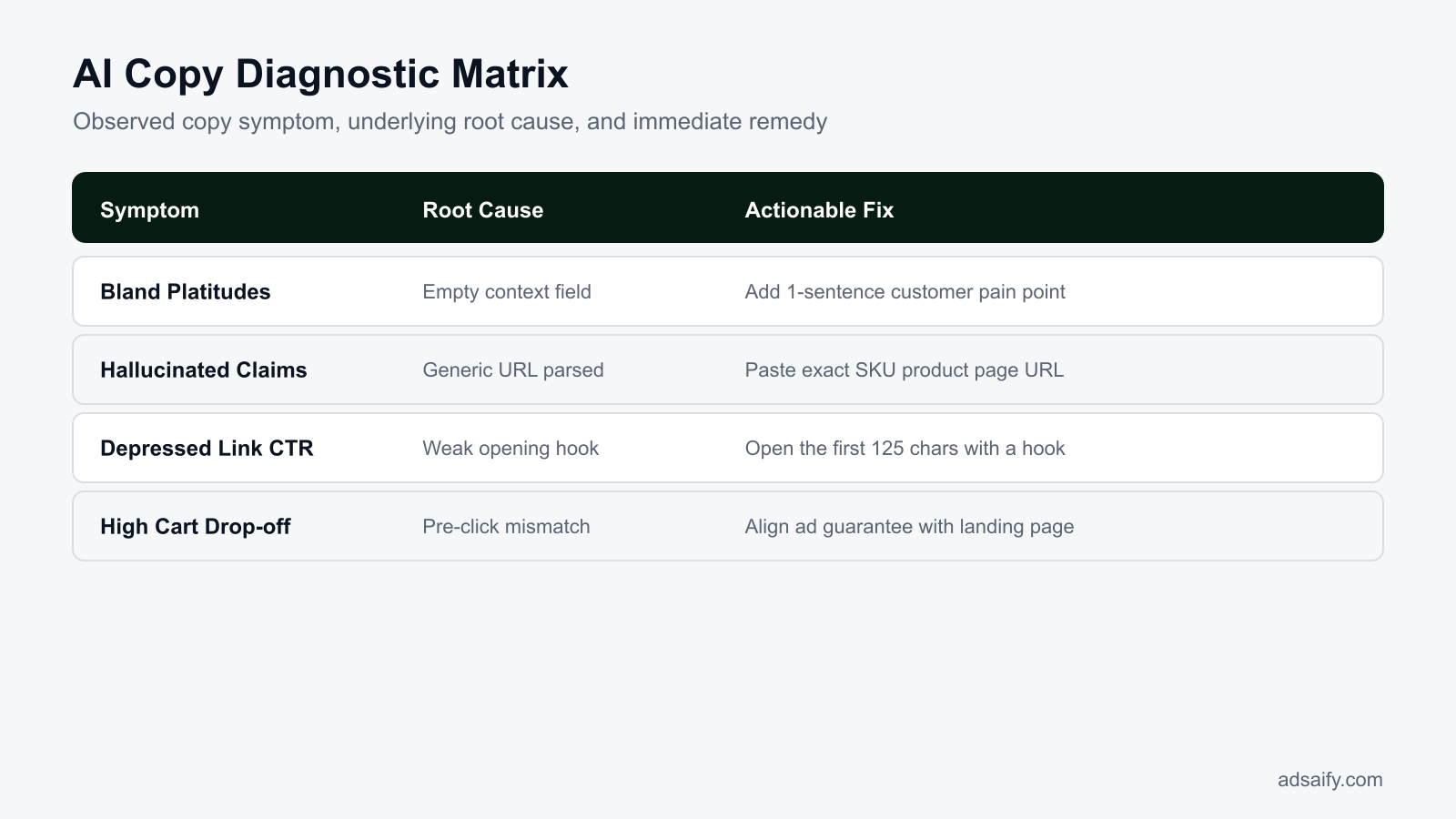
| Observed Symptom | Underlying AI Cause | Meta Ads Manager Metric Signal | Corrective Action |
|---|---|---|---|
| Ad displays generic policy text or site slogans | Scraper pulled navigation elements or footer code | High CPM with below-average Quality Ranking | Input direct product descriptions manually |
| Accurate features but users ignore the post | Prompt lacked a clear hook or emotional conflict | Low Outbound CTR (click-through rate) | Rewrite primary text opening with a problem angle |
| Tone feels too stiff or inappropriately casual | Missing audience persona and demographic context | High bounce rate on landing page views | Define target buyer voice in campaign setup |
| Clicks occur but visitors abandon carts quickly | Missing commercial offer, price, or guarantees | High cost per purchase despite healthy CTR | Insert concrete bundles, guarantees, or pricing |
How do I isolate whether low engagement stems from the ad copy or the visual creative?
Isolate copy performance from creative performance by running an A/B test in Meta Ads Manager that holds the visual asset constant while testing two distinct copy variations. Alternatively, compare the three-second video play rate against the outbound click-through rate. A strong thumbstop rate paired with a weak outbound click-through rate proves that the visual stopped the user, but the primary text and headline failed to build sufficient interest to earn the click.
If you would rather not set up each of these steps by hand, try it in Adsaify: your first ad is free, so there is nothing to lose. Create a free account.
What should you prepare before fixing AI-generated ad copy?
To fix generic AI-generated ad copy, you must prepare verified customer intelligence, clear landing page elements, and concrete promotional parameters before running any prompts. Gathering the primary customer pain point, specific conversion offers, and a distilled brand voice summary ensures the artificial intelligence receives precise context rather than relying on bland defaults.
Landing page structure and customer friction points
Artificial intelligence generates weak ad copy when it crawls pages that lack structural focus. Before generating ad copy, inspect the target landing page above the fold, which is the portion of a web page visible without scrolling. The landing page must feature an unmistakable H1 headline stating your exact value proposition, supported by a bulleted three-point benefit summary that outlines outcomes rather than mere product features.
Next, define the psychological profile of the prospect. Pinpoint the single biggest daily frustration your product resolves and the primary buying hesitation that prevents an immediate purchase, such as fear of poor fit or shipping delays. Supplying these parameters prevents the AI from defaulting to vague claims like "premium quality" or "best customer experience."
Pre-campaign assets and context snippets
Establish your exact commercial offer before initiating copy generation. Decide on the call to action (CTA), such as "Shop Now" or "Claim Offer," along with any promotional incentive, such as a 15 percent bundle discount or a 30-day money-back guarantee. Finally, draft a 20- to 30-word brand context snippet detailing your industry, tone, and positioning. When setting up an automated workflow on Adsaify, this snippet ensures the platform accurately captures your unique value proposition from the start.
- Audit the landing page above-the-fold area to confirm an explicit H1 headline communicates the core offer.
- Write three concrete benefit bullets directly beneath the main landing page headline.
- Identify the single greatest objection that stops a visitor from buying right now.
- Formulate a clear promotional guarantee or bundle incentive to reduce customer risk.
- Draft a 25-word summary describing your brand voice, product category, and target audience.
- Select the intended Meta call to action button before drafting any text variations.
Can I solve this entirely inside the AI ad tool without altering my website landing page?
No, you cannot solve generic AI ad copy entirely inside an ad tool without aligning your landing page. When an AI tool crawls an ambiguous page, it generates unfocused copy that mirrors that ambiguity. Even if you manually force strong copy inside the tool, mismatched landing pages elevate bounce rates and lower conversion rates. This friction signals poor post-click relevance to the Meta auction system, degrading your ROAS (return on ad spend), which is the revenue generated for every dollar spent on advertising.
How do you create high-converting Meta ad copy with AI step by step?
You create high-converting Meta ad copy with AI by feeding the model a granular product URL, supplying targeted customer pain points, generating three distinct messaging angles, and pruning the opening text. This structured workflow forces the AI to produce specific, problem-aware copy that grips user attention before the feed truncates the message.
Step-by-step workflow for high-converting AI prompts
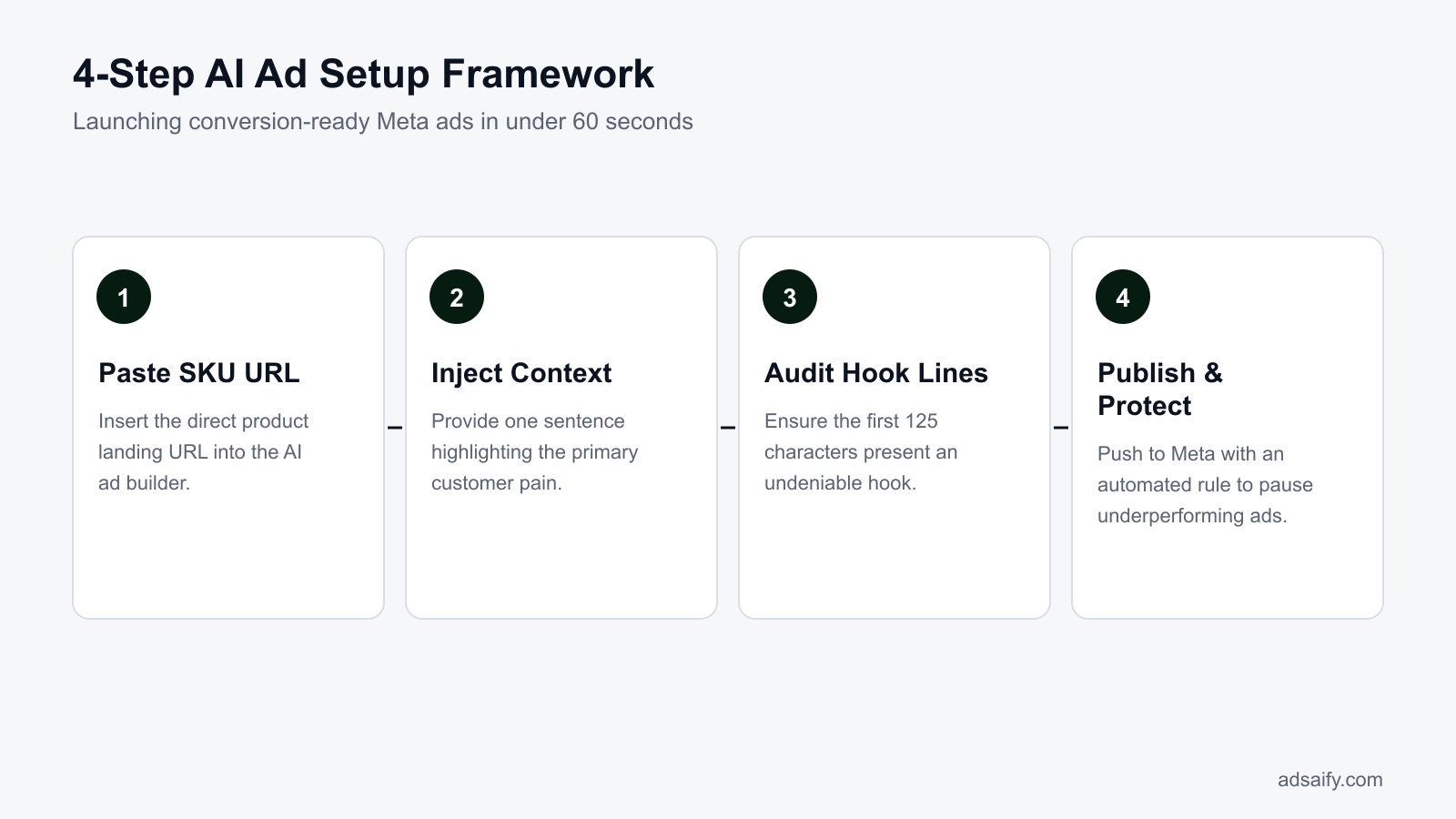
Begin by providing the AI with the specific product detail page (PDP) URL rather than your general store homepage. Product detail pages contain technical specifications, pricing, and localized customer reviews that give the crawler factual material to pull into ad copy.
Next, seed the generator with a two-sentence prompt context. The first sentence must state the exact frustration the customer feels, and the second sentence must describe the emotional transformation achieved after using the product. Require the AI engine to generate three distinct marketing angles: a direct hook that highlights the core problem immediately, an objection-handler that dispels hesitation regarding price or durability, and a social-proof summary that highlights aggregated ratings.
Finally, edit the primary text field in Meta Ads Manager to safeguard the first 125 characters. In mobile feeds, Meta truncates primary text after roughly 125 characters behind a "See More" link. The opening sentence must deliver the hook immediately without introductory filler, rhetorical questions, or introductory greetings.
- URL Extraction — The marketer submits a specific product page URL into the AI tool so the system pulls exact product specs before writing begins.
- Context Seeding — The user enters a two-sentence note on buyer frustration and transformation, which directs the AI toward emotionally resonant angles.
- Angle Generation — The AI drafts three distinct copy variations, prompting the user to evaluate whether all three hooks address unique buying motivations.
- Character Truncation Audit — The operator inspects the first 125 characters in Meta Ads Manager preview to confirm the hook displays before the fold.
- Campaign Publication — The user approves the final copy variants and creatives to launch the campaign through their Meta ad account, such as by completing a new setup on Adsaify.
Should I test the three generated copy variations in one ad set or across separate ad sets?
You should test the three generated copy variations inside a single ad set rather than across separate ad sets. Splitting copy variations into separate ad sets fractures your campaign budget and causes audience fragmentation, meaning your own ads compete against each other in the Meta auction. Running all three copy variations inside one ad set allows Meta's machine learning algorithm to distribute spend toward the variation achieving the most efficient CPA (cost per acquisition), which is the total ad spend divided by the number of purchases.
How is an effective Meta ad campaign built in under 60 seconds with AI?
An effective Meta ad campaign is built in under sixty seconds by using an artificial intelligence platform to ingest a product URL, parse core customer pain points, generate structured copy variations, and publish the campaign directly to Meta Ads Manager alongside pre-set automated rules to pause underperforming ads automatically.
The 60-second campaign creation workflow
For example, an e-commerce brand selling an eco-friendly stain remover can launch a test campaign with a 500 TL daily budget using Adsaify through the following sequence:
- Seconds 0–15: The marketer pastes the direct stain remover product page URL into Adsaify to trigger an automated scan of the landing page features, active ingredients, and customer reviews.
- Seconds 16–35: The natural language processing engine isolates the main customer pain point—removing stubborn coffee and pet stains without toxic chemicals—and drafts targeted messaging angles for busy parents and pet owners.
- Seconds 36–50: The marketer reviews the generated creative suggestions alongside hook-driven primary text options in the ad builder interface, approving the copy that speaks directly to stain removal speed.
- Seconds 51–60: The campaign is published directly to the user's connected Meta ad account with pre-configured safety rules, such as automatically pausing an ad if its spend exceeds a specific threshold without registering a conversion.
A worked optimization example for a test campaign
In this worked scenario, the business tests two primary text variations at a 500 TL daily budget. The original manual copy reads, "Try our eco-friendly stain remover today for clean clothes," while the AI-generated variation focuses on customer struggle: "Old coffee stains on your favorite white shirt? Lift tough pet and drink marks in 3 minutes without bleach." Over the following 72 hours, the marketer evaluates Cost Per Link Click and Outbound Click-Through Rate within the Meta Ads Manager reporting dashboard to confirm which angle captures customer interest before increasing spend. Marketers can build their first campaign by setting up an account at Adsaify registration.
How does a 60-second AI campaign compare to one prepared manually over several days?
A sixty-second artificial intelligence build isolates core customer problems directly from existing landing pages, bypassing the delays of traditional copywriting and manual ad set structuring. Manual setup allows deeper subjective brand nuance over multiple drafting cycles, but AI deployment standardizes message architecture rapidly. This allows media buyers to test concrete value propositions in real Meta auctions immediately, making live user engagement data the primary guide for optimization rather than internal brand speculation.
Which metrics prove whether your new AI ad copy is actually working?
Advertisers evaluate whether new artificial intelligence ad copy is working by monitoring outbound click-through rate, cost per link click, Meta ad quality ranking, and downstream add-to-cart conversion rate. Positive improvements across these metrics confirm that the advertising hook successfully captures genuine audience attention and qualifies visitor buying intent.
Primary performance diagnostics in Meta Ads Manager
Outbound CTR (click-through rate) is the percentage of ad impressions that result in a click leading off Meta platforms to the advertiser's destination. Generic copy usually lingers below 0.8%, whereas sharp hook copy targeting clear customer problems should achieve 1.5% or higher. When the ad message directly addresses customer frustrations, users click through at significantly higher rates.
CPC (cost per link click) is the average amount paid for each user click on an ad link. When copy clarifies the exact product value before the click, link click costs decline steadily because Meta rewards relevant ads with lower auction bid costs.
Meta Ad Quality Ranking is a diagnostic metric in Meta Ads Manager that measures an ad's perceived quality compared to ads competing for the same audience. Replacing vague copy shifts this account diagnosis from "Below Average" to "Average" or "Above Average," signaling that users are not hiding the ad or bouncing immediately.
Add to Cart conversion rate is the percentage of website visitors who add at least one product to their digital shopping basket after clicking an ad. Clear pre-click positioning ensures traffic arrives with accurate expectations, lifting store cart rates because unqualified clicks have been filtered out before landing on the product page. Advertisers can test these performance shifts on their own accounts at Adsaify demo start.
| Performance Metric | Generic AI Copy Diagnostic | Optimized AI Copy Benchmark | Meta Ads Manager Location |
|---|---|---|---|
| Outbound CTR | Below 0.8% | 1.5% or higher | Performance and Clicks column preset |
| Cost Per Link Click (CPC) | High and rising over time | Stable or declining steadily | Performance and Clicks column preset |
| Quality Ranking | Below Average (bottom 20–35%) | Average to Above Average | Ad Performance diagnostics columns |
| Add to Cart Rate | Low post-click store intent | Measurable increase from ad traffic | Custom Conversions reporting tab |
How many impressions or ad spend should I accumulate before evaluating copy performance?
You should accumulate between 2,000 and 3,000 impressions per ad, or spend roughly two to three times your target cost per acquisition, before judging copy performance. Making decisions with fewer than 1,000 impressions exposes your analysis to auction volatility, whereas waiting for 3,000 impressions provides statistically reliable data on outbound click-through rates and early engagement indicators inside Meta Ads Manager without exhausting testing capital.
Want to see this in your own account? Enter your website address and Adsaify drafts the campaign for you. The first ad is free. Try it now or log in.
What weekly review routine prevents ad copy quality from degrading?
A weekly review routine prevents ad copy quality from degrading by systematically auditing performance drops, collecting fresh customer language, and replacing fatigued messaging before costs rise. Performance marketers evaluate engagement metrics on specific days, extract real objection data, and apply rules to pause underperforming ad variations while introducing refreshed AI-generated angles.
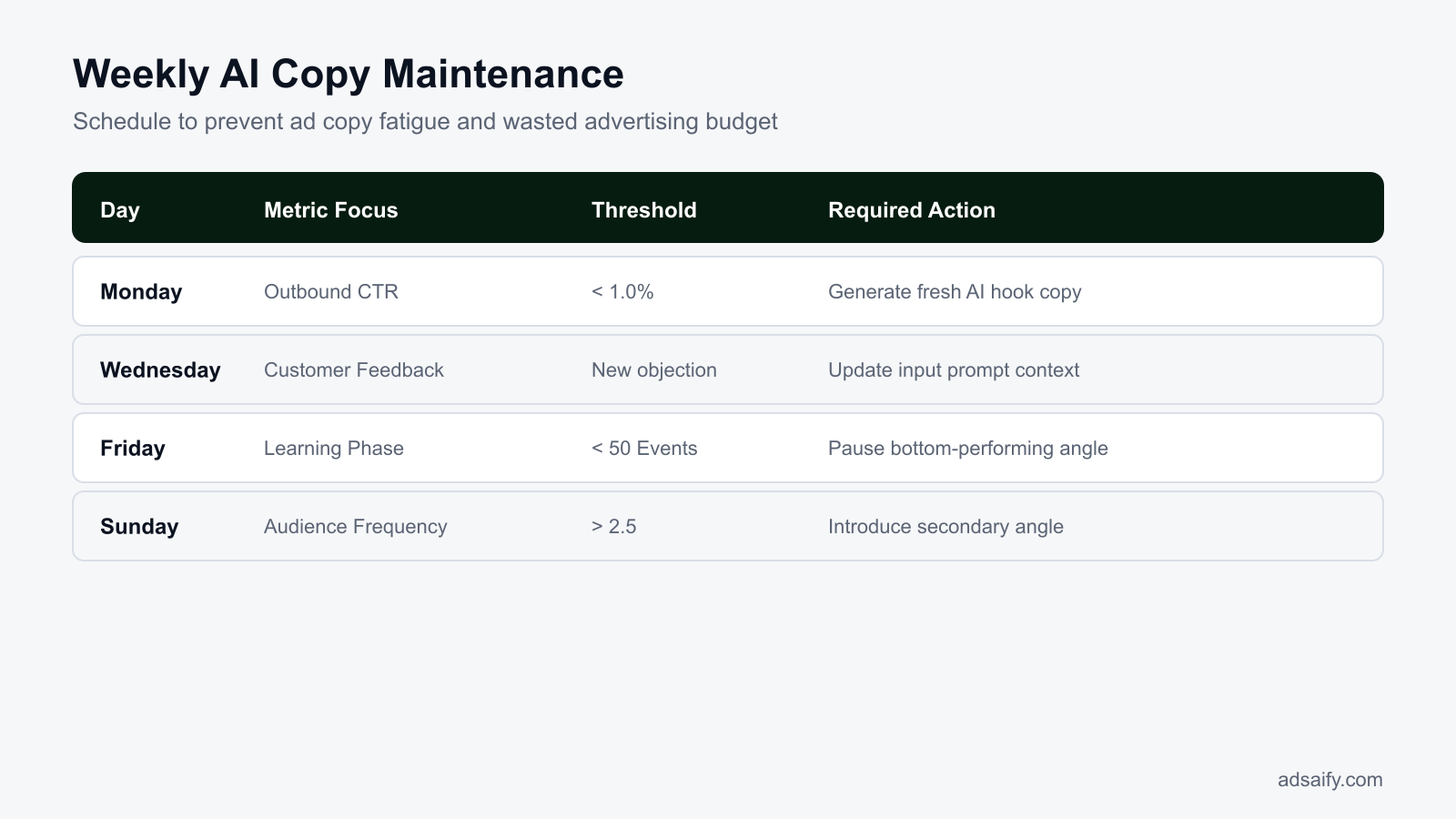
- Weekly (Monday): Audit trailing 7-day outbound CTR (click-through rate, which is the percentage of ad impressions that lead to clicks to your external website) in Meta Ads Manager. When outbound CTR falls below your target benchmark—for example, dropping under 1.2% in an e-commerce campaign spending 500 TL daily—tag that creative as fatiguing.
- Weekly (Tuesday): Cross-examine conversion rates inside Meta Ads Manager to distinguish whether copy fatigue or landing page issues cause rising acquisition costs. If ad link clicks remain steady but purchases drop, the ad copy may be over-promising or targeting mismatched shopper intent.
- Weekly (Wednesday): Review fresh customer support tickets and product reviews to extract at least one real customer pain point. Add this phrase into your artificial intelligence prompt bank to generate copy angles that counter current buyer hesitations.
- Weekly (Thursday): Check drop-off points in ad engagement metrics to verify if users abandon the creative at the opening hook or after reading the body text. Adjust the primary text opening line accordingly to hook scrollers faster.
- Weekly (Friday): Use automated rules, such as performance rules configured inside Adsaify, to automatically pause ads that breach your cost-per-acquisition threshold, then manually create fresh copy variations using your updated prompt bank.
- Weekly (Sunday): Check ad frequency metrics (frequency is the average number of times an individual user views an ad over a specific period). If ad frequency exceeds 2.5 on broad audiences or 4.0 in retargeting, queue new hook copy to prevent audience burnout.
Should I turn off a winning ad completely during my weekly audit, or iterate on its angle?
You should never turn off a winning ad completely during a weekly audit if it continues delivering profitable results. Pausing an active winner resets Meta delivery algorithms and forfeits accumulated social proof like comments and shares. Instead, duplicate the winning concept, isolate the original hook angle, and generate two or three AI copy variations that address secondary angles or objections. Run these new variations in a separate testing ad set alongside your original winner.
What are the most common AI ad copy mistakes and how do you fix them?
The most common AI ad copy mistakes include publishing raw unedited text, targeting broad store homepages instead of specific product pages, and overloading copy with spam-inducing formatting. Advertisers fix these errors by instituting manual reviews, feeding artificial intelligence specific product detail pages, stripping gimmicky language, and directing the model to emphasize customer benefits over dry technical specifications.
Publishing unverified AI outputs without manual compliance checks
Artificial intelligence language models occasionally hallucinate claims, fabricating guarantees or medical benefits that violate Meta advertising policies. Allowing unverified text to go live can trigger immediate ad rejection or account bans. Always perform a ten-second proofread to confirm that claims match your product capabilities and advertising compliance standards.
Supplying homepage URLs instead of granular product pages
Providing an artificial intelligence tool with a generic homepage URL forces the scraper to ingest generic navigation links and footer slogans instead of distinct product value propositions. This produces vague copy that lacks product-specific benefits. Always feed tools like Adsaify direct SKU (stock-keeping unit, which is a unique identifier for a specific product item) pages to yield precise copy.
Overloading ad copy with excessive emojis and capitalized guarantees
Generative models often default to flashy aesthetics, inserting dozens of emojis and all-caps promises such as "100% GUARANTEED RESULTS". Meta spam filters penalize sensationalist formatting, which drives up CPM (cost per mille, which is the cost an advertiser pays for one thousand ad impressions). Remove dramatic formatting and maintain natural, professional prose.
Listing physical product specifications instead of emotional outcomes
Unprompted AI copy often recites dimensions, fabrics, or processor speeds without context, failing to connect with customer desires. Features state what a product is, but benefits explain what the product does for the buyer. Instruct the AI model to translate technical specifications into emotional relief and time savings.
Reusing a single copy variation across distinct audience temperatures
Broad prospecting audiences need education about an unfamiliar problem, whereas retargeting audiences already understand your brand and require objection handling or incentive prompts. Using the same generic AI message for both audiences depresses conversion rates. Generate tailored copy sets mapped to specific stages of the customer journey.
Omitting an explicit call to action in primary ad text
AI engines frequently craft engaging descriptions but omit a definitive CTA (call to action, which is an instruction directing the user toward the next step). Without clear guidance, prospective buyers consume the ad without clicking. End every primary text variation with an unambiguous command, such as directing users to claim a promotion or view the product catalog.
Does adding emojis to AI-generated ad copy improve click-through rates or harm credibility?
Adding emojis to AI-generated ad copy can modestly improve click-through rates when used sparingly as bullet points or visual anchors, but excessive use harms account credibility. Cluttered icons distract prospects, make high-ticket offers look untrustworthy, and can trigger Meta delivery algorithms to classify the creative as low quality. Use a maximum of two relevant emojis per ad copy variation to structure reading flow without diluting brand authority.
When does AI copy optimization fail to solve ad performance issues?
AI copy optimization fails to solve Meta ad performance issues when fundamental post-click bottlenecks or offer misalignments break the conversion chain. Persuasive ad text cannot compensate for poor product-market fit, uncompetitive pricing, broken checkout flows, slow landing pages, or visual creatives that fail to halt scrolling within the first three seconds.
Upstream Visual Failure and Core Offer Misalignment
Meta feeds are visual-first environments where users consume media rapidly. If the initial 3-second video hook or static image fails to stop the user from scrolling, the target audience will never pause to read the accompanying primary text. In Meta Ads Manager, a low thumb-stop rate indicates that the visual asset failed before the copy had an opportunity to persuade.
Furthermore, if an underlying product lacks product-market fit—meaning there is no genuine demand for the solution—even flawless copy cannot manufacture sustainable sales. Similarly, if your offer is priced significantly higher than direct market competitors without clear differentiation, shoppers who click will abandon the transaction once they reach your catalog.
Post-Click Technical Bottlenecks and Infrastructure Failures
Once a user clicks your ad, conversion responsibility shifts entirely to your landing page. If mobile page load speed exceeds three seconds, bounce rates escalate drastically, wiping out high-intent traffic before your landing page headline can be read. Comparing the Outbound Clicks metric against Landing Page Views in Meta Ads Manager quickly reveals page-drop volume caused by latency.
Technical errors also neutralize ad creative excellence instantly. Broken payment gateways, missing checkout buttons, inaccurate shipping calculations, or products displaying as out-of-stock make completion impossible. When technical errors arise, you can use automated rules in Adsaify to automatically pause campaigns whose conversion rate collapses, preventing wasted ad spend while site fixes occur.
Pre-Optimization Diagnostic Checklist
- Audit mobile page load speed using developer tools to ensure assets render in under three seconds.
- Complete a live test transaction on a mobile device to confirm payment gateways function correctly.
- Verify inventory levels in your store catalog to ensure promoted product variants are in stock.
- Compare your delivered pricing and shipping fees against top search competitors in your niche.
- Check the 3-second video play percentage in Meta Ads Manager to confirm visual assets stop scrolling.
- Inspect destination URLs across all active ad sets to eliminate broken links or 404 errors.
If my ad generates strong outbound CTR but zero purchases, is the problem in the ad copy or the site?
The problem is almost certainly on your website rather than the ad copy. A high outbound CTR (click-through rate) confirms that your ad hook, creative visual, and primary text successfully stimulated interest and generated qualified traffic. When users arrive on the site but refuse to purchase, the friction exists post-click: unexpected shipping costs, slow page load speeds, uncompetitive pricing, missing payment options, or a landing page design that fails to reflect the ad promise.
What key terms must you know when creating Meta ads with AI?
Creating Meta ads with AI requires mastering specific advertising terminology to bridge automated generation with measurable campaign performance. Understanding Meta metrics and prompt parameters enables advertisers to evaluate generated text accurately, calibrate artificial intelligence inputs effectively, and diagnose whether performance bottlenecks stem from ad messaging, creative engagement, or technical post-click friction.
- Hook: An arresting opening sentence or visual element placed at the start of an ad to stop users from scrolling within the first one to three seconds.
- Primary Text: The main advertising copy displayed directly above or alongside image and video creatives in Meta feed placements.
- Outbound CTR: Outbound CTR (click-through rate) is the percentage of ad impressions that resulted in an explicit click leading to an external web destination outside Meta technologies.
- Thumb-Stop Rate: The ratio of 3-second continuous video plays divided by total ad impressions, measuring how effectively a visual asset halts scrolling.
- Context Injection: The practice of supplying structured background details, such as target audience pain points and product specifications, into an AI generation prompt.
- ROAS: ROAS (return on ad spend) is the revenue generated directly from advertising divided by the total advertising dollars spent to produce those sales.
- CPA: CPA (cost per acquisition) is the total advertising expense divided by the number of completed purchase conversions.
- Dynamic Creative: A Meta ad setup feature that automatically tests multiple text options, headlines, images, and videos across audiences to identify winning combinations.
- Landing Page View: A Meta reporting metric recorded when a user clicks an ad link and successfully loads the destination webpage with an active Meta Pixel.
- Frequency: The average number of times each unique individual saw your advertisement over a selected reporting period.
- Meta Pixel: A snippet of tracking code installed on your website that measures user behavior and sends conversion data back to Meta Ads Manager.
What is the primary functional difference between the primary text and the ad headline in Meta ads?
The primary text sits above the creative in mobile feeds and functions to build desire, detail customer benefits, explain offer mechanics, and handle objections. The headline sits directly below the visual asset next to the call-to-action button, functioning strictly as a concise, high-impact prompt that clarifies the offer or reinforces the action the user must take next. While primary text elaborates on the solution, the headline secures the immediate click.
Can You Launch High-Performing Meta Ads Fast Without Sacrificing Quality?
Fixing generic AI ad copy requires anchoring generation to concrete brand assets rather than vague descriptions. First, supply the AI with granular inputs, including exact product specifications, distinct customer pain points, and real value propositions. Second, direct the copy structure using clear direct-response formulas like problem-agitate-solution while enforcing specific tone guidelines. Third, generate distinct variations to test multiple angles, review the copy for compliance, and publish the campaign directly into your Meta ad account.
Audit your active Meta ad creatives today to flag generic claims such as "best quality" or "affordable prices." Replace those vague lines with verifiable details, explicit guarantees, or specific use cases. You can streamline this workflow by using Adsaify to analyze your website URL, draft targeted copy angles, and set up your initial ad campaign for free.
Want to see this in your own account? Enter your website address and Adsaify drafts the campaign for you. The first ad is free. Try it now or log in.
Frequently Asked Questions (FAQ)
1. Is creating ad copy using AI contrary to Meta's advertising policies?
No, creating ad copy using artificial intelligence does not violate Meta's advertising policies. Meta allows advertisers to utilize AI tools for drafting copy, generating images, and targeting audiences. However, all AI-generated copy must strictly comply with standard Meta Advertising Standards. The copy must avoid deceptive claims, discriminatory language, personal attributes references, and misleading health or financial promises.
2. How much test budget should be allocated to an AI-generated ad campaign?
An effective test budget depends on your target cost per acquisition, which is the ad spend required to acquire one customer. A standard testing guideline allocates at least three to five times your estimated cost per acquisition per ad set. For example, if your target acquisition cost is 200 TL, allocate 600 TL to 1,000 TL to gather sufficient conversion data during initial testing.
3. Do AI ad tools write identical ad copy for competing brands in the same industry?
AI ad tools generate distinct copy based on the specific inputs provided for each business. When two competing brands use the same AI tool, outputs differ if each prompt incorporates unique website URLs, specific product features, target demographics, and pricing. Generic prompts produce overlapping copy, whereas brand-specific inputs yield unique marketing angles and distinct positioning tailored to each specific company.
4. How can AI craft persuasive copy if my product has zero customer reviews yet?
When a product lacks customer reviews, AI can craft persuasive copy by highlighting product specifications, manufacturing processes, and problem-solving features. The AI can emphasize risk-reversal elements, such as return guarantees or trial periods, and focus on the direct customer pain point the product solves. This framework builds credibility based on verifiable product utility rather than relying on social proof.
5. Do short punchy ad copies or long-form storytelling AI copies convert better on Meta?
Neither short punchy copy nor long-form copy universally outperforms the other on Meta platforms. Short copy often works best for impulse purchases, simple consumer goods, and retargeting campaigns where users recognize the brand. Long-form storytelling copy tends to convert better for high-consideration purchases, complex services, or cold audiences requiring education. Testing both copy lengths simultaneously against each audience reveals what works best.
6. Should I manually override the target audiences suggested by the AI tool?
You should only manually override AI-suggested target audiences if you possess verifiable business data that contradicts the suggestion. For example, if your product ships exclusively to specific postal codes or serves a strictly local market, manual audience adjustments are necessary. Otherwise, modern Meta ad delivery algorithms optimize efficiently when targeting broad audience parameters, allowing the ad creative and copy to segment the buyers naturally.
7. Can an underperforming AI-generated ad be paused automatically to safeguard budget?
Yes, underperforming ads can be paused automatically using automated rules within Meta Ads Manager or third-party platforms like Adsaify. Advertisers define custom condition thresholds, such as pausing an ad if its cost per acquisition exceeds a set limit or if its ROAS (return on ad spend) falls below a specified target. Automation rules execute these actions systematically based on incoming performance data to prevent wasted ad spend.
8. Can I rely on AI copy translations when running cross-border Meta ads in foreign languages?
AI translations provide a functional starting point for cross-border ads, but relying solely on direct automated translations poses risks. Direct translation often misses local cultural idioms, regional buying motivations, and colloquial nuances specific to foreign markets. For optimal campaign performance, have a native speaker review the AI-translated copy or prompt the AI to transcreate the text by adapting cultural context rather than translating literally.
How can you try this with Adsaify?
The quickest way to apply the steps in this article to your own account is to try them. Adsaify analyses your business from your website address, drafts the campaign with an audience, ad copy, creative and a budget suggestion, and publishes it to your own Meta ad account once you approve.
- Your first ad is free: there is nothing to lose by trying.
- Your own ad account: the campaign runs in your Meta account and you stay in control.
- Images and video: generate ad creatives with AI or promote an existing Instagram post.
Create a free account and try your first ad · Already have an account? Log in.