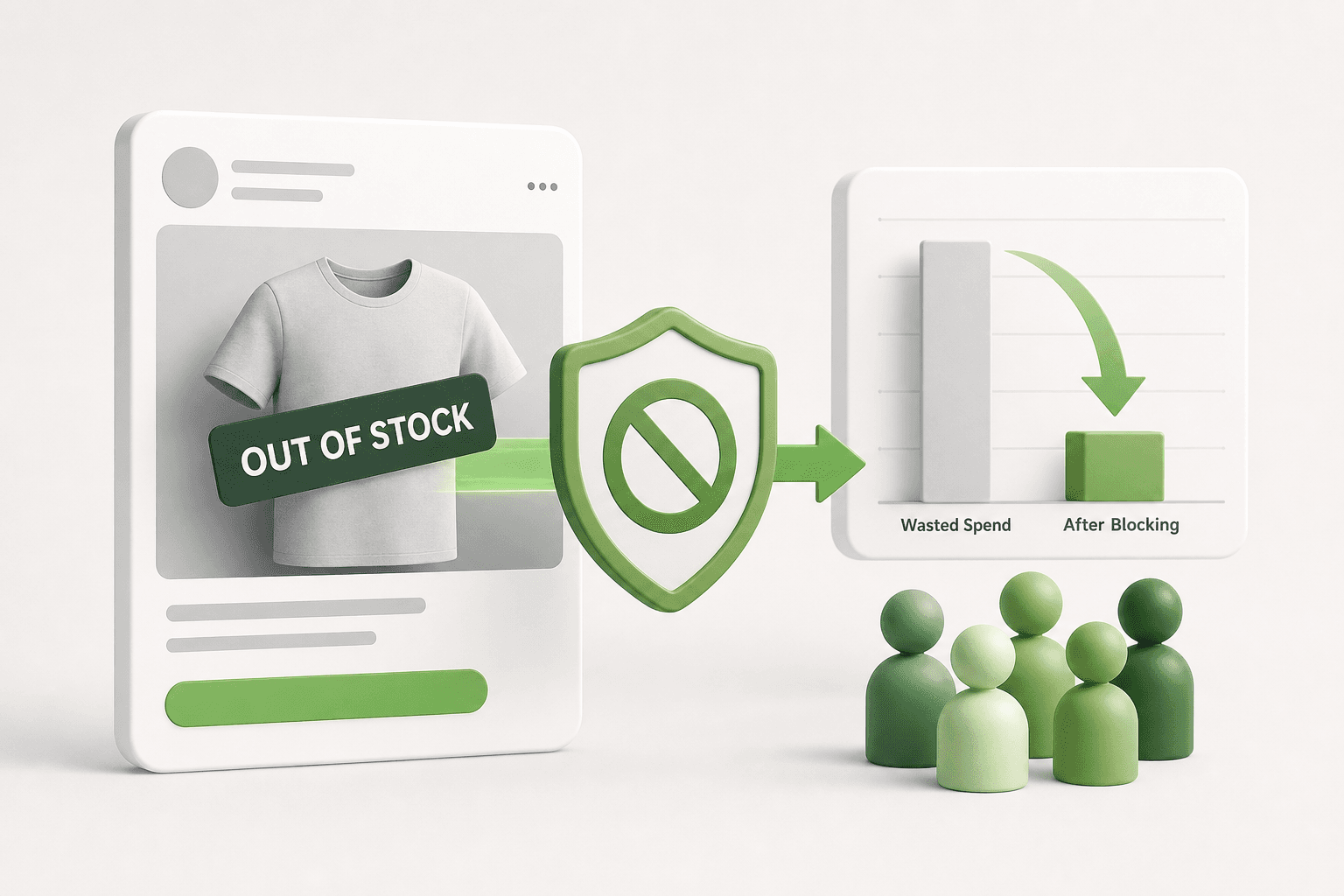

Short answer: Meta Advantage+ Shopping Campaigns (ASC) naturally chase low-friction sales, often over-delivering cheap impulse products that depress average order value and net profit margins. To solve this, segment your product catalog by profit tier, deploy high-AOV bundle creatives directly into the campaign asset pool, and optimize for purchase value rather than conversion volume.
Your Meta Advantage+ Shopping Campaign appears healthy inside Ads Manager, reporting steady purchase volume and a stable cost per acquisition. Yet when you reconcile your ad spend against your ecommerce backend, net cash profit is stagnant. The campaign algorithm is directing the majority of your daily budget toward low-priced impulse items instead of your high-margin flagship offers. While orders accumulate, average order value (AOV)—the average amount of money a customer spends during a single transaction—plummets, leaving your business with minimal gross revenue per sale.
This margin bleed occurs because Meta's automated delivery system naturally chooses the path of least resistance to generate conversions. When an automated campaign has free rein over your entire catalog, it gravitates toward inexpensive products with lower purchase friction to log easy conversion events. Leaving this dynamic unchecked creates severe financial drag: once you account for fixed packaging, shipping fees, payment processing, and cost of goods sold, high transaction counts on cheap items actively burn your working capital.
This guide outlines the exact process required to halt margin erosion and stabilize unit economics in automated shopping campaigns. You will learn how to isolate low-AOV spend patterns, reconfigure campaign optimization goals toward order value, build creative frameworks that sell profitable bundles, and audit your performance metrics to ensure scaling ad spend yields genuine net margin.
Key Takeaways
- Meta ASC defaults to conversion volume, causing the delivery system to favor cheap impulse items over profitable products.
- Filter your catalog feed by price and contribution margin to keep unprofitable single SKUs out of the automated pool.
- Introduce bundle creatives and multi-pack visual angles directly into the asset mix to force higher basket thresholds.
- Switch the campaign optimization goal from aggregate purchase volume to purchase value to steer spend toward high-tier buyers.
How Do You Identify Low AOV in Meta ASC Campaigns?
Advertisers identify low average order value in Meta Advantage+ shopping campaigns by calculating the ratio between reported purchase conversion value and total purchases inside Ads Manager. Comparing this ratio against standard e-commerce store benchmarks reveals whether automated budget allocation favors lower-priced catalogue items at the expense of overall basket profitability.
Calculating Average Basket Values in Meta Ads Manager
ASC (Advantage+ shopping campaigns) is Meta's machine learning-driven campaign type that automates audience targeting and creative delivery to maximize conversion value or volume. AOV (average order value) is the average monetary amount spent by a customer each time they complete a transaction. Meta Ads Manager does not provide a default column titled "Average Order Value," so media buyers must examine two core metrics side by side.
To inspect this data inside Meta Ads Manager, navigate to the Columns dropdown menu, select Customise Columns, and ensure both Purchases and Purchases Conversion Value are checked. Dividing the total Purchases Conversion Value by the total number of Purchases yields the campaign-specific AOV. Tracking this calculated number weekly highlights whether campaign efficiency is declining despite steady purchase volumes.
Spotting Margin Erosion and Product ID Discrepancies
Margin erosion occurs when transaction counts increase while net profit margins drop due to unoptimized basket sizes. To locate which specific products are causing this discrepancy in Advantage+ shopping campaigns, apply the catalog breakdown inside Meta Ads Manager:
- Open Meta Ads Manager and select the active Advantage+ shopping campaign.
- Click on the Breakdown menu located in the top-right corner of the reporting table.
- Select By Product and choose Product ID to view impressions, spend, and purchases per SKU.
Reviewing this breakdown often reveals that the delivery algorithm allocates 60% or more of the daily budget to entry-level items. Comparing these campaign-specific purchase values against store-wide organic order data from your e-commerce platform highlights whether Meta ASC is underperforming your store baseline.
Worked Example: Diagnosing Basket Size Compression
For example, an apparel retailer spending $500 per day in Meta ASC observes daily purchases rising from 20 to 35 orders, while total daily revenue moves only from $1,600 to $1,750. In this example, the retailer opens Ads Manager, checks the Product ID breakdown, and discovers that 75% of the $500 daily budget is being absorbed by a single $22 graphic t-shirt rather than higher-priced $110 outerwear items. To address this imbalance, the retailer creates an account on Adsaify to set up automated rules that monitor conversion thresholds and pause low-margin creative variants. When reviewing campaign data seven days later, the retailer checks whether the ad-attributed AOV has moved closer to the store-wide organic benchmark of $80.
If total sales volume is rising, does a lower average order value actually hurt business?
Yes, rising sales volume combined with a lower average order value damages net business profitability because fixed operating expenses apply to every individual parcel shipped. Pick-and-pack warehousing fees, domestic postage, packaging boxes, and payment gateway transaction fees remain relatively constant regardless of cart size. When order values decline, these fixed operational costs consume a much larger percentage of gross revenue, leaving the merchant with minimal net contribution profit despite strong top-line conversion counts.
Why Does Meta ASC Favor Low-Priced Products in Ad Spend?
Meta Advantage+ shopping campaigns favor low-priced products because the delivery auction prioritizes high conversion probabilities to spend budgets efficiently. Inexpensive items present lower financial friction for shoppers, producing rapid checkout signals that satisfy machine learning feedback loops much faster than premium items requiring extended buyer consideration cycles.
The Impact of Estimated Conversion Rate on Ad Auctions
Meta determines ad distribution through an auction formula that evaluates advertiser bids alongside estimated user actions. eCVR (estimated conversion rate) is the algorithmic probability calculated by Meta that a specific ad impression will result in a confirmed purchase. Products priced under $30 generate faster impulse purchases, leading to significantly higher eCVR scores in early impressions.
Because the automated delivery system seeks the path of least resistance to allocate daily spend, items that convert quickly receive disproportionate delivery. Machine learning models treat these fast purchases as immediate positive feedback, reinforcing delivery to low-ticket items while starving higher-ticket inventory of ad impressions.
Catalog Ingestion and Missing Profit Awareness
When merchants upload a complete product catalog into Advantage+ shopping campaigns without segmentation, Meta treats every item as equal inventory. The delivery engine lacks native visibility into product cost of goods sold, shipping overhead, or gross margins. The algorithm evaluates raw purchase counts or gross revenue metrics, entirely unaware that a lower-priced item might yield zero net margin after fulfillment expenses.
| Delivery Factor | Low-Priced Product Behavior | High-Priced Product Behavior |
|---|---|---|
| Buyer Consideration Window | Minutes to hours; instant impulse purchase | Several days to weeks; comparison shopping required |
| Algorithmic eCVR Score | Consistently high due to low friction at checkout | Lower initial rate due to longer consideration periods |
| Budget Allocation Pattern | Quickly absorbs majority of daily ASC budget | Starved of spend before accumulating conversion data |
| Impact on Ad Account AOV | Depresses average cart value across the campaign | Raises average cart value and net revenue per order |
| Net Contribution Margin | Frequently eroded by packaging and shipping costs | Higher dollar margin available to absorb delivery costs |
When media buyers feed diverse price tiers into a single Advantage+ campaign, the automated engine naturally gravitates toward items with the lowest barrier to sale. Without structural safeguards, this mechanism systematically depresses campaign-wide basket values.
Why can't the delivery algorithm figure out that expensive items yield more profit?
Meta's delivery algorithm cannot calculate profit because it receives data only on top-line conversion values and event frequencies, not internal merchant expenses. The system has no access to supplier costs, merchant merchant processing rates, or packaging overheads. Consequently, the auction interprets five separate $20 purchases as equal to a single $100 purchase in gross value, but prefers the five transactions because multiple conversion signals provide faster statistical confidence for machine learning optimization models.

How Much Damage Does Unchecked ASC Spend Cause to Net Margins?
Unchecked ASC (Advantage+ sales campaign) spend destroys net margins by driving cheap orders that fail to cover fixed operating expenses. When the campaign optimizes purely for volume, low order values cannot absorb warehouse handling, courier charges, and product costs, turning seemingly profitable top-line ad revenue into compounding net cash losses across your balance sheet.
Why does high reported ROAS mask negative cash profit?
ROAS (return on ad spend) is the gross revenue generated divided by the advertising dollars spent. POAS (profit on ad spend) is the net gross margin dollars generated divided by advertising spend. Meta Ads Manager measures revenue blindly, celebrating a 4.0 ROAS whether that revenue arrives as one 100-dollar basket or ten 10-dollar baskets.
When an Advantage+ sales campaign favors low-priced items, fixed picking, packing, and fulfillment overheads consume the entire gross margin of undersized baskets. Every physical delivery incurs non-negotiable costs: picking labor, packaging materials, shipping postage, and payment gateway fixed transaction fees. If a customer buys a five-dollar accessory, fulfillment fees quickly surpass the product's gross profit, generating a net operating deficit despite a high platform ROAS.
How does a low-AOV acquisition spiral ruin unit economics?
CAC (customer acquisition cost) is the total advertising spend required to acquire a single paying customer. When an automated campaign acquires first-time buyers through single, low-priced entry items, the business rarely recovers CAC on the initial purchase. E-commerce businesses rely on adequate initial basket sizes to offset front-loaded media costs immediately.
Burning advertising impressions on low-margin accessories creates an operational opportunity cost by starving higher-ticket items of algorithmic exposure. For example, consider an apparel store operating with a 500-dollar daily budget. When Meta ASC spent the entire budget pushing a 12-dollar accessory, the campaign achieved a 3.0 ROAS at a 4-dollar cost per purchase. However, after subtracting 3 dollars for product manufacturing, 5 dollars for warehouse pick-and-pack, 4 dollars for domestic shipping, and 4 dollars for advertising, each order lost 4 dollars in cash. When the brand restructured ad delivery to feature a 70-dollar jacket bundle, the ROAS dipped to 2.5 with a 28-dollar acquisition cost. After deducting 20 dollars for product costs, 5 dollars for warehouse handling, and 6 dollars for shipping, each transaction generated 11 dollars in true net profit. Marketers should review contribution margin and net cash flow rather than Meta reported ROAS to protect profitability. Automation rules in platforms like Adsaify can pause ad variations when efficiency drops below defined profit thresholds.
How do undersized baskets hurt cash flow when fixed fulfillment costs stay unchanged?
Undersized baskets hurt cash flow because fixed fulfillment costs like boxing, picking, payment gateway base fees, and shipping labels remain static regardless of order size. When Meta ASC delivers orders close to your delivery expense floor, these static warehouse and logistics fees consume the entire gross margin of the items. Cash drains out immediately to pay logistics providers and Meta ad invoices, while inventory replenishment funds vanish before repeat purchases ever materialize.
How Do You Increase Basket Size and Margins in Meta ASC?
You increase basket size and margins in Meta ASC by switching bidding from conversion volume to conversion value, filtering low-margin items out of the catalog, and serving bundle creatives. Directing Meta's delivery algorithms toward higher transaction values and enforcing price minimums forces the system to find buyers willing to spend more per checkout.
Which structural adjustments raise basket values in Meta Ads Manager?
Value-Based Bidding (VBB) is an optimization method in Meta Ads Manager that instructs the delivery algorithm to maximize total transaction value rather than transaction count. In your campaign settings under the ad set level, change the performance goal from "Maximize number of conversions" to "Maximize value of conversions". This instructs Meta to evaluate user purchasing history and prioritize profiles showing a pattern of larger cart checkouts.
Next, open Meta Commerce Manager and establish curated product sets that strictly exclude SKUs priced below your profitability floor. If your unit economics require a minimum transaction of 40 dollars to cover fulfillment and advertising overheads, create a catalog filter that only includes products above that price point. Removing low-value accessories from the dynamic catalog eliminates Meta's ability to hunt for easy, low-value conversion signals.
- Audit catalog profit thresholds — Calculate the minimum checkout value required to cover product cost, fulfillment, and expected ad spend to determine your catalog cutoff price.
- Segment Commerce Manager product sets — Filter the active product catalog by price rules to exclude all individual items sitting below your defined margin floor.
- Update campaign performance goals — Switch the campaign optimization objective from conversion volume to conversion value inside Meta Ads Manager.
- Introduce bundle creatives — Add video demonstrations and multi-pack carousel cards into the ASC creative pool to showcase high-value offers.
- Implement checkout threshold incentives — Configure tiered cart progress bars and free shipping thresholds on your e-commerce storefront to lift units per transaction.
- Establish margin-based automation guards — Deploy performance monitoring rules to pause underperforming ad variations before spend drains operating capital.
How do you steer customer checkout behavior toward higher thresholds?
To lift AOV (average order value), which is the average currency amount spent per transaction, you must update the creative assets inside the campaign. Populate your creative pool with multi-pack bundles, tiered kits, and demonstration videos showing complementary items used together. When drafting new campaign concepts, tools like Adsaify can analyze a product URL to generate fresh creative drafts and copy variations highlighting product bundles.
Pair these ad creative adjustments with storefront incentives. Implement a dynamic free shipping threshold set approximately fifteen to twenty percent above your current average order value. Displaying tiered volume discounts directly on product pages reinforces higher basket quantities, ensuring that Meta traffic converting on your website meets your necessary margin targets.
Will switching to value optimization force the campaign back into learning mode?
Yes, switching the performance goal from conversion volume to conversion value resets the campaign into learning mode. Meta Ads Manager treats this switch as a fundamental change to its bidding model, requiring roughly fifty optimization events within a seven-day window to recalibrate delivery. To minimize performance disruption during this transition, keep historical creative assets active and maintain a stable daily budget while the algorithm learns to identify higher-spending customer profiles.
If you would rather not set up each of these steps by hand, try it in Adsaify: your first ad is free, so there is nothing to lose. Create a free account.
Which Settings Should You Check Before Restructuring Meta ASC?
Before restructuring Meta ASC (Advantage+ shopping campaigns), you should check purchase conversion tracking fidelity, product catalog data integrity, account-level conversion volume, and existing customer budget caps. Verifying these configurations ensures Meta machine learning optimizes for real transaction revenue rather than distorted product margins or cheap repeat customer purchases.
Auditing Conversion Event Data and Catalog Feeds
First, verify your tracking infrastructure in Meta Events Manager. Meta Pixel is the browser tracking code placed on your storefront, while Conversions API (CAPI) is the server-side data pipeline connecting your website server directly to Meta. Both signals must transmit accurate purchase value and currency parameters without deductions or discrepancies. If the purchase value sent to Meta includes gross values before refunds or omits currency codes, algorithmic delivery assigns spend improperly. Next, open Meta Commerce Manager to inspect your product catalog feed. Audit price, availability, and product category fields. You can use custom_label_0 through custom_label_4 attributes to tag items according to gross margin tiers or retail price brackets, which enables precise catalog filtering inside campaign sets later.
Verifying Purchase Volume and Customer Budget Caps
Next, confirm your account logs enough transactional volume to support value-based bidding. VO (Value Optimization) is a Meta bidding strategy that directs ad delivery toward users likely to spend higher monetary amounts per purchase. For value optimization to function reliably, your ad account should generate at least 50 to 100 purchase events within a 7-day attribution window. If your account records fewer conversions, the algorithmic model struggles to predict high-value spenders accurately. Finally, inspect your ad account settings under Advantage+ shopping campaign settings to audit the existing customer budget cap. If you do not define existing customer custom audiences and set an appropriate budget cap (such as 0% to 5%), Meta ASC campaigns often harvest repeat buyers of low-priced replacement items, inflating reported return without expanding net margin from new buyers.
- Inspect purchase events in Events Manager to verify that monetary value and currency match transaction receipts.
- Audit product feed parameters inside Commerce Manager to ensure current pricing and stock availability align with your store.
- Assign custom margin labels across product variants in your data feed to prepare segmented product sets.
- Confirm your ad account logs at least 50 purchase events per week before enabling value optimization.
- Define your existing customer custom audience list inside Meta ad account settings.
- Set an existing customer budget cap of 5% or less to prevent disproportionate spending on retention purchases.
Do you need custom data layers on your site to segment catalog sets by margin?
You do not need custom website data layers simply to segment catalog sets by margin. You can map gross margins directly within your e-commerce product feed using supplemental spreadsheets or catalog rules in Meta Commerce Manager. By assigning margin thresholds to custom label attributes, Meta Ads Manager allows you to filter product sets based on profitability without altering your underlying site code.
How Do You Build a High-AOV ASC Structure in Practice?
To build a high-AOV Meta ASC structure, you filter your product catalog to exclude low-ticket individual items, build bundled offers exceeding your minimum target order value, configure value optimization, and scale budget incrementally over fourteen days. This forces Meta algorithms to hunt for shoppers who purchase higher-priced bundles instead of cheap impulse products.
Catalog Filtering and Bundle Creative Development
To restructure an underperforming campaign, open Meta Ads Manager and adjust your catalog product sets. Filter your dynamic catalog to exclude standalone accessories or low-priced items below $15, isolating curated outfits or bundled units priced above $60. This simple adjustment prevents the algorithm from defaulting to cheap accessories that yield low AOV (average order value, the mean amount spent per transaction). Next, develop dedicated creative assets showcasing multi-pack savings, styling kits, or quantity breaks. You can analyze your product URLs using Adsaify to generate ad copy, structured campaign suggestions, and AI-generated image or video variations that highlight these bundled packages. Highlighting bundled benefits directly in the visual creative sets customer expectations for larger basket sizes before they click.
Worked Example: Restructuring an Apparel Store Spending $100 Daily
For example, consider an apparel and accessories store spending a $100 daily budget inside Meta ASC. The store previously advertised its entire 400-item catalog, resulting in 10 daily purchases of $12 socks, producing $120 gross revenue at an unviable margin bleed. The merchant created a filtered catalog set containing only 3-piece apparel sets priced at $75 and excluded individual items priced below $20. Adsaify was used to analyze the collection landing page URL, drafting fresh bundle-oriented ad copy and creative suggestions that were published directly to the ad account. Within seven days, ad spend concentrated entirely on the bundled outfits. The campaign delivered 2 purchases per day at $75 each, generating $150 daily revenue. While raw unit volume dropped from 10 orders to 2 orders, AOV increased from $12 to $75, shipping fulfillment costs fell significantly, and contribution margin rose into sustainable territory.
Configuring Value Optimization and the 14-Day Scaling Phase
When launching your updated catalog set, select "Maximize value of conversions" instead of "Maximize number of conversions" in the ad set optimization settings. Meta uses historical spending patterns to target users with a propensity for higher basket sizes. Once launched, avoid adjusting the daily budget by more than 15% to 20% every three days. A gradual 14-day scaling phase allows the delivery engine to stabilize conversion rates across higher price tiers without resetting campaign learning.
Can you run both standalone SKUs and high-ticket bundles on a $100 daily budget?
You should not run standalone low-ticket SKUs and high-ticket bundles simultaneously inside a single Meta ASC campaign on a $100 daily budget. Meta delivery algorithms naturally gravitate toward the cheaper product because its lower friction delivers cheaper conversion volume. On a $100 daily budget, you should consolidate all ad spend exclusively into bundles to give machine learning adequate data density.

Which Mistakes Ruin Profitability When Scaling Meta ASC Campaigns?
Advertisers ruin profitability during Meta Advantage+ Shopping Campaign scaling by connecting unfiltered product catalogs without margin controls, over-indexing on ultra-expensive inventory that halts conversion volume, ignoring website bundling mechanisms, and failing to implement automated pause rules. These strategic errors cause Meta algorithms to prioritize cheap, low-margin purchases that deplete capital.
Catalog and SKU Selection Errors in Advantage+ Campaigns
Meta Advantage+ Shopping Campaigns (ASC) are automated performance ad campaigns designed to maximize purchase conversions across Meta networks using machine learning. Feeding an unfiltered master product catalog directly into Meta ASC invites margin bleed. Meta machine learning algorithms optimize for the highest conversion probability at the lowest cost per acquisition. Because lower-priced accessories convert with less friction than higher-priced items, the delivery engine pushes budget aggressively toward catalog items that generate minimal gross profit.
Conversely, swinging too far in the opposite direction creates conversion choking. When media buyers manually strip out all entry-level inventory and force Meta ASC to promote only high-priced luxury stock, aggregate purchase liquidity collapses. Meta ad sets require approximately 50 conversion events per week to exit the learning phase. Forcing delivery exclusively on luxury items raises the cost per acquisition and depresses total conversion volume, stranding the campaign in perpetual optimization volatility.
| Strategic Mistake | Algorithmic Mechanism | Impact on Account | Corrective Setting |
|---|---|---|---|
| Unfiltered Master Catalog | Meta prioritizes cheapest items for rapid conversion signals | AOV drops while total volume stays artificially high | Product set filter excluding low-margin SKUs |
| Luxury-Only Catalog Pruning | Conversion volume drops below 50 events per week threshold | Ad set enters learning limited status, spiking CPM | Pre-bundled product sets at mid-tier price thresholds |
| Creative-Only Basket Scaling | Traffic reaches single-product pages without bundle offers | Cart abandonment rises; units per transaction stagnate | On-page volume discounts and post-purchase upsells |
| Manual Spend Monitoring | Underperforming creative variants consume daily spend unattended | Ad spend accumulates on zero-margin product orders | Automated rules to pause low-AOV ad variations |
Funnel Mismatches and Absent Automation Guardrails
Relying solely on ad creatives to elevate order values represents a critical operational disconnect. A dynamic ad can feature a collection or showcase bundled value, but if the destination landing page lacks on-site cross-sells, tiered bundle pricing, or pre-checkout add-ons, consumers purchase single items. Media buyers must align creative hooks with landing page architecture to ensure the cart actually expands upon arrival.
Furthermore, failing to configure performance automation rules guarantees wasteful ad spend. When scaling an ASC campaign, individual dynamic creative combinations or asset variations inevitably spend budget generating orders for low-margin products. Marketers can set automated rules inside Meta Ads Manager or connect external automation via tools like Adsaify to automatically pause underperforming ad variations when metrics breach minimum acceptable return thresholds.
Does shutting off cheap entry products altogether halt total account delivery?
Shutting off cheap entry products completely will not halt account delivery entirely, but it often degrades optimization efficiency. Meta delivery algorithms depend on continuous conversion signals to identify receptive audiences. When lower-priced discovery products disappear, conversion velocity slows down, potentially triggering learning phase issues and inflating cost per acquisition across remaining ads. Rather than turning off cheap products entirely, advertisers should package those items into multi-packs or set minimum order thresholds so algorithmic liquidity stays active without destroying overall order margins.
How Do You Measure If Your Meta ASC Margin Fix Actually Worked?
Performance marketers measure the success of an Advantage+ Shopping Campaign margin fix by monitoring increases in blended average order value, calculating profit on ad spend, tracking units per transaction, and verifying positive contribution margins. A validated fix results in higher net cash retention per conversion across extended 14-day and 30-day attribution windows.
Tracking Reporting Windows, POAS, and Basket Density
AOV (average order value) is the average monetary amount spent by a customer during a single transaction. Analyzing AOV inside Meta Ads Manager requires customized reporting columns. Marketers should review Purchases Conversion Value divided by Purchases across 14-day and 30-day attribution windows. Short-term windows often display false dips due to delayed conversion reporting and delayed attribution cycles.
True margin validation requires evaluating POAS. POAS (profit on ad spend) is a metric calculated by dividing gross profit generated from ads by total ad spend. Unlike traditional return on ad spend, POAS incorporates product cost of goods sold, shipping fees, and payment gateway percentages. For example, with an ad spend of 10,000 USD, generating 30,000 USD in revenue at a 30 percent gross margin yields 9,000 USD in gross profit, resulting in a POAS of 0.90, which confirms an operational loss despite an apparent 3.0 ROAS.
Marketers must also track UPT. UPT (units per transaction) is an e-commerce metric measuring the average number of physical products bought per customer order. A successful ASC restructure increases UPT alongside order revenue, proving that shoppers are buying multi-packs or accepting cross-sell recommendations rather than purchasing single discounted items.
Iterative Creative Testing and Account Audit Routines
Fixing margin bleed is not a one-time setup; it requires consistent operational auditing. Advertisers must monitor asset performance weekly, retiring ad creatives that attract single-item buyers and introducing variations that promote high-margin bundles. Media buyers looking to test new bundle angles can use Adsaify to draft campaign structures and generate fresh image and video creative concepts from a product URL.
- Export 30-day order exports from your e-commerce platform to calculate baseline net contribution margin per product set.
- Configure custom metric columns inside Meta Ads Manager for average order value, cost per purchase, and purchase conversion value.
- Compare 14-day trailing POAS against pre-restructure benchmark periods to confirm real cash profitability.
- Audit units per transaction weekly within store analytics to verify customers are adding cross-sell items.
- Review creative asset breakdown reports inside Meta Ads Manager to identify dynamic ads driving low-value orders.
- Schedule recurring bi-weekly creative rotations to test updated bundle messaging, packaging angles, and multi-unit offers.
Is it safe to rely on the first 7 days of blended ad data to judge success?
Relying on the first 7 days of blended ad data to judge margin performance is unsafe and frequently leads to premature adjustments. Conversion lag, delayed attribution through Meta Conversions API, and customer consideration periods distort early performance figures. High-AOV bundles and premium products typically require longer consideration cycles than impulse purchases, meaning transactions initiated on day two may not settle until day seven or ten. Media buyers should allow at least 14 full days of stabilized delivery before evaluating financial outcomes.
How Do You Maintain Sustainable Profitability in Meta ASC?
To resolve low average order value and margin bleed in Meta Advantage+ Shopping Campaigns (ASC), audit your product sets to eliminate low-margin loss-leaders. Shift campaign optimization from raw purchase volume to purchase value optimization (maximizing value of conversions) once your pixel records steady sales data. Pair this algorithm shift with structured store offers like minimum spend thresholds for free shipping, curated multi-packs, and bundle-specific creatives that explicitly highlight high-tier orders.
Today, audit your Meta catalog and create a custom product set that removes every item priced below your target break-even order value. You can then use Adsaify to generate fresh bundle creatives and ad copy from your website URL, publish them directly to your Meta ad account, and set automated rules to pause any ad variations that fail to maintain your desired return.
Want to see this in your own account? Enter your website address and Adsaify drafts the campaign for you. The first ad is free. Try it now or log in.
Frequently Asked Questions (FAQ)
1. What is the minimum number of high-AOV products needed in a Meta ASC catalog?
A Meta ASC catalog performs best with at least 10 to 20 distinct high-AOV products or bundles. Providing fewer than 10 products limits Meta's machine learning delivery system, which needs sufficient creative variety to match appropriate items with different user segments without quickly exhausting product-level audience interest.
2. How many weekly purchases are required to unlock purchase value optimization?
Meta generally requires approximately 50 purchase events per ad set per week to exit the learning phase and optimize effectively. While purchase value optimization can technically be selected immediately, maintaining roughly 50 weekly transactions gives the algorithm sufficient conversion value data to reliably predict and pursue higher-spending buyers.
3. Does excluding low-margin entry items from ASC increase CPM costs?
Excluding low-margin items can cause a slight increase in CPM (cost per thousand impressions) because your target audience narrows to buyers with higher purchasing intent. However, this marginal cost increase is typically offset by significantly higher average order values and healthier net profit margins across your delivered orders.
4. Can Adsaify help generate high-AOV bundle creatives for Meta ASC campaigns?
Yes, Adsaify analyzes your store website URL or description to draft targeted ad copy, budget suggestions, and AI-generated image or video creatives centered on bundles. It publishes these campaigns directly to your Meta ad account, where you can incorporate them into your Advantage+ Shopping setup alongside catalog ads.
5. Does creating custom product sets slow down Meta's ASC algorithm?
Creating custom product sets does not slow down Meta's ASC algorithm, provided the filtered set still contains enough inventory and purchase volume to exit the learning phase. Constraining catalog feeds merely prevents the algorithm from chasing cheap conversions on low-margin products that damage overall campaign profitability.
6. Should low-budget stores use manual sales campaigns instead of Meta ASC?
Low-budget stores should often choose manual sales campaigns over ASC if they cannot generate roughly 50 weekly purchases. Manual campaigns allow granular audience targeting, explicit placement controls, and strict exclusion settings, whereas ASC requires substantial data volume and broad liquidity to allocate budget efficiently across audiences.
7. Does increasing the free shipping threshold directly improve ASC average basket size?
Increasing your free shipping threshold directly improves basket sizes by incentivizing shoppers to add supplemental items to qualify for delivery discounts. Because Meta's ASC algorithm optimizes for observed conversion patterns, buyers naturally building larger baskets signal the system to favor audiences prone to higher checkout values.
8. Can dynamic catalog formats and custom video bundles run together inside one ASC?
Yes, Meta ASC allows advertisers to mix dynamic catalog formats and custom video bundles within the same campaign, up to 150 total creative assets. Combining both formats lets Meta deliver personalized product feeds to high-intent shoppers while using rich video storytelling to introduce high-value bundles.
How can you try this with Adsaify?
The quickest way to apply the steps in this article to your own account is to try them. Adsaify analyses your business from your website address, drafts the campaign with an audience, ad copy, creative and a budget suggestion, and publishes it to your own Meta ad account once you approve.
- Your first ad is free: there is nothing to lose by trying.
- Your own ad account: the campaign runs in your Meta account and you stay in control.
- Images and video: generate ad creatives with AI or promote an existing Instagram post.
Create a free account and try your first ad · Already have an account? Log in.