Short answer: To measure net ROAS differences between agencies and AI platforms, include management retainers and software fees into your total marketing spend. Net ROAS equals total revenue divided by ad spend plus operational fees. While agency commissions erode net margins as budgets grow, AI buying platforms maintain flat overhead, allowing brands to scale ROAS faster.
Many marketers struggle with understanding the true financial performance of their advertising efforts, especially when comparing the effectiveness of agencies versus AI platforms. As ad spend increases, deciphering how much of that investment translates into actual revenue becomes increasingly complex. Marketers often find themselves questioning whether their chosen model is truly optimizing their return on ad spend (ROAS) or if hidden costs are eating away at their profits. The divergence in costs between agency fees and AI platform expenses can lead to significant financial losses if not properly addressed. Agencies typically charge commissions that can escalate alongside ad spend, which may result in diminishing returns as budgets grow. In contrast, AI platforms usually operate with fixed costs, which can keep overhead predictable. Failing to analyze these differences can lead to misguided decisions that jeopardize overall profitability and hinder growth. This article will guide you through the essential steps to accurately measure net ROAS differences, equipping you with the tools to make informed decisions about your advertising strategy. You will learn how to differentiate between net and gross ROAS, diagnose your brand's needs, gather critical metrics, and establish a routine for ongoing performance audits. By the end, you'll be well-prepared to choose the right operational model that maximizes your advertising ROI.Key Takeaways
- Gross ROAS reported inside Meta Ads Manager ignores operational fees; net ROAS must factor in management overhead to reflect reality.
- Agency commissions of 10-15% or fixed retainers rapidly erode net margins, particularly on ad spends between $1,000 and $10,000.
- AI media buying tools operate on fixed subscription tiers, which progressively lowers management cost per dollar spent as you scale.
- Brands capable of supplying basic creative assets achieve profitable ROAS scaling faster through AI automation than traditional agency workflows.
What Is the Difference Between Net ROAS and Gross ROAS?
ROAS (return on ad spend) is a core advertising metric calculated by dividing ad-attributed revenue by direct platform spend. Gross ROAS looks exclusively at figures inside Meta Ads Manager, ignoring management retainers, percentage cuts, and software tool costs. Net ROAS divides total generated revenue by the combined sum of direct ad spend and all management overhead. Brands often mistakenly celebrate high gross ROAS figures while failing to notice that operational overhead is causing net financial losses.
Understanding Gross ROAS
Gross ROAS is computed using only the revenue generated from ads against the ad spend recorded in Meta Ads Manager. For example, if a clothing retailer spends $10,000 on ads and generates $40,000 in revenue, their gross ROAS is 4.0 ($40,000 ÷ $10,000). However, this metric does not account for any additional costs related to agency fees or software tools, which can significantly impact overall profitability.
Calculating Net ROAS
Net ROAS provides a more accurate picture of profitability by including total expenses. If the same clothing retailer incurs $2,000 in agency fees and $500 in software costs, their total expenses are $12,500. Thus, the net ROAS is calculated as follows: Revenue ($40,000) ÷ Total Costs ($12,500) = 3.2. This shows that despite a gross ROAS of 4.0, the net ROAS indicates a less favorable scenario, emphasizing the importance of considering all costs.
An Example of Net vs. Gross ROAS
Consider a digital marketing agency managing a $15,000 monthly ad budget for a local gym. If the gym earns $60,000 from ads, the gross ROAS is 4.0. However, if the agency charges a $3,000 retainer and earns a 15% commission on ad spend ($2,250), the total costs amount to $20,250. The net ROAS becomes $60,000 ÷ $20,250 = 2.96. Brands must evaluate both metrics to understand their true financial position.
If my Ads Manager dashboard shows a 4.0 ROAS, am I definitely profitable?
No, a 4.0 gross ROAS does not guarantee profitability. To determine true profitability, you must calculate the net ROAS, which includes all associated costs such as agency fees and software expenses. If these costs significantly reduce your net ROAS, you may not be making a profit, even with a high gross ROAS.
Why Do Agency Fees and AI Costs Diverge as Ad Spend Scales?
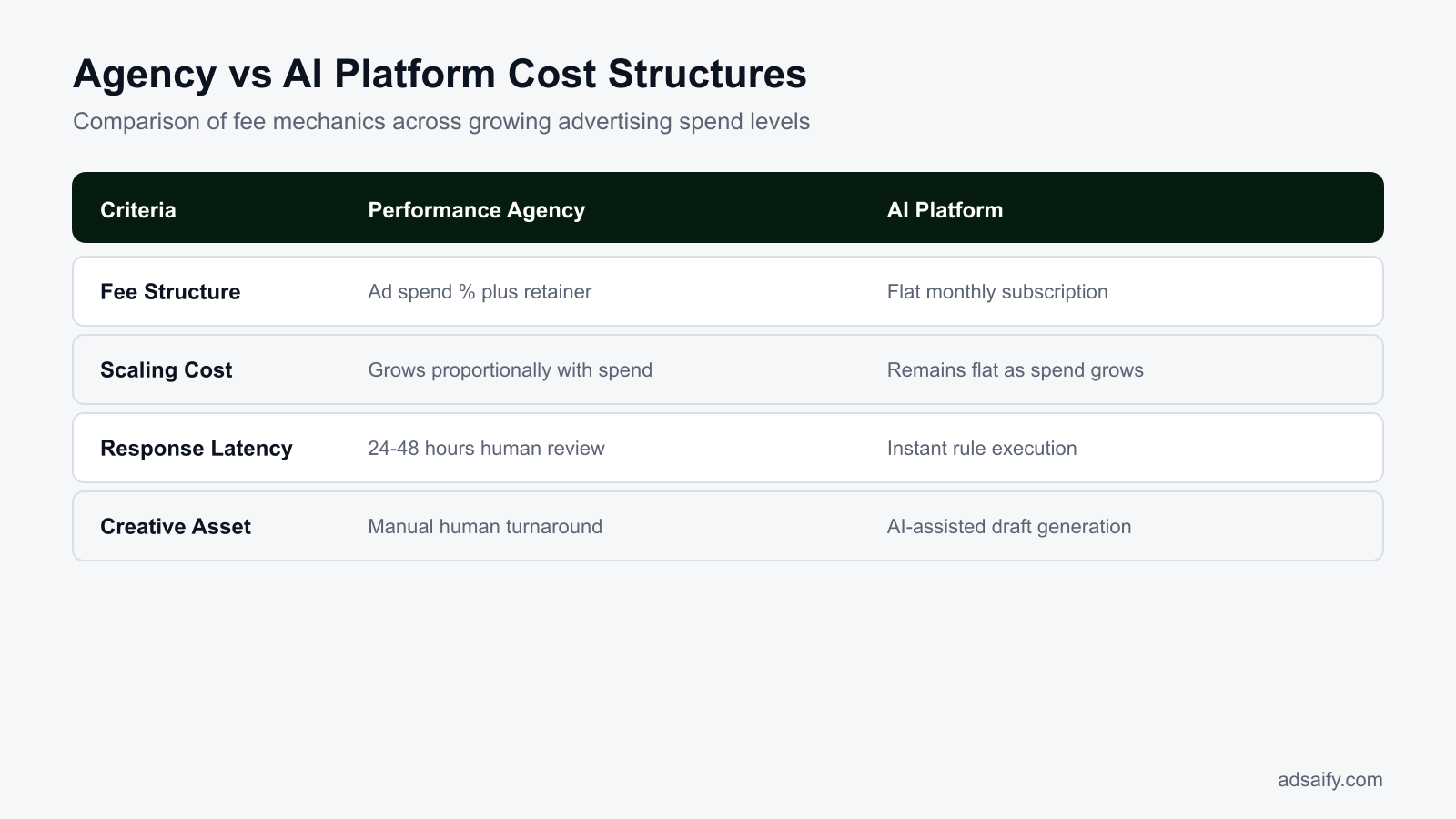
Traditional performance agencies typically charge a monthly base retainer alongside a 10% to 20% variable commission on total ad spend. As ad spend climbs from $5,000 to $20,000, agency management fees double or triple despite requiring minimal incremental human effort. In contrast, AI media buying tools operate primarily on flat monthly software subscription tiers regardless of campaign spend volume. This divergence ensures that as media spend scales, AI software drastically lowers overhead cost per advertising dollar spent.
Agency Fee Structure
Agencies often have a structure that includes both a fixed fee and a commission based on ad spend. For instance, if an agency charges a $2,500 monthly retainer plus 15% on ad spend, the fees can escalate quickly. For an ad budget of $20,000, the total fees would be $2,500 + ($20,000 × 0.15) = $5,500. This increase in fees does not correlate with a proportional increase in the effort required to manage the campaigns.
AI Cost Structure
AI platforms, like Adsaify, typically charge a flat monthly fee that remains constant regardless of the ad spend. For example, if the monthly subscription is $300, the cost does not change as the ad budget increases. This structure allows for substantial cost savings as ad spend scales, making AI tools an attractive option for brands looking to maximize their advertising efficiency without incurring high management fees.
| Model | Fee Structure | Cost at $5,000 Spend | Cost at $20,000 Spend |
|---|---|---|---|
| Agency | $2,500 + 15% | $2,500 + $750 = $3,250 | $2,500 + $3,000 = $5,500 |
| AI Platform | Flat Rate | $300 | $300 |
Why do agencies scale their fees with ad spend while AI tools charge a flat price?
Agencies scale their fees with ad spend due to a combination of fixed retainers and variable commissions, which can lead to significantly higher costs as budgets grow. In contrast, AI tools utilize a flat pricing model that allows brands to manage larger budgets without incurring proportional increases in management costs, providing a more cost-effective solution as ad spend increases.
What Financial Losses Occur When Choosing the Wrong Management Model?
A wrong management model can lead to significant financial losses for brands. For example, a small brand paying a hefty agency retainer may find itself spending more on management fees than on actual media distribution, which can severely limit cash flow. Additionally, communication lags within agency workflows often result in failing ads running longer than necessary, leading to wasted ad spend. Brands that adopt AI platforms without creative assets ready face creative fatigue, which diminishes campaign efficiency. Finally, mismatches between the operational model and the brand's budget tier can accelerate net profit margin decay during scaling.High Agency Retainers vs. Media Spend
Small brands often struggle with high agency retainers. For instance, if a brand pays $3,000 monthly to an agency but only allocates $2,000 for ad spend, it effectively spends 150% more on management than on ads. This imbalance can choke liquidity, making it difficult to reinvest in product development or inventory. Brands should evaluate their budget and consider switching to an AI platform, which typically charges less and allows for better allocation of funds towards media spend.Communication Lags and Wasted Ad Spend
In agency-managed campaigns, delays in communication can lead to inefficiencies. For example, if an agency takes a week to inform a brand that a particular ad is underperforming, the brand may waste an additional $700 on that ad before making adjustments. In contrast, AI platforms provide real-time performance monitoring, allowing brands to pause underperforming ads almost instantly, minimizing wasted ad spend.Creative Fatigue and Campaign Efficiency
Brands jumping into AI platforms without pre-prepared creative assets often encounter creative fatigue. If a brand launches an AI-driven campaign using only a few generic images, the audience may quickly lose interest, leading to decreased engagement rates. Brands should ensure they have a library of creative assets ready before launching campaigns to maintain audience interest and campaign effectiveness.- Evaluate your current agency retainer against ad spend.
- Monitor communication efficiency with your agency team.
- Prepare a diverse set of creative assets before using AI tools.
- Assess your budget tier against your operational model.
- Calculate the potential ROI of switching to an AI platform.
- Identify any ongoing wasted ad spend in your current setup.
How long does it take to realize that I chose the wrong operational model?
Realizing the wrong operational model can take anywhere from a few weeks to a few months, depending on performance metrics and cash flow. If a brand notices consistent underperformance, high costs, and low engagement, it may be a clear sign that adjustments are needed sooner rather than later.How Do You Diagnose Whether Your Brand Needs an Agency or an AI Tool?
To determine whether a brand needs an agency or an AI tool, several factors must be considered. Brands with an internal team member capable of generating basic product photos and videos can thrive using AI media buying platforms. Conversely, businesses lacking marketing knowledge, strategic positioning, or creative production capability may initially require an agency. E-commerce stores with monthly ad budgets between $1,500 and $30,000 generally preserve higher net profit margins using AI platforms over agencies. Additionally, AI automation rules react instantly to performance dips, outperforming the scheduled weekly meetings typical of agency workflows.Comparison of Agency and AI Tool Options
| Criteria | Agency | AI Tool |
|---|---|---|
| Internal Creative Capability | Not required | Preferred |
| Monthly Budget Range | Higher fees | Lower fees |
| Performance Monitoring | Weekly meetings | Real-time updates |
| Ad Performance Optimization | Manual adjustments | Automated rules |
| Strategic Marketing Knowledge | Essential | Not necessary |
If we cannot create ad images or videos ourselves, can an AI tool still suffice?
If a brand lacks the ability to create ad images or videos, an AI tool can still be beneficial, but it may not be fully effective. While AI platforms can assist in media buying and optimization, they rely on existing creative assets. Brands may need to consider outsourcing creative production or collaborating with freelancers to ensure their campaigns are visually appealing and effective.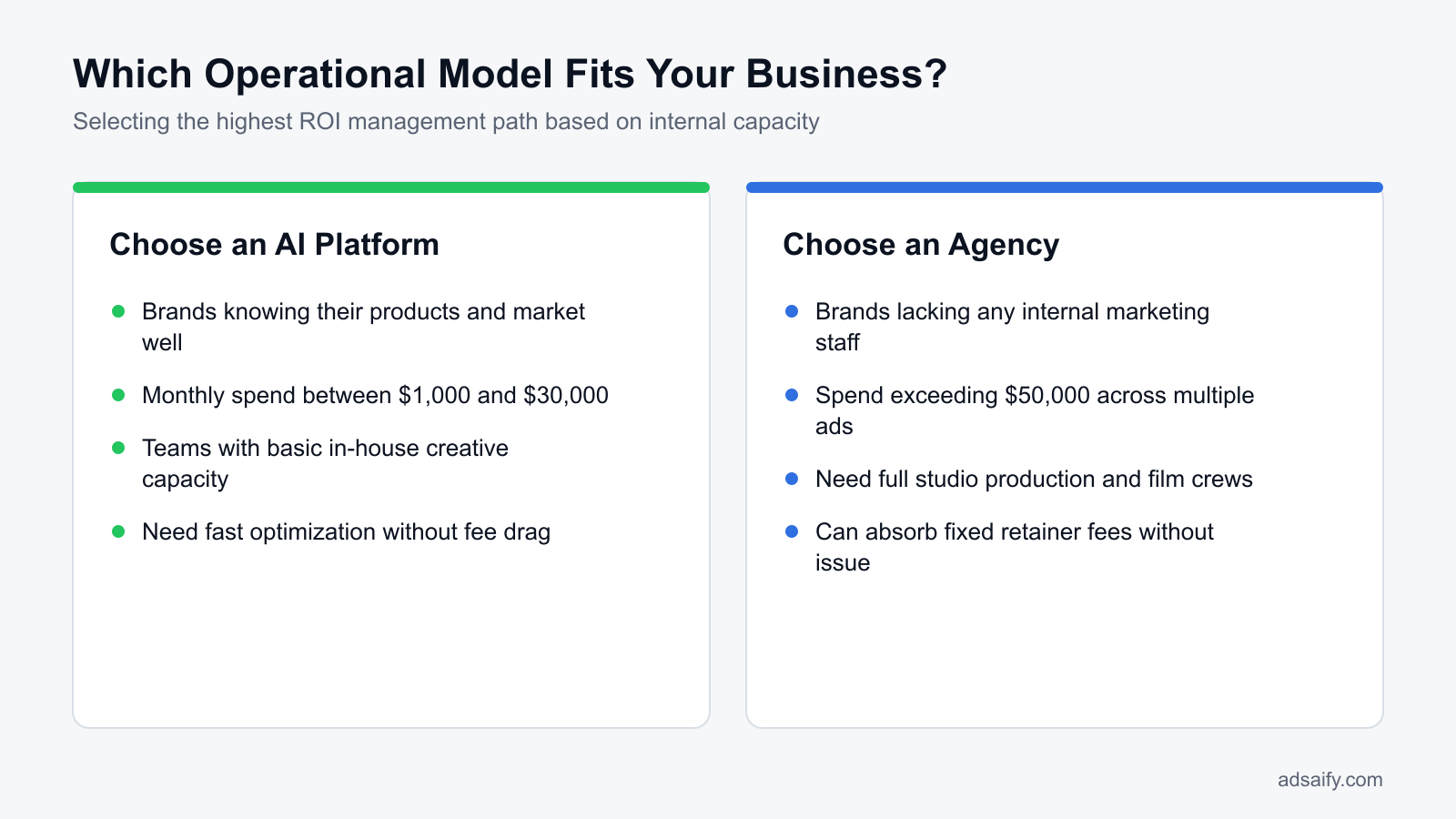
If you would rather not set up each of these steps by hand, try it in Adsaify: your first ad is free, so there is nothing to lose. Create a free account.
Which Metrics Must You Gather Before Comparing Operational Costs?
To effectively compare operational costs between an agency and an AI platform, gather specific metrics that reflect your advertising spend and revenue. This includes average monthly Meta ad spend and attributed gross sales revenue from the last three months, itemized agency quotes, the flat subscription price of the AI software, and the execution latency for campaign adjustments.Extract Average Monthly Meta Ad Spend and Attributed Gross Sales Revenue
Begin by reviewing your Meta Ads Manager account for the last three months. Navigate to the “Reports” section, and select “Performance” to extract your average monthly ad spend and gross sales revenue. Calculate the average monthly spend by summing the total spent across three months and dividing by three. For example, if you spent $15,000, $20,000, and $25,000, your average monthly spend would be ($15,000 + $20,000 + $25,000) / 3 = $20,000. Next, check the “Purchase” metric under the “Conversions” tab to find attributed sales revenue.Itemize Agency Quotes
Collect detailed quotes from agencies you are considering. Itemize the costs, including the monthly base retainer, percentage-of-spend tiers, and any optional creative production surcharges. For example, an agency might charge a $2,000 monthly retainer, a 15% commission on ad spend, and an additional $1,000 for creative services. Ensure you have a complete understanding of how each fee impacts your overall budget.Determine AI Software Subscription Costs and Internal Labor Hours
Next, identify the flat subscription price for the AI platform you are evaluating, such as Adsaify. Additionally, estimate the internal labor hours needed for asset creation, including time spent on generating ad images or videos and writing ad copy. For instance, if the AI software costs $500 per month and you anticipate spending 10 hours monthly on asset creation, document this to understand the total cost.Benchmark Execution Latency for Campaign Adjustments
To benchmark execution latency, track how long it takes to implement campaign adjustments in both models. For agencies, note the average time taken to push updates live, which may range from 24 hours to several days. For AI platforms, measure how quickly changes can be made. Document these times to clarify the operational efficiency differences between the two models.- Extract average monthly ad spend and gross sales revenue.
- Gather itemized agency quotes for accurate comparison.
- Determine the subscription cost of the AI platform.
- Estimate internal labor hours required for asset creation.
- Measure execution latency for campaign adjustments.
How should I calculate the internal labor cost spent on operating software?
To calculate the internal labor cost for operating software, multiply the hourly wage of the personnel managing the software by the total hours spent on tasks such as creating ad assets and analyzing campaign performance. For example, if the hourly wage is $25 and 10 hours are spent, the internal labor cost would be $250.How Do You Calculate True Net ROAS and Scaling Velocity Step by Step?
Calculating true Net ROAS (return on ad spend) involves a structured approach to understanding your advertising effectiveness and operational costs. Follow these steps to derive your Net ROAS and assess your scaling velocity accurately.Step 1: Identify Gross Attributed Revenue
Start by identifying the gross attributed revenue generated from your Meta ad campaigns. For instance, if your campaigns generated $20,000 in sales during a specific period, this figure serves as your gross revenue. Use the “Sales” report in Meta Ads Manager to confirm this number.Step 2: Calculate Total Outlay
Next, calculate your total outlay for both management models. For an agency, this includes ad spend, the monthly retainer, and commission fees. For example, if your ad spend is $10,000, the monthly retainer is $2,000, and the commission is 15% of ad spend ($1,500), your total outlay would be $10,000 + $2,000 + $1,500 = $13,500. For an AI platform, the calculation would be ad spend plus the software fee, e.g., $10,000 + $500 = $10,500.Step 3: Compute Net ROAS
To compute Net ROAS, divide the gross revenue by the total operational expenditure. Using the previous example, if gross revenue is $20,000 and total outlay for the agency is $13,500, the Net ROAS would be $20,000 / $13,500 = 1.48. For the AI platform, it would be $20,000 / $10,500 = 1.90.Step 4: Factor in Operational Velocity
Finally, factor in operational velocity by tracking how long it takes to deploy new creative variations in both workflows. For an agency, this may take several days, while an AI platform may allow for quicker changes. Document these timeframes to assess the efficiency of each model.- Identify Gross Revenue — Determine the total revenue generated from Meta ad campaigns.
- Calculate Total Outlay — Sum ad spend, agency fees, or AI software costs.
- Compute Net ROAS — Divide gross revenue by total outlay to find Net ROAS.
- Assess Operational Velocity — Measure the time taken to implement changes in both models.
Should cost of goods sold (COGS) and shipping be included in this Net ROAS equation?
Cost of goods sold (COGS) and shipping should not be included in the Net ROAS equation, as ROAS is primarily focused on the efficiency of ad spending relative to generated revenue. However, understanding COGS and shipping costs is crucial for overall profitability analysis. This distinction helps businesses evaluate the effectiveness of their advertising without conflating operational costs with performance metrics.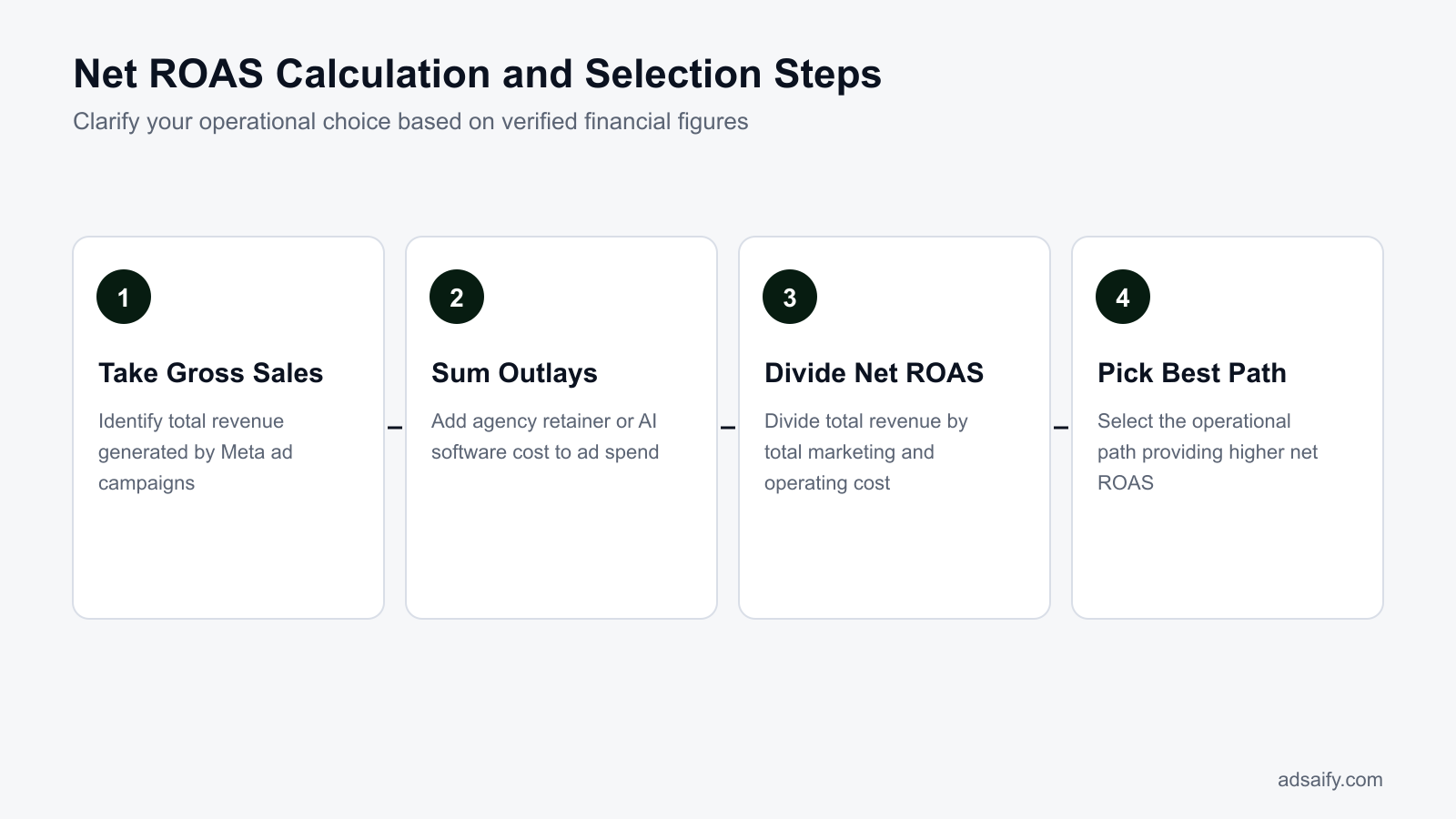
How Does a $10,000 Monthly Budget Perform Under Agency vs AI Models?
An e-commerce brand spending $10,000 monthly on Meta ads can achieve a gross ROAS (return on ad spend) of 3.0, resulting in $30,000 in revenue according to Ads Manager. Under an agency model, with a $2,000 retainer and a 10% commission based on ad spend ($1,000), the total cost rises to $13,000, which pulls the Net ROAS down to 2.30. In contrast, utilizing an AI platform incurs a flat $250 monthly fee, leading to a total outlay of $10,250 and maintaining a strong Net ROAS of 2.92. The AI setup retains an additional $2,750 in monthly cash flow, providing immediate surplus capital for new creative tests and inventory.Example of Performance Analysis for an E-Commerce Brand
Consider a hypothetical e-commerce brand, "EcoGoods," that sells eco-friendly products. EcoGoods allocates a monthly budget of $10,000 for Meta ads, achieving a gross ROAS of 3.0. In the agency model, the $2,000 retainer and $1,000 commission increase total expenditure to $13,000, resulting in a Net ROAS of 2.30 ($30,000 revenue / $13,000 spend). In contrast, when EcoGoods opts for an AI platform with a $250 fee, the total outlay becomes $10,250, allowing for a Net ROAS of 2.92 ($30,000 revenue / $10,250 spend). The AI model enables EcoGoods to keep an extra $2,750 in cash flow each month, which can be reinvested into creative testing or inventory, enhancing growth potential. This example illustrates the financial advantage of choosing an AI platform over an agency model, especially as ad spend scales.What would the financial difference look like if my monthly budget was only $2,000?
If the monthly budget were reduced to $2,000, the agency model would still incur a retainer and commission, resulting in a total spend of $2,600 and a lower Net ROAS. Conversely, with an AI platform, total spend would be $2,250, maintaining a relatively higher Net ROAS. The financial difference emphasizes the cost-effectiveness of AI platforms, especially for smaller budgets.Which KPIs Prove That Your Chosen Operational Model Accelerated ROAS?
To evaluate the effectiveness of your operational model in accelerating ROAS, several key performance indicators (KPIs) should be monitored. The Net ROAS trajectory measures the stability of your net margin as daily budgets scale. The Marketing Efficiency Ratio (MER) assesses overall business health by comparing total store revenue to total marketing outlay. Creative testing velocity indicates how many distinct visual hooks and angles are tested weekly, while stop-loss reaction speed measures how quickly underperforming ads exceeding target CPA (cost per acquisition) are paused.| KPI | Agency Model | AI Model |
|---|---|---|
| Net ROAS Trajectory | Fluctuates with fees | More stable with low fees |
| Marketing Efficiency Ratio (MER) | Higher costs decrease MER | Lower costs improve MER |
| Creative Testing Velocity | Limited by budget | Enhanced with available cash flow |
| Stop-Loss Reaction Speed | Slower due to manual oversight | Quicker with automated rules |
If my blended MER improves while Meta reported ROAS dips, which number should I trust?
In this scenario, you should trust the blended Marketing Efficiency Ratio (MER) over the reported ROAS from Meta. An improving MER indicates that your overall marketing strategy is becoming more efficient, suggesting that the return on your total marketing investment is increasing, even if specific ad campaigns show a dip in ROAS. Always consider the broader context of your marketing performance.Want to see this in your own account? Enter your website address and Adsaify drafts the campaign for you. The first ad is free. Try it now or log in.
How Do You Establish a Monthly Audit Routine to Protect Net ROAS?
Establishing a monthly audit routine is critical to maintaining healthy net ROAS (return on ad spend). On the first day of each month, combine all media spend invoices, SaaS subscriptions, and agency invoices into a single audit ledger. This practice allows for a comprehensive view of your expenses and helps identify any discrepancies or areas for improvement.- Monthly: Combine media spend invoices, SaaS subscriptions, and agency invoices into a single audit ledger to ensure all costs are accounted for.
- Monthly: Calculate your management overhead ratio by dividing total management fees by total ad spend. Ensure this ratio does not exceed 10% to maintain profitability.
- Monthly: Review automated rules configured within your AI platform like Adsaify to confirm that poor-performing ads were paused and successful ads were scaled appropriately.
- Monthly: Verify the volume of new creative variations introduced to counter ad fatigue. A lack of fresh creatives can lead to diminished engagement and increased costs.
- Weekly: Check performance metrics such as CTR (click-through rate) and CPA (cost per action) to quickly identify trends and make adjustments as necessary.
- Daily: Monitor budget pacing to ensure that you are on track to spend your allocated budget effectively without overspending.
- Monthly: Assess the overall campaign performance against your KPIs (key performance indicators) to measure success and areas for improvement.
Is checking automated rules once a month sufficient for Meta's bidding algorithms?
Checking automated rules once a month may not be sufficient, as Meta's algorithms require consistent data input to optimize performance. Regularly reviewing these rules—ideally on a weekly basis—ensures that underperforming ads are paused quickly and that successful strategies are scaled effectively, thereby maintaining a healthy net ROAS.What Are the Most Common Mistakes in Choosing Between Agencies and AI?
Choosing between agencies and AI platforms can lead to costly mistakes if not approached carefully. Evaluating agency performance solely based on Meta dashboard ROAS without considering retainer deductions is one critical error that can lead to an inflated view of performance.Evaluating Agency Performance Solely on Meta Dashboard ROAS
Relying only on Meta dashboard ROAS ignores the significant costs associated with agency retainers. This oversight can result in a misleading understanding of actual profitability. To fix this, always calculate net ROAS by subtracting agency fees from gross revenue before making decisions.Expecting AI Platforms to Produce Studio Videos Autonomously
Assuming that AI platforms can autonomously create high-quality video content without any original assets can halt scaling efforts. AI tools like Adsaify can assist in generating creatives, but they require input. To fix this, provide original videos or images to enhance the effectiveness of the AI-generated content.Neglecting Weekly Metrics
Handing total unchecked control to an external agency while neglecting weekly metrics can lead to wasted ad spend. Agencies may not always prioritize your goals. Regularly review performance metrics weekly to ensure alignment with your objectives, allowing for timely adjustments.Setting AI Automation Rule Triggers Too Tightly
Setting automation rule triggers too strictly can frequently reset Meta's learning phase, leading to higher CPA (cost per action). This disrupts the optimization process. To fix this, use broader triggers that allow the algorithm to learn effectively without constant resets.Failing to Align Goals with Agency Objectives
Not aligning your business goals with the agency's objectives can create a disconnect, leading to suboptimal performance. Regularly communicate your goals and expectations to ensure both parties are on the same page.Overlooking the Importance of A/B Testing
Neglecting to perform A/B testing can prevent you from discovering the most effective ad creatives and targeting strategies. Implement structured A/B tests to continuously refine and optimize campaign performance.Ignoring the Need for Regular Communication
Failing to maintain regular communication with your agency or AI platform can lead to misunderstandings and misaligned strategies. Schedule regular check-ins to discuss performance and strategy adjustments.How can automation rules be set up without resetting Meta's learning phase?
To set up automation rules without resetting Meta's learning phase, avoid making frequent changes to the same ad set. Instead, establish rules based on performance metrics that allow gradual adjustments, ensuring that the algorithm retains its learning and optimizes effectively over time.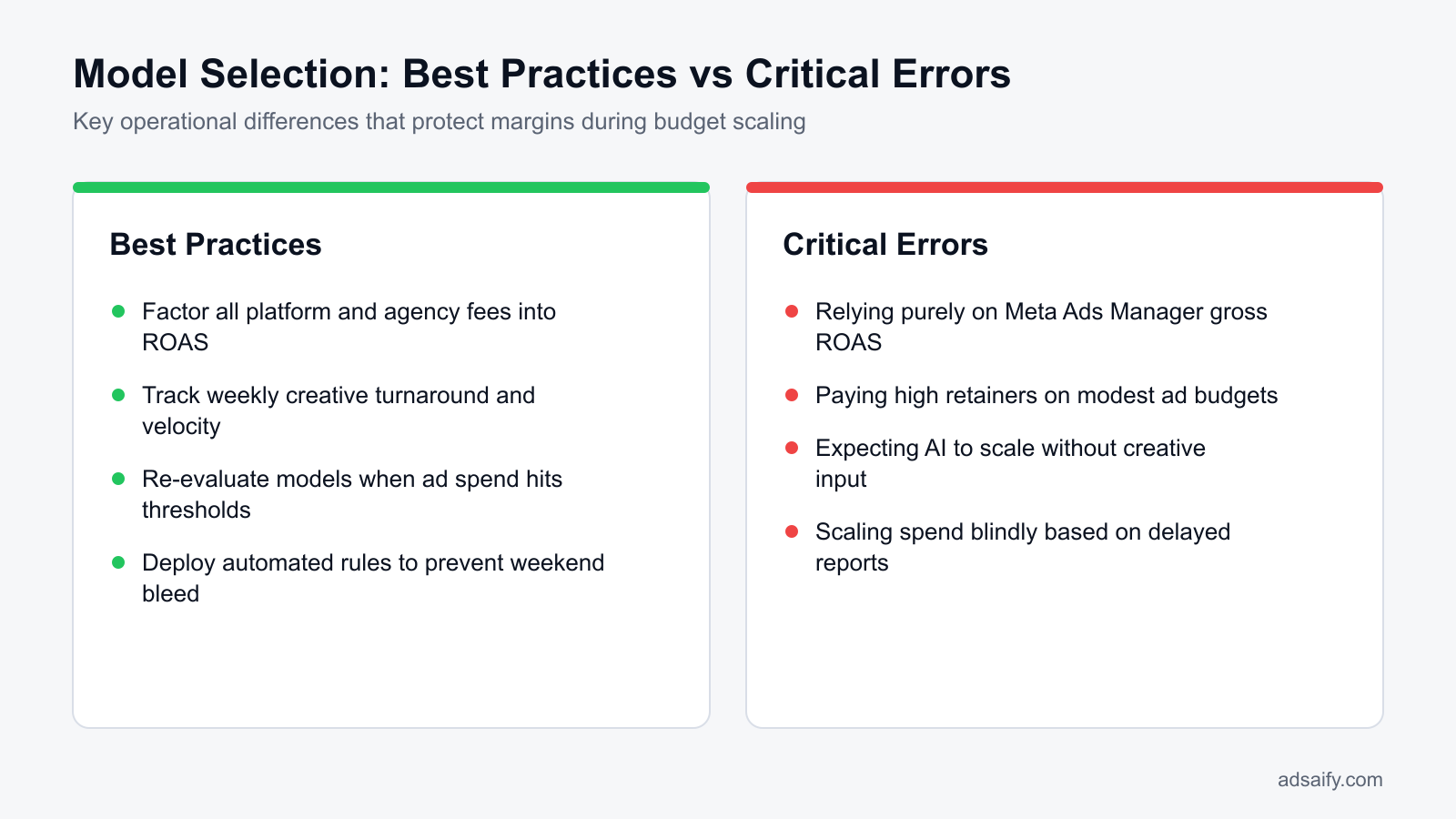
In Which Scenarios Can an AI Platform Not Replace a Dedicated Agency?
An AI platform like Adsaify cannot replace a dedicated agency in specific scenarios, particularly those requiring high-touch, personalized service or intricate production capabilities. For instance, luxury brands often need on-location lifestyle filming, professional models, and bespoke video direction that AI tools cannot provide. Furthermore, businesses without validated product-market fit need foundational market positioning research, which is beyond automated capabilities.Luxury Brand Production Needs
Luxury brands often require specialized production elements that necessitate an agency's creative expertise. This includes hiring professional models, securing high-end filming locations, and engaging experienced directors for bespoke video content. For example, a luxury fashion brand may need a commercial showcasing its latest collection shot in a glamorous setting, which involves logistics and artistic direction that an AI tool cannot manage. Such projects demand human creativity and intuition, making an agency indispensable.Foundational Market Positioning
Businesses that have not yet validated their product-market fit often require in-depth market positioning research before launching automated ad campaigns. An AI platform like Adsaify can generate campaigns, but without understanding the target audience's desires and pain points, the campaigns may miss the mark. Conducting qualitative and quantitative research is crucial for these businesses to establish their value proposition and messaging. An agency can provide the necessary insights and strategic guidance to ensure that the automated campaigns resonate with potential customers.Asset Management and Strategy Assessment
Organizations lacking internal staff to manage new assets and evaluate strategic direction should consider retaining a full-service agency. While Adsaify can generate campaigns and ad copy, it does not handle the ongoing needs for fresh creative assets or strategic pivots based on campaign performance. Teams need time to upload new images, videos, or copy and assess how well the current strategy is performing. An agency can offer the comprehensive support needed to adapt and optimize campaigns effectively.- Assess production requirements for high-end content.
- Evaluate existing product-market fit through research.
- Determine internal resources for asset management.
- Identify the need for strategic direction and consultation.
- Consider the complexity of campaign execution.
- Analyze the level of creative expertise required.
Does it make sense to pair an AI media buying tool with freelance creative designers?
Yes, pairing an AI media buying tool with freelance creative designers can be a smart strategy. While the AI can automate campaign management, freelance designers can provide the tailored creative assets necessary for effective marketing. This combination allows businesses to leverage the efficiency of AI while still benefiting from human creativity and expertise in producing compelling visuals and messaging.What Are the Essential Terms in Media Buying and Performance Marketing?
Understanding essential terms in media buying and performance marketing is crucial for any marketer. Gross ROAS (return on ad spend) is calculated by dividing attributed revenue solely by the direct ad spend reported inside Meta Ads Manager. In contrast, Net ROAS is attributed revenue divided by the sum of direct ad spend plus all management retainers and software subscription costs. A retainer is a fixed monthly fee paid to a marketing agency, regardless of ad spend volume or direct campaign performance. The Marketing Efficiency Ratio (MER) is another vital metric, calculated by dividing total business revenue by total cumulative marketing expenditures. Adsaify is an AI tool that analyzes your website to generate audience targeting, ad copy, and campaign drafts published directly to your Meta ad account; your first ad is free to try (sign up).- Gross ROAS: Attributed revenue divided solely by the direct ad spend reported inside Meta Ads Manager.
- Net ROAS: Attributed revenue divided by the sum of direct ad spend plus all management retainers and software subscription costs.
- Retainer: A fixed monthly fee paid to a marketing agency regardless of ad spend volume or direct campaign performance.
- MER (Marketing Efficiency Ratio): Total business revenue divided by total cumulative marketing expenditures.
- Attribution: The process of identifying which ads or marketing channels led to a conversion.
- CPM (Cost Per Mille): The cost of 1,000 ad impressions on a given platform.
- CPC (Cost Per Click): The amount paid for each click on an ad.
- CTR (Click-Through Rate): The percentage of people who click on an ad after seeing it.
- Conversion Rate: The percentage of users who complete a desired action after clicking on an ad.
- Audience Targeting: The practice of defining specific demographics, interests, and behaviors to reach the desired audience.
- Ad Spend: The total amount of money allocated to a particular advertising campaign.
- Creative Assets: The visual and textual elements used in an ad, such as images, videos, and copy.
Do these financial terms apply equally to B2B lead generation campaigns?
Yes, these financial terms apply equally to B2B lead generation campaigns. While the context may differ, the principles of measuring return on ad spend, understanding costs, and evaluating performance metrics remain consistent across both B2B and B2C environments. Effective management of these terms can enhance the efficiency of lead generation efforts.How to Choose the Optimal Scaling Model for Speed and Net Profit
To measure net ROAS differences between agencies and AI platforms, analyze your current ROAS, evaluate the performance of both options, and compare the results. Start by collecting data on your existing campaigns and setting up an AI platform, like Adsaify, to draft new ad campaigns for comparison. Today, you can register for Adsaify and test the platform's capabilities with your ad campaigns.
Want to see this in your own account? Enter your website address and Adsaify drafts the campaign for you. The first ad is free. Try it now or log in.
Frequently Asked Questions (FAQ)
1. Does switching from an agency to an AI platform immediately increase ROAS?
Switching from an agency to an AI platform does not guarantee an immediate increase in ROAS (return on ad spend). The effectiveness of the switch depends on factors such as the quality of the AI platform, the strategies employed, and how well the campaigns are optimized post-transition.
2. Can AI media buying platforms produce ad creatives completely autonomously?
AI media buying platforms can assist in generating ad creatives, but they do not do so completely autonomously. Users typically need to provide input, such as brand guidelines and content preferences, before the AI generates suitable ads.
3. At what monthly advertising budget does hiring a full-service agency make sense?
Hiring a full-service agency generally makes sense for businesses with a monthly advertising budget exceeding 5,000 TL. At this budget level, the expertise and resources of an agency can significantly enhance campaign performance and justify the associated costs.
4. Do third-party AI platforms conflict with Meta's native Advantage+ campaign features?
Third-party AI platforms do not inherently conflict with Meta's native Advantage+ campaign features. However, users should ensure that the strategies employed by both align to maximize effectiveness and avoid overlap in campaign management.
5. Do performance marketing agencies utilize similar AI tools for campaign management?
Yes, performance marketing agencies often utilize similar AI tools for campaign management. These tools help automate tasks, analyze data, and optimize campaigns, allowing agencies to focus on strategy and creative aspects while leveraging AI for efficiency.
6. How should product return rates be factored into the Net ROAS formula?
Product return rates should be factored into the Net ROAS formula by adjusting the total revenue generated from sales. For accurate calculations, subtract the value of returned products from total revenue before dividing by the advertising spend to get a true reflection of profitability.
7. How much daily time is required to manage campaigns using an AI buying platform?
Managing campaigns using an AI buying platform typically requires around 1 to 2 hours daily. This time includes setting up campaigns, monitoring performance, and making adjustments based on automation rules and insights provided by the platform.
8. Is paying both an agency retainer and an AI software subscription a waste of budget?
Paying both an agency retainer and an AI software subscription may not be a waste of budget if both provide distinct value. Combining the strategic insights of an agency with the efficiency of an AI platform can enhance overall campaign performance, depending on the business's specific needs.
How can you try this with Adsaify?
The quickest way to apply the steps in this article to your own account is to try them. Adsaify analyses your business from your website address, drafts the campaign with an audience, ad copy, creative and a budget suggestion, and publishes it to your own Meta ad account once you approve.
- Your first ad is free: there is nothing to lose by trying.
- Your own ad account: the campaign runs in your Meta account and you stay in control.
- Images and video: generate ad creatives with AI or promote an existing Instagram post.
Create a free account and try your first ad · Already have an account? Log in.