Short answer: To stop high return rates in e-commerce ads, you should clearly define your target audience, clarify product descriptions, and optimize the return process.
High return rates can be a significant pain point for e-commerce businesses leveraging Meta ads. You may have experienced the frustration of seeing a surge in returns shortly after launching a new ad campaign. This not only disrupts your inventory and logistics but also strains your profit margins, making it challenging to sustain growth and scale your advertising efforts effectively. High return rates often occur due to mismatches between customer expectations and the actual product experience. Factors such as misleading ad copies, poor product quality, or inadequate customer education can lead to dissatisfaction, prompting customers to return items. Ignoring this issue can be costly; it can lead to wasted advertising spend, eroded customer trust, and ultimately, a detrimental impact on your brand's reputation. In this article, you will learn how to effectively address and reduce high return rates when scaling your Meta ads. We will cover how to recognize high return rates, diagnose their causes, and prepare for implementing fixes. Furthermore, you will discover actionable steps to stop high return rates, measure the effectiveness of your solutions, and prevent future occurrences, ensuring that your advertising efforts yield the best possible returns.Key Takeaways
- Conduct audience analysis to reach the right customer segment.
- Make product descriptions clear and detailed.
- Ease the return process to enhance customer satisfaction.
- Use better visuals and video content to manage customer expectations.
What are high return rates and how to recognize them?
High return rates refer to a situation where a significant percentage of products sold are returned by customers. This metric is crucial for e-commerce businesses, as high return rates can erode profit margins and indicate underlying issues with product satisfaction. To effectively track return rates, businesses should utilize analytics tools available in Meta Ads Manager or other e-commerce platforms, which provide insights into sales and return data. Recognizing high return rates early allows businesses to address customer dissatisfaction promptly.Understanding Return Rates
Return rates are typically calculated by dividing the number of returned items by the total number of items sold, then multiplying by 100 to get a percentage. For instance, if an online fashion retailer sells 1,000 dresses in a month and 150 of those are returned, the return rate would be 15%. This is considered high, as return rates above 10% are usually flagged for investigation. Tools like Google Analytics or Meta's built-in analytics can help track these metrics, providing a clearer picture of customer behavior and satisfaction.Example of Tracking Return Rates
Consider an online electronics store with a daily advertising budget of 1,000 TL. After launching a new campaign targeting young adults, they notice a spike in returns, with 200 out of 1,000 gadgets sold being returned within the first month. The return rate of 20% indicates a problem. Upon analyzing customer feedback, they realize the product description did not accurately reflect the gadget's capabilities. After adjusting the ad copy and product description to clarify features, they monitor return rates over the following month. This adjustment, combined with targeted analytics, reveals a decrease in return rates to 8%, indicating improved customer satisfaction.How do I know if I have high return rates?
To determine if you have high return rates, regularly calculate the return percentage for your products using sales data from your e-commerce platform. A return rate exceeding 10% generally signals a need for investigation into customer feedback, product quality, and marketing strategies. Utilize analytics tools to track these metrics consistently.Why do high return rates occur?
High return rates can occur for several reasons, primarily involving mismatches between customer expectations and product offerings. One common cause is selecting the wrong target audience, which can lead to unmet expectations regarding the product. When customers receive items that do not meet their needs or desires, they are more likely to return them. Another significant factor is incomplete or misleading product descriptions that fail to provide accurate information, causing disappointment upon delivery. Lastly, poor product quality can lead to dissatisfaction, prompting customers to return items that do not meet their standards.Factors Leading to High Return Rates
The following table compares various factors contributing to high return rates in e-commerce:| Factor | Symptoms | Possible Solutions |
|---|---|---|
| Wrong Target Audience | High returns from mismatched demographics | Refine audience targeting in campaigns |
| Incomplete Product Descriptions | Frequent returns due to unmet expectations | Enhance descriptions with detailed features |
| Poor Product Quality | Negative reviews and high return rates | Implement quality checks and improvements |
| Inadequate Customer Support | Increased returns from unresolved issues | Enhance support channels and responsiveness |
| Mismatch in Pricing | Frequent returns after price drops | Review pricing strategy and communicate changes |
Why are so many products being returned?
Products are often returned due to a combination of factors such as mismatched expectations, misleading product descriptions, and poor quality. When customers feel that their needs are not met, or when a product fails to perform as advertised, they are likely to initiate returns. Regularly reviewing customer feedback and product performance can help identify these issues early.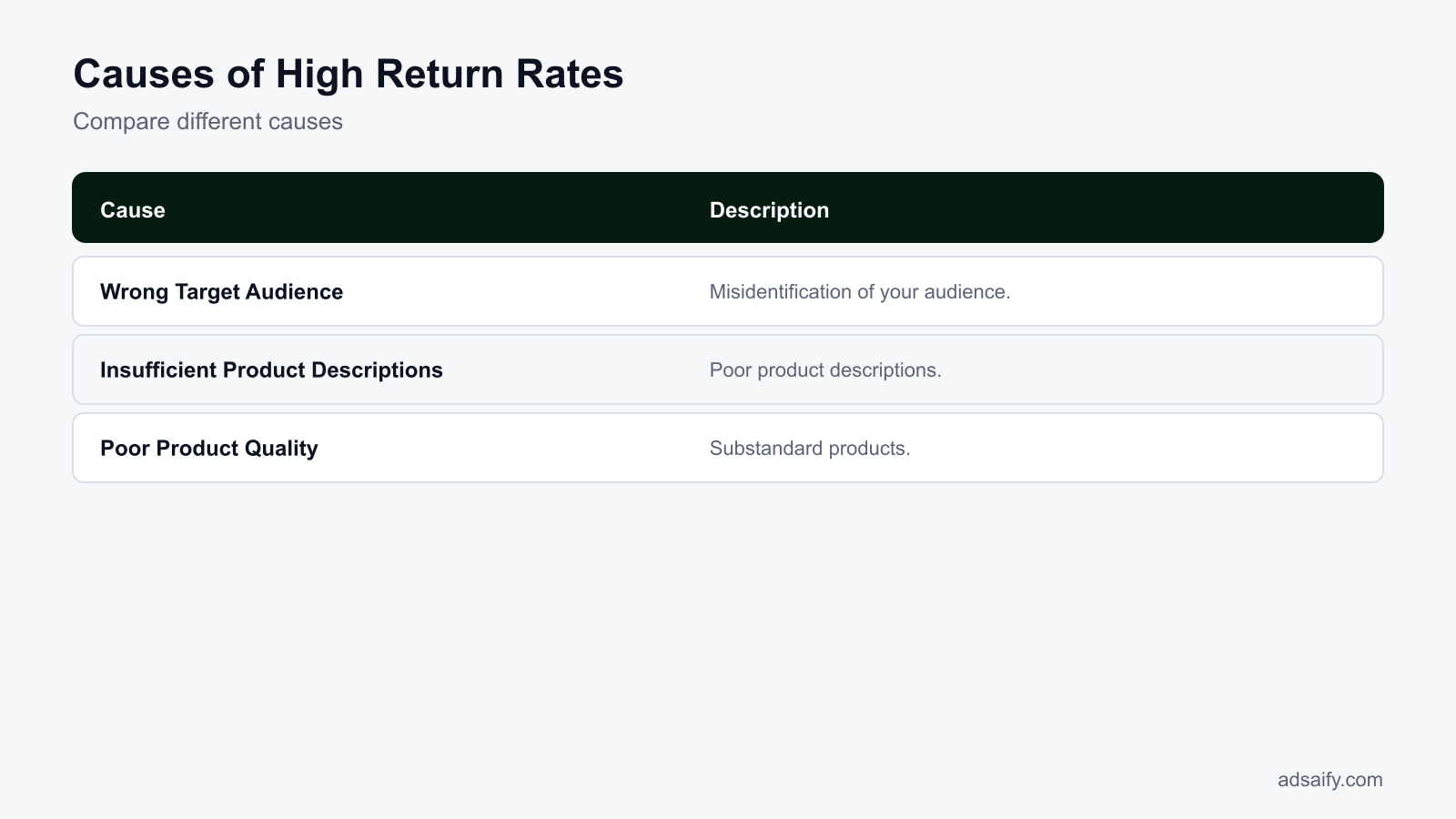
What is the cost of high return rates and what happens if ignored?
High return rates can severely impact your profit margins, leading to reduced revenue and increased expenses. Each return not only reflects lost sales but also incurs additional costs such as shipping, restocking, and handling. Furthermore, the labor associated with processing returns can strain resources, and high return rates may erode customer loyalty, resulting in long-term negative effects on brand reputation.Impact on Profit Margins
High return rates directly diminish profit margins as they represent sales that do not convert into profit. For instance, if a business sells a product for $100, but has a 30% return rate, it effectively loses $30 for every $100 in revenue. This loss compounds if the business cannot recoup the costs associated with the returned items, such as shipping fees and restocking charges. It’s crucial to monitor the Return on Ad Spend (ROAS) to ensure that the cost of acquiring customers does not outweigh the revenue generated from sales.Additional Costs and Labor
Processing returns involves various costs, including shipping fees for the return, labor costs for handling the return, and potential discounts or refunds issued. Each return can consume significant time and resources, diverting attention from customer acquisition and retention strategies. For instance, if your business processes 100 returns in a month, and each return costs an average of $15 in labor and shipping, that totals $1,500 in additional costs that could have been used for marketing or product development.Risk of Losing Customer Loyalty
High return rates can lead to customer dissatisfaction, causing consumers to seek alternatives. If customers frequently encounter issues with product quality, sizing, or misrepresentation, they may choose to abandon your brand altogether. This risk is particularly pronounced in competitive markets where customers have numerous options. Maintaining a positive customer experience is essential to fostering loyalty and repeat business.- Analyze your return rate data regularly.
- Calculate the financial impact of returns on your margins.
- Assess the labor costs associated with processing returns.
- Gather customer feedback on return experiences.
- Monitor customer retention rates after returns.
- Evaluate product quality and descriptions.
- Implement strategies to reduce return rates.
- Review your shipping policies for potential improvements.
What do I lose if my return rates are high?
If your return rates are high, you risk losing substantial profit margins, incurring additional operational costs, and damaging customer loyalty. High returns can lead to a negative perception of your brand, making it difficult to attract and retain customers in a competitive landscape, ultimately jeopardizing your long-term business success.How to diagnose the causes of high return rates?
Diagnosing the causes of high return rates requires a systematic approach utilizing analytics tools, customer feedback, and audience analysis. By leveraging the right metrics and insights, businesses can identify underlying issues that contribute to returns, allowing them to implement effective solutions.Utilize Analytics Tools
Use tools like Meta Ads Manager to track return rates and monitor performance metrics. Within the platform, navigate to the "Ads Reporting" section to analyze your ad performance and see how return rates correlate with different campaigns. Set up custom reports to focus on key metrics such as customer purchase behavior and return frequency. This data will help pinpoint which products have the highest return rates and may necessitate further investigation.Collect Customer Feedback
Engaging with customers post-purchase can provide invaluable insights. Send follow-up emails or surveys asking customers about their experience with the product and the return process. Use platforms like Google Forms or SurveyMonkey to create feedback forms that inquire about product quality, sizing, and overall satisfaction. Analyzing this feedback can highlight recurring issues that lead to returns.Analyze Your Target Audience
Understanding your target audience is critical in diagnosing return causes. Use audience insights available in Meta Ads Manager to assess demographics, interests, and behaviors. If your products are mismatched with the audience you are targeting, consider revising your ad targeting strategies. For example, if data shows that a large percentage of returns come from a specific age group that does not align with your product offerings, it may indicate a mismatch that needs addressing.| Diagnosis Method | Details | Tools Used | Outcome |
|---|---|---|---|
| Analytics Tracking | Monitor return rates in relation to ad performance | Meta Ads Manager | Identify high-return products |
| Customer Surveys | Gather direct feedback on products and return process | Google Forms, SurveyMonkey | Understand reasons for dissatisfaction |
| Audience Analysis | Check demographics and behaviors of returning customers | Meta Audience Insights | Reveal mismatches in targeting |
| Product Quality Assessment | Review product specifications and customer reports | Internal Quality Control | Identify quality issues |
How can I find out the reason for my return rates?
To find out the reason for high return rates, combine data from analytics tools, customer feedback, and audience analysis. By systematically reviewing these sources, you can pinpoint specific issues related to product quality, customer expectations, or mismatched targeting, enabling you to devise effective strategies for reducing returns and enhancing customer satisfaction.If you would rather not set up each of these steps by hand, try it in Adsaify: your first ad is free, so there is nothing to lose. Create a free account.
What should I prepare and check before applying the fix?
Before applying a fix to high return rates, it's essential to prepare by reviewing product descriptions, updating audience data, and optimizing the return process. These steps ensure that your advertising strategy aligns with customer expectations, enhances targeting accuracy, and improves overall satisfaction with your products.Review your current product descriptions
Begin by examining your product descriptions for clarity and accuracy. Ensure that each description includes essential details, such as size, color, material, and usage instructions. Misleading or vague descriptions often lead to customer dissatisfaction and increased returns. Use the Meta Ads Manager to analyze which products have higher return rates, and then adjust their descriptions accordingly to better reflect the actual product experience.Update your audience data
Next, refresh your audience data to ensure your ads reach the most relevant customers. Use Meta's Audience Insights tool to analyze demographics, interests, and behaviors of your target audience. Identify any shifts in customer preferences or new trends that may affect your campaigns. Adjust your targeting settings in the Ads Manager to focus on audiences more likely to convert, reducing the chances of returns due to mismatched expectations.Evaluate and optimize your return process
Finally, assess your return process to streamline and enhance customer satisfaction. An overly complicated return process can frustrate customers, leading to negative experiences and increased returns. Consider simplifying return policies and clearly communicating them on your website and within your ads. Additionally, gather feedback from customers who have returned products to understand their reasons and make necessary improvements.- Review product descriptions for accuracy.
- Update audience targeting based on recent data.
- Evaluate the return process for clarity and ease.
- Gather customer feedback on returned items.
- Analyze return rates in Meta Ads Manager.
- Adjust advertising strategies based on insights.
What data should I review?
Review product return rates, customer feedback on specific items, audience engagement metrics from Meta Ads Manager, and the effectiveness of your current ad targeting. Analyzing this data will help identify patterns and areas for improvement, ultimately reducing return rates and enhancing customer satisfaction.What are the steps to stop high return rates?
To stop high return rates, follow a structured approach that involves clearly defining your target audience, detailing product descriptions, and easing the return process. These steps work together to align customer expectations with their actual experiences, thereby reducing the likelihood of returns.Clearly define your target audience
Start by refining your target audience based on demographics, interests, and purchasing behavior. Use the audience segmentation tools in Meta Ads Manager to create specific segments that resonate with your product offerings. This targeted approach increases the likelihood of attracting customers who are genuinely interested in your products and reduces the chances of returns.Detail and clarify product descriptions
Ensure that your product descriptions are comprehensive and precise. Include all relevant details, such as dimensions, materials, and care instructions. Use high-quality images and videos in your ads to showcase products effectively. The more information customers have, the less likely they are to return items due to unmet expectations.Easing the return process and enhancing customer satisfaction
Streamline your return process to make it hassle-free for customers. Clearly outline return policies on your website and in your ads. Implement user-friendly return labels and instructions. Offering exchanges or store credit can also encourage customers to keep products instead of returning them.- Define Target Audience — Identify the most relevant customer segments for your products.
- Detail Product Descriptions — Ensure all product information is accurate and comprehensive.
- Enhance Visuals — Use high-quality images and videos to showcase your products.
- Streamline Return Process — Make returns easy with clear policies and user-friendly instructions.
- Gather Customer Feedback — Collect insights from customers regarding their return experiences.
- Implement Changes — Make necessary adjustments based on feedback and data analysis.
What steps should I follow?
Follow these steps: define your target audience using Meta's segmentation tools, detail product descriptions with accurate information, enhance visuals with quality images, streamline the return process for ease of use, gather customer feedback, and implement changes based on insights. This structured approach will help reduce return rates effectively.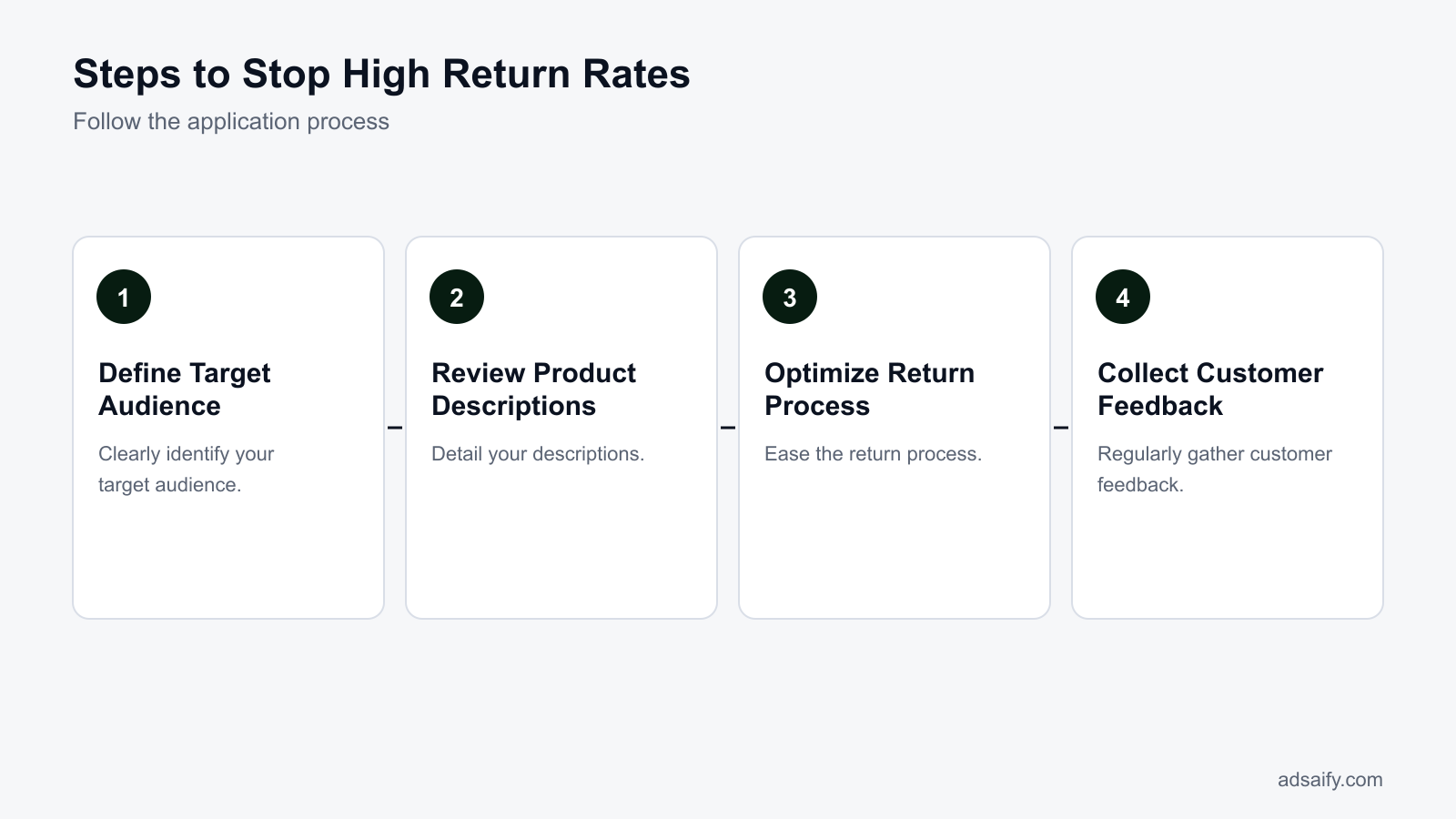
How can I apply the process with a detailed example?
To effectively apply the process of reducing high return rates, start by preparing a detailed example product description, analyzing your target audience, and creating a scenario that evaluates the return process. This structured approach will provide clarity on the steps needed to implement changes.Example Product Description
Consider a fictional online store called "EcoGadgets" that sells sustainable kitchen products. One of their popular items is a biodegradable kitchen sponge. The product description highlights features such as eco-friendliness, durability, and effectiveness in cleaning. It includes high-quality images and customer testimonials to enhance credibility. The price is set at 50 TL, and they offer free shipping on orders over 200 TL.Review Data Related to Your Target Audience
Next, access Meta Ads Manager to identify the target audience. Navigate to the "Audience Insights" section. For EcoGadgets, the target demographic may include environmentally conscious individuals aged 25-45, who are interested in sustainability, home improvement, and eco-friendly products. Use filters such as geographical location, interests, and purchase behavior to refine the audience. Analyze past ad performance metrics, such as click-through rates (CTR) and conversion rates, to understand what resonates with this audience.Create a Scenario by Evaluating the Return Process
Imagine EcoGadgets runs a campaign with a daily budget of 500 TL for two weeks. They notice a 30% return rate on the biodegradable sponges during this period. To evaluate the return process, they should consider the following: 1. **Customer Feedback**: Check reviews and comments on social media to identify common complaints. Are customers unhappy with the product quality? 2. **Return Reasons**: Examine the reasons for returns in the order management system. Are items returned due to defects, or do customers feel the product did not meet their expectations? 3. **Ad Targeting**: Review the audience targeting settings in the campaign. Are the ads reaching the right customers, or are they attracting individuals who might not be genuinely interested in eco-friendly products? By analyzing these areas and adjusting the campaign accordingly, EcoGadgets can work towards lowering the return rate effectively.Can I create an example scenario?
Yes, creating an example scenario involves assessing your product, audience, and return process. By applying specific metrics and analyzing data from your ad campaigns, you can simulate potential outcomes and strategize effective changes to reduce return rates.How can I measure whether the fix worked?
To determine if the implemented fixes have successfully reduced return rates, track and analyze return rates, conduct customer satisfaction surveys, and review sales data for any changes. Each of these methods provides valuable insights into customer behavior and product performance.Track and Analyze Return Rates
Utilize Meta Ads Manager to monitor your return rates over a specified period. Navigate to the “Ads Reporting” section to create a custom report that includes metrics such as return rate, conversion rate, and click-through rate (CTR). Set benchmarks based on historical data to measure improvement. For example, if your return rate was initially 30%, aim to reduce it to 15% within the next campaign cycle.Conduct Customer Satisfaction Surveys
Implement customer satisfaction surveys post-purchase to gather direct feedback. Use platforms like SurveyMonkey or Google Forms to create a simple survey that asks customers about their purchase experience, product satisfaction, and reasons for returns. Analyze the data to identify trends and areas for improvement.Review Sales Data to Evaluate Changes
Examine sales data before and after implementing the fixes. Look for changes in the total number of sales, average order value, and overall revenue. Create a comparative table to visualize the effectiveness of your adjustments.| Metric | Before Fix | After Fix | Change |
|---|---|---|---|
| Return Rate | 30% | 15% | -15% |
| Sales Volume | 100 units | 150 units | +50 units |
| Average Order Value | 200 TL | 250 TL | +50 TL |
| Total Revenue | 20,000 TL | 37,500 TL | +17,500 TL |
How can I measure success?
Measuring success involves analyzing return rates, customer feedback, and sales data. By comparing these metrics before and after implementing fixes, you can assess the effectiveness of your strategies and make informed adjustments for future campaigns.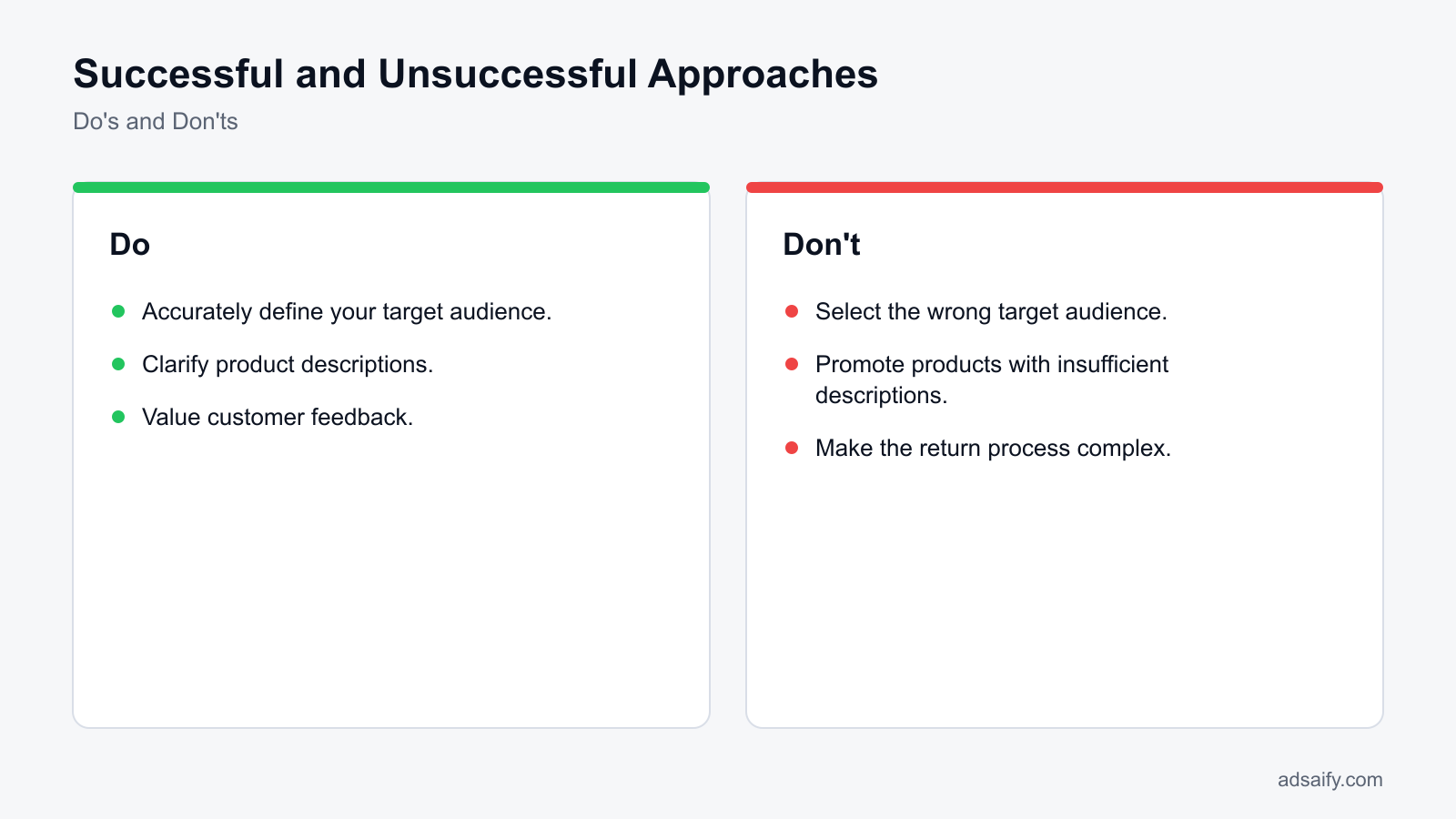
Want to see this in your own account? Enter your website address and Adsaify drafts the campaign for you. The first ad is free. Try it now or log in.
How can I prevent this problem from recurring?
Regularly preventing high return rates involves implementing a structured routine to monitor performance and gather insights. By conducting analyses, gathering customer feedback, and reviewing your target audience, you can adapt your approach to mitigate future issues effectively.- Daily: Check ad performance metrics in Meta Ads Manager. Look for trends in click-through rates (CTR) and conversion rates to identify any immediate issues.
- Daily: Monitor customer feedback on social media and review platforms. Quick responses to complaints can prevent returns and improve customer satisfaction.
- Weekly: Analyze the return rates of individual products. Understanding which items are returned frequently can lead to necessary adjustments in marketing or product descriptions.
- Weekly: Review audience insights in Meta Ads Manager. Ensure that your ads are reaching the intended demographic and adjust targeting settings if necessary.
- Monthly: Update product descriptions based on customer feedback. Clear and comprehensive descriptions can reduce misunderstandings that lead to returns.
- Monthly: Conduct a competitive analysis of similar products. Understanding how competitors present their products can inspire improvements in your own listings.
- Quarterly: Reassess your overall marketing strategy. Evaluate the effectiveness of your ads and make adjustments based on performance data and market trends.
- Quarterly: Hold team meetings to discuss recurring issues. Collaborating with your team can help identify blind spots and foster innovative solutions.
What should I do to prevent this issue from recurring?
To prevent high return rates, establish a routine of daily performance checks, weekly audience reviews, and monthly updates to product descriptions. Regularly analyze customer feedback and conduct competitive assessments to ensure your marketing strategies remain effective and relevant. This proactive approach will help you adapt to changing market conditions and customer expectations.What are the most common mistakes and how to fix them?
High return rates can often be traced back to specific mistakes in marketing and customer engagement. Recognizing these errors and implementing corrective actions is essential for long-term success.Misidentifying the target audience
Targeting the wrong audience can lead to increased returns, as customers may purchase products that do not meet their needs. To fix this, refine your audience targeting in Meta Ads Manager by analyzing the demographics, interests, and behaviors of your existing customers. Use the “Audience Insights” tool to gather data and adjust your ad targeting accordingly.Insufficient product descriptions
Vague or incomplete product descriptions can cause confusion, leading customers to return items that do not match their expectations. Ensure your product descriptions are detailed and informative, highlighting key features and benefits. Use bullet points for clarity and include high-quality images to provide a better understanding of the product.A complex return process
A cumbersome return process can frustrate customers, leading to negative experiences and increased return rates. Simplify your return policy by clearly stating the steps involved. Consider offering free returns to enhance customer satisfaction and trust. Make sure this information is easily accessible on your website and in order confirmation emails.Poor customer service
Negative interactions with customer service can result in returns and lost customers. Train your team to respond promptly and helpfully to inquiries. Implementing a live chat feature on your website can provide immediate support, improving overall customer satisfaction.Ignoring customer feedback
Failing to pay attention to customer reviews and feedback can result in repeated mistakes. Regularly analyze customer feedback to identify trends and areas for improvement. Use this information to adapt your marketing strategies and product offerings.Inconsistent branding
Inconsistent branding can confuse customers, leading to returns. Ensure that your messaging, visuals, and tone are cohesive across all platforms. Regularly review your branding materials to maintain a unified presence.Neglecting to A/B test ads
Not testing different ad creatives can limit your understanding of what resonates with your audience. Conduct A/B tests on ad copy, images, and targeting options. Use the insights gained to optimize future campaigns and reduce return rates.Failing to analyze return data
Not analyzing the reasons behind returns can prevent you from addressing core issues. Set up a system to track and categorize return reasons. Use this data to make informed decisions about product adjustments and marketing strategies.How can I fix these mistakes?
To address these common mistakes, focus on refining audience targeting, enhancing product descriptions, simplifying return processes, and improving customer service. Regularly analyze feedback and test ad performance to adapt strategies. By implementing these fixes, you can significantly reduce return rates and enhance customer satisfaction.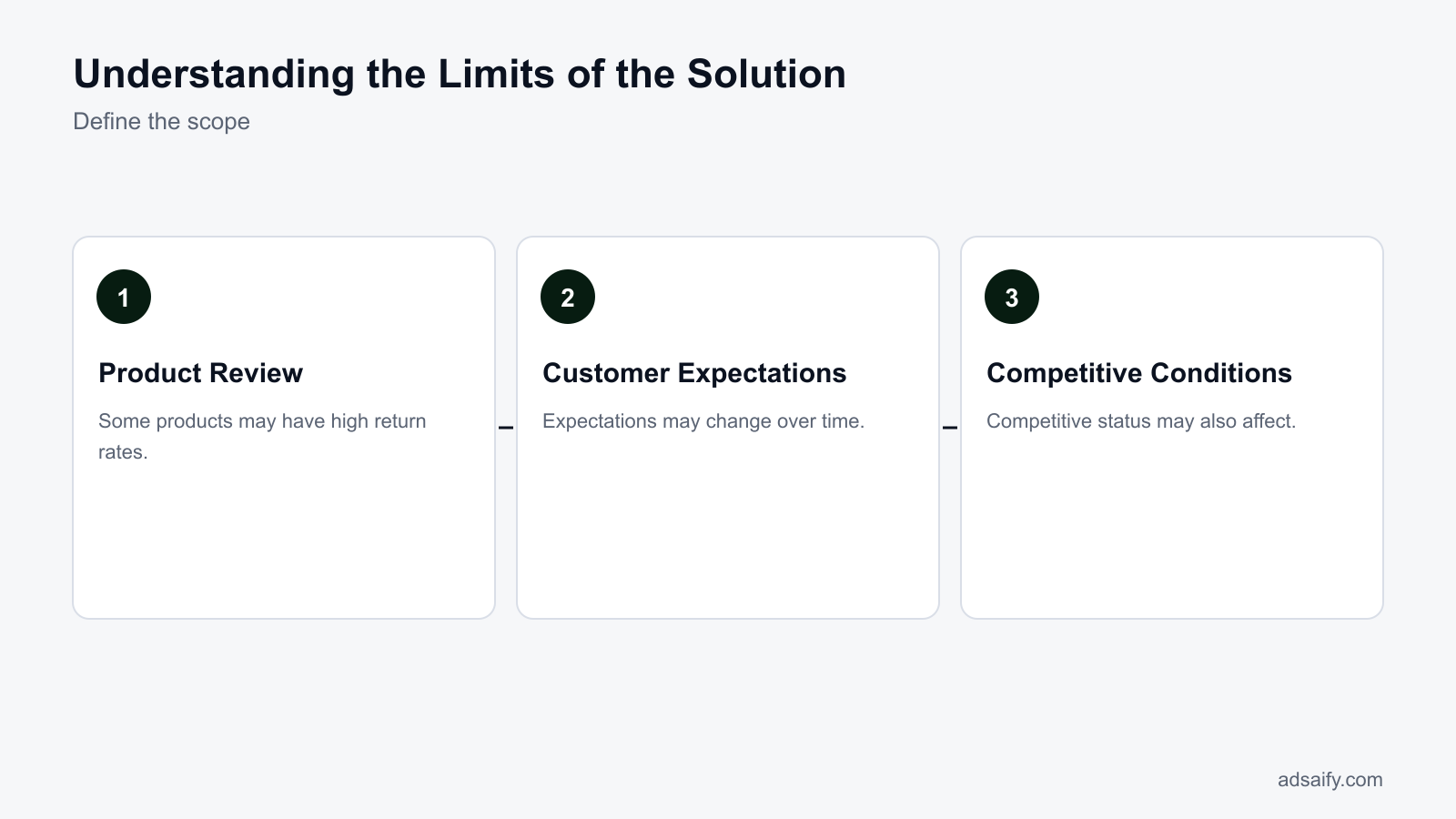
Does the solution always work? What are its limits?
Some products may inherently have high return rates due to their nature, such as clothing that may not fit as expected. Additionally, customer expectations can shift over time based on market trends and competitor offerings. Competitive conditions, such as aggressive return policies from rivals, can also influence return rates and make it challenging to implement a one-size-fits-all solution.High Return Rates by Product Type
Certain product categories naturally have higher return rates. For example, fashion items often see returns due to sizing issues or changes in style preferences. In the Meta Ads Manager, you can analyze your product categories by reviewing the "Performance" tab. Look for metrics like "Return Rate" and "Sales" to identify which products are underperforming. If you notice that a specific product category consistently shows high return rates, it may indicate that the product itself is not suitable for scaling.Changing Customer Expectations
Customer expectations can evolve based on various factors, including marketing trends and reviews. For example, if a competitor introduces a new feature that customers find appealing, your existing products may no longer meet their expectations. Regularly monitor customer feedback through surveys or social media engagement to stay informed. Use the "Audience Insights" feature in Meta Ads Manager to gather demographic data and preferences, adjusting your campaigns accordingly.Competitive Conditions and Market Dynamics
The competitive landscape can significantly affect return rates. If competitors offer more lenient return policies, customers may feel encouraged to return items. To assess your competitive stance, utilize the "Ad Library" feature in Meta Ads Manager to analyze competitor ads and their messaging. Ensure your return policy is competitive and clearly communicated in your ads, as this can help manage customer expectations and reduce return rates.- Analyze product categories for return rates.
- Monitor customer feedback regularly.
- Adjust campaigns based on audience insights.
- Review competitor ads in the Ad Library.
- Ensure return policies are competitive.
Is this solution valid in every case?
This solution is not universally applicable, as high return rates can stem from various factors beyond ad performance. Product type, customer expectations, and market competition all play crucial roles. Thus, while the strategies may help reduce return rates, they must be tailored to specific circumstances.What key terms are used in this article?
Return rate refers to the percentage of sales that are returned by customers. Understanding key terms is essential for effectively managing and optimizing Meta ads, as these terms provide clarity on performance metrics and marketing strategies.- Return Rate: The percentage of sales that are returned.
- Target Audience: The group of customers expected to buy your product.
- Customer Satisfaction: The level of contentment a customer feels with a product and service.
- ROAS (Return on Ad Spend): A metric that measures the revenue generated for every dollar spent on advertising.
- Ad Creative: The visual and textual content used in an advertisement.
- Performance Metrics: Data points used to evaluate the effectiveness of advertising campaigns.
- Conversion Rate: The percentage of users who take a desired action after interacting with an ad.
- Audience Insights: Data that provides information about the demographics and interests of your target audience.
- Ad Library: A Meta tool that allows users to view active ads from any advertiser.
- Competitive Analysis: The assessment of competitors' strategies and performance in the market.
- Automation Rules: Predefined settings in Meta Ads Manager that trigger specific actions based on ad performance.
- Market Trends: Patterns and shifts in consumer preferences and behaviors over time.
What do these terms mean?
Understanding these key terms is crucial for anyone involved in performance marketing. Each term provides insight into different aspects of advertising and customer engagement, enabling marketers to make informed decisions and optimize their campaigns effectively.Conclusion
To effectively reduce high return rates when scaling Meta ads, start by measuring return rates and analyzing your audience. Use analytics tools to refine product descriptions and enhance customer satisfaction, while optimizing the return process. A concrete step you can take today is to implement an audience analysis using Adsaify to better target your ads.
Want to see this in your own account? Enter your website address and Adsaify drafts the campaign for you. The first ad is free. Try it now or log in.
Frequently Asked Questions (FAQ)
1. What is a high return rate?
A high return rate occurs when a significant percentage of purchased products are returned by customers. Typically, return rates above 20% are considered high, indicating potential issues with product quality, descriptions, or customer expectations.
2. How do I measure return rates?
To measure return rates, divide the total number of returned items by the total number of items sold, then multiply by 100. For example, if 50 out of 500 items sold are returned, the return rate would be 10%, calculated as (50/500) x 100.
3. Why is audience analysis important?
Audience analysis is crucial because it helps identify the specific demographics and behaviors of your target customers. Understanding your audience allows you to tailor ads and product offerings to meet their needs, thereby reducing return rates and increasing customer satisfaction.
4. What analytics tools should I use?
Utilize tools like Google Analytics and Facebook Insights to gain insights into customer behavior and ad performance. These tools provide valuable data on demographics, engagement, and conversion rates, enabling you to make informed decisions for your campaigns.
5. How can I improve product descriptions?
To improve product descriptions, focus on clarity and detail. Include key features, specifications, and benefits while using high-quality images. Use customer feedback to identify common questions and concerns, addressing these directly in the descriptions to set accurate expectations.
6. How can I enhance customer satisfaction?
Enhancing customer satisfaction can be achieved by providing excellent customer service, ensuring product quality, and maintaining clear communication. Implementing feedback mechanisms, such as surveys, can help identify areas for improvement and foster a positive shopping experience.
7. How can I optimize the return process?
To optimize the return process, simplify return instructions and ensure they are easily accessible. Offer prepaid return labels and clear timelines for refunds. Streamlining the process can make it less frustrating for customers, potentially reducing overall return rates.
8. How can I reduce high return rates?
To reduce high return rates, focus on improving product quality, enhancing descriptions, and analyzing audience data. Implementing better customer support and optimizing the return process can also help. Use Adsaify to create targeted campaigns that address these factors effectively.
How can you try this with Adsaify?
The quickest way to apply the steps in this article to your own account is to try them. Adsaify analyses your business from your website address, drafts the campaign with an audience, ad copy, creative and a budget suggestion, and publishes it to your own Meta ad account once you approve.
- Your first ad is free: there is nothing to lose by trying.
- Your own ad account: the campaign runs in your Meta account and you stay in control.
- Images and video: generate ad creatives with AI or promote an existing Instagram post.
Create a free account and try your first ad · Already have an account? Log in.