Short answer: To prevent ad fatigue with AI, utilize dynamic creatives, audience optimization, and continuous testing strategies to lower CPA.
Ad fatigue is a common challenge for marketers running Meta ad campaigns. You may have noticed that your ads, which once performed well, are now seeing declining engagement rates and increasing costs per acquisition (CPA). This issue can manifest as a drop in click-through rates (CTR), stagnation in conversions, or an overall sense of disinterest from your target audience. Recognizing these signs is crucial, as ad fatigue can significantly hinder your marketing efforts and return on investment. Ad fatigue occurs when your audience sees the same ad repeatedly, leading to diminished interest and engagement. This can result from a lack of creative variety or targeting the same audience too frequently. If left unaddressed, ad fatigue can lead to wasted ad spend and reduced return on ad spend (ROAS), ultimately affecting your overall marketing budget and campaign effectiveness. Ignoring this issue may cause your ads to become less effective over time, forcing you to spend more to achieve the same results. In this article, you will learn how to identify and address ad fatigue effectively. We will cover essential strategies for diagnosing the problem, preparing for solutions, and implementing actionable steps to refresh your campaigns. By utilizing these strategies, including dynamic creatives and audience optimization, you will be equipped to enhance your ad performance and maintain audience engagement over time.Key Takeaways
- AI reduces ad fatigue.
- Dynamic creatives and targeting are crucial.
- Continuous testing lowers CPA.
- Enhance strategies with data analysis.
What is Ad Fatigue and How to Recognize It?
Ad fatigue is the decline in audience interest in an advertisement over time. It usually manifests through low click-through rates (CTR) and rising costs per click (CPC). For instance, a local coffee shop running a Meta ad campaign with a daily budget of 300 TL may start with a CTR of 2.5%. However, after two weeks of using the same creative, the CTR could drop to 0.8%, while the CPC increases from 1.00 TL to 3.50 TL. This indicates that the audience is becoming bored with the repeated creatives, leading to diminished engagement and higher costs.How can I identify the signs of ad fatigue?
To identify signs of ad fatigue, monitor key performance indicators such as click-through rates (CTR), conversion rates, and engagement metrics. A consistent decline in these metrics over time, alongside increased costs per click (CPC), signals that your audience is losing interest in your ads. Regularly reviewing your ad performance in Meta Ads Manager can help catch these signs early.What Causes Ad Fatigue?
Using the same ad creatives repeatedly is a primary cause of ad fatigue. When audiences see the same images or messages too often, they become desensitized, leading to lower engagement. Additionally, messages that do not resonate with the audience can contribute to fatigue. If the ad content fails to connect emotionally or address audience needs, it will likely be ignored. Low engagement rates and repetitive targeting also exacerbate the issue, resulting in a lack of fresh interactions with your ads.| Cause of Ad Fatigue | Signs | Potential Solutions |
|---|---|---|
| Repeated Creatives | Declining CTR, rising CPC | Refresh creatives every 1-2 weeks |
| Irrelevant Messaging | Low engagement rates | Conduct audience research |
| Limited Targeting | Same audience seeing ads | Diversify targeting options |
| Static Formats | Low interaction | Incorporate video or carousel ads |
| Excessive Frequency | High ad fatigue rate | Limit frequency to 2-3 impressions/week |
Why is my audience getting bored of the same ads?
Your audience may be getting bored of the same ads due to repetitive exposure to unchanging creatives and messages. When ads do not evolve or resonate with their interests, viewers are likely to disengage. Additionally, if the same targeting parameters are used, the audience may feel overwhelmed or annoyed by seeing the same content repeatedly, prompting them to ignore your ads altogether.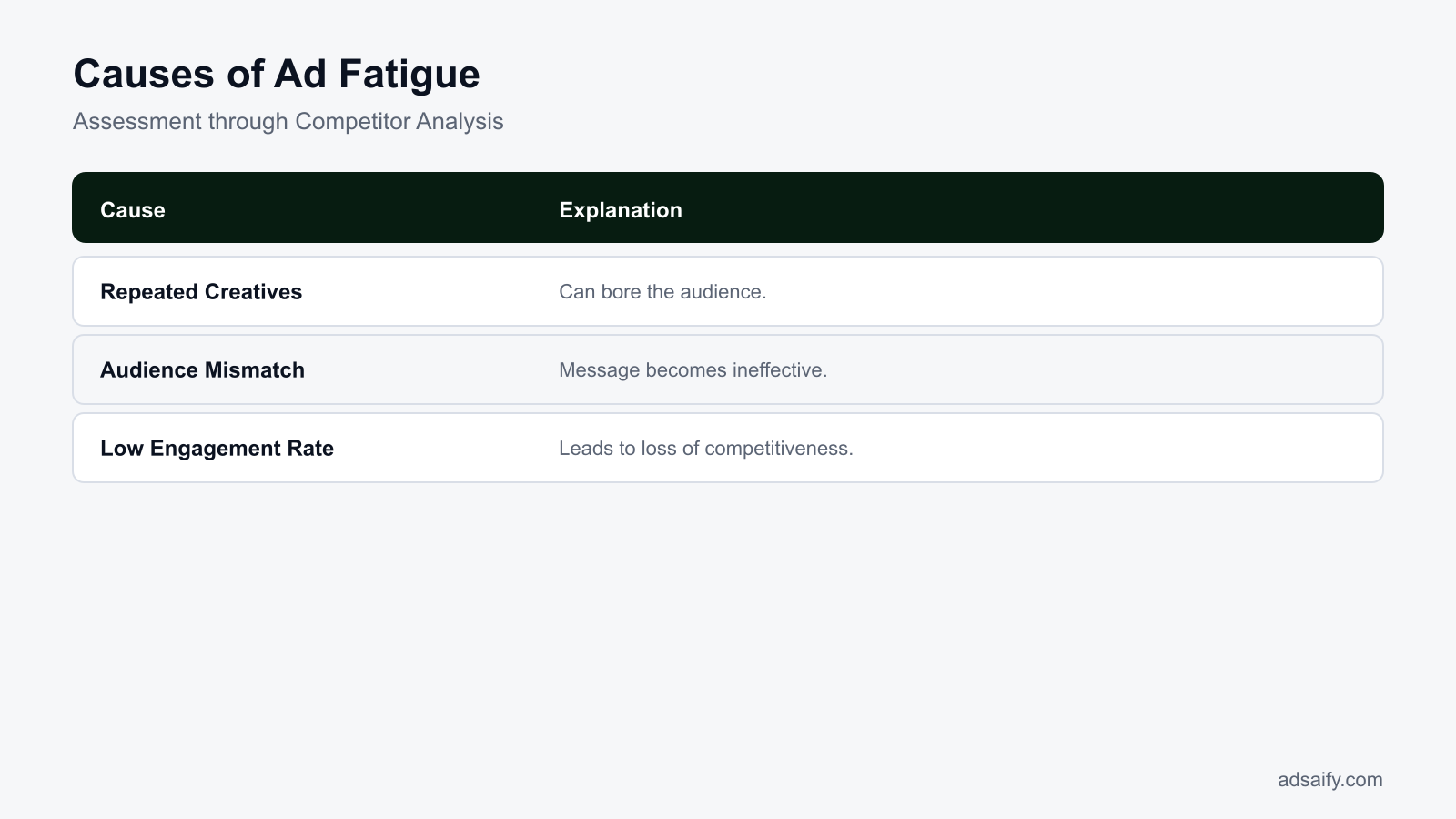
What Happens if Ad Fatigue is Ignored?
Ignoring ad fatigue can lead to a significant increase in CPA (cost per acquisition), diminishing returns on ad spend, and potential damage to brand image. Over time, audiences become less responsive to repetitive ads, which drives up costs and hampers overall campaign effectiveness. Furthermore, the long-term competitive advantage may erode as competitors adapt and innovate their advertising strategies.Increased CPA
When ad fatigue sets in, the CPA tends to rise as the same audience is targeted with the same message repeatedly. In Meta Ads Manager, you can track CPA under the "Performance" column. If you notice that your CPA is rising beyond your set benchmarks, it likely indicates that your audience is no longer engaging with your ads as they once did. For instance, if your CPA was previously 50 TL and it increases to 80 TL, this signals that your ads are losing effectiveness.Loss of Competitive Advantage
Ad fatigue can diminish your competitive edge in the market. If your ads become stale, competitors may seize the opportunity to attract your audience with fresh messaging or creative campaigns. Regularly reviewing the "Audience Insights" section in Meta Ads Manager can help you gauge how your audience is reacting compared to competitors. If you notice a drop in engagement metrics, such as click-through rates (CTR), it’s a clear sign that you need to revamp your strategy to maintain your competitive position.Negative Impact on Brand Image
Repeated exposure to the same ad can lead to a negative perception of your brand. Audiences may perceive your brand as unoriginal or out of touch. To monitor this, check the "Ad Relevance Diagnostics" in Meta Ads Manager, which includes metrics such as Quality Ranking and Engagement Rate Ranking. If these metrics are trending downwards, it may suggest that your brand is suffering from ad fatigue.- Track CPA metrics regularly.
- Review audience engagement rates weekly.
- Analyze competitor ad performance monthly.
- Refresh ad creatives every 4-6 weeks.
- Conduct surveys to gauge brand perception.
- Implement automation rules to pause poorly performing ads.
- Adjust targeting parameters based on performance data.
What consequences will I face if I ignore fatigue?
If ad fatigue is ignored, you will experience higher CPA, diminished campaign effectiveness, and potential damage to your brand's image. As audience engagement declines, your ads will perform poorly, leading to wasted budget and lost opportunities for conversion. This scenario can ultimately hinder your overall marketing goals and impede growth.How to Diagnose the Causes of Ad Fatigue?
Diagnosing the causes of ad fatigue involves conducting a competitor analysis, monitoring competing ads' performance, and analyzing your own campaign data. This process allows you to identify underlying issues that may be affecting your ad effectiveness, enabling you to make informed decisions for future campaigns.Conduct Competitor Analysis
To start, conduct a thorough competitor analysis to evaluate how your audience interacts with similar ads. Utilize tools like Facebook Ad Library to view active ads from competitors and identify their messaging and targeting strategies. Look for patterns in their engagement and adjust your approach accordingly. For instance, if a competitor's ad has a higher engagement rate, analyze their creative elements and audience targeting to determine areas for improvement in your own campaigns.Monitor Competing Ads' Performance
Monitoring the performance of competing ads can provide insights into industry trends and audience preferences. Use Meta Ads Manager to track key performance indicators (KPIs) such as CTR and conversion rates for your ads. Compare these metrics against competitors and identify any significant discrepancies. A sudden drop in your ad performance relative to competitors may indicate that your audience is fatigued.Analyze Campaign Data
Analyze your campaign data to assess performance effectively. Navigate to the “Ads Reporting” section in Meta Ads Manager and create custom reports focused on metrics like engagement, impressions, and conversions. Look for trends over time, such as a decrease in CTR or an increase in ad frequency. These indicators can help pinpoint whether ad fatigue is present and guide your strategy moving forward.| Metric | Your Campaign | Competitor A | Competitor B |
|---|---|---|---|
| CTR | 1.5% | 2.3% | 2.0% |
| CPA | 80 TL | 60 TL | 70 TL |
| Ad Frequency | 4.5 | 3.2 | 3.8 |
| Engagement Rate | 2% | 3.5% | 3.0% |
What data should I analyze?
To diagnose ad fatigue, analyze performance metrics such as CTR, CPA, engagement rates, and ad frequency. These indicators provide insights into how well your ads resonate with the audience and reveal whether they require refreshing. Regularly monitoring this data can help identify trends and inform necessary adjustments to your ad strategy.If you would rather not set up each of these steps by hand, try it in Adsaify: your first ad is free, so there is nothing to lose. Create a free account.
What Should I Prepare Before Implementing the Solution?
Before implementing a solution to prevent ad fatigue, marketers should conduct a thorough review of their current ad campaigns, define audience segments, and prepare content for dynamic creatives. This preparation ensures that the strategy is tailored to the current performance metrics and audience insights, allowing for a more effective execution of the solution.Review your current ad campaigns
Start by analyzing the performance of your existing campaigns in Meta Ads Manager. Look at key metrics like click-through rate (CTR), conversion rate, and return on ad spend (ROAS). Identify which ads are underperforming and which are still engaging your audience. Use the “Ad Performance” report to filter by date ranges and see trends over time. This will help you understand which creatives resonate with your audience and which need refreshing.Define your audience segments
Segmenting your audience allows for more precise targeting. Use the “Audience Insights” tool in Ads Manager to analyze demographic data, interests, and behaviors of your current audience. Create distinct audience groups based on these insights, such as "lookalike audiences" or "custom audiences" based on past purchasers. This data-driven approach helps ensure that your ads are reaching the most relevant users, reducing the risk of ad fatigue.Prepare content for dynamic creatives
Dynamic creatives automatically tailor ads based on user preferences and behaviors. Prepare a variety of images, videos, and ad copies that can be mixed and matched. Use the “Dynamic Creative” setting in Ads Manager to upload multiple assets. Ensure that your content is diverse and adaptable to different audience segments, which helps keep ads fresh and engaging.- Review key performance metrics from existing campaigns.
- Analyze audience demographics and behaviors.
- Create distinct audience segments in Ads Manager.
- Gather diverse images and videos for dynamic creatives.
- Write multiple variations of ad copy for testing.
- Set up tracking for new ad performance metrics.
- Schedule regular reviews of ad performance.
- Ensure compliance with Meta advertising policies.
What resources will I need?
To prepare effectively, you will need access to Meta Ads Manager, a list of your current ad creatives, analytical tools for audience insights, and assets for dynamic creatives. Additionally, having a content team or resources for creating diverse ad formats will be beneficial in ensuring your campaigns remain engaging and effective.What is the Solution to Prevent Ad Fatigue?
The solution to prevent ad fatigue involves implementing dynamic creative optimization, regularly updating audience segments, and conducting continuous A/B testing. These strategies keep ads relevant and engaging, ensuring that your audience does not become desensitized to your messaging.Implement dynamic creative optimization
Dynamic creative optimization allows for automated ad variations based on user engagement. By using the “Dynamic Creative” feature in Ads Manager, you can input multiple headlines, images, and calls to action. Meta will then determine the best-performing combinations in real-time, ensuring your audience sees the most engaging content.Regularly update your audience
To maintain engagement, frequently refresh your audience segments. This can be done by incorporating new data points such as recent website visitors or recent purchasers. Use the “Audiences” tool in Ads Manager to create new segments based on recent interactions, ensuring that you are targeting users who are most likely to convert.Conduct continuous A/B testing
A/B testing helps identify which ad elements perform best. Set up experiments in Ads Manager by duplicating your ads and changing one variable at a time, such as the image or call to action. Monitor the results using the “Experiments” feature to see which variations drive better performance, allowing you to optimize your campaigns continually.- Set Up Dynamic Creatives — Input multiple assets into Ads Manager, allowing for automated combinations.
- Identify Audience Segments — Use current data to create new audience segments based on recent interactions.
- Run A/B Tests — Duplicate ads and modify one variable to test performance differences.
- Monitor Performance — Use the “Ad Performance” report to evaluate which elements drive engagement.
- Optimize Campaigns — Adjust targeting and creatives based on A/B test results and performance metrics.
- Refresh Assets — Regularly update images and copy to avoid ad fatigue.
How can I implement this solution?
To implement this solution, begin by setting up dynamic creatives in Meta Ads Manager, ensuring you have a variety of ad assets ready. Regularly analyze your audience segments, adjusting them based on recent data. Finally, set up A/B tests for your ads to identify the most effective combinations, making data-driven decisions to optimize your campaigns.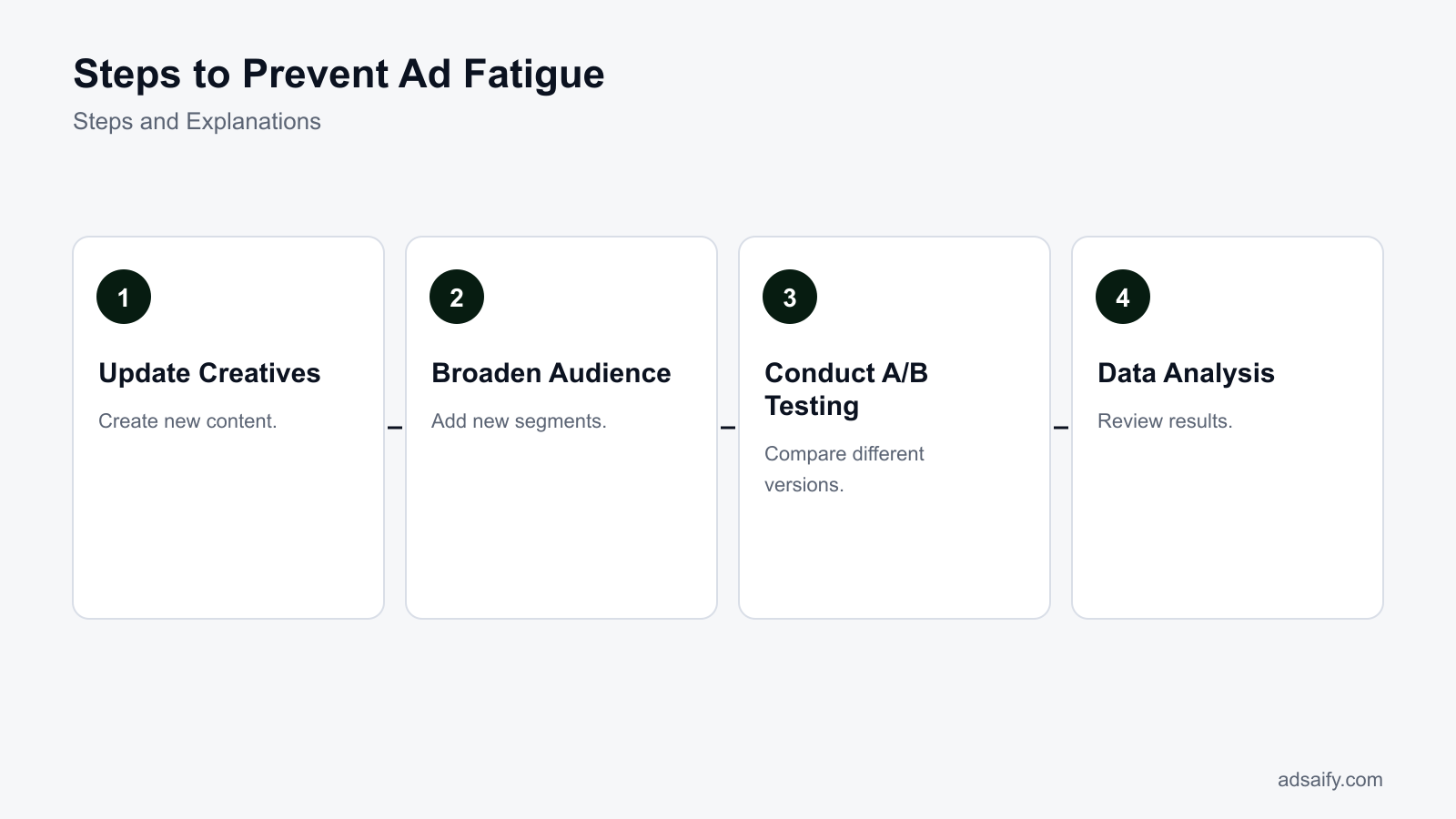
How to Apply the Solution with a Detailed Example?
To effectively apply the solution for preventing ad fatigue, businesses should start by selecting a specific campaign and defining their target audience. Next, they should create dynamic creatives that automatically adjust based on audience preferences. Finally, continuous monitoring and optimization of ad performance are crucial for achieving desired results.Choose a campaign and define your audience
Begin by selecting a campaign that has shown signs of ad fatigue. For instance, if you run a local coffee shop and have a campaign focused on promoting a new seasonal drink, analyze the audience demographics in Meta Ads Manager. Navigate to the "Audiences" section under the "Tools" menu. Here, you can define your audience based on location, age, interests, and behaviors. For example, target users aged 18-35 within a 10-mile radius of your coffee shop who have shown interest in coffee or local dining.Create and test dynamic creatives
Once the audience is defined, create dynamic creatives that can adapt to different audience segments. In the "Ad" section of the campaign setup in Meta Ads Manager, select "Dynamic Creative." Upload multiple images, headlines, and descriptions related to the seasonal drink. Meta will automatically test combinations to determine which performs best. For example, if you have a budget of 500 TL daily, allocate 200 TL to dynamic creative testing. Monitor which combinations yield the best engagement rates and adjust accordingly.Monitor and optimize performance
After launching the campaign with dynamic creatives, it's essential to monitor performance metrics closely. Check the "Ads Manager" dashboard for key performance indicators (KPIs) such as click-through rate (CTR) and cost per acquisition (CPA). If the CTR is below 1% after a week, consider refreshing your creatives or adjusting your audience targeting. For instance, if the seasonal drink campaign sees a CPA of 50 TL but a target CPA is 30 TL, make changes to the ad copy or visuals to enhance appeal.Is there a real campaign example?
Yes, a real campaign example could involve a local coffee shop that previously ran static ads showcasing a seasonal drink. By implementing dynamic creatives, the shop increased engagement rates by 30% within two weeks and reduced CPA from 50 TL to 25 TL. This approach not only revitalized the campaign but also helped in minimizing ad fatigue.How to Measure if the Solution Worked?
To determine whether the solution for preventing ad fatigue was effective, monitor click-through rates (CTR) and cost per acquisition (CPA). Evaluating conversion rates is essential, along with comparing your campaign's performance against competitors. These metrics provide insights into the ad's effectiveness and overall return on ad spend (ROAS).Monitor click-through rates and CPA
Start by tracking the CTR, which indicates how often people click on your ad after seeing it. A higher CTR typically signifies effective ad messaging and targeting. Additionally, analyze the CPA, which measures how much you spend to acquire a customer. For example, if your CTR improves from 0.8% to 2% after implementing dynamic creatives, this indicates that the solution is working.Evaluate conversion rates
Next, assess conversion rates by looking at how many users complete the desired action after clicking on your ad. Navigate to the "Conversions" section in Meta Ads Manager to gather this data. If your conversion rate increases from 3% to 5%, it suggests that your ad is resonating better with the audience and driving sales effectively.Compare with competitive analyses
Lastly, conduct a competitive analysis to understand how your campaigns stack up against industry benchmarks. This can be done through tools that provide insights into competitor ad performance. Comparing your results with competitors can highlight areas for improvement or validate your campaign's success.| Metric | Before Solution | After Solution | Industry Average |
|---|---|---|---|
| Click-Through Rate (CTR) | 0.8% | 2% | 1.5% |
| Cost Per Acquisition (CPA) | 50 TL | 25 TL | 30 TL |
| Conversion Rate | 3% | 5% | 4% |
| Engagement Rate | 1% | 4% | 2.5% |
What metrics should I track?
You should track key metrics such as click-through rate (CTR), cost per acquisition (CPA), conversion rate, and engagement rate. Monitoring these metrics allows you to evaluate the effectiveness of your campaigns and make informed decisions for future advertising strategies.Want to see this in your own account? Enter your website address and Adsaify drafts the campaign for you. The first ad is free. Try it now or log in.
What Routine Should I Follow to Prevent Recurrence?
To effectively prevent ad fatigue, marketers should adopt a structured routine that includes regular updates, performance analyses, and reporting. This routine helps ensure that ads remain fresh, target audiences are effectively reached, and performance data is continuously monitored for informed decision-making.- Daily: Check ad performance metrics in Meta Ads Manager, focusing on CTR (click-through rate) and CPC (cost per click) to identify underperforming ads.
- Daily: Review audience engagement on your ads to assess which segments are responding positively and which are not.
- Weekly: Update creatives by testing new visuals and copy to keep the ad content engaging and relevant.
- Weekly: Analyze audience demographics and behaviors in the Audience Insights tool to adjust targeting strategies accordingly.
- Monthly: Create a performance report that summarizes key metrics such as ROAS (return on ad spend) and conversion rates to evaluate overall campaign success.
- Monthly: Conduct an audience refresh by creating new custom or lookalike audiences based on recent customer data to maintain engagement levels.
- Monthly: Review and refine your ad budget allocation based on performance data to ensure optimal spending across high-performing campaigns.
How can I implement these routines?
To implement these routines, create a calendar or task management system that reminds you of daily, weekly, and monthly tasks. Use tools like Meta Ads Manager to automate data collection and reporting, and consider using Adsaify for generating new ad creatives, which can streamline the process of updating your campaigns.What are the Most Common Mistakes and Solutions?
Understanding common mistakes in ad management can significantly enhance campaign effectiveness. By recognizing these pitfalls and implementing solutions, marketers can minimize ad fatigue and improve overall performance.Changing creatives too frequently
Changing creatives too often can confuse your audience and prevent effective brand recognition. Instead of refreshing ads every few days, aim for a balance where creatives are updated based on performance metrics. A good practice is to refresh ads every 2-4 weeks, depending on engagement trends.Narrowing the audience too much
Narrowing the audience excessively can limit potential reach and reduce ad effectiveness. When targeting becomes too specific, the ad may not reach enough users, leading to higher frequency and potential ad fatigue. Instead, maintain a broader audience and use segmentation strategies to target different groups while still reaching a larger base.Failing to analyze data
Neglecting to analyze performance data can result in missed opportunities for optimization. Regularly review your ad metrics, such as CTR, conversion rates, and audience engagement levels. Implement a strategy for data analysis that includes weekly reviews to ensure you are making data-driven decisions that can enhance campaign performance.Not utilizing A/B testing
Failing to implement A/B testing can prevent marketers from understanding what resonates with their audience. Regularly test different ad elements, such as headlines, images, and CTAs (calls to action), to find the most effective combinations. Use Meta's A/B testing feature to run controlled experiments and adjust campaigns based on results.Ignoring feedback from audience engagement
Disregarding comments or feedback on ads can lead to repeated mistakes and missed insights. Pay close attention to audience responses and adjust your messaging or targeting based on their feedback. This can help create a more relevant advertising experience and foster engagement.Overlooking mobile optimization
Not optimizing ads for mobile can lead to poor user experience and lower engagement rates. Ensure that all creative assets are mobile-friendly and test how ads appear on different devices. Use Meta's Preview tool to see how ads will look on mobile versus desktop.How can I avoid these mistakes?
To avoid these common mistakes, establish a systematic approach to audience targeting and creative management. Regularly review performance data and incorporate A/B testing into your campaigns. Additionally, be open to feedback and continuously adapt strategies based on audience engagement to maintain effective advertising.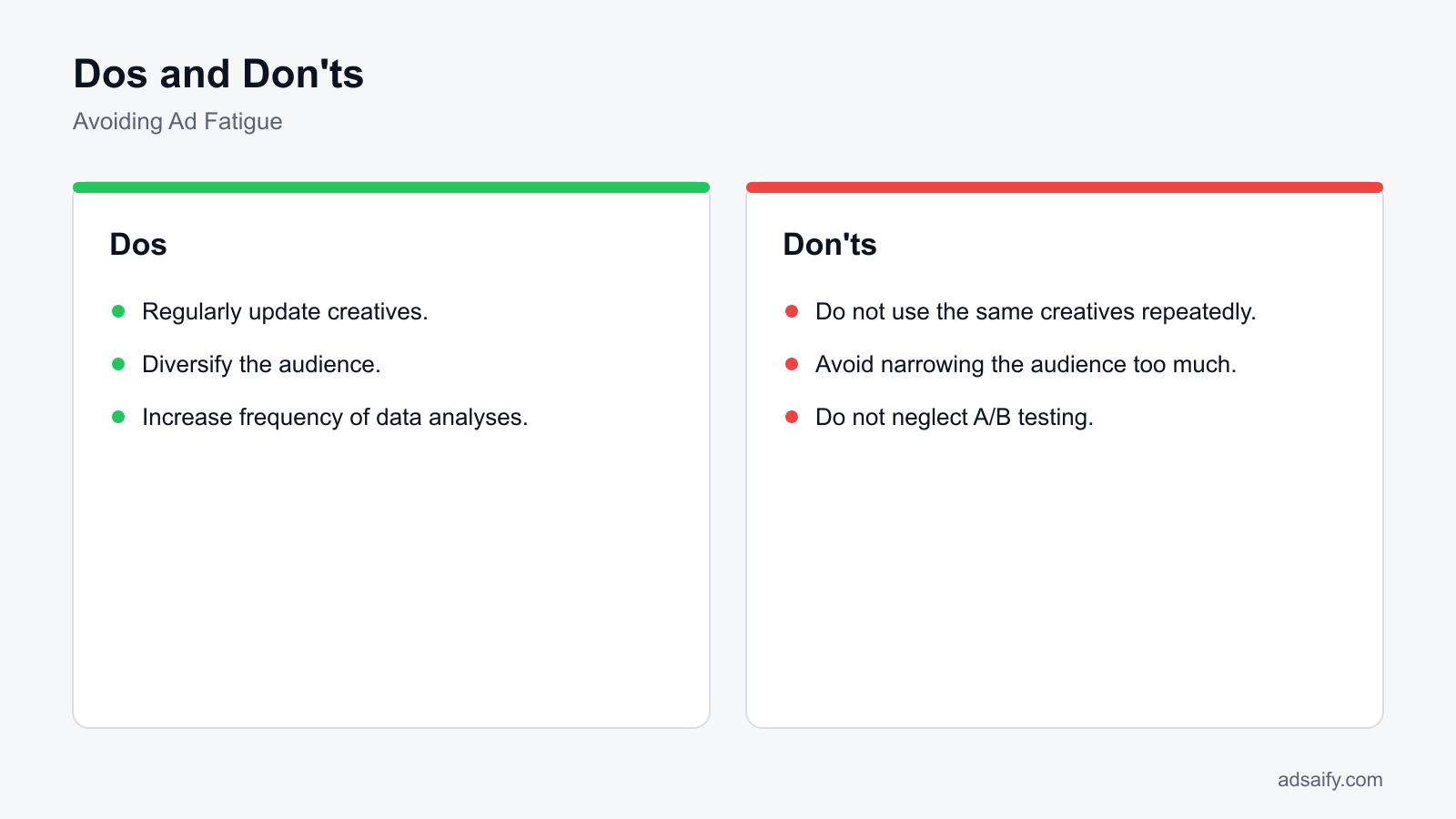
When Will the Solution Not Help?
Ad fatigue solutions may not be effective in specific scenarios, such as operating in highly competitive markets, failing to accurately define the target audience, or using low-quality creatives. Each of these factors can lead to diminished ad performance, regardless of the strategies implemented to combat ad fatigue.Operating in Highly Competitive Areas
In highly competitive markets, ad fatigue can occur more rapidly due to the saturation of similar ads. For instance, if multiple brands are targeting the same audience with similar products, consumers may become overwhelmed and disengaged. To address this issue, it’s crucial to differentiate your ad campaigns by focusing on unique selling propositions (USPs) and leveraging advanced targeting options in Meta Ads Manager. Consider using lookalike audiences to find users similar to your existing customers, which can help improve engagement rates.Failing to Accurately Define the Audience
Not clearly defining your target audience can lead to ad fatigue. If ads are shown to irrelevant users, it increases the likelihood of them being ignored. In Meta Ads Manager, ensure that you utilize audience insights to refine your targeting. Use the Audience section to create custom audiences based on demographics, interests, and behaviors. Regularly analyze performance metrics such as click-through rate (CTR) and conversion rate to assess audience engagement and make necessary adjustments.Using Low-Quality Creatives
Using low-quality creatives can significantly contribute to ad fatigue, as poor visuals or messaging fail to capture attention. Meta Ads Manager allows you to test different creatives through A/B testing, where you can compare performance between various images, videos, and copy. Focus on high-quality images and compelling ad copy that resonates with your audience. Use tools like Adsaify to generate engaging visuals and captions that align with your brand’s voice.- Analyze your market competition.
- Define your target audience accurately.
- Ensure high-quality creatives are used.
- Utilize A/B testing for ad variations.
- Review performance metrics regularly.
- Adjust your budget based on ad performance.
- Incorporate unique selling propositions in your ads.
- Leverage audience insights for better targeting.
What should I do in this case?
If the ad fatigue solution does not help, reassess your market strategy by conducting thorough competitive analysis. Refine your audience targeting based on insights and ensure your creatives are of high quality. Continuously monitor ad performance and adjust your campaigns to better resonate with your audience.What are the Key Terms?
Understanding key terms is essential for effectively managing ad campaigns and preventing ad fatigue. Familiarity with industry terminology helps marketers communicate their strategies and analyze performance metrics accurately.- CPA (cost per acquisition): The cost spent to acquire a customer through marketing efforts.
- Dynamic creative: Ad contents personalized for the audience based on their interactions and preferences.
- A/B testing: A test comparing two versions of an ad to determine which performs better.
- CTR (click-through rate): The percentage of users who click on an ad after seeing it.
- ROAS (return on ad spend): A metric that measures the revenue generated for every dollar spent on advertising.
- Lookalike audience: A targeting option that finds new users similar to your existing customers.
- Custom audience: An audience created based on specific criteria, such as website visitors or email subscribers.
- Ad creative: The visual and textual elements used in an advertisement.
- Impressions: The total number of times an ad is displayed to users.
- Ad fatigue: A decline in ad performance due to overexposure to the same ad.
- Engagement rate: The level of interaction users have with an ad, such as likes, shares, and comments.
- Audience insights: Data that provides information about the demographics and behaviors of your target audience.
Why should I know these terms?
Knowing these terms empowers marketers to make informed decisions and optimize ad campaigns effectively. Familiarity with industry jargon enables clearer communication with team members and stakeholders, leading to better strategic planning and execution in performance marketing.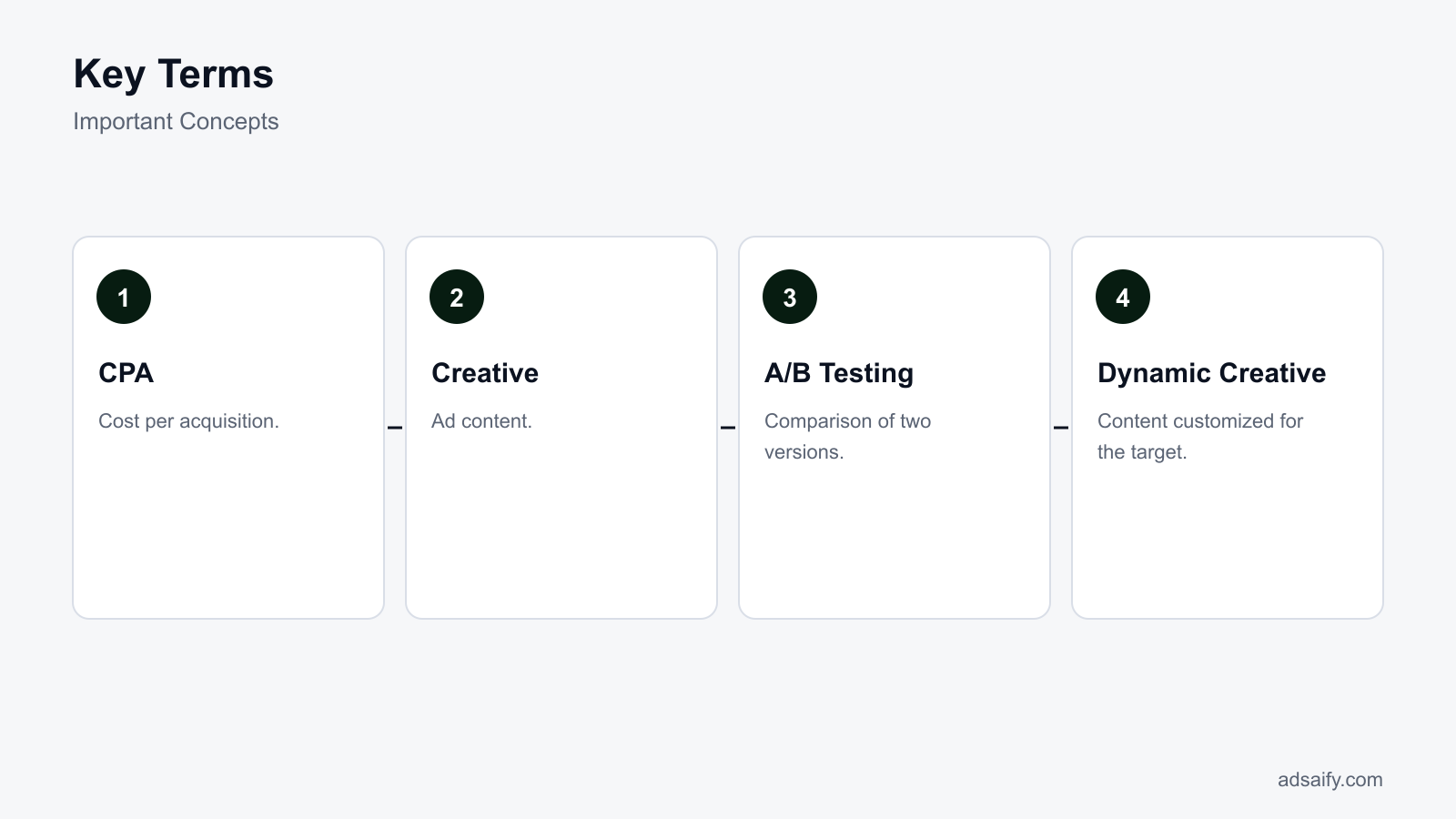
The Importance of Preventing Ad Fatigue
To prevent ad fatigue, regularly refresh ad creatives, utilize dynamic creatives, and conduct continuous A/B testing. Additionally, analyze your audience and competitors frequently to stay relevant. As a concrete next step, consider signing up for Adsaify to streamline your ad campaign setup and management, ensuring you can easily create new content and optimize performance.
Want to see this in your own account? Enter your website address and Adsaify drafts the campaign for you. The first ad is free. Try it now or log in.
Frequently Asked Questions (FAQ)
1. How quickly does ad fatigue appear?
Ad fatigue can appear within a few weeks, depending on factors like audience size and ad frequency. When users see the same ad repeatedly, they may become less responsive, leading to decreased engagement and effectiveness. Monitoring performance metrics can help identify the onset of ad fatigue.
2. What is the cost of ad fatigue?
The cost of ad fatigue includes reduced click-through rates (CTR), lower return on ad spend (ROAS), and wasted advertising budgets. As audience engagement declines, businesses may spend more on ineffective ads, ultimately impacting overall marketing efficiency and profitability.
3. How can I prevent ad fatigue?
To prevent ad fatigue, regularly update ad creatives, diversify messaging, and rotate different visuals. Implementing automation rules to pause underperforming ads can help maintain audience interest. Tools like Adsaify can assist in generating fresh content and managing campaigns effectively.
4. How do dynamic creatives work?
Dynamic creatives automatically customize ad content based on user data and behavior. This means that different audience segments see tailored images, headlines, and calls to action, increasing relevance and engagement. By using dynamic creatives, advertisers can reduce ad fatigue and improve performance.
5. What are the benefits of continuous A/B testing?
Continuous A/B testing allows marketers to compare different ad variations to determine which performs best. This data-driven approach helps optimize ad copy, visuals, and targeting strategies, ultimately leading to improved performance. Regular testing ensures that campaigns evolve based on audience preferences.
6. How often should audience analysis be done?
Audience analysis should be conducted at least quarterly, or more frequently if there are significant changes in market conditions or business objectives. Regular analysis helps identify shifts in audience behavior and preferences, allowing marketers to adjust their strategies accordingly and maintain engagement.
7. Why is competitor analysis important?
Competitor analysis is crucial because it provides insights into industry trends, successful strategies, and potential gaps in the market. Understanding competitors' strengths and weaknesses can inform your advertising approach, helping to differentiate your campaigns and capture audience attention effectively.
8. What are the downsides of narrowing the audience too much?
Narrowing the audience too much can lead to limited reach and reduced ad impressions. This may cause ad fatigue to set in quickly, as the same small group of users sees the ads repeatedly. A balanced approach is necessary to maintain engagement while optimizing targeting.
How can you try this with Adsaify?
The quickest way to apply the steps in this article to your own account is to try them. Adsaify analyses your business from your website address, drafts the campaign with an audience, ad copy, creative and a budget suggestion, and publishes it to your own Meta ad account once you approve.
- Your first ad is free: there is nothing to lose by trying.
- Your own ad account: the campaign runs in your Meta account and you stay in control.
- Images and video: generate ad creatives with AI or promote an existing Instagram post.
Create a free account and try your first ad · Already have an account? Log in.