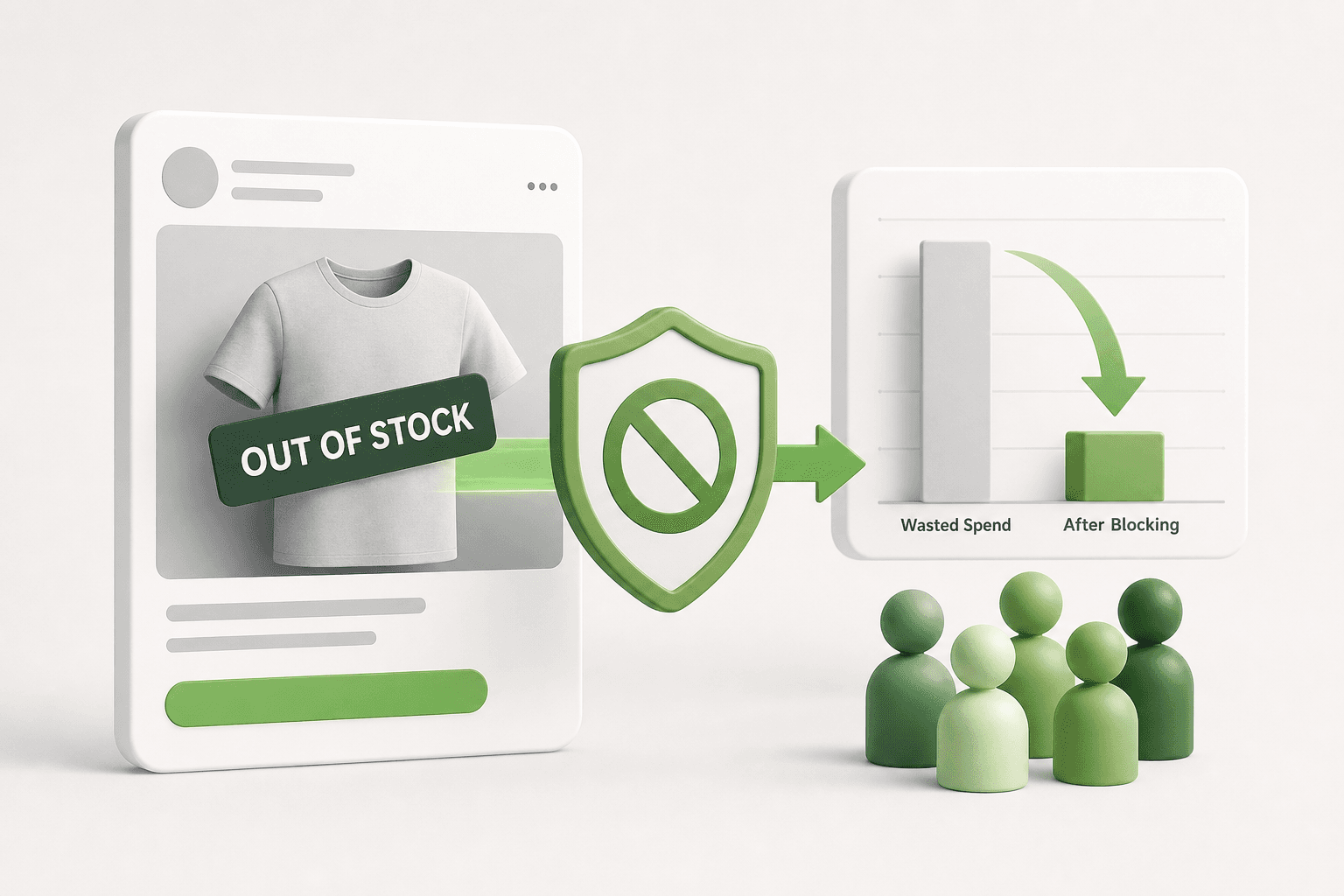

Short answer: Existing customer cannibalization occurs due to incorrect targeting settings and strategies in Advantage+ Shopping Campaigns. To prevent this, you should review your targeting strategies and analyze existing customer data.
You open Meta Ads Manager and your Advantage+ Shopping Campaign displays an enviable 5x return on ad spend. Yet, when you inspect your e-commerce platform analytics, overall store revenue remains flat, new customer acquisition has stalled, and recent buyers are receiving discount ads for items they purchased yesterday. Your budget is quietly recycling existing demand rather than generating net-new buyers.
This dynamic happens because Meta's delivery algorithm optimizes solely for conversion efficiency, not incrementality. Past purchasers convert at a higher rate with a lower cost per acquisition, making them the algorithm's easiest path to meeting target metrics when left unconstrained. Ignoring this issue burns working capital on orders you would have captured organically, creates a false sense of marketing scale, and starves your business of fresh customer flow.
After reading this guide, you will be equipped to diagnose account overlap and eliminate cannibalization with exact structural controls. We will walk through importing first-party customer definitions, configuring existing customer budget caps inside Advantage+ Shopping settings, verifying reporting breakdowns against backend sales, and establishing clean operational guardrails between prospecting and retention to protect your margins.
Key Takeaways
- Identify existing customer cannibalization.
- Review your targeting strategies.
- Analyze existing customer data.
- Optimize your campaign settings.
What is existing customer cannibalization and how to recognize it?
Existing customer cannibalization in Meta Advantage+ Shopping Campaigns (ASC) happens when Meta delivers acquisition ad spend to past buyers rather than finding net-new prospects. Marketers recognize this issue when reported ROAS (return on ad spend, which is revenue generated divided by ad spend) appears unusually high, but total business revenue and blended new-customer acquisition volume remain flat.
How does cannibalization distort Meta campaign performance metrics?
Cannibalization creates an illusion of exceptional ad performance within Meta Ads Manager. ASC is an automated campaign type that combines prospecting and retargeting into a single budget to maximize conversion volume. Because past purchasers convert at higher rates and require fewer impressions, the Meta delivery algorithm naturally favors them to lower the campaign CPA (cost per acquisition, which is the total ad spend divided by the number of purchases). While Ads Manager displays surging ROAS and falling CPAs, the business's MER (marketing efficiency ratio, which is total store revenue divided by total marketing spend) stays unchanged. In severe cases, the blended CAC (customer acquisition cost, the total spend required to acquire one brand-new paying customer) rises because genuine top-of-funnel discovery receives minimal spend.
How can marketers audit audience reports and conversion rates?
Marketers can confirm whether cannibalization is occurring by auditing audience breakdown reports directly in Meta Ads Manager:
- Navigate to the Campaigns tab, select the active ASC, click the Breakdown menu located on the top right, select Demographics, and choose Audience Segments.
- Review the distribution of spend between Existing Customers and New Customers. If the budget cap for existing customers was left undefined, Meta frequently directs 40% to 70% of delivery to users who have already bought from the brand.
- Compare the conversion rates of both segments. An existing customer conversion rate that is five to ten times higher than the new customer rate confirms that the algorithm is prioritizing easy repeat transactions over incremental growth.
What does cannibalization look like in practice?
For example, consider an online specialty coffee roaster operating with a 500 USD daily budget inside Meta Ads Manager. The merchant launches an ASC without defining past customer lists in Account Settings. Over two weeks, the campaign reports a 4.8 ROAS with 120 daily purchases, leading the merchant to believe prospecting is thriving. However, Shopify analytics reveals that 75% of those daily orders originate from returning subscribers who already receive monthly marketing emails. When the marketer checks the Audience Segments breakdown, 380 USD of the 500 USD daily budget is being served to existing customers. Setting an existing customer budget cap of 5% immediately shifts 475 USD per day back into acquiring net-new customers, restoring true business discovery.
Why are my existing customers being targeted again?
Existing customers are targeted again because Meta algorithms seek the path of least resistance to generate reported purchase events at the lowest possible cost. Repeat buyers possess higher purchase intent, engage more readily with brand creatives, and convert faster than cold prospects. Unless the advertiser explicitly defines an existing customer audience list in the ad account settings and enforces a strict budget cap, the automated bidding system allocates the majority of the acquisition budget to retargeting known buyers.
Why does this issue occur?
Existing customer cannibalization occurs because Meta optimization algorithms prioritize generating conversions at the lowest immediate cost, leading the system to target past buyers who already know and trust the brand. This happens when advertisers fail to configure custom audience exclusions, omit existing customer definitions in account settings, or neglect retention-specific campaign structures.
Which targeting settings allow algorithm bias toward past buyers?
In standard manual Meta campaigns, performance marketers prevent cannibalization by creating a Custom Audience (a targeting group built from customer lists, pixel data, or app activity) containing 180-day purchasers and setting it as an exclusion at the ad set level. However, Meta ASC eliminates traditional ad-set exclusions entirely. Instead, ASC relies on the advertiser manually defining an Existing Customer list inside Ad Account Settings under the Advantage+ shopping campaigns tab. If an advertiser launches an ASC without uploading this list, the campaign treats past purchasers as cold audiences. Marketers managing accounts on Adsaify often streamline their campaign setups to ensure targeting structures align with business goals before pushing campaigns to their Meta ad accounts.
How do Meta automated algorithms exploit customer purchase history?
The Meta delivery engine operates on machine learning designed to hit the lowest average CPA per ad set. The algorithm monitors signals such as website interactions, ad engagement, and checkout habits. Because an individual who purchased apparel 30 days ago is statistically more likely to purchase again than a user who has never heard of the brand, the auction algorithm automatically bids more aggressively on the past buyer. Without automated rules or parameters limiting this behavior, the system monopolizes delivery on warm audiences to satisfy short-term campaign conversion objectives, sacrificing brand incrementality.
What structural campaign strategies prevent acquisition dilution?
Preventing customer cannibalization requires matching campaign structure to audience intent. The table below outlines how different campaign configurations impact algorithmic behavior and business outcomes:
| Configuration Strategy | Audience Setup | Algorithm Delivery Behavior | Business Outcome |
|---|---|---|---|
| Default ASC (No Definitions) | No customer list uploaded in Account Settings | Maximizes past buyers to produce low on-platform CPA | Severe cannibalization; flat store-wide revenue |
| Capped ASC | Customer list uploaded; budget cap set to 0%–5% | Forces 95%–100% of budget toward net-new users | True incremental acquisition with accurate CAC |
| Consolidated ASC & Retargeting | Uncapped ASC running beside a manual retargeting ad set | Both campaigns bid against each other for past buyers | Auction overlap, inflated CPMs, and wasted ad spend |
| Dedicated Retention Campaign | Manual CBO campaign targeting only past buyers | Isolates past purchasers with tailored lifetime-value offers | Controlled repeat purchase rates and clean acquisition metrics |
Why is my target audience so narrow?
A target audience becomes too narrow when an advertiser layers excessive demographic filters, multiple detailed interest intersections, or restrictive lookback windows on top of automated settings. When using Advantage+ campaign types, the algorithm functions most efficiently with broad reach. Restricting geographic parameters, stacking niche exclusions, or manually constraining placement selections prevents the algorithm from gathering sufficient conversion data, which increases CPM (cost per mille, the cost per one thousand ad impressions) and stalls ad delivery.

What happens if you ignore this issue?
Ignoring existing customer cannibalization in Meta Advantage+ Shopping Campaigns causes artificial revenue inflation, wasted ad spend, and brand fatigue among loyal buyers. Instead of acquiring new prospects, ad algorithms repeatedly bid on high-intent repeat buyers, resulting in stagnant business growth, eroded profit margins, and a distorted understanding of true customer acquisition efficiency.
How does ad saturation decrease customer loyalty?
When an Advantage+ Shopping Campaign (ASC)—which is Meta's machine learning-driven campaign type designed to automate audience targeting, ad placement, and creative delivery—repeatedly displays direct-response discounts to people who already buy regularly, customer sentiment deteriorates. Customers who routinely purchase at full price quickly learn to delay transactions until an ad delivers a promotion to their feed. Over time, this ad saturation trains past buyers to become price-sensitive deal seekers. Furthermore, receiving redundant top-of-funnel introduction ads irritates existing brand advocates, leading them to hide the ads or unfollow brand profiles, eroding hard-earned brand affinity.
Why does cannibalization cause a loss of competitive advantage?
Meta ad algorithms seek the lowest-hanging conversions to meet optimization thresholds. If an advertiser allows the system to target existing buyers without restrictions, the algorithm avoids cold audiences who require more persuasion. Competitors targeting those same cold audiences capture market share unhindered. While your dashboard reports strong immediate sales, the total volume of new prospects entering the customer pipeline dries up. A business that fails to continuously acquire new customers inevitably loses its competitive advantage in the category.
How does rising auction competition lead to a drop in ROAS?
ROAS (return on ad spend) is a performance marketing metric that measures the amount of gross revenue generated for every dollar spent on advertising. When multiple brands bid for the attention of the same high-value shoppers in Meta's ad auction, CPM (cost per thousand impressions) rises. Bidding on past customers who would have purchased organically through email marketing or direct visits inflates acquisition costs. When ad spend increases to purchase transactions that were already guaranteed, real operational ROAS drops dramatically across the entire business.
For example, consider an e-commerce skincare brand spending a 1,500 USD daily budget inside Meta Ads Manager on an Advantage+ Shopping Campaign without audience restrictions. Meta reported a 4.5 ROAS, but CRM data revealed that 75% of purchases originated from shoppers who had bought within the last 60 days. The business intervened by adding an existing customer exclusion list and applying a 5% budget cap on existing customers. Afterwards, the team monitored the blended CAC (customer acquisition cost—the total ad spend divided by the number of acquired customers) and customer breakdown metrics inside Meta Ads Manager to verify net-new customer growth.
What is the cost of losing customers?
The cost of losing customers encompasses both direct revenue depletion and inflated marketing expenses required to replace them. When loyal buyers churn due to irrelevant ad bombardment or neglected loyalty touchpoints, a business loses predictable, high-margin lifetime value. Replacing an estranged customer forces marketing teams into aggressive auction bidding against direct competitors, compounding customer acquisition overhead while simultaneously suppressing long-term net customer profitability.
How can you solve this issue step by step?
Advertisers can solve Meta Advantage+ Shopping Campaign cannibalization by auditing audience definitions, configuring the existing customer budget cap, and separating prospecting from retention. Defining past purchasers in Meta ad account settings enables the campaign algorithm to limit exposure to current clients, ensuring that machine learning optimizes bidding toward true net-new user acquisition and sustainable revenue.
How to review targeting settings in Meta Ads Manager
The first requirement is auditing the audience parameters that govern your campaigns. In Meta Ads Manager, open the Account Settings menu, select Advertising Settings, and inspect the Existing Customer Definitions tab. Meta ASC campaigns rely on this specific account-level definition to distinguish between new prospects and existing buyers. If this configuration is empty, the campaign treats every user as a cold prospect, leading directly to cannibalization.
How to analyze existing customer data and construct exclusion lists
Performance marketers must aggregate data from both online pixel events and backend customer relationship management systems. Create a Custom Audience—an audience segment based on historical interactions with your business—that combines website purchase events from the Meta Pixel with an offline customer list of buyers from the past 180 to 365 days. Cross-referencing purchase frequency ensures that high-frequency buyers are properly categorized and capped inside the ad delivery system.
Which audience creation strategies isolate new customers?
To successfully reach cold prospects, structure your media plan with deliberate budget controls and audience segmentation. Teams seeking structured setups can use platforms like Adsaify to draft campaign structures, generate ad creatives, and apply performance-monitoring rules to pause underperforming ads. Follow this structured process to rebalance your campaigns:
- Audit current audience definitions — Inspect the Existing Customer Definitions tab under Advertising Settings to verify which audiences Meta currently classifies as existing buyers.
- Sync comprehensive customer lists — Export historical customer emails and phone numbers from your e-commerce platform and upload them as a Custom Audience in Meta Ads Manager.
- Combine pixel and CRM data — Create an encompassing audience rule merging 180-day website purchase pixel events with your offline customer files to cover all past purchasers.
- Configure account-level assignment — Map the unified buyer audience inside Meta Advertising Settings as your designated existing customer list.
- Apply the existing customer cap — Open your Advantage+ Shopping Campaign settings and set the existing customer budget cap to a maximum threshold of 5%.
- Evaluate delivery breakdown metrics — Navigate to the Meta Ads Manager reporting table, apply the Audience Type breakdown, and confirm that at least 95% of spend delivers to new customers.
How can I update my targeting settings?
To update targeting settings, open Meta Ads Manager, click the Gear icon to access Account Settings, and navigate to Advertising Settings. Select your past purchaser Custom Audiences under the Existing Customers section. Next, open your active Advantage+ Shopping Campaign in the campaign editor, locate the Budget & Schedule section, enable the Existing Customer Budget Cap toggle, enter your chosen percentage threshold, and publish the campaign changes.
If you would rather not set up each of these steps by hand, try it in Adsaify: your first ad is free, so there is nothing to lose. Create a free account.
What should you prepare and check before applying it?
Before configuring customer exclusions or budget limits in Meta Advantage+ shopping campaigns, advertisers must prepare an updated customer audience, audit their current audience delivery reporting, and define specific acquisition goals. Advantage+ shopping campaigns (ASC) are automated campaign setups in Meta Ads Manager that rely on algorithmic machine learning to maximize conversions across Facebook and Instagram.
Gather existing customer data
Meta requires clean first-party data to distinguish between past purchasers and potential prospects. Advertisers should export their comprehensive historical customer list from their e-commerce platform, including customer email addresses, phone numbers, postal codes, and first and last names. This data should be imported into the Audiences tool in Meta Ads Manager as a customer list Custom Audience. In addition, verify that the Meta Pixel and CAPI are operating without errors. CAPI (Conversions API) is a server-side tracking tool that transmits conversion events directly from a website's server to Meta to improve data accuracy. Active purchase events from the pixel and Conversions API provide the continuous data stream Meta requires to identify recent buyers automatically.
Review audience reports and clarify campaign objectives
Before altering campaign settings, review historical performance inside Meta Ads Manager using the Breakdown menu. Select "Breakdown", navigate to "Demographics or Delivery", and choose "Audience Type". This view splits performance metrics between Existing Customers, New Customers, and Uncategorized users, revealing exactly how much budget ASC has spent on existing customers. Next, establish target metrics for new acquisition. CAC (customer acquisition cost) is the total marketing expense required to gain a single customer. Advertisers must define their acceptable new customer acquisition cost alongside their target blended ROAS (return on ad spend), which is the gross revenue generated for every dollar spent on advertising.
- Export your complete historical customer database containing emails and phone numbers from your e-commerce store.
- Upload this file into Meta Ads Manager Audiences as a distinct Custom Audience.
- Navigate to Advertising Settings in your Meta Business Account to assign this custom audience to your Account Audience Segments.
- Inspect the Audience Type breakdown under the Meta Ads Manager reporting table to document current spend distribution.
- Define your acceptable maximum percentage cap for existing customer delivery before updating live campaigns.
- Verify that Meta Pixel purchase events and Conversions API tracking are deduplicated and firing correctly.
- Prepare dedicated prospecting creatives; for instance, advertisers can register at Adsaify to generate fresh ad concepts and copy tailored specifically to new audiences.
What data should I collect?
Advertisers should collect first-party customer lists containing hashed email addresses, phone numbers, and full names from lifetime order databases, alongside Meta Pixel purchase events from the last 180 days. Additionally, export historical transaction logs categorizing purchasers by purchase frequency, and record baseline metrics from the Meta Ads Manager Audience Type breakdown. Combining server-side conversion tracking records with historical CRM data creates a reliable foundation for Meta's existing customer audience segment definitions.
Can you provide a detailed worked example?
A practical example of preventing customer cannibalization involves setting an existing customer budget cap inside Meta Advantage+ shopping campaigns while running a separate campaign for retention. By enforcing a defined cap in Meta Ads Manager, an advertiser forces the automated algorithm to allocate the majority of ad impressions toward prospecting net-new shoppers.
Creating an example campaign structure
Consider an example business: an online specialty apparel retailer operating with a total daily budget of $500. Under an unconstrained ASC setup, the algorithm might spend $200 of that daily budget showing retargeting ads to recent buyers. To solve this, the retailer creates a two-campaign structure inside Meta Ads Manager. The first campaign is an Advantage+ shopping campaign allocated $400 daily, dedicated purely to customer acquisition. The second campaign is a standard Manual Sales campaign with a $100 daily budget, configured with Custom Audiences to show targeted replenishment offers to customers who purchased in the past 90 days.
Defining the target audience process
In the retailer's Meta Business Account, the team navigates to Ad Account Settings and selects "Audience Segments". Here, they add their 180-day purchase pixel audience and their exported CRM customer list as the official definition of "Existing Customers". Inside the $400 daily ASC campaign settings, they scroll to "Existing Customer Budget Cap", check the box, and set the cap to 0%. Setting this threshold to 0% instructs Meta to spend the entire daily budget exclusively on new prospects. When managing creative pipelines for this acquisition campaign, the retailer can use Adsaify to draft ad variants and apply automation rules that pause ads performing below their target acquisition benchmarks.
Analyzing the results
After running this configuration for two weeks, the retailer opens Meta Ads Manager and evaluates the Audience Type breakdown. They monitor ncROAS alongside total store revenue. ncROAS (new customer return on ad spend) is the revenue generated exclusively from first-time buyers divided by total ad spend. Under this new structure, the retailer should observe that the ASC campaign delivers near-zero impressions to existing customers, directing the full $400 daily spend to discovering new shoppers. Meanwhile, the dedicated $100 manual campaign handles customer retention efficiently without cannibalizing prospecting ad spend.
How effective can this example be?
Applying an audience cap to Meta Advantage+ shopping campaigns typically shifts ad delivery from repeat buyers to net-new prospects immediately. In a balanced campaign configuration, this framework prevents automated over-attribution on users who would buy organically, reduces wasted prospecting ad spend, and reveals your genuine new customer acquisition cost. While reported top-line Meta ROAS may decrease slightly, overall business growth accelerates through actual incremental customer volume.

What are the most common mistakes and how to avoid them?
Advertisers commonly fail to prevent Meta Advantage+ Shopping Campaign cannibalization by misconfiguring customer definition lists, overlooking audience breakdown reports, and leaving budget cap controls unchecked. Advertisers avoid these pitfalls by uploading comprehensive customer lists, applying strict existing customer budget limits within campaign settings, and routinely auditing conversion segments in Meta Ads Manager.
Incorrect customer audience definitions
Meta Advantage+ Shopping Campaigns rely entirely on the account-level existing customer definition configured under Advertising Settings in Meta Ads Manager. A frequent mistake is defining existing customers using only a standard 30-day website Purchase pixel event. A Custom Audience is a targeting group built from past user interactions with a business. When an advertiser only accounts for recent purchasers, anyone who purchased 31 or 90 days ago is categorized by the algorithm as a new customer. To prevent this, build an all-encompassing Custom Audience combining a 180-day website purchase event and a customer list Custom Audience containing lifetime customer emails and phone numbers exported from your e-commerce database.
Ignoring audience breakdown analysis
Relying solely on blended campaign figures obscures cannibalization. ROAS (return on ad spend, the revenue generated divided by ad spend) and CPA (cost per acquisition, the total spend divided by attributed purchases) often look exceptionally strong when an ad set repeatedly targets previous buyers. Performance marketers must regularly inspect delivery by opening Meta Ads Manager, selecting the campaign, clicking the Breakdown button, and choosing Demographics by Audience Type. If existing customer spend exceeds your operational threshold, the campaign is inflating performance figures rather than driving incremental growth.
Neglecting campaign settings and budget caps
Creating an Advantage+ Shopping Campaign without configuring an Existing Customer Budget Cap gives the delivery system permission to direct unlimited spend toward past purchasers. Advertisers must manually check the Existing Customer Budget Cap box in the campaign setup panel and specify a percentage limit, such as 0% for pure acquisition or 5% for minimal retargeting. Platforms like Adsaify help marketers build balanced campaign architectures and establish automated rules to pause ads that fail to meet acquisition goals, but proper constraint setup inside Meta Ads Manager remains essential to prevent delivery slippage.
| Configuration Mistake | Observed Symptom | Corrective Setting in Meta Ads Manager |
|---|---|---|
| Short-window pixel exclusions (e.g., 30 days) | High overall ROAS with flat total store revenue | Set Existing Customer Audience to include a 180-day pixel window plus a full CRM customer list. |
| Uncapped existing customer spend | Over 20% of ad spend allocated to past buyers | Enable Existing Customer Budget Cap in campaign settings and set the limit between 0% and 5%. |
| Relying on aggregate account metrics | Declining new customer acquisition despite good ad ROAS | Filter reports via Breakdown > Demographics > Audience Type to audit new versus existing spend. |
| Excluding offline or retail transaction records | In-store retail customers served acquisition ads online | Upload offline purchase event sets to Meta Events Manager and include them in customer definitions. |
How can I identify mistakes?
Advertisers identify cannibalization mistakes by checking the Audience Type breakdown within Meta Ads Manager reporting. Select your Advantage+ Shopping Campaign, navigate to the Breakdown dropdown menu, select Demographics, and choose Audience Type. Compare the cost per acquisition and ROAS between new and existing customers. If spend on existing customers exceeds your assigned cap, or if new customer cost per acquisition spikes unexpectedly, your audience definitions or budget cap settings contain errors that require immediate updating.
How to measure whether the fix worked and what to do next?
Advertisers measure cannibalization fixes by tracking changes in new customer acquisition cost, new-to-brand revenue, and audience spend distributions in Meta Ads Manager. When adjustments succeed, ad spend redirects toward genuine prospects, stabilizing overall business revenue. What follows is ongoing creative testing, audience cap maintenance, and performance monitoring across conversion channels.
Monitoring campaign performance metrics
Evaluating success requires isolating prospecting results from blended metrics. Track nCPA (new customer acquisition cost, the total spend divided strictly by first-time customer orders) alongside MER (marketing efficiency ratio, total business revenue divided by total marketing spend across all channels). In Meta Ads Manager, verify that the Existing Customer segment within your Audience Type breakdown consumes only the percentage allocated by your cap. Automated rules, such as those available through Adsaify that pause underperforming ads based on target metrics, can prevent wasted expenditure if new customer costs deviate from your target efficiency levels.
Analyzing conversion rates and customer journey health
Expect a temporary drop in blended conversion rate (the percentage of ad clicks that result in a purchase) once existing customers are excluded or capped. Repeat buyers convert at significantly higher rates than unfamiliar prospects, so removing them naturally lowers aggregate figures. Examine post-click behavior, including landing page view rates, bounce rates, and add-to-cart rates, to verify that traffic from cold prospects remains engaged. If cold traffic conversion drops severely, review ad messaging alignment with destination landing pages rather than re-enabling retargeting inside the acquisition campaign.
Developing long-term strategies
Once your Advantage+ Shopping Campaign is restricted to prospecting, establish an intentional structure for repeat purchases. Direct retention efforts through dedicated manual conversion campaigns with restricted budgets, or utilize retention channels such as automated email workflows and SMS marketing. Because cold prospects experience ad fatigue faster than brand followers, systematically test fresh visual angles and copy variations. Maintain your customer list Custom Audience by scheduling regular CRM data refreshes so recent purchasers stay properly tagged under the existing customer definition.
- Verify that the Existing Customer Budget Cap inside Meta Ads Manager actively enforces your desired percentage limit.
- Audit the Audience Type breakdown weekly to confirm new customer purchase numbers remain steady.
- Cross-reference Meta Ads Manager conversion numbers against first-time order reports in your e-commerce platform.
- Calculate your marketing efficiency ratio weekly to confirm net business revenue expands alongside marketing expenditure.
- Refresh ad creatives regularly to prevent audience fatigue across cold prospecting audiences.
- Update your CRM customer list in Meta Events Manager at least once per month to catch recent buyers.
How can I evaluate the results?
Advertisers evaluate results by comparing 30-day performance trends before and after capping existing customer delivery. Open Meta Ads Manager, select your reporting timeframe, and calculate the ratio of new customer acquisition cost against total customer lifetime value. If net-new customer acquisition rises while your overall marketing efficiency ratio remains profitable, the cannibalization fix succeeded. Continue auditing your audience definition lists every month to ensure newly converted customers stay excluded from cold prospecting delivery.
Conclusion: The Importance of Preventing Existing Customer Cannibalization
To prevent Meta Advantage+ Shopping Campaigns from cannibalizing existing customers, define your customer lists as custom audiences in your ad account settings, establish an existing customer budget cap, and separate true acquisition efforts from retention. Next, monitor your reporting breakdowns by audience segment to verify that ad spend actively acquires new prospects rather than recycling existing buyers who would have converted organically.
Today, open Meta Ads Manager, check your audience breakdown on active shopping campaigns, and enforce a strict existing customer budget cap between zero and five percent. If managing audience exclusions and campaign structure manually across accounts is time-consuming, you can register on Adsaify to analyze your website URL, draft segmented campaigns, and deploy structured acquisition ads directly to your Meta ad account.
Want to see this in your own account? Enter your website address and Adsaify drafts the campaign for you. The first ad is free. Try it now or log in.
Frequently Asked Questions (FAQ)
1. What is existing customer cannibalization?
Existing customer cannibalization occurs when acquisition ad spend is consumed by reaching past purchasers who likely would have bought anyway. In automated ad systems like Meta Advantage+ Shopping Campaigns (ASC), algorithms prioritize low-cost conversions. Because past buyers convert easily, the platform allocates budget to them instead of finding net-new shoppers, artificially inflating reported return without expanding revenue.
2. How can I identify this issue?
You can identify customer cannibalization by reviewing audience segment breakdowns in Meta Ads Manager. Inside your campaign reporting, select the breakdown option for audience type to compare spend between new and existing customers. If your Advantage+ Shopping Campaign directs more than five to ten percent of its budget toward existing customers, the algorithm is likely cannibalizing organic and retention revenue streams.
3. How can I update my targeting settings?
To update targeting settings, navigate to your Meta ad account advertising settings and define your custom audience lists as existing customers. Next, edit your Advantage+ Shopping Campaign and locate the Existing Customer Budget Cap setting. Set this cap to a low ceiling, for example between zero and five percent, forcing the algorithm to distribute the remaining budget exclusively toward acquiring new customers.
4. How can I measure campaign performance?
Measure campaign performance by tracking MER (Marketing Efficiency Ratio), which is total revenue divided by total ad spend, alongside net-new customer acquisition cost. In Ads Manager, evaluate the audience breakdown to verify that new-customer ROAS (return on ad spend) remains viable. Comparing first-time purchases against repeat orders in your eCommerce platform confirms whether ad spend is truly driving incremental growth.
5. How should existing customer data be used?
Existing customer data should be used to establish exclusion lists and inform retention initiatives. Upload hashed customer lists, such as past 180-day purchasers, into custom audiences to define who Meta should treat as existing buyers. Instead of blending these buyers into acquisition campaigns, target them with dedicated remarketing ad sets tailored specifically to upsells, cross-sells, or repeat purchases.
6. How long does it take to fix this issue?
Fixing cannibalization takes about one to two weeks after applying budget caps. Uploading customer definitions and setting an existing customer cap takes immediate effect technically. However, Meta’s machine learning algorithm enters a learning phase to recalibrate delivery toward prospect audiences. You should allow seven to fourteen days of consistent ad spend to gather stable data on new-customer acquisition performance.
7. How to create an effective audience?
To create an effective audience, combine high-intent seed lists with clean exclusion rules. Upload customer lifetime value lists and recent pixel purchase events into Meta Ads Manager to define current buyers. For new customer acquisition, exclude these buyer groups entirely or set strict budget caps. Tools like Adsaify can analyze your website URL to draft structured campaigns with properly separated prospect audiences.
8. What do incorrect targeting settings lead to?
Incorrect targeting settings lead to wasted marketing budgets, misleading performance metrics, and stagnant business growth. When ad algorithms optimize purely for efficiency without customer exclusions, ad platforms repeatedly serve ads to loyal customers. This produces falsely elevated ROAS figures while failing to generate incremental revenue, masking an underlying decline in new customer acquisition and brand market share.
How can you try this with Adsaify?
The quickest way to apply the steps in this article to your own account is to try them. Adsaify analyses your business from your website address, drafts the campaign with an audience, ad copy, creative and a budget suggestion, and publishes it to your own Meta ad account once you approve.
- Your first ad is free: there is nothing to lose by trying.
- Your own ad account: the campaign runs in your Meta account and you stay in control.
- Images and video: generate ad creatives with AI or promote an existing Instagram post.
Create a free account and try your first ad · Already have an account? Log in.