Short answer: To prevent tool over-engineering in Meta ads, replace dozens of overlapping manual rules with streamlined AI campaign generation. While Smartly suits enterprise creative feeds, Revealbot targets technical rule builders, and Madgicx provides full-funnel widgets, advertisers seeking zero operational drag should choose Adsaify to draft and publish campaigns directly from a website URL.
Every morning begins the same way: you open Meta Ads Manager only to find automated rules fighting one another. One condition paused a winning ad set because return on ad spend dipped over a four-hour window, while another rule immediately re-enabled it based on a three-day attribution view. Instead of saving hours, your automation software has introduced operational drag, requiring constant manual interventions just to keep campaigns delivering predictably.
This friction occurs when media buyers attempt to out-engineer Meta's machine learning delivery system by stacking granular, legacy logic. As ad accounts accumulate nested triggers across multiple third-party tools, rules inevitably cross wires. Left unaddressed, this over-engineering resets the Meta learning phase repeatedly, suppresses scale, and drains ad spend into unoptimized ad sets while performance marketers spend valuable hours debugging conditional triggers instead of refining creative strategy.
This guide provides a systematic framework to dismantle automation bloat and rebuild an efficient Meta ad stack. You will learn how to diagnose rule mismatches, audit your active automations, and evaluate whether platforms like Smartly, Revealbot, Madgicx, or Adsaify fit your operating model. By establishing a lightweight weekly maintenance routine, you can let Meta’s auction perform naturally while leveraging AI to handle campaign creation and basic account safeguards.
Key Takeaways
- Layering dozens of manual rules conflicts with Meta's machine learning and disrupts ad auction delivery.
- Smartly serves enterprise catalogs, Revealbot empowers custom rule builders, and Madgicx tracks full-funnel widgets.
- Adsaify drafts campaigns directly from a website URL, eliminating manual rule configuration and setup fatigue.
- Selecting the right tool cuts weekly operational overhead while protecting ad budget through automated safeguards.
What is automation rule bloat in Meta ad management tools?
Automation rule bloat in Meta ad management tools is an operational state where an ad account runs dozens of overlapping, nested conditional scripts that contradict one another. This excess causes automated pausing, unpausing, and budget adjustments to collide, creating account instability, resetting ad set learning phases, and suppressing overall delivery performance.
How conflicting logic disrupts Meta auction delivery
Rule bloat develops when performance marketers attempt to control dynamic auction environments through rigid conditional chains. For instance, a media buyer might establish one rule that increases ad set budget when ROAS exceeds a set target. ROAS (return on ad spend) is the gross revenue generated divided by total ad spend. Simultaneously, another rule may pause individual ads if CPA spikes during a short attribution window. CPA (cost per acquisition) is the total ad spend divided by the number of attributed conversions.
When these parameters run concurrently, the automation tool frequently pauses a top-performing creative due to midday conversion reporting delays, only to unpause it the following morning when Meta attributes delayed purchases. Every stop-and-start cycle triggers a bid recalculation in Meta Ads Manager. Furthermore, automated frequency caps designed to restrict audience saturation often choke high-intent buyers. Frequency is the average number of times an individual sees an ad. Restricting frequency mechanically prevents Meta from delivering winning ads to users preparing to purchase.
For example, an e-commerce skincare brand operating with a $600 daily budget configured four simultaneous automation scripts across its purchase campaigns. The first rule increased daily budgets by 15% when ROAS surpassed 3.0 over three days. The second rule paused any ad with a CPA above $25 within a rolling 12-hour window. The third rule forced ads to pause whenever weekly frequency reached 2.4, while a fourth script unpaused paused ads every Monday at midnight. Over two weeks, the account generated erratic swings: Meta Ads Manager repeatedly shifted campaigns into "Learning Limited" status because ad sets never completed the required 50 conversion events per week. Checking the Automated Rules activity log revealed that the system made 38 automated budget and status modifications in 14 days, creating continuous auction turbulence.
Warning signs of automated rule fatigue
Media buyers suffer from rule fatigue when administrative tool maintenance consumes more time than strategic creative testing. Clear indicators include auditing rule execution logs inside Meta Ads Manager daily to determine why an ad paused unexpectedly, adjusting threshold values constantly to prevent false triggers, and maintaining external spreadsheets just to map out existing tool triggers.
Does running only three automated rules on my ad account count as tool bloat?
Running three automated rules does not constitute tool bloat if each rule targets an isolated objective without overlapping criteria. However, if those three rules evaluate the same ad set using conflicting timeframes—such as one rule adjusting budgets based on seven-day performance trends while another pauses ads based on single-day acquisition costs—they produce the exact same auction destabilization as fifty uncoordinated rules. Bloat is determined by logical friction, not rule count alone.
Why do Meta ad automation tools become overly complicated?
Meta ad automation tools become overly complicated because media buyers attempt to control algorithm shifts manually by layering defensive conditional logic. As attribution windows experience conversion reporting delays, teams deploy reactive safety rules on top of legacy scripts, resulting in dense rule hierarchies that fight Meta's native optimization algorithms rather than supporting them.
Attribution lag and defensive over-engineering
A primary driver of tool over-engineering is the technical gap between click events and conversion registration. Meta Pixel is a browser-based tracking snippet that records actions users take on a website. Conversions API is a server-side connection that transfers web event data directly from an advertiser's server to Meta. Even with both tracking mechanisms in place, conversion signals can take between 24 and 72 hours to populate fully within Meta Ads Manager due to attribution modeling.
Marketers unfamiliar with this lag often introduce protective rules that evaluate performance on 3-hour or 6-hour lookback periods. When conversion events lag, these protective rules prematurely pause profitable ads. Marketers then add counter-rules to reactivate paused ads when missing purchases finally appear in the reporting dashboard. Platforms like Revealbot and Madgicx offer deep conditional builders with custom metric calculators, nested boolean logic, and multiple time-window triggers. These features encourage advertisers to treat Meta ad accounts like algorithmic trading platforms, multiplying failure points.
Agency turnover and compounding technical debt
Account transitions accelerate tool complexity. When an e-commerce brand changes agencies or internal media buyers, the incoming team frequently installs new automated guardrails without auditing or removing legacy scripts. Old rules continue executing silently in the background, conflicting with the new team's bid strategies and scaling schedules.
| Management Approach | Trigger Frequency | Impact on Learning Phase | Operational Maintenance |
|---|---|---|---|
| Granular Nested Logic | Hourly automated evaluations | Frequent resets and Learning Limited states | High; requires daily log audits |
| Lag-Compensating Scripts | Every 2 to 4 hours | Constant pausing and unpausing loops | High; requires manual threshold tuning |
| Conflicting Multi-Agency Stack | Daily overlapping schedules | Erratic auction bidding and budget spikes | Critical; requires complete account rebuild |
| Simplified Performance Safeguards | Evaluation across 3 to 7 days | Stable delivery with uninterrupted learning | Low; clear performance boundaries |
Instead of building intricate conditional webs, advertisers achieve better stability by adopting unified platforms. For example, Adsaify streamlines execution by analyzing a website URL to generate campaigns, ad copy, and creatives, maintaining clear baseline automation rules like pausing underperforming ads without drowning accounts in micro-management triggers.
Why do software vendors add more conditional filters instead of simplifying workflow design?
Software vendors add granular conditional filters because complex settings create perceived technical control for enterprise agencies. Marketing software providers historically differentiated their products by offering nested boolean operators, custom metrics, and complex workflow builders to justify higher subscription tiers. Simplifying workflow design requires shifting product architecture toward algorithmic trust and clean campaign structures, which conflicts with legacy software business models centered on selling dense, engineer-focused configuration consoles to hands-on media buyers.
How much ad budget is wasted by conflicting automation rules?
Conflicting automation rules waste substantial Meta ad budget by triggering constant delivery resets, multiplying software overhead, and causing auction instability. When competing automated triggers pause and scale campaigns simultaneously, ad sets exit Meta's learning phase prematurely. This operational friction drives up cost per acquisition while seat licensing fees erode real business operating margins.
The Financial Impact of Learning Phase Resets and Delivery Whiplash
The learning phase in Meta Ads Manager is the operational period during which the delivery system collects approximately 50 conversion events to stabilize bid efficiency. When automation rules are configured too aggressively, they sabotage this process. For example, setting an automated rule to pause any ad set whose CPA (cost per acquisition, which is total ad spend divided by purchases) exceeds $45 over a trailing three-hour window often halts delivery after only two expensive conversions. If a complementary rule unpauses the campaign the following morning, the learning phase counter frequently resets to zero. Meta's algorithm must then restart exploratory bidding, forcing the account to pay higher prices for sub-optimal impressions.
Delivery whiplash occurs when scaling and pausing rules run concurrently without shared logic. An automated rule might increase the daily budget by 20% because ROAS (return on ad spend, defined as total revenue divided by ad spend) exceeded 3.5 in the morning, while a second rule cuts budgets at noon due to temporary attribution delays in Meta Ads Manager. This constant budget volatility prevents the delivery algorithm from establishing predictable pacing, causing erratic bid behavior and immediate acquisition cost spikes.
Software Overhead and Margin Erosion
Beyond wasted media spend, bloated automation architectures impose severe indirect overhead. Enterprise platforms such as Smartly frequently mandate minimum monthly spend contracts and setup fees that drain operating cash flow during low-volume seasons. Tools like Revealbot require ongoing technical oversight; media buyers routinely spend five to eight billable hours every week auditing rules to ensure formulas do not contradict one another. Furthermore, multi-seat software licenses inflate fixed software costs without providing measurable conversion lift.
Review the following operational checklist to audit your account for conflicting automation triggers:
- Audit automated rule execution logs in Meta Ads Manager to identify rules triggering multiple times daily on identical ad sets.
- Disable intraday pause rules that evaluate metrics on sample sizes smaller than 20 conversion events.
- Consolidate scaling rules to ensure daily budget adjustments occur no more than once every 48 hours.
- Calculate total third-party software subscriptions as a percentage of gross advertising margin to detect software bloat.
- Remove overlapping rules where pause conditions and budget-scaling conditions evaluate conflicting attribution windows.
- Deactivate automated rules that toggle campaign status on and off within the first seven days of launch.
If an automated rule erroneously pauses a winning ad, does unpausing it restore original performance?
Unpausing an erroneously paused ad rarely restores its original performance immediately. When an ad remains paused for longer than 24 hours, Meta Ads Manager re-evaluates the ad set or reallocates delivery to other active creatives within the ad set. The ad loses its historical auction momentum, bid pacing stability, and temporary relevance scores. While performance can recover over several days if conversion volume remains steady, advertisers often face higher initial acquisition costs upon reactivation.
How to diagnose which automation tool mismatch hurts your account?
Diagnosing an automation tool mismatch requires analyzing team operational bottlenecks against account performance stability. Accounts suffer when software complexity exceeds team bandwidth, resulting in slow creative iteration, fractured attribution, or excessive manual oversight. Choosing the right tooling depends on identifying whether operational delays stem from complex rules, excessive reporting interfaces, rigid dynamic templates, or insufficient creative testing.
Identifying Tool Bottlenecks Across Common Meta Stacks
Different ad tools present distinct operational failure modes. In enterprise platforms like Smartly, the primary bottleneck is catalog and creative rigidity. Teams frequently become bogged down maintaining complex dynamic product feed rules and strict governance permissions, which slows down the speed of launching new creative tests in Meta Ads Manager.
In rule builders like Revealbot, the bottleneck is rule sprawl. Media buyers build nested conditional statements incorporating custom CTR (click-through rate, which is the percentage of impressions that result in a click), frequency, and purchase metrics. Because these rules act on narrow timeframes, they often pause high-potential ads prematurely due to standard intraday data reporting lags.
In diagnostic platforms like Madgicx, the bottleneck is dashboard paralysis. Teams spend excessive hours reviewing full-funnel reporting and theoretical audience overlaps instead of producing new visual concepts. By contrast, Adsaify resolves management complexity by analyzing a business website URL to automatically generate campaigns—including audiences, ad copy, and creatives—while applying clean performance safeguards like automated ad pausing without unnecessary logic layers.
| Automation Tool | Primary Bottleneck Symptom | Impact on Meta Ads Account | Optimal Team Profile |
|---|---|---|---|
| Smartly | Rigid catalog configurations and heavy administrative governance | Delayed campaign launches and slow iteration on high-velocity creative variations | Enterprise teams with dedicated technical feed specialists and large product catalogs |
| Revealbot | Over-engineered conditional rules acting on small sample sizes | Erratic delivery pacing, auction restarts, and premature pausing of profitable ads | Technical media buyers managing dozens of accounts requiring custom programmatic triggers |
| Madgicx | Analysis paralysis caused by dense full-funnel reporting views | Marketers spend time reviewing dashboards rather than producing new creative assets | Analytics-focused growth agencies that need multi-tier funnel visualization |
| Adsaify | Manual creative refreshing required when running ads experience creative fatigue | Stable algorithmic delivery paired with simple performance-based pause automation | Lean e-commerce teams wanting URL-based campaign generation and streamlined rule execution |
How do I know which tool philosophy aligns with my monthly advertising budget and team size?
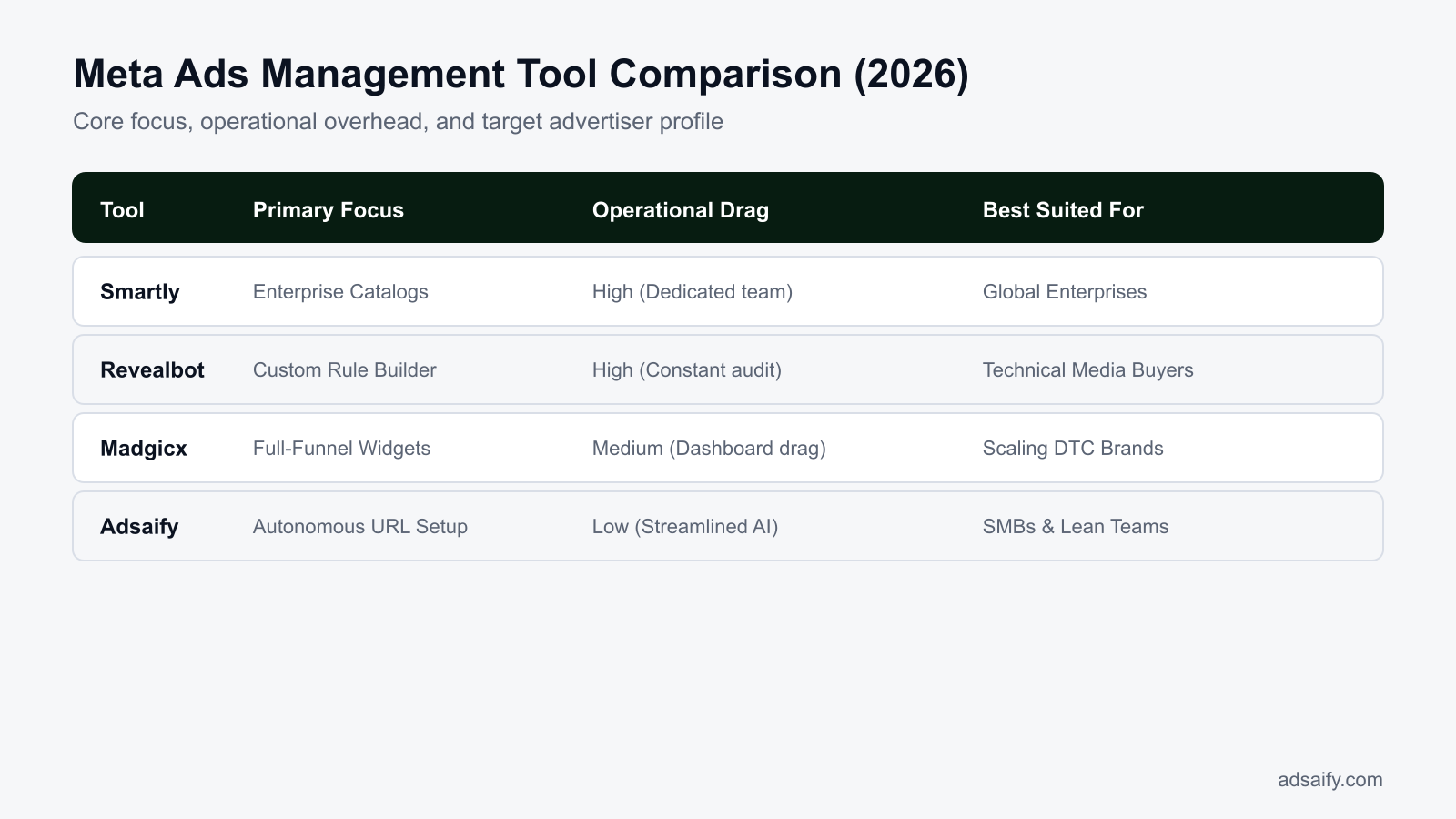
Tool alignment depends directly on your monthly advertising spend and internal technical capacity. If your brand spends under $50,000 monthly without a dedicated ad operations specialist, autonomous platforms like Adsaify eliminate manual setup and rule collisions by generating campaigns directly from your URL. Mid-sized teams with technical media buyers can justify rule-builder tools like Revealbot for granular control. Enterprise brands spending over $250,000 monthly with extensive dynamic inventories benefit most from enterprise platforms like Smartly.
If you would rather not set up each of these steps by hand, try it in Adsaify: your first ad is free, so there is nothing to lose. Create a free account.
What should you audit before simplifying your ad tool stack?
Before simplifying your Meta ad tool stack, audit your active automated rules, historical 30-day performance trends, internal operational labor hours, and technical alignment with Meta’s native delivery system. This structured review identifies redundant software triggers, prevents accidental spending spikes, and reveals whether external automation tools actually support or undermine native algorithmic learning.
Auditing rule execution history and ROAS trajectories
Begin by opening the native Automated Rules menu inside Meta Ads Manager and clicking on View Run History. Cross-reference this log with the activity logs of any connected third-party tools to identify overlapping automation triggers. Calculate the 30-day trajectory of ROAS across all modified ad sets. ROAS (return on ad spend) is the total advertising revenue divided by total ad spend. For example, with a 500 TL daily budget on an ad set, inspect whether external automation rules paused the asset prematurely before Meta gathered enough statistical signals, or whether automated budget increases occurred right before performance deteriorated.
Measuring team labor versus Advantage+ machine learning compatibility
Track the actual weekly hours your team spends building, monitoring, and debugging complex rule trees instead of developing new advertising angles. Modern Meta delivery engines, particularly Advantage+ shopping campaigns, optimize distribution by evaluating broad behavioral signals across the user base. When external tools execute micro-adjustments to budgets multiple times per day, they frequently reset the learning phase. The learning phase is the calibration period during which the Meta delivery system gathers conversion data to stabilize ad set distribution costs.
- Export all active automated rules from Meta Ads Manager and external third-party software dashboards into a single spreadsheet.
- Review every ad set paused by automation over the past thirty days to verify whether the pause decision reflected actual unprofitable delivery.
- Calculate the internal hours dedicated to software maintenance compared to time spent producing new creative concepts.
- Inspect ad set edit histories to flag automated budget changes that occurred more frequently than once every twenty-four hours.
- Identify rule conditions that conflict directly with Advantage+ broad targeting or automatic placement logic.
- Assess attribution discrepancies between third-party automation webhooks and Meta Ads Manager reporting.
Does turning off all third-party rules at once risk sudden ad spend leakage across my account?
Turning off third-party rules at once creates ad spend leakage only if your ad sets lack basic native safeguards. Before disabling external software, set native account-level or campaign-level spending limits within Meta Ads Manager, alongside standard lifetime or daily ad set budgets. Keep a simple native rule active that pauses ad sets spending twice your target CPA (cost per acquisition) without a conversion. CPA is the total ad spend divided by the number of tracked conversion actions. This prevents runaway spend while liberating native algorithms.
How to choose between Adsaify, Madgicx, Revealbot, and Smartly?
To choose between Adsaify, Madgicx, Revealbot, and Smartly, evaluate your team structure, catalog complexity, and media buying bottleneck. Enterprise global brands require Smartly for catalog transformation, quantitative media buyers select Revealbot for nested boolean rules, analytical agencies prefer Madgicx for visual cohort widgets, and lean e-commerce teams use Adsaify for autonomous creative and campaign generation.
Matching third-party automation tools to catalog size and rule complexity
Smartly serves enterprise advertisers managing vast product catalogs across international markets. A SKU (stock keeping unit) is an internal identification code assigned to a distinct product variant. Brands managing hundreds of thousands of dynamic SKU combinations across multiple localized currencies utilize Smartly for creative rendering and catalog synchronization. Revealbot caters to specialized programmatic media buyers who write complex algorithmic formulas. Teams with in-house data engineers use Revealbot to construct multi-layered boolean rules combining third-party attribution data, mobile measurement platforms, and customized pacing schedules.
Comparing analytics dashboards with automated campaign generation
Madgicx serves performance marketers who require granular visual auditing, funnel segmentation dashboards, and creative scoring tools. It organizes account data across acquisition and retention stages to help media buyers manually adjust manual bids and budgets. Conversely, Adsaify focuses on automated execution for businesses that lack time for manual campaign configuration. Instead of requiring complex manual rule logic, Adsaify analyzes a product website URL or business description to draft campaign audiences, write primary copy, suggest starting budgets, and generate visual creatives. While Adsaify provides automated safety rules to pause underperforming ads, it does not automatically swap creative files in running campaigns, making it ideal for lean teams needing structured execution rather than complex dashboard engineering.
- Catalog and spend audit — Review whether your business requires automated catalog rendering for tens of thousands of SKUs, which indicates an enterprise solution like Smartly.
- Rule engineering evaluation — Determine if your strategy depends on multi-layered conditional logic linking third-party metrics, which points toward Revealbot.
- Reporting needs assessment — Evaluate whether your internal team requires visual funnel segmentation widgets, which directs your selection toward Madgicx.
- Execution bottleneck diagnosis — Identify whether campaign creation and creative ideation consume most of your working hours, which indicates a need for Adsaify.
- Operational capacity alignment — Choose the single tool matching your workflow capability to prevent maintaining overlapping dashboards that duplicate native functionality.
Why is deploying Smartly or Revealbot often overkill for small-to-medium e-commerce businesses?
Deploying Smartly or Revealbot is often overkill for small-to-medium e-commerce brands because these platforms demand specialized technical management and substantial software overhead to deliver positive value. Lean teams rarely manage the hundreds of catalog feeds or intricate external data pipelines required to justify nested boolean rules. When smaller brands configure complex rule architectures, they divert working hours away from creative production and frequently constrict Meta's native machine learning, ultimately hurting campaign efficiency and return on ad spend.
How does an e-commerce brand migrate from complex rules to AI execution?
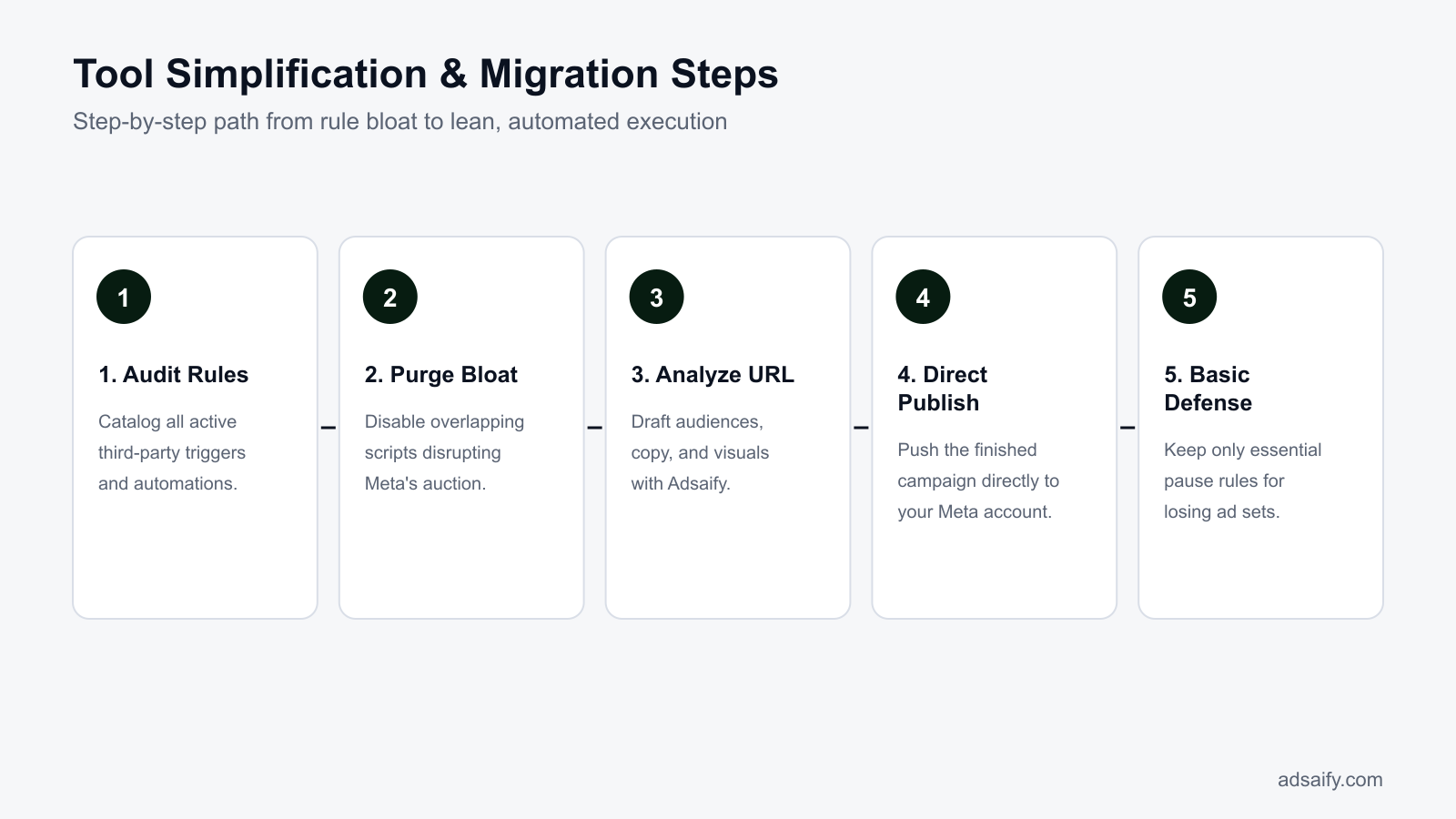
An e-commerce brand migrates from complex rules to AI execution by deactivating redundant conditional triggers, shifting campaign creation to automated systems, and maintaining minimal guardrails. Instead of micro-managing hourly bid adjustments, the advertiser lets algorithmic delivery manage budget allocation while utilizing AI software to analyze store data and draft relevant campaign assets.
Step 1: Pruning redundant triggers down to an essential safety rule
Consider an apparel brand spending 100,000 TL monthly running 28 nested rules across Revealbot. These rules often contain conflicting commands—such as automated 15 percent midday budget surges alongside 4-hour return on ad spend (ROAS) pause triggers—that throw ad sets into constant recalculation. The brand deactivates 26 of these micro-management conditions inside its third-party dashboard. It preserves only a foundational stop-loss automation rule: if an ad spends more than two times the target cost per acquisition (CPA, the total ad spend divided by the number of purchases) without generating a single purchase over a 72-hour window, the system automatically pauses that creative. Pruning conflicting logic eliminates accidental bidding resets inside Meta Ads Manager.
Step 2: Generating campaign foundations via store analysis
With external rule interference eliminated, the business generates its campaign framework using artificial intelligence. The advertiser inputs the store URL into Adsaify, which scans the website catalog, product descriptions, and site structure. The tool then drafts campaign parameters, generating proposed audience targeting clusters, distinct marketing angles, ad copy variations, and recommended budget allocations. Rather than spending hours manually configuring lookalike audiences and ad set hierarchies, the marketer reviews structured campaign proposals that align directly with real inventory data.
Step 3: Direct publishing and establishing baseline conversion metrics
The brand publishes the generated campaign directly to its existing Meta ad account from the interface. Once live, the advertiser monitors primary conversion metrics within Meta Ads Manager, specifically tracking purchase ROAS, cost per purchase, and conversion rate (the percentage of ad clicks that result in completed purchases). For example, after migrating this 100,000 TL apparel account, the team observes ad sets over a 14-day window without manual mid-day budget edits. They evaluate cost stability across Advantage+ placements, validating that Meta's internal auction distribution stabilizes when unhindered by external rule conflicts.
Do I need to build external conditional rules to govern budget pacing for ads published through Adsaify?
No, you do not need external conditional rules to govern pacing for campaigns published through Adsaify. Meta's native pacing algorithm monitors auction opportunities continuously across a 24-hour cycle to distribute your daily budget effectively. Layering third-party pacing conditions often interrupts this calibration, triggering erratic bidding. Adsaify provides necessary baseline automation, such as pausing underperforming ads based on actual performance, which lets you protect your ad spend without deploying fragile external scheduling chains.
How to measure if simplifying ad management tools improved ROAS?
You measure if simplifying ad management tools improved ROAS by auditing five operational and performance areas: the time spent maintaining rules versus developing creative, the frequency of Learning Limited flags, cost per acquisition stability, blended profitability, and total software expenditure over thirty to sixty days following simplification.
Operational velocity and algorithmic stability
Operational velocity tracks how internal team resources shift after removing complex tool configurations. Marketers record the hours previously dedicated to diagnosing broken automation conditions, webhook failures, and execution logs in tools like Revealbot or Madgicx. That saved time is redirected toward designing net-new creative variations, recording authentic user-generated content, and improving product landing pages.
Simultaneously, the advertiser monitors the delivery status column within Meta Ads Manager. When third-party automation software frequently alters ad set budgets by more than 20 percent, ad sets reset their calibration phases repeatedly. Removing these external interruptions reduces the incidence of the Learning Limited status—a state reached when an ad set exits the initial calibration window without achieving 50 conversion events—allowing Meta's machine learning models to exit calibration and locate buyers consistently.
Cost stability and software expenditure analysis
Simplified management manifests directly in cost per acquisition (CPA) stability. Without external scripts artificially throttling bids during brief performance dips, Meta balances out dayparting fluctuations across weekly averages. Furthermore, brands evaluate their POAS (profit on ad spend, calculated as gross profit divided by ad spend) alongside overhead changes. Eliminating redundant software tier charges improves the company's net bottom line independent of minor auction price variations.
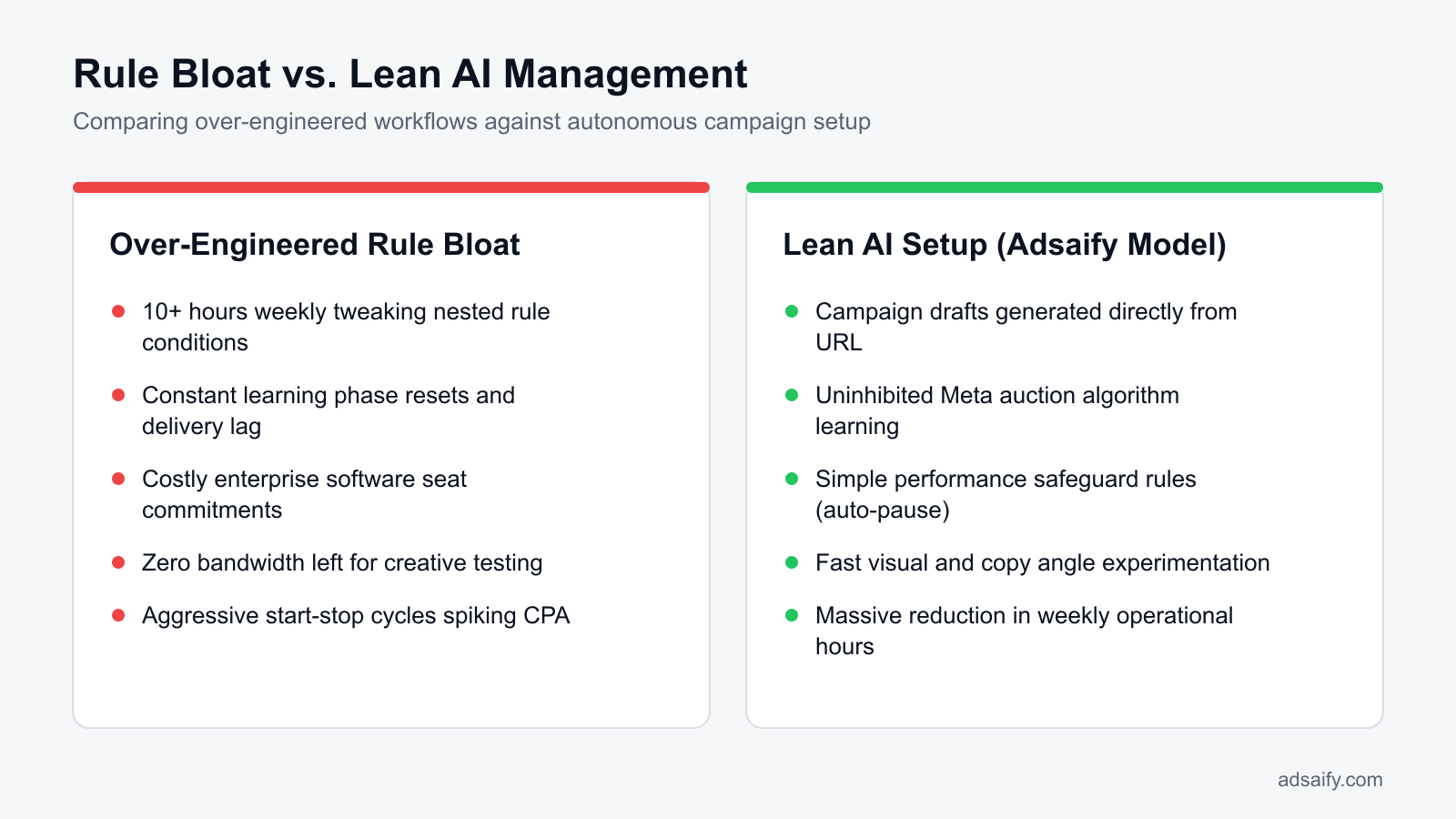
| Performance Dimension | Over-Engineered Rule Environment | Simplified Algorithmic Execution |
|---|---|---|
| Ad Set Delivery Status | Frequent resets and persistent Learning Limited flags | Stable delivery exiting the learning phase smoothly |
| Weekly Workflow Allocation | Hours spent auditing rule conditions and resolving trigger errors | Time dedicated to creative production and store conversion rates |
| Intraday Bid Behavior | Volatile bidding spikes caused by conflicting third-party rules | Predictable auction participation managed by Meta's pacing engine |
| Software Cost Structure | Multiple overlapping subscriptions eating into marketing margins | Streamlined tooling using simple automation via Adsaify |
How many days does it take for Meta's auction algorithm to stabilize after removing external rule triggers?
Meta's auction algorithm typically takes between three to seven days to stabilize after removing external rule triggers. During this window, an ad set requires approximately 50 conversion events under consistent budget conditions to complete its learning phase. Eliminating erratic rule interruptions allows the machine learning model to accurately map user intent, identify viable audience segments, and normalize your daily cost per acquisition across normal auction fluctuations.
Want to see this in your own account? Enter your website address and Adsaify drafts the campaign for you. The first ad is free. Try it now or log in.
Which weekly routine keeps ad tool management simple and effective?
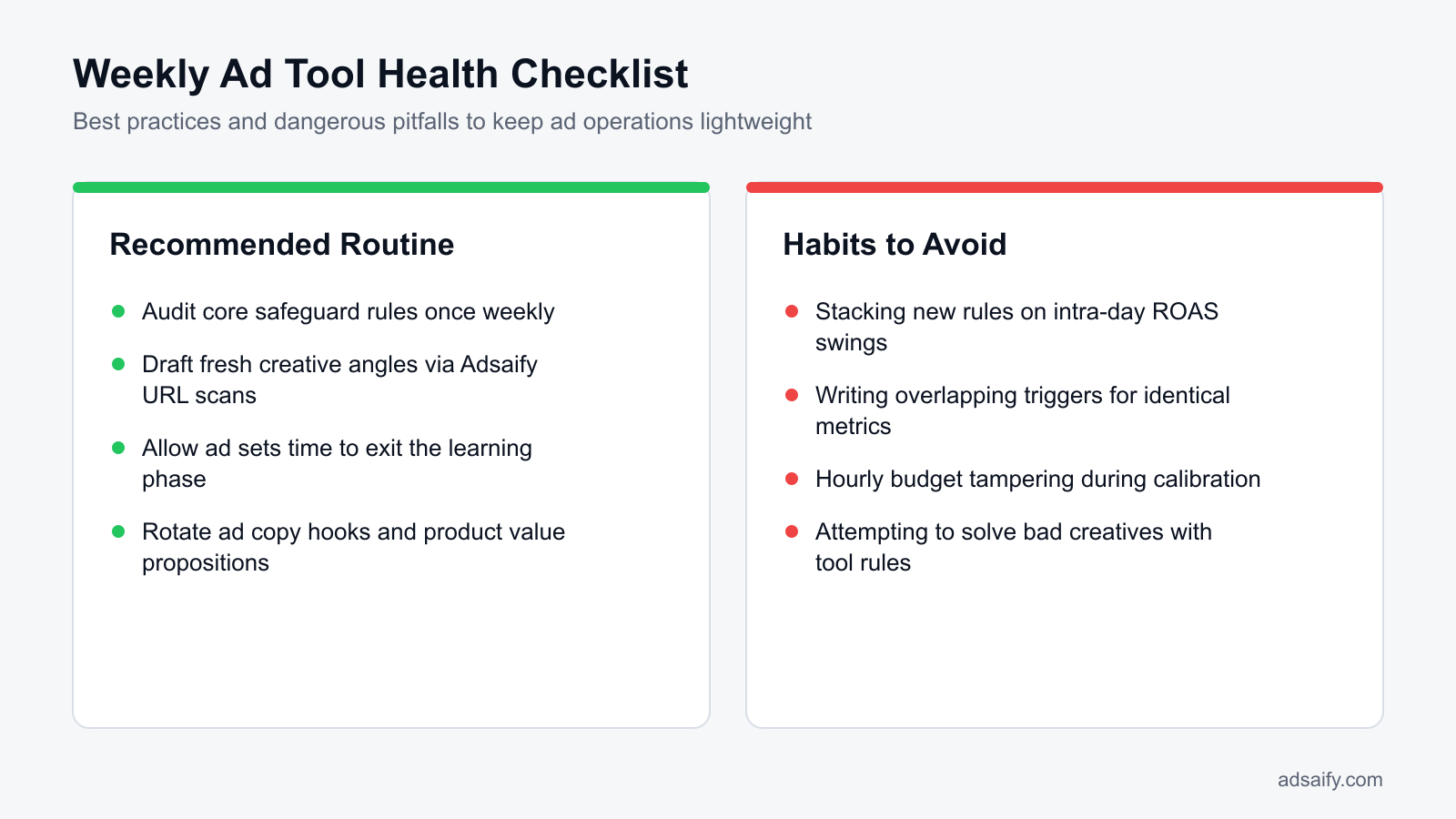
A simple weekly routine for Meta ad tool management involves checking basic stop-loss rules on Monday, staging fresh creative concepts on Wednesday, and confirming budget pacing on Friday. This schedule prevents tool over-engineering by focusing on ongoing creative production rather than micromanaging real-time bid filters or running complex, layered automation scripts.
Structured maintenance checklist for Meta ad accounts
Maintaining an effective ad account requires consistent operational hygiene across Meta Ads Manager rather than continuous intervention. The following recurring schedule keeps ad management streamlined and protects delivery stability:
- Daily: Check Meta Ads Manager delivery status and account spending limits to confirm active campaigns run smoothly without sudden billing disruptions or payment threshold rejections.
- Weekly (Monday): Verify that fundamental stop-loss rules remain active across campaigns, such as pausing an individual ad when its spend exceeds the target CPA (cost per acquisition is the ad spend required to generate one sale) without delivering a conversion.
- Weekly (Wednesday): Feed a product landing page URL into Adsaify to generate and stage new creative angles, draft copy variations, and suggest target audiences for the next deployment round.
- Weekly (Friday): Check account-level budget pacing and blended ROAS (return on ad spend is total revenue divided by ad spend) to ensure campaigns have adequate headroom for weekend e-commerce purchase spikes.
- Weekly (Sunday): Review creative engagement indicators such as CTR (click-through rate is the percentage of impressions that result in clicks) to identify which visual formats resonated best over the weekend.
- Monthly: Open Meta Business Settings, navigate to System Users and Connected Apps, and audit third-party access tokens to revoke authorizations for discontinued software tools.
- Monthly: Purge outdated conditions within the Meta Ads Manager Automated Rules panel to eliminate obsolete rules that conflict with active campaign objectives.
If I skip adding new creatives during my weekly routine, will automated rules protect my account from fatigue?
No, automated rules cannot protect an ad account from creative fatigue. Automation rules can only pause decaying ads or lower budgets when ad fatigue raises CPA; they cannot produce or launch replacement ads on their own. When fatigue sets in and you do not introduce fresh angles, your rules will simply turn off unprofitable ads until your entire account stops spending and revenue drops. Continuous creative staging remains mandatory regardless of your software stack.
Which common mistakes occur when selecting Meta ad management tools?
The most common mistakes when selecting Meta ad management tools include prioritizing complex rule builders over creative iteration, purchasing expensive enterprise platforms prematurely, and expecting automated software to refresh decaying ads autonomously. Advertisers often over-engineer their tech stack with overlapping rules, which damages ad delivery and creates unnecessary monthly software overhead.
Confusing rule complexity with business value
Advertisers frequently believe that managing fifty granular rule triggers will yield higher performance than running five simple conditions. In practice, dense rule configurations trigger rapid budget fluctuations that reset Meta's ad set learning phase. The fix is to configure only high-level safety rules, such as pausing ads that spend more than two times target CPA without a conversion.
Neglecting creative quality while tuning automation
Media buyers often spend hours writing conditional logic instead of testing fresh ad concepts. No automation algorithm can make an unappealing product offer or low-quality visual profitable. The fix is to allocate the majority of weekly marketing hours toward customer research, visual asset production, and hook testing.
Signing enterprise commitments prematurely
Subscribing to enterprise platforms like Smartly before monthly ad spend justifies catalog rendering suites introduces heavy software overhead. These commitments drain cash flow that should fund ad spend testing. The fix is to adopt streamlined platforms like Adsaify to draft campaigns and enforce simple protection rules before scaling into enterprise-tier contracts.
Expecting software to refresh ad creative autonomously
Media buyers sometimes assume that ad automation tools will detect audience fatigue and automatically replace worn-out visual assets inside active ad sets. No tool, including Adsaify, swaps or replaces creative assets in running campaigns unassisted. The fix is to stage new visuals manually each week and launch them into your testing ad sets.
Stacking multiple automation tools on one account
Operating multiple external automation tools simultaneously results in conflicting automated commands sent to the Meta Marketing API. One tool may attempt to increase budget based on return signals while another pauses the ad set due to impression frequency. The fix is to choose a single platform as your system of record for account automation.
Automating decisions on statistically insignificant data
Setting automation rules that trigger after an ad spends an arbitrary sum, for example 50 TL, pauses potential winners before Meta delivers enough impressions to stabilize delivery. The fix is to calibrate rule evaluation windows to minimum sample sizes, evaluating metrics over three-day or seven-day attribution windows.
Does it make sense to run Revealbot or Madgicx for rules while drafting campaigns through Adsaify?
Running multiple tools simultaneously usually creates technical conflict and unnecessary subscription expenses. Adsaify provides its own automation rules for pausing poor performers alongside AI campaign drafting, making an additional rule tool redundant for most brands. Stacking Revealbot or Madgicx on top of Adsaify increases the risk of overlapping pause and unpause triggers fighting each other in Meta Ads Manager. Consolidating your stack onto a single platform keeps your ad operations simpler, cheaper, and more reliable.
When will switching or simplifying Meta ad tools not solve ad performance?
Switching or simplifying Meta ad tools will not solve poor ad performance when foundational commercial issues exist outside of campaign automation. If an e-commerce website suffers from severe checkout friction, broken server tracking, negative unit economics, or insufficient ad spend to exit the learning phase, altering your software stack cannot produce sustainable profitability.
Commercial and Conversion Bottlenecks Outside Meta Ads Manager
Automation platforms only amplify the conversion efficiency of an underlying offer. If an e-commerce store exhibits a fundamentally flawed landing page conversion rate—where CRO (conversion rate optimization) is the systematic practice of increasing the percentage of visitors who complete a purchase—no automation rule can force a sale. High checkout abandonment frequently stems from unexpected shipping fees added at the final step, slow site loading speeds, or missing mobile payment gateways such as Apple Pay. Similarly, if unit economics leave insufficient gross margin after accounting for product costs, fulfillment, and returns, paying a lower CPA (cost per acquisition) will still fail to produce a positive ROAS (return on ad spend is the revenue generated divided by ad spend).
Data Integrity and Delivery Volume Constraints
Tool configurations cannot compensate for corrupted data telemetry. Meta relies on signals from the Meta Pixel and Conversions API (CAPI is a server-to-server data bridge transmitting web events directly to Meta) to identify prospective buyers. When duplicate events fire without unique event IDs, or when Event Match Quality scores drop critically low in Meta Events Manager, the bidding algorithm receives inaccurate conversion values. Furthermore, Meta requires roughly 50 conversion events per ad set within a 7-day window to exit the Learning Phase. An advertiser spending 300 TL per day on a product with a 600 TL acquisition cost cannot generate the volume required for algorithmic stability, regardless of whether rules are managed natively or via external software.
- Verify server-side event deduplication in Meta Events Manager between the browser Pixel and Conversions API.
- Test every payment gateway across both mobile and desktop screen sizes using live test transactions.
- Calculate gross margins after product cost, packaging, payment gateway fees, and average return rates.
- Inspect mobile page load speeds on landing pages using throttled network connections to prevent drop-offs.
- Audit weekly purchase volume to confirm each active ad set generates at least 50 optimization events.
- Review Event Match Quality scores in Events Manager to ensure customer parameters pass without warnings.
If my conversion rate is lagging, what should I audit on my website before reconfiguring ad tools?
Audit your mobile checkout funnel, page load latency, pricing clarity, and trust signals before altering ad management software. Check whether page loading takes longer than three seconds on standard mobile connections, test if form fields require unnecessary inputs, and ensure payment methods such as Apple Pay or local cards process without errors. Additionally, inspect shipping fees, return policy visibility, and product review authenticity to confirm that friction on the product detail page is not driving prospective customers away.
Which key terms define modern Meta ad management tools?
Modern Meta ad management tools are defined by technical terms describing algorithmic delivery, conditional automation, programmatic campaign creation, and data telemetry. Understanding these concepts allows advertisers to evaluate software capabilities objectively, avoid redundant tool configurations, and structure ad accounts in harmony with Meta's native machine learning auction algorithms rather than against them.
- Rule-Based Automation: Pre-programmed conditional logic that fires specific adjustments, such as pausing an underperforming ad, when predefined metric criteria are satisfied.
- Autonomous Ad Creation: Software systems that analyze a business website URL or brief description to draft targeting parameters, ad copy, and creative assets without manual campaign assembly.
- Learning Phase: The calibration period during which Meta's delivery system gathers approximately 50 conversion events per ad set to stabilize auction pricing and delivery efficiency.
- Creative Fatigue: The natural performance decay that occurs when ad frequency rises, causing an audience to tire of an asset and conversion rates to drop.
- Conversions API (CAPI): A server-side integration that transfers customer action data directly from a merchant's server to Meta to safeguard measurement against browser-level blocking.
- Advantage+ Shopping Campaigns (ASC): Meta's native automated campaign model that combines audience targeting, budget allocation, and creative testing within a single machine-learning-driven structure.
- Cost Per Acquisition (CPA): The total marketing spend divided by the total count of completed purchase actions attributed to an advertising campaign.
- Return on Ad Spend (ROAS): ROAS (return on ad spend) is a foundational performance metric calculated by dividing gross campaign revenue by total advertising spend.
- Bid Cap: An auction constraint setting the maximum dollar amount an advertiser permits Meta to bid in any individual ad auction.
- Event Match Quality (EMQ): A metric inside Meta Events Manager rating how well customer data parameters match against active Meta user profiles for conversion attribution.
- Auction Overlap: An operational conflict where multiple ad sets from the same ad account compete against each other in the auction, causing Meta to suppress one to prevent self-inflation.
Do autonomous ad creation platforms replace Meta's native Advantage+ campaign ecosystem?
No, autonomous ad creation platforms do not replace Meta's native Advantage+ campaign ecosystem; instead, they complement it by generating and deploying structured assets into the ad account. Modern tools like Adsaify analyze a website URL to draft targeted ad copy, generate creatives, and suggest budgets, which are then published directly into your Meta ad account. Meta's native algorithms still manage real-time auction bidding and impression delivery, while creation platforms streamline upstream campaign preparation.
What is the best way to move past rule bloat in Meta ads?
To prevent tool over-engineering in Meta ad automation, begin by auditing all active automation rules across Meta Ads Manager and third-party platforms to identify overlapping triggers. Next, consolidate complex campaign structures into unified workflows that combine Meta machine learning with straightforward rules, such as pausing underperforming ads. Finally, disconnect redundant third-party applications from Meta Business Settings to eliminate duplicate API requests and lower software overhead.
Today, open Meta Ads Manager and review your automation history to turn off any rule that has not triggered over the past thirty days. Simplify your active rules down to one basic safety check, such as pausing ads when spend exceeds your target CPA (cost per acquisition) without generating a purchase. This single step immediately reduces system fragility while maintaining essential account safety.
Want to see this in your own account? Enter your website address and Adsaify drafts the campaign for you. The first ad is free. Try it now or log in.
Frequently Asked Questions (FAQ)
1. Will my ad spend spiral out of control if I delete all custom rules in Revealbot or Madgicx?
No, ad spend will not spiral out of control if you delete custom rules, provided that you configure daily or lifetime budgets correctly at the campaign or ad set level in Meta Ads Manager. Native account budgets establish hard spend caps that Meta cannot exceed. You can also deploy basic native automated rules directly within Meta to pause underperforming ads if performance drops.
2. At what spend threshold and business complexity does Smartly become necessary?
Smartly becomes practical primarily for enterprise brands managing large monthly ad spend across tens of thousands of dynamic product catalog items and multiple localized markets. If your business runs standard catalog sales or standard creative campaigns with moderate product variations, native Meta Ads Manager features combined with lightweight tools like Adsaify fulfill daily campaign drafting and rule requirements without enterprise-level software complexity.
3. Do I ever need to open native Meta Ads Manager while managing campaigns with Adsaify?
Yes, you will occasionally need to open native Meta Ads Manager while managing campaigns with Adsaify. Adsaify drafts audiences, copy, creatives, and budget suggestions, and publishes them to your account with automated pause rules. However, managing primary payment methods, editing business account user roles, and setting account-level spending limits must still be completed directly inside native Meta Business Settings.
4. Does connecting multiple automation tools to the same ad account trigger API conflicts?
Yes, connecting multiple automation tools to the same ad account frequently causes API (application programming interface) conflicts. If tool A raises a campaign budget based on ROAS (return on ad spend) while tool B simultaneously pauses the ad set due to rising cost per click, the tools trigger conflicting commands, reset campaign learning phases, and hit Meta API rate limits.
5. Do third-party automated rules cooperate well with Meta's Advantage+ Shopping Campaigns?
Third-party automated rules often conflict with Advantage+ Shopping Campaigns because Meta's machine learning dynamically shifts budgets across audience segments and creative combinations. External rules that frequently pause creative assets or adjust budgets disrupt this native algorithmic optimization, forcing the ad set back into the learning phase and diminishing overall campaign efficiency.
6. Can Adsaify automatically pause ad variations that fail to meet performance thresholds?
Yes, Adsaify offers automated rules that monitor campaign metrics and automatically pause ad variations that fail to achieve defined performance thresholds, such as an acceptable cost per result. However, Adsaify does not create new creative replacements automatically; the user must generate new creative assets within the tool and add them to the campaign manually.
7. Does eliminating automation rule bloat reduce agency fees or internal team headcount?
Eliminating automation rule bloat directly reduces the labor hours required to troubleshoot conflicting scripts and broken workflows. While it may not automatically eliminate headcount, it decreases reliance on specialized marketing operations personnel and expensive third-party software subscriptions. This operational simplicity allows internal teams and agencies to focus resources on creative testing and strategic growth rather than rule maintenance.
8. Is there a fee to test and publish my first AI campaign draft through Adsaify?
No, there is no fee to test and publish your first AI campaign draft through Adsaify because the first ad on Adsaify is free to try. You can register an account, let the tool analyze your website URL to generate campaign assets and budget suggestions, and publish that initial campaign directly to your Meta ad account.
How can you try this with Adsaify?
The quickest way to apply the steps in this article to your own account is to try them. Adsaify analyses your business from your website address, drafts the campaign with an audience, ad copy, creative and a budget suggestion, and publishes it to your own Meta ad account once you approve.
- Your first ad is free: there is nothing to lose by trying.
- Your own ad account: the campaign runs in your Meta account and you stay in control.
- Images and video: generate ad creatives with AI or promote an existing Instagram post.
Create a free account and try your first ad · Already have an account? Log in.