
Short answer: Utilizing AI tools is crucial for enhancing e-commerce ad performance. These tools analyze target audiences more effectively and optimize your ad strategies.
Every morning starts inside Meta Ads Manager reviewing yesterday's numbers: your cost per purchase is steadily climbing, click-through rates on core creatives are dropping, and campaigns that generated stable returns last week have suddenly stalled. You spend hours writing fresh ad copy, testing interest audiences, and reallocating daily budgets across ad sets, yet your blended customer acquisition cost keeps eating directly into store margins.
This performance decay occurs because modern ad auctions penalize repetitive creatives, narrow manual targeting, and slow operational responses to creative fatigue. When an e-commerce store relies entirely on manual account adjustments, production speed cannot keep pace with audience saturation, causing ad algorithms to bid on increasingly expensive impressions. Leaving these inefficiencies unaddressed drains working capital, inflates acquisition costs, and forces brands to contract their ad budgets rather than scale profitably.
By following this guide, you will learn how to diagnose systemic delivery bottlenecks, prepare clean tracking data, and apply artificial intelligence to streamline creative production and campaign management. We cover why e-commerce campaigns underperform, what structural preparations to make before launching new tests, and how to measure real post-click performance to build sustainable advertising profitability on Facebook and Instagram.
Key Takeaways
- AI conducts audience analysis.
- Enables competitive ad budget management.
- Offers continuous optimization for competitive advantage.
- Provides performance tracking and reporting capabilities.
What Are the Performance Issues in E-Commerce Ads?
E-commerce ad performance issues primarily manifest as low click-through rates, high costs per click, and declining conversion rates. These symptoms indicate that users either ignore the creative in the feed, find the messaging irrelevant, or abandon the purchase journey after landing on the online store, leading to unprofitable ad spend.
What causes low click-through rates?
CTR (click-through rate) is the percentage of impressions that result in a click. In Meta Ads Manager, advertisers should evaluate CTR (Link Click-Through Rate) rather than CTR (All), because link clicks represent actual traffic navigating toward the online catalog. When CTR drops below 1.00% on a cold acquisition campaign, the ad creative usually suffers from a weak visual hook within the first three seconds, unreadable overlay text, or visual fatigue from prolonged ad delivery.
Why do cost-per-click values become expensive?
CPC (cost per click) is the financial amount an advertiser pays each time an ad click occurs. Elevated CPC values occur when Meta's ad auction assigns low quality or low engagement rankings to an ad relative to competitors competing for the same audience. When an ad fails to generate initial positive engagement, the algorithm charges a premium to show that ad in high-value placements such as the Instagram Feed or Facebook Stories.
What factors lead to low conversion rates?
CVR (conversion rate) is the percentage of website visitors who complete a purchase after clicking an ad. A low CVR indicates a breakdown between ad messaging and the product detail page. Common causes include slow mobile page loading speeds exceeding three seconds, inconsistent pricing between the ad and checkout page, or forced account registration. ROAS (return on ad spend) is the total revenue generated divided by the total advertising spend. When CVR collapses, ROAS falls alongside it.
For example, an e-commerce store selling leather messenger bags operated with a 500 USD daily budget in Meta Ads Manager. The initial campaign recorded a CTR (Link Click-Through Rate) of 0.45%, a CPC of 3.20 USD, and zero purchases across two days. The advertiser switched the campaign creative from a single static studio photo to a product video demonstrating bag compartments and added customer review quotes in the primary text. Afterwards, the advertiser checked the Ads Manager reporting dashboard and observed the CTR rise to 1.80%, the CPC decrease to 0.95 USD, and the conversion rate reach 2.40% across the subsequent seven days.
How can I identify these issues?
To identify e-commerce ad issues, open Meta Ads Manager, select the Columns dropdown menu, and choose Customize Columns. Add Link Click-Through Rate, CPC (Cost per Link Click), Purchases, and Cost per Purchase to the reporting view. Compare these metrics against baseline benchmarks. A low link click rate paired with a high click cost points to an ad creative failure, whereas a healthy click rate coupled with zero purchases points directly to an on-site checkout problem.
Why Do E-Commerce Ads Underperform?
E-commerce ads underperform primarily due to mismatched audience targeting, budgets that cannot clear Meta's learning phase amidst competitive auctions, and creative content that fails to capture shopper attention. When ad delivery algorithms receive insufficient conversion signals or audiences scroll past generic product imagery, acquisition costs rise and campaign efficiency collapses.
Why does audience setup cause poor ad delivery?
Meta's advertising delivery engine relies on machine learning to locate buyers within designated target parameters. When an advertiser stacks narrow, overlapping interest groups in a single ad set, the audience size becomes excessively restricted. This restriction prevents the algorithm from finding the most cost-effective conversion opportunities within the larger pool. Conversely, using broad targeting without clear creative hooks forces the algorithm to spend ad budget testing users who have zero intent to buy.
Why does budget size fail against auction competition?
The learning phase is the period where Meta's delivery system explores the best ways to deliver an ad set, requiring roughly 50 optimization events within a seven-day window. When an e-commerce merchant sets a daily budget of 10 USD on an ad set optimizing for a Purchase event that costs 30 USD to acquire, the ad set cannot generate the necessary 50 purchases. As a result, the campaign remains stuck in Learning Limited status, causing volatile delivery costs during peak auction periods.
How does uncompetitive creative content reduce delivery?
Meta prioritizes ads that keep users engaged on Instagram and Facebook. Static catalog images lacking context, clear benefits, or user-generated reviews fail to stop scrolling behavior in the feed. Brands can use AI platforms like Adsaify to analyze a store URL, generate conversion-focused ad images and videos, and publish them directly into their Meta ad accounts. Merchants can register for an account to draft campaigns based on automated website analysis.
| Campaign Element | Underperforming Setup | Optimized Configuration | Observed Symptom |
|---|---|---|---|
| Audience Structure | 5 overlapping interest groups in one ad set | Advantage+ audience with broad parameters | Audience fatigue and high frequency |
| Budget Allocation | Budget lower than 50x target cost per purchase weekly | Daily budget aligned to hit 50 events in 7 days | Ad set trapped in Learning Limited |
| Creative Format | Single white-background product catalog photo | Short-form video demonstrating product usage | Hook rate under 15% in first 3 seconds |
| Bid Strategy | Bid caps set below actual market clearing prices | Highest Volume bidding for consistent delivery | Budget fails to spend completely each day |
How can I better define my target audience?
To define your audience effectively, leverage Advantage+ audience within Meta Ads Manager instead of layering dozens of niche interest tags. Provide customer list Custom Audiences as audience suggestions to guide the algorithm toward existing buyers. Ensure the ad creative itself qualifies the viewer by explicitly stating the product benefit, price bracket, and solution within the first three seconds of video footage or top text lines.
What Are the Costs of Low E-Commerce Ad Performance?
The costs of low e-commerce ad performance include direct revenue loss from missed sales opportunities, suppressed brand visibility across ad placements, and excessive media waste. When campaigns fail to convert profitably, advertising budgets deplete without generating customer acquisition, which distorts attribution data and limits the capital available for business growth.
How Poor Ad Performance Causes Revenue and Visibility Losses
Direct sales losses occur when ad traffic fails to convert on your storefront. In Meta Ads Manager, when metrics like outbound click-through rate (CTR), which is the percentage of ad impressions that resulted in an outbound click to your website, fall below healthy baselines, your conversion volume drops while your ad spend continues. E-commerce merchants holding seasonal inventory or perishable promotional margins feel this immediately in reduced cash flow.
Brand visibility also decreases because of Meta's auction mechanics. Meta evaluates ads using an total auction value formula based on bid, estimated action rates, and ad quality. Ad quality is a diagnostic rating reflecting audience feedback and post-click experience. When ad quality scores lag, Meta shifts impressions to competing advertisers. Your ads receive poorer placements in Instagram Feed and Facebook Reels, requiring higher bids simply to maintain basic reach.
High advertising costs quickly follow as cost per acquisition (CPA), which is the total advertising spend divided by the number of purchases, escalates. A retailer operating with negative unit economics burns liquidity rapidly. For example, consider an online specialty coffee store spending a daily budget of $200 in Meta Ads Manager. Initially, the merchant targets a broad audience using a single static image ad, recording a CPA of $50 against an average order value of $40, yielding a ROAS (return on ad spend, calculated as revenue divided by ad spend) of 0.80. The merchant changes strategy by segmenting the campaign into two ad sets: one testing three dynamic video creatives showcasing bean brewing techniques, and another using Meta Advantage+ catalog ads. After seven days, the merchant evaluates Cost per Result, Website Purchases, and ROAS in Meta Ads Manager. The catalog ad set drops the acquisition cost to $20 with a ROAS of 2.00, while the underperforming static ad set is paused, recapturing daily margins.
What are the financial costs of low performance?
The financial costs of low e-commerce ad performance include squandered media expenditure, inflated customer acquisition expenses, and depressed gross profit margins. When return on ad spend drops below your break-even threshold, every ad impression drains working capital. Furthermore, unoptimized ad accounts force businesses to absorb elevated platform delivery bids, turning ad campaigns from predictable customer acquisition engines into net liabilities that stall inventory turnover and restrict ongoing cash flow.
What Steps Should I Follow to Improve Ad Performance?
To improve e-commerce ad performance, you should deploy artificial intelligence tools to identify buyer personas, produce high-engagement creative variations, and implement automated budget allocation rules. Following a systematic optimization workflow eliminates media waste, stabilizes return on ad spend, and ensures your campaigns consistently adapt to changing market signals in Meta Ads Manager.
Executing an Optimization Workflow with AI and Meta Tools
Begin by using AI-powered tools for audience analysis. Rather than guessing demographic targets inside Meta Ads Manager's detailed targeting interface, an AI platform can analyze your e-commerce catalog URL or product descriptions to suggest high-intent buyer interests, lookalike concepts, and Advantage+ audience configurations. Integrating AI at this stage removes bias and aligns your campaigns with verified customer intent.
Next, create competitive content using artificial intelligence. Creative fatigue, which is the performance decline that happens when audiences see the same advertisement too frequently, represents the main reason ROAS degrades over time. Produce multiple creative iterations, including AI-generated static lifestyle backgrounds, engaging short-form video concepts, and diverse copywriting angles highlighting different buyer pain points. You can also turn existing top-performing organic Instagram posts into paid ads within your campaign architecture.
Finally, optimize your budget with automated ad management systems. Platforms like Adsaify automate the campaign drafting process by scanning your website URL to suggest audiences, copy, creatives, and initial budgets, publishing the build directly to your connected Meta ad account. Once campaigns are live, automated rules protect profitability by monitoring metric thresholds. For example, you can set an automation rule to pause any ad set whose CPA exceeds your target over a three-day evaluation window. You can create an account on Adsaify to launch your first AI-drafted campaign for free.
- Store analysis — An AI tool analyzes your website URL or product catalog to establish target buyer personas, which determines your initial ad targeting structure.
- Creative generation — The platform drafts varied image prompts, video assets, and primary text options, which determines the ad variations uploaded to Meta Ads Manager.
- Campaign deployment — The campaign, ad sets, and creative combinations publish directly to your Meta ad account, which initiates the delivery learning phase.
- Threshold evaluation — Automated performance rules monitor return on ad spend and cost per acquisition daily, which decides whether an individual ad remains active or is paused.
- Creative review — The media buyer checks diagnostic metrics like frequency and outbound click rate, which determines when to manually generate and insert fresh creative variations.
Which AI tools should I use?
You should use artificial intelligence tools that integrate directly with Meta Ads Manager to streamline ad creation, creative production, and performance monitoring. Solutions like Adsaify evaluate your e-commerce storefront URL to draft complete campaign architectures, generate promotional copy and visual assets, and execute budget protection rules. By pairing generative AI for creative asset development with rule-based automation for metric evaluation, you optimize operational efficiency while keeping tight control over campaign profitability.
If you would rather not set up each of these steps by hand, try it in Adsaify: your first ad is free, so there is nothing to lose. Create a free account.
What Preparations Should I Make Before Optimizing My Ads?
Before optimizing e-commerce ads, marketers must audit historical performance metrics in Meta Ads Manager, organize audience retention data from Meta Pixel, and evaluate competitor creative angles in Meta Ad Library. These preparations identify baseline conversion rates and high-value customer segments so optimizations address proven conversion bottlenecks rather than guesswork.
What baseline metrics should you audit in Meta Ads Manager?
Auditing historical campaign delivery requires reviewing specific metrics over a 30-day attribution window. ROAS (return on ad spend) is total revenue generated divided by ad spend, and CPA (cost per acquisition) is total ad spend divided by completed purchases. Marketers must open Meta Ads Manager, select the Columns dropdown, and choose Customize Columns to display ROAS, CPA, purchase conversion value, and CTR (click-through rate), which is the percentage of impressions that result in clicks. Use the Breakdown menu to inspect delivery by placement, age, and gender. Identifying which placements produce conversions below your break-even ROAS prevents wasting optimization budgets on unviable delivery channels.
How do you gather target audience and competitive data?
Audience preparation relies on first-party data captured by Meta Pixel, which is the tracking script installed on an e-commerce website to record visitor actions. In Events Manager, verify that Purchase, Add to Cart, and View Content events fire without duplicate records. Marketers should extract customer email lists to construct Custom Audiences and generate a 1% Lookalike Audience based on high-lifetime-value purchasers. Next, review active competitor campaigns inside Meta Ad Library. Analyze the value propositions, discount angles, and media formats competitors run for more than 30 days, as sustained campaigns indicate profitable customer response. Marketers seeking automated baseline targeting can test Adsaify, which analyzes an e-commerce store from its website URL to draft initial campaign structures and audience suggestions.
Complete this preparation checklist before adjusting active budgets or ad sets:
- Audit 30-day CPA, ROAS, and CTR benchmarks in Meta Ads Manager.
- Verify Meta Pixel and Conversions API event deduplication in Events Manager.
- Export top-purchaser lists to build 1% Lookalike Audiences in Audiences manager.
- Inspect active competitor creatives and offers inside the Meta Ad Library.
- Confirm advertised product stock levels in e-commerce inventory management.
- Calculate break-even CPA thresholds based on gross product margins.
How should I analyze my campaign data?
To analyze campaign data effectively, open Meta Ads Manager and select the Custom Conversions reporting view spanning the last 14 to 30 days. Segment ad set delivery using the Breakdown menu by placement, device, and demographic group to spot high-cost outliers. Compare your Cost Per Purchase against your target break-even CPA, and examine Click-Through Rate alongside Frequency, which is the average number of times each unique user sees an ad. If Frequency exceeds 3.0 while Click-Through Rate declines, ad fatigue is suppressing conversion efficiency.
What Does an Example of Improving Ad Performance Look Like?
An effective ad performance turnaround replaces fragmented, broad campaigns with consolidated budget structures, refreshed creative angles, and rule-based optimizations. In practice, a store restructures ad sets around verified purchase signals, tests AI-generated image variations, reallocates budget to top-performing ad sets, and uses automated rules to pause underperforming ads before wasting budget.
How does audience restructuring work in practice?
Consider an example of an online leather goods store spending 1,000 TL per day across eight scattered ad sets, producing an unprofitable ROAS of 1.4 and a CPA of 250 TL. The marketer consolidates the campaign structure into an Advantage Campaign Budget setup, which distributes budget dynamically across ad sets using Meta algorithms. The marketer creates two ad sets: one broad ad set using Advantage+ audience targeting, and one custom ad set targeting a 1% Lookalike Audience of previous purchasers. Consolidating budget exits the Meta learning phase faster, concentrating delivery on audiences with higher purchase intent.
How does AI content creation improve testing?
Creative fatigue often drives high acquisition costs when identical product images run for weeks without variation. In this leather goods example, the retailer uses AI to produce four distinct visual angles without organizing costly photoshoots: a studio product close-up, an outdoor lifestyle scene, a customer unboxing shot, and an annotated graphic highlighting craftsmanship details. E-commerce owners can use Adsaify to generate ad images and videos with AI, draft contextual ad copy, and publish the campaign directly into their Meta ad account, where the first ad is free to try. Testing multiple AI-generated creative concepts simultaneously lowers Cost Per Click by discovering which visual hooks resonate with distinct buyer personas.
How should you optimize budgets and track results?
After launching the consolidated campaign with refreshed AI creatives, the retailer monitors metrics over seven days. In this example, the lifestyle image generates purchases at 95 TL CPA, while the unboxing concept produces a CPA of 310 TL against a 140 TL target threshold. The marketer applies automation rules to pause any ad creative that fails to deliver a purchase within two times the target CPA. Adsaify provides automated rules that pause underperforming ads based on live performance data. Following these optimizations, the store's blended ROAS rises to 3.1, and average CPA drops to 110 TL across the account.
How can I proceed with a real example?
To proceed with a real campaign turnaround, select your single highest-converting product catalog item and define your target unit economics. Build one consolidated Advantage Campaign Budget structure with two ad sets: one broad audience and one verified retargeting pool. Generate three distinct creative angles using AI imagery, launch with a purchase conversion objective, and monitor Cost Per Acquisition daily. Apply an automated rule to pause any ad exceeding your target acquisition threshold after reaching 500 impressions.

What Are the Most Common Mistakes in E-Commerce Ads?
The most common mistakes in e-commerce ads are over-constraining audience targeting, setting budgets below the threshold required for algorithmic learning, and deploying generic or repetitive creative assets. These execution errors prevent Meta Ads Manager from finding conversion patterns, inflate customer acquisition costs, and cause ad fatigue before campaigns achieve stable profitability.
Narrowing Down the Target Audience
Many media buyers restrict ad delivery by stacking multiple interest, demographic, and behavior filters inside the Ad Set setup screen. In Meta Ads Manager, detailed targeting restricts the machine-learning delivery system from discovering potential buyers outside arbitrary categories. Meta requires roughly 50 conversion events per ad set within a 7-day period to exit the learning phase—the initial calibration stage where the delivery algorithm determines who is most likely to convert. Micro-targeting shrinks the addressable pool, driving up CPM (cost per mille, which is the cost per one thousand ad impressions) and forcing ad sets into the "Learning Limited" status.
Allocating Insufficient Budget
Setting budgets too low for the account's target CPA (cost per acquisition, which is the total ad spend required to generate a single purchase) directly starves the Meta optimization algorithm. For example, if an online store has an average CPA of $30, allocating a daily budget of $10 per ad set guarantees that the ad set cannot generate the necessary 50 weekly purchases needed for delivery optimization. When an ad set fails to complete 50 conversions in a week, delivery fluctuations increase, CPM prices spike, and performance becomes unpredictable.
Producing Inadequate Content
Running single static images or low-effort creative assets across all placements leads to swift ad fatigue, which occurs when target audiences see the same advertisement too frequently and stop responding. Using only 1:1 square assets also wastes vertical display space on Instagram Reels and Stories, which require 9:16 aspect ratios. E-commerce advertisers often fail to supply enough video and static variations for Meta to test. Marketers can use Adsaify to analyze their online store URL and generate fresh ad image and video assets to maintain creative diversity across all ad placements.
| Campaign Variable | Common Mistake | Recommended Configuration | Algorithmic Impact |
|---|---|---|---|
| Target Audience | Stacking 10+ narrow interest layers | Advantage+ audience with broad demographic filters | Permits the auction engine to find buyers across the entire platform. |
| Daily Ad Budget | Setting daily spend below the target CPA | Allocating at least five to seven times the target CPA daily | Generates enough conversion volume to complete the learning phase. |
| Creative Formats | Deploying a single 1:1 image across all placements | Supplying tailored 1:1, 9:16, and 4:5 image and video variations | Maximizes visual real estate on Instagram Reels, Stories, and Feeds. |
| Asset Refresh | Leaving fatigued creative active indefinitely | Testing new creative iterations on a scheduled weekly cadence | Lowers ad frequency saturation and maintains competitive click costs. |
How can I avoid these mistakes?
To avoid these mistakes, adopt broad targeting or Advantage+ audience settings to give Meta delivery algorithms room to optimize. Set your daily ad set budget to at least one-seventh of fifty times your target cost per acquisition, ensuring your campaign can exit the learning phase. Finally, maintain a structured testing pipeline that introduces varied image and vertical video formats regularly, preventing creative fatigue and stabilizing your conversion metrics over sustained scaling periods.
How Can I Measure the Success of My Performance Improvement Efforts?
You can measure the success of e-commerce ad optimization by tracking ROAS (return on ad spend), conversion rates across your funnel, and click-through rates within Meta Ads Manager. Evaluating these metrics together reveals whether campaign changes reduced media acquisition costs, improved traffic quality, or increased revenue per visitor over time.
Track ROAS Rates
ROAS (return on ad spend) is the total revenue generated by an advertising campaign divided by the total advertising spend. In Meta Ads Manager, track the "Purchase ROAS (return on ad spend)" metric alongside your blended storefront data. A sustainable media strategy requires knowing your break-even ROAS, which is calculated as 1 divided by your gross profit margin. For example, if an online store operates on a 50% gross margin, its break-even ROAS is 2.0; any campaign reporting an ongoing ROAS above 2.0 generates gross profit. Evaluating ROAS alongside total net revenue confirms whether campaign improvements are delivering profitable financial expansion or merely harvesting low-volume returns.
Analyze Your Conversion Rates
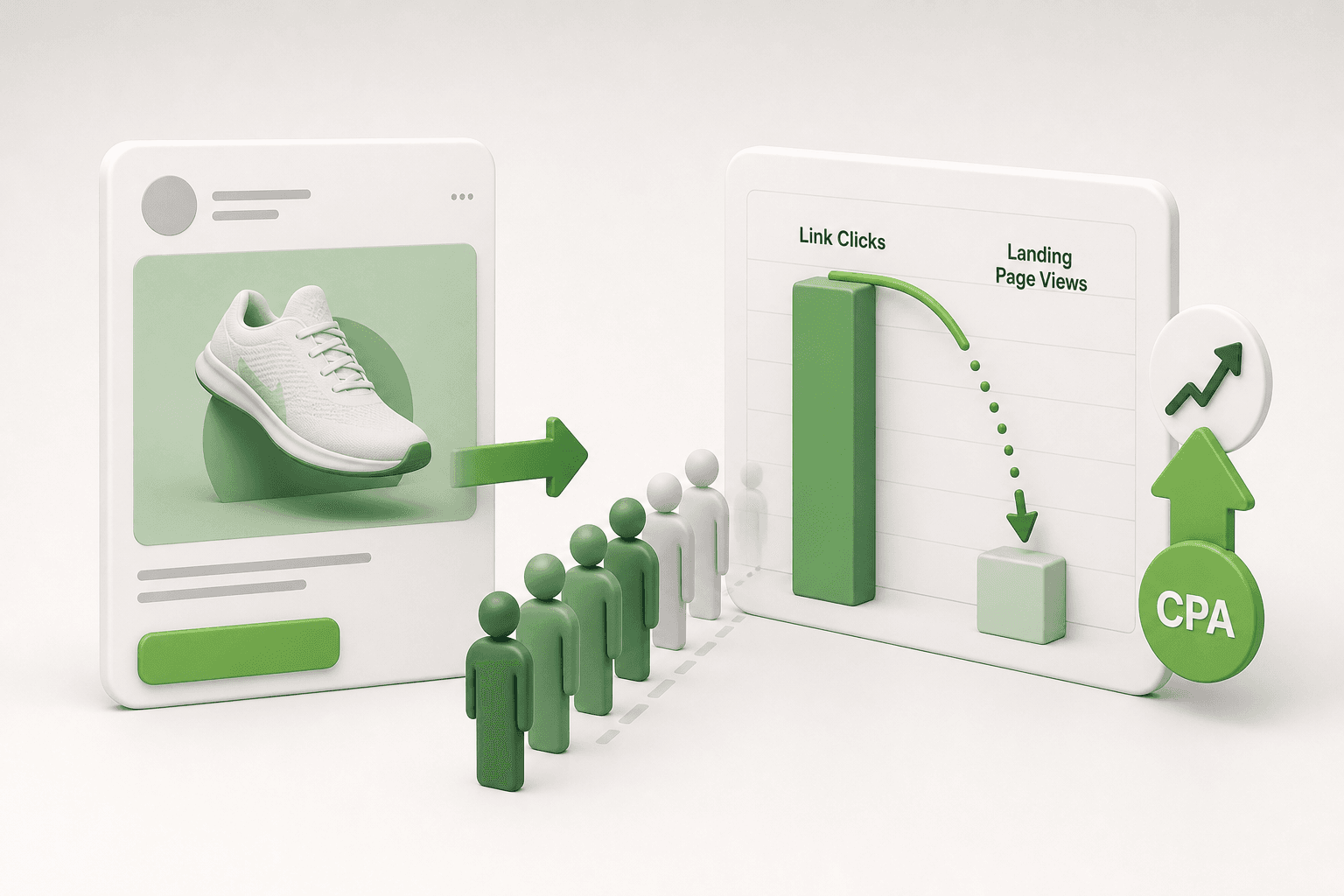
A conversion rate is the percentage of users who complete a desired commercial action out of the total number of users who entered the funnel. In Meta Ads Manager and your storefront analytics, monitor both the "Result Rate" for the purchase objective and down-funnel milestones such as view content, add to cart, and initiate checkout. An increase in link clicks without a corresponding lift in landing page conversion rate indicates a disconnect between the ad creative and the product page pricing, shipping terms, or load speed.
Monitor Click-Through Rates
CTR (click-through rate) is the percentage of ad impressions that result in user clicks. In Meta Ads Manager reports, differentiate between "CTR (All)" and "CTR (Link Click-Through Rate)". While "CTR (All)" captures post reactions, comments, and image expansions, "CTR (Link Click-Through Rate)" measures users actively navigating toward your online store. A rising outbound CTR confirms that visual hooks and promotional angles are resonating with target buyers, pulling qualified traffic into the conversion funnel at lower unit costs.
- Audit Meta Pixel and Conversions API setups to verify purchase events fire with matching value parameters.
- Calculate your store break-even ROAS based on gross product margins and operating overhead.
- Customize Meta Ads Manager reporting columns to display outbound CTR alongside standard CTR (All).
- Evaluate conversion rates across individual funnel steps from add-to-cart to completed checkout.
- Set automation rules inside Adsaify to pause underperforming ads when key performance indicators decline.
- Examine 7-day click and 1-day view attribution windows to identify over-reported platform conversions.
What metrics should I use to measure success?
To measure success accurately, use purchase ROAS as your primary commercial metric, evaluated directly against your store break-even threshold. Pair this financial figure with outbound click-through rate to evaluate creative resonance, cost per acquisition to measure audience efficiency, and checkout conversion rate to evaluate landing page performance. Tracking these operational indicators together ensures you identify whether performance shifts originate from ad creative, targeting delivery, or website checkout friction.
Conclusion
Enhancing e-commerce ad performance with artificial intelligence begins with setting structured campaign foundations. Start by feeding your product catalog and store URL into an AI tool to identify relevant audiences, generate tailored ad copy, and produce varied visual creatives. Next, deploy these assets directly to your ad account alongside clear performance thresholds. Finally, monitor key indicators such as return on ad spend and cost per purchase, applying automated rules to pause underperforming variations while continually adding fresh creative assets to prevent fatigue.
To put this framework into practice today, audit your current Meta campaigns to identify which ads consistently fall below your target efficiency thresholds. You can then test an automated workflow by signing up at Adsaify to generate and launch your first AI-assisted ad draft for free, connecting your store URL directly to your Meta ad account.
Want to see this in your own account? Enter your website address and Adsaify drafts the campaign for you. The first ad is free. Try it now or log in.
Frequently Asked Questions (FAQ)
1. Why is AI important for e-commerce ads?
AI is important for e-commerce ads because it automates time-consuming technical workflows while optimizing resource allocation. In digital advertising, AI analyzes store data to identify target customer segments, write product copy, generate visual creatives, and suggest budgets. This allows e-commerce merchants to test multiple creative variations systematically, identify profitable combinations, and apply automated performance rules without manually managing individual campaign adjustments every day.
2. How much do AI tools cost?
The cost of AI advertising tools varies depending on software features, platform integrations, and billing models. Most platforms charge through tiered monthly subscriptions, usage-based credits, or flat management fees, while some ad networks include basic machine learning algorithms at no additional cost. Certain specialized platforms, including Adsaify, allow advertisers to test the service by creating their first ad campaign for free before subscribing.
3. How long does it take to improve performance in e-commerce ads?
Improving e-commerce ad performance typically requires several days to a few weeks, depending on your conversion volume and testing speed. Ad algorithms need time to exit the learning phase—a period where ad delivery systems gather data to stabilize costs—usually requiring dozens of conversions. Introducing AI-generated creative variations and pausing poor performers can yield directional improvements after initial performance data stabilizes.
4. How can I better define my target audience?
You can better define your target audience by combining first-party customer data with algorithmic analysis. First-party data is information collected directly from your own customers, such as past purchases and website visits. AI tools analyze your store URL and historical traffic to map buyer personas, suggest demographic interests, and build lookalike audiences on Meta platforms, matching users with high purchase intent.
5. What types of content are more effective for my e-commerce ads?
Content that clearly showcases product utility, addresses common pain points, and reflects customer experiences generally proves most effective for e-commerce ads. Short-form video demonstrations, user-generated style clips, and high-contrast product imagery tend to capture attention in social feeds. Testing a mixture of static AI-generated product visuals and video variations helps you determine which format resonates best with your specific shoppers.
6. What are the effects of low performance?
Low ad performance leads to depleted marketing budgets, inflated customer acquisition costs, and poor inventory turnover. When ads generate low click-through rates or conversions, platform algorithms assign lower relevance scores, increasing the cost to reach potential buyers. Over time, sustaining inefficient campaigns diminishes store profitability and prevents capital from being reinvested into profitable product lines or new customer acquisition channels.
7. What metrics should I track in e-commerce ads?
You should track ROAS (return on ad spend), CPA (cost per acquisition), and CTR (click-through rate). ROAS measures revenue generated per dollar spent on ads, while CPA tracks the expense required to generate a completed purchase. Additionally, monitoring conversion rates and frequency ensures that your campaigns remain profitable and alerts you when audience fatigue begins to reduce ad effectiveness.
8. How is ad management done with AI?
Ad management with AI involves using software to draft campaigns, generate ad copy and visual assets, and enforce performance controls. For example, Adsaify analyzes a website URL to draft targeted Meta campaigns, pushes approved assets to the user's ad account, and applies automation rules to pause ads that fall below specific benchmarks, allowing advertisers to manually introduce fresh creatives when needed.
How can you try this with Adsaify?
The quickest way to apply the steps in this article to your own account is to try them. Adsaify analyses your business from your website address, drafts the campaign with an audience, ad copy, creative and a budget suggestion, and publishes it to your own Meta ad account once you approve.
- Your first ad is free: there is nothing to lose by trying.
- Your own ad account: the campaign runs in your Meta account and you stay in control.
- Images and video: generate ad creatives with AI or promote an existing Instagram post.
Create a free account and try your first ad · Already have an account? Log in.