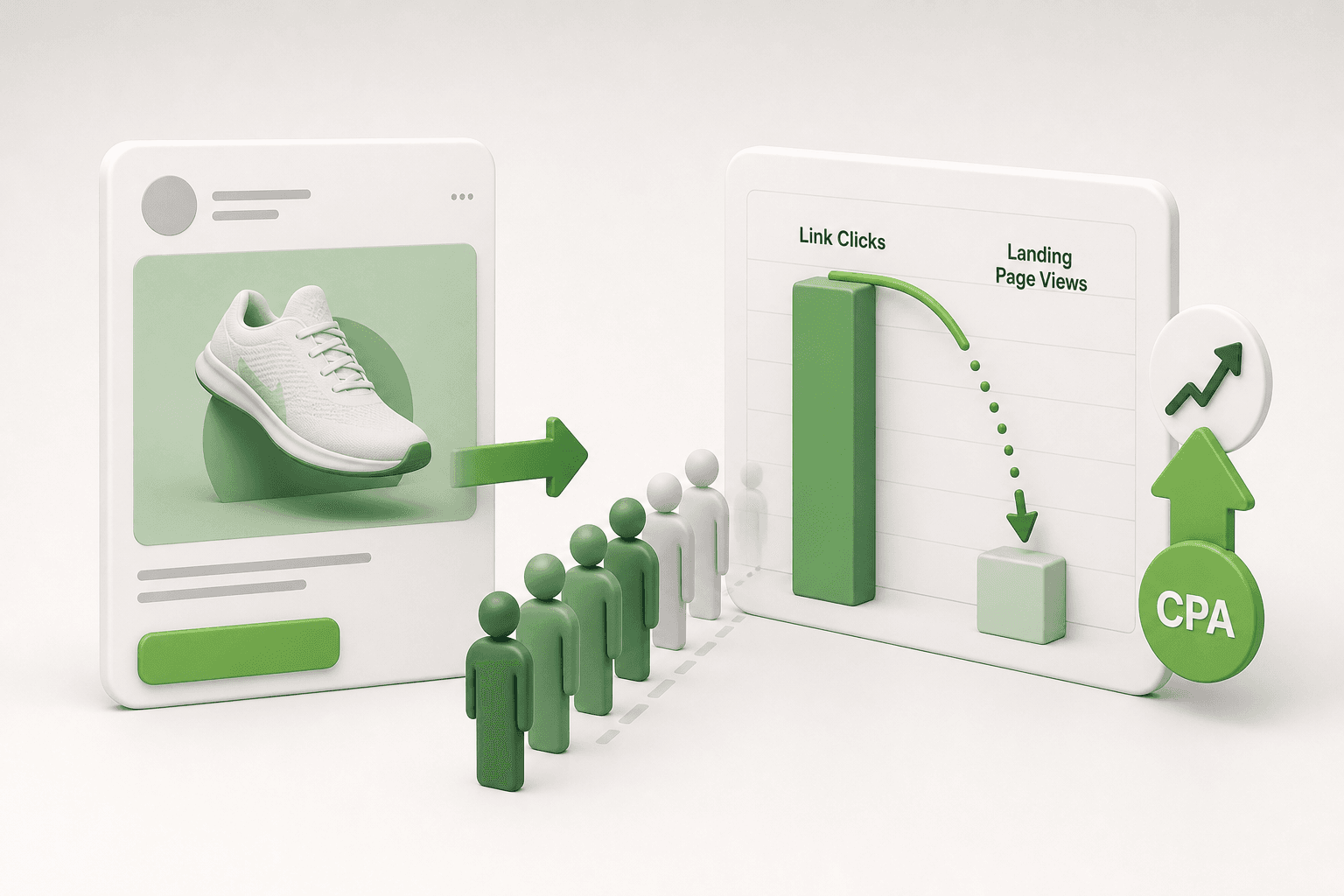

Short answer: Fast Meta ads ROAS scaling stalls with agencies because manual human operations cannot match real-time auction velocity, while variable retainers increase break-even targets. When scaling budgets, agency response lags cause ad fatigue and wasted spend. AI media buying platforms solve this by instantly analyzing store data, drafting targeted campaigns, and applying automated performance safeguards.
You increase your daily Meta ad spend from 1,000 TL to 3,000 TL expecting a proportional surge in revenue, but performance sharply declines instead. ROAS (return on ad spend) is the ratio of gross revenue generated to total advertising spend. When performance deteriorates, your agency account manager schedules an audit for the following week, leaving unprofitable ad sets active while acquisition costs compound. You watch profitable momentum dissolve because agency communication operates on office hours rather than live auction volatility.
This stall happens because manual agency operations rely on multi-tiered approval chains, slow creative turnarounds, and rigid reporting cadences that lag behind Meta machine learning models. Furthermore, agency retainers that increase alongside media spend inflate your break-even requirements during sensitive growth phases. If you leave this operational gap unaddressed, recurring delays continuously siphon margin from high-performing campaigns, throttle top-line growth, and ultimately cap your business at an artificial revenue ceiling.
By reading this article, you will learn how to identify structural scaling bottlenecks, measure the true cost of agency delays, and leverage AI media buying platforms to protect margins. We examine the essential account audits to run before adopting automated tools, analyze a practical 50,000 TL scaling blueprint, and outline the exact performance metrics needed to sustain profitable Meta advertising growth.
Key Takeaways
- Agency retainer and spend percentage fees raise break-even ROAS thresholds as budgets scale, eroding net profitability.
- Human-operated agency workflows lag during evening and weekend auction shifts, letting inefficient ad spend burn capital.
- AI media buying platforms analyze website URLs to draft audiences, ad copy, and budget frameworks without operational delay.
- Automated rules pause bleeding ad creatives instantly, while systematic manual asset injection keeps scaling healthy.
How Can You Identify a ROAS Scaling Bottleneck on Meta?
ROAS (return on ad spend) is a performance metric measuring gross revenue generated for every unit of currency spent on advertising. You identify a ROAS scaling bottleneck on Meta when incremental spend drives higher gross revenue while net profit margins drop, creative fatigue causes frequency to rise, and customer acquisition costs outpace revenue growth.
Divergence Between Revenue Expansion and Profit Margin Decay
The earliest indicator of a scaling constraint appears in the relationship between top-line store revenue and net profitability. Inside Meta Ads Manager, increasing a budget—either through Advantage campaign budget (formerly Campaign Budget Optimization) or manual ad set daily budgets—often generates an immediate surge in tracked conversions. However, if the scaling mechanism lacks structural efficiency, the blended Purchase ROAS drops below the breakeven threshold. Advertisers must cross-reference Meta Ads Manager metrics, such as Amount Spent and Purchases Conversion Value, with backend accounting data. If ad spend scales by 50% while gross margin dollars only increase by 5%, the account is experiencing diminishing marginal returns from immediate audience over-delivery.
Unchecked Spend on Inefficient Ads Pending Agency Reviews
Bleeding ad sets persist when media teams adhere to rigid communication schedules rather than real-time monitoring. In typical agency relationships, account audits occur shortly before weekly alignment calls. During the intervening five to six days, ads with high CPA (cost per acquisition, which is the total ad spend divided by the total number of conversions) continue spending against the allocated daily budget. Performance marketers should review the "Cost per Result" column inside Meta Ads Manager grouped by 3-day and 7-day trailing windows. If an ad produces zero conversions at twice the target CPA for 72 consecutive hours without human intervention or an automated pause rule, operational lag is eroding account efficiency.
Rapid Creative Monopolization and Audience Saturation
A scaling bottleneck routinely surfaces when Meta's delivery algorithm allocates 70% or more of an ad set's total budget to a single legacy creative asset. Marketers can identify this by reviewing the "Amount Spent" column at the Ad level within Ads Manager, then applying the "Frequency" metric. If frequency crosses 2.8 to 3.5 within a 7-day window on cold prospecting campaigns, the target audience is exhausted. Without rapid introduction of fresh creative formats, Outbound CTR (click-through rate) declines and CPM (cost per mille, which is the cost per one thousand ad impressions) climbs rapidly.
For example, an online footwear retailer scales daily spend from 2,000 TL to 6,000 TL within Meta Ads Manager using an Advantage+ shopping campaign. Within five days, daily store sales increase from 8,000 TL to 15,000 TL, but Purchase ROAS drops from 4.0 to 2.5, while CPA increases from 80 TL to 160 TL. Upon inspecting the ad set breakdowns, the retailer observes that 4,500 TL of the 6,000 TL daily budget is allocated to a single product video featuring a 3.9 frequency score. To resolve this bottleneck, the performance marketer inspects creative-level spend distribution and introduces new visual angles to prevent algorithm-driven budget concentration.
What exact timeframe reveals whether an agency is lagging behind my scaling requirements?
A testing window of 7 to 14 days reveals whether an agency is lagging behind scaling demands. If an account scales ad spend by 30% or more, delivery volatility typically surfaces within 48 to 72 hours. Performance buyers must evaluate metrics daily. When an agency allows underperforming ad sets to exceed target CPA thresholds for two consecutive weekly reporting cycles without implementing corrective actions or fresh creative testing, their operational speed cannot support sustainable account scaling.
Why Does ROAS Growth Slow Down Under Agency Management?
ROAS growth slows down under agency management because manual media buyers handle competing client accounts, creating operational delays that prevent real-time bid adjustments. Agency workflow friction—including protracted creative approval queues, misaligned percentage-of-spend contracts, and delayed weekend auction reactions—causes high-cost ad fatigue to consume ad spend before human managers intervene.
Multi-Account Media Buyer Allocation and Human Latency
Media buyers at traditional agencies manage multiple client accounts simultaneously, severely capping the time dedicated to any single Meta Ads Manager account. When Meta's ad auction experiences intra-day cost spikes, manual buyers cannot monitor performance continuously across ten distinct dashboards. While business owners can register for automated platforms that enforce custom rules, manual agency processes rely entirely on human checks during normal business hours. If an ad's Cost per Result doubles on a Tuesday morning, an overextended media buyer might not review that specific ad set until Thursday afternoon, allowing unproductive spend to depress total campaign ROAS.
Weekend Auction Volatility and Incentive Misalignment
E-commerce conversion volumes typically peak during Friday evenings, weekends, and seasonal holidays. Traditional agency media buyers operate on standard weekday business schedules, leaving campaigns unmanaged precisely when consumer intent and CPM volatility peak. Furthermore, standard agency pricing models charge a percentage of overall ad spend rather than tying fees to net ROAS or contribution margins. This structure financially rewards agencies for scaling overall budgets through the Meta dashboard, regardless of whether that additional spend produces profitable incremental sales or triggers diminishing returns.
Operational Delays in Creative Production Queues
Creative velocity is the primary lever for controlling Meta ad auction costs. Under standard agency workflows, testing a new ad requires drafting briefs, assigning copywriters, routing assets through graphic designers, and scheduling external client approval calls. This multi-layered chain stretches creative turnaround times to weeks. Because modern Meta auctions rely on broad audience targeting where the creative itself acts as the targeting filter, slow creative delivery forces campaigns to rely on saturated assets.
| Operational Variable | Traditional Agency Workflow | Automated Performance Management |
|---|---|---|
| Weekend Auction Monitoring | Paused or unmonitored until Monday morning | Continuous metric checks via programmatic rules |
| Underperforming Ad Cutoffs | Manual reviews during weekly account audits | Automated rules pause ads breaching target CPA |
| Creative Deployment Time | Multi-week copywriting and design queues | Rapid generative drafting and direct Meta publishing |
| Commercial Fee Alignment | Percentage of total ad spend | Fixed tooling access independent of spend levels |
Even with experienced ad buyers, is agency delay an unavoidable structural flaw?
Yes, agency delay is an unavoidable structural flaw stemming from human labor capacity rather than individual buyer competence. Even an experienced media buyer overseeing six client accounts must divide an eight-hour workday into administrative reporting, client meetings, and cross-channel analysis. Because Meta auctions adjust bids dynamically thousands of times per hour, manual workflows cannot match continuous auction shifts, making multi-day turnaround intervals an inevitable byproduct of traditional agency operations.

How Much Revenue Do Agency Overhead and Delays Cost Brands?
Agency overhead and operational delays reduce brand revenue by increasing the true cost of customer acquisition and wasting media spend on inactive account management. Fixed monthly retainers and ad spend surcharges raise break-even thresholds, while human response delays over weekends leave declining ads active, consuming budget that could otherwise fund profitable ad variations.
How Retainers and Surcharges Elevate Break-Even Thresholds
ROAS (return on ad spend) is the revenue generated for every unit of currency spent on advertising. Traditional marketing agencies typically charge a fixed monthly retainer alongside a 10 to 15 percent fee on gross ad spend. This fee structure increases the baseline commercial requirement before an ad account achieves actual net profitability.
When an agency charges an additional percentage on spend, the advertiser must generate more revenue per transaction just to cover administrative overhead. In Meta Ads Manager, the reported platform ROAS might appear acceptable, but factoring in management invoices reveals that campaigns require higher conversion efficiency to avoid burning company capital.
The Real Financial Impact of Weekend Delays and Creative Fatigue
Human media buyers rarely optimize accounts across non-working hours, creating operational gaps that burn marketing capital. CPM (cost per mille) is the cost an advertiser pays for one thousand impressions on Meta platforms. CPC (cost per click) is the amount an advertiser pays each time an audience member clicks on an ad. CTR (click-through rate) is the percentage of impressions that result in a click.
When an ad fatigue event occurs, CTR drops and Meta automatically increases CPM and CPC to account for lower user engagement. If an ad set degrades on a Friday evening, an agency that only reviews accounts during standard business hours allows that unprofitable ad set to run unchecked for roughly 48 hours. By Monday morning, hundreds or thousands of currency units have been delivered to exhausted audiences, draining cash reserves that should have supported top-of-funnel discovery.
Worked Example: Measuring Overhead and Waste in a DTC Skincare Account
Consider an example with a direct-to-consumer skincare brand operating with a 100,000 TL monthly media budget, a 20,000 TL fixed agency retainer, and a 10 percent ad spend fee (10,000 TL). The brand spends a total of 130,000 TL each month to deploy 100,000 TL in media.
Over a standard weekend, one scaling Advantage+ shopping campaign ad set spending 2,500 TL per day experiences performance decay starting Friday at 6:00 PM, generating zero sales at an elevated CPA (cost per acquisition, which is the total advertising cost required to generate a single conversion). Because agency personnel do not review the account until Monday at 10:00 AM, the ad set spends roughly 6,500 TL with zero return.
To audit this loss afterwards in Meta Ads Manager, navigate to the Ad Sets tab, apply the "Columns: Performance and Clicks" preset, and set the date breakdown to daily increments over the weekend. Check the Cost per Result and Amount Spent columns to calculate the total budget wasted during unmonitored hours. Because high fixed agency overhead consumes 30,000 TL before media delivery begins, the brand lacks the remaining liquid budget to launch net-new creative tests that could replace the fatigued ad set.
How does factoring agency invoices directly into marketing costs alter my true net ROAS?
Factoring agency invoices directly into marketing expenses lowers true net ROAS because total marketing expenditure increases while gross platform revenue remains identical. When an advertiser calculates platform ROAS in Meta Ads Manager, the formula divides purchase conversion value solely by ad spend. Calculating true net ROAS requires dividing that same conversion value by combined ad spend, fixed monthly retainers, and percentage management fees, which reveals a substantially lower real return and elevates the actual break-even benchmark required for profitability.
How Can an AI Media Buying Platform Accelerate ROAS Growth?
An AI media buying platform accelerates ROAS growth by automating campaign creation, enforcing immediate performance-based budget protection, and eliminating expensive agency management fees. By analyzing store content instantly to generate campaign frameworks and deploying rule-based triggers that pause unprofitable ads automatically, platforms preserve capital and channel all available budget directly into active ad spend.
Rapid Asset Generation and Algorithmic Campaign Drafting
Traditional agency onboarding can take weeks to produce creative concepts and campaign structures. An AI media buying platform evaluates a business directly from its website URL or a brief business description. The software extracts product features, target customer pain points, and commercial value propositions to assemble a ready-to-launch campaign structure.
Instead of manual drafting across multiple spreadsheets, the tool configures audience targeting options, writes ad copy variations, and provides suggested starting budgets. Furthermore, the software can generate ad images and videos with AI, or turn an existing high-performing Instagram post into a promotional ad unit, dramatically shortening the gap between product availability and active ad testing.
Protecting Margins with Automated Performance Triggers
AI platforms eliminate human monitoring delays through continuous, programmatic account checks. Within Meta Ads Manager, automated rules can be established to inspect performance data continuously. When key metrics breach pre-set boundaries, automated actions trigger immediately.
If an ad variation sees its CPA spike past acceptable unit economics or its ROAS dip below target thresholds over a designated evaluation window, the automation rule executes a pause action. Because the platform executes these rules systematically, unprofitable ad variations stop spending immediately, preserving ad spend for high-performing variations without waiting for manual human intervention.
Directing Total Capital to Media Spend
Replacing percentage-based agency retainers allows brands to allocate 100 percent of working capital directly to media delivery. Without agency markups on spend, every marketing dollar works directly inside Meta's auction to collect signal, train the Meta pixel, and drive sales conversions.
Advertisers can use Adsaify to launch a free first campaign test with automated audience recommendations. The platform publishes campaigns directly to the user's own Meta ad account, ensuring complete data ownership and transparency while removing operational friction.
- Input store URL — The system scans product pages and metadata to extract core value propositions and determine audience characteristics.
- Draft campaign structure — The software generates audience angles, ad copy variations, creative concepts, and initial budget suggestions based on catalog insights.
- Review generated assets — The media buyer approves or modifies the drafted copy and AI-generated image or video assets before publication.
- Publish to Meta — The platform pushes the campaign structure and creative assets directly to the connected Meta ad account.
- Evaluate incoming performance — Automation rules continuously compare live CPA and ROAS data against predefined target thresholds.
- Trigger automated pause — The system automatically pauses ad variations that exceed CPA caps to protect working capital for performing assets.
How does an AI media buying tool monitor live performance once campaigns are published?
An AI media buying tool monitors live performance by reading data directly from the Meta Marketing API across campaigns, ad sets, and ads. The software compares real-time delivery metrics, such as cost per purchase, click-through rate, and ROAS, against user-defined automation thresholds. When an ad satisfies negative performance conditions, such as exceeding maximum allowable acquisition costs, the platform immediately executes a pause command to prevent further financial loss without requiring manual human oversight.
If you would rather not set up each of these steps by hand, try it in Adsaify: your first ad is free, so there is nothing to lose. Create a free account.
Which Audits Should You Run Before Adopting AI Media Buying?
Before adopting AI media buying on Meta, advertisers must audit tracking data integrity, catalog feeds, historical creative performance, and rule parameters. Specifically, you should inspect Conversions API event match quality, reconcile product catalog inventory, review historical top-performing creative angles in Ads Manager, and set firm cost-per-acquisition thresholds before automating campaigns.
Data Tracking and Catalog Verification in Meta Events Manager
Clean conversion data forms the foundation of any algorithmic media buying setup. Meta Conversions API (CAPI) is a server-side technology that transfers consumer actions directly from a website's hosting server to Meta, bypassing browser-level ad blockers and tracking restrictions. Advertisers must navigate to Meta Events Manager and evaluate the Event Match Quality (EMQ) score for the Purchase event. An EMQ score below 6.0 out of 10 indicates incomplete customer parameter matching—such as missing hashed email addresses, phone numbers, or external IDs—which leads the delivery algorithm to optimize against incomplete conversion data.
E-commerce stores running dynamic catalog campaigns must also verify product integrity inside Meta Commerce Manager. Product catalogs frequently experience synchronization errors that cause out-of-stock items, expired promotions, or outdated product variants to remain active in ad sets. Promoting a discontinued SKU forces ad spend into traffic that cannot convert, distorting the bidding algorithm. Verifying that the product inventory feed refreshes daily and that all item prices match landing page checkout values prevents automated budgets from flowing into unpurchasable products.
Historical Creative Auditing and Automation Guardrails
Deploying automated workflows requires a clear baseline of what visual concepts have previously converted. In Meta Ads Manager, marketers should isolate the trailing 90-day window and apply the Breakdown menu by Dynamic Creative Element to inspect individual images, primary texts, and headlines. This audit identifies winning creative angles, such as unboxing videos, static comparison charts, or customer testimonial carousels, which provide the structural prompts needed when generating new campaigns through platforms like Adsaify.
Finally, advertisers must establish clear operational boundaries before turning on automated campaign actions. CPA (cost per acquisition) is the total advertising expenditure divided by the total number of verified conversion events. A stop-loss ROAS is the minimum allowable return on ad spend below which an ad immediately begins eroding gross operating margin. Setting these numerical guardrails ensures automated rules shut down failing ads without manual oversight. Before launching, complete this preliminary technical checklist:
- Inspect the Purchase Event Match Quality score in Meta Events Manager to verify it rates 6.0 or higher.
- Confirm server-side event deduplication between the browser Meta Pixel and Conversions API using unique event IDs.
- Resolve all diagnostic warnings and out-of-stock product flags within Meta Commerce Manager catalog data feeds.
- Extract the top three historical creative formats and copy hooks by reviewing 90-day ROAS reporting breakdowns.
- Calculate exact break-even CPA and stop-loss ROAS figures based on merchant net margin formulas.
- Configure platform-level rules to automatically pause underperforming ad variants that exceed CPA tolerances after registering an account on Adsaify.
Will AI-drafted campaigns perform reliably on ad accounts with limited historical pixel data?
AI-drafted campaigns can perform reliably on ad accounts with limited historical pixel data if the campaign architecture uses Meta broad targeting paired with high-intent product creative. When an account lacks historical conversion signals, the Meta delivery algorithm relies heavily on creative content and ad copy to identify relevant users. By analyzing your website address to draft structured ad copy and audience parameters, tools like Adsaify supply the initial delivery inputs required to generate early conversion events efficiently.
How Do You Structure a 50,000 TL ROAS Scaling Worked Example?
To structure a 50,000 TL monthly Meta budget for ROAS scaling, divide the 1,660 TL daily spend into a 70 percent core scaling tier and a 30 percent creative testing tier. You maintain proven ad sets with 1,162 TL daily while allocating 498 TL to new AI-generated variations, using automated rules to pause underperforming ads.
Budget Allocation Between Core Scaling and Creative Testing Tiers
Scaling ad spend without triggering performance decay requires separating validated winners from experimental concepts. ROAS (return on ad spend) is the gross revenue generated divided by the total ad spend allocated to that campaign. On a 50,000 TL monthly budget (approximately 1,660 TL per calendar day), an advertiser should dedicate 70 percent (1,162 TL daily) to an established scaling campaign, such as an Advantage+ Shopping Campaign or a manual broad-targeting ad set containing proven creative winners.
The remaining 30 percent of the budget (498 TL daily) should be routed to a dedicated testing campaign. This testing framework evaluates newly generated ad visuals, headlines, and angles. Adsaify streamlines this workflow by analyzing an e-commerce website address, drafting structured campaign assets, and publishing those visual drafts directly into the user's native Meta ad account. Note that Adsaify does not autonomously swap creatives inside live ad sets; rather, the marketer generates new visual assets, approves them, and publishes them into the testing structure to identify future winners.
Worked Example: Ceramic Tableware Brand Scaling Execution
Consider an artisanal home goods brand selling ceramic dinnerware with an AOV (average order value is the total sales revenue divided by the total order count) of 1,200 TL, a maximum allowable CPA of 400 TL, and a target ROAS of 3.0. For example, during a 30-day scaling period, the brand executes the following structured workflow:
- The merchant creates a scaling campaign budgeted at 1,162 TL per day containing four verified image and video creatives.
- The merchant uses the Adsaify campaign creation flow to generate three new ad creative concepts and publishes them into a testing ad set at 498 TL per day.
- An automated rule monitors ad variants daily: pause any individual creative if it spends 600 TL (1.5 times target CPA) without generating a sale, or if ROAS drops 20 percent below target (below 2.4 ROAS) after recording at least three purchases.
- At the weekly review, the merchant extracts winning creatives achieving a 3.5 ROAS from the testing tier, imports their existing post IDs into the scaling campaign, and pauses lower-performing variations.
By enforcing this structured workflow, the ceramic brand protects its operating cash flow, prevents budget waste on ineffective concepts, and maintains an aggregate account ROAS above target while scaling.
How would a 10,000 TL agency management fee mathematically damage profitability on this budget?
A 10,000 TL agency retainer represents a 20 percent overhead surcharge on a 50,000 TL advertising spend. If an e-commerce store generates 150,000 TL in revenue at a 3.0 ROAS, adding a 10,000 TL agency fee increases total cash outlay to 60,000 TL, reducing the effective blended ROAS down to 2.5. Because smaller accounts operate on tighter gross cash margins, fixed management fees siphon away working capital that would otherwise fund creative experimentation or inventory restocks.

What Are the Most Common Mistakes When Switching to AI Platforms?
The most common mistakes when switching to AI platforms include expecting autonomous creative swapping, enforcing over-aggressive automated pause rules during the learning phase, blaming media buying automation for website conversion friction, and restricting Meta Business Manager permissions. Advertisers succeed when treating AI tools as execution engines that require human creative direction.
Creative Stagnation and Premature Automation Rules
A frequent operational misunderstanding occurs when media buyers assume an AI platform replaces creative strategy. Adsaify analyses a business website URL, suggests ad copy, drafts targeting, generates AI images and videos, and sets up campaigns. However, Adsaify does not autonomously swap or refresh creatives inside a running campaign when fatigue sets in. The performance marketer must review asset performance, generate fresh creative variations within the platform, and publish them to the ad account.
Another error involves setting automated performance rules with narrow margins. In Meta Ads Manager, the learning phase is the calibration period during which the delivery system explores the best audience segments for an ad set, requiring roughly 50 optimization events over a seven-day window. When advertisers configure an automation rule to pause an ad set if ROAS (return on ad spend, calculated as revenue divided by ad spend) drops after just 200 impressions or 24 hours, they terminate campaigns before Meta stabilizes bid costs. Rules should evaluate performance on a rolling three-day or seven-day window, with an impression threshold such as 2,000 to 3,000 impressions before firing pause actions.
Technical Misconfigurations and Conversion Drop-offs
Performance marketers often blame automated tools when revenue stalls, even though the problem originates on the destination website. CRO (conversion rate optimization) is the practice of increasing the percentage of site visitors who complete a desired purchase. If an automated campaign delivers an outbound click-through rate above 1.5% at an acceptable cost, but store purchases drop, the friction typically exists in slow page speeds, confusing checkout forms, unexpected shipping fees, or payment gateway errors. Media buying tools cannot fix on-site conversion bottlenecks.
Finally, automated platforms require complete technical permissions. Media buyers who restrict Meta Business Manager access to "Employee" or withhold full control of the Meta Pixel dataset, product catalog, or ad account prevent optimization APIs from receiving granular feedback signals. You can configure full asset access in your Meta Business Settings before you register and link your ad account.
| Mistake | Observed Symptom | Correct Configuration |
|---|---|---|
| Expecting autonomous creative swapping | Frequency rises above 3.0 while click-through rates decline | Manually generate fresh creatives and add them to ad sets |
| Aggressive pause rules during learning | Ad sets stuck in "Learning Limited" with sporadic spend | Set rules requiring at least 2,000 impressions before firing |
| Blaming media buying for on-site friction | High click-through rate but sharp decline in conversion rate | Audit mobile checkout speed, shipping costs, and payment gateways |
| Restricted Business Manager permissions | Tracking sync errors and incomplete attribution data | Assign full Admin permissions on Datasets, Catalogs, and Accounts |
When ad fatigue sets in, does the AI tool notify me, and how should I introduce replacement creatives?
Adsaify monitors performance drops through automated threshold rules, which flag declining return on ad spend and pause underperforming ads based on your criteria. However, the platform does not automatically replace creative assets inside active campaigns. When performance declines, generate new creative variations within Adsaify using the website analysis feature or creative generation tools. Then, publish those fresh assets into your existing campaign structure or a new ad set to let the algorithm enter an updated evaluation cycle.
Which Metrics Measure ROAS Scaling Success and What Steps Follow?
Advertisers measure Meta ROAS scaling success using Marketing Efficiency Ratio (blended top-line revenue divided by total ad spend), outbound click-through rates, cost per click, and net contribution margins. Once these metrics stabilize during spend increases, advertisers systematically identify top-performing ad angles and launch iteration batches using automated workflow builders.
Blended Efficiency, In-Platform Signals, and Margin Health
Scaling campaigns solely against platform-reported ROAS can mislead performance marketers due to attribution overlaps, delayed attribution windows, and iOS privacy signal loss. MER (Marketing Efficiency Ratio) is total store revenue across all sales channels divided by total advertising spend across all paid channels. For example, if a store generates 200,000 TL in total net sales across a weekend while spending 40,000 TL across all Meta campaigns, the MER is 5.0. Tracking MER provides a ground-truth benchmark that confirms whether scaling ad budgets drives absolute business growth or merely re-attributes existing organic sales.
Inside Meta Ads Manager, media buyers must observe leading diagnostic metrics to confirm that audience resonance holds as budgets scale:
- Outbound CTR: CTR (click-through rate) is the percentage of ad impressions that lead to clicks on the ad link. A falling outbound CTR indicates creative fatigue or audience saturation.
- CPC: CPC (cost per click) is the average cost incurred each time an ad link is clicked. Rising CPC at higher spends reflects rising bid competition or declining relevance.
- CPM: CPM (cost per mille) is the cost of delivering 1,000 ad impressions. Significant CPM spikes indicate delivery constraints or audience overlap.
Advertisers must also measure net contribution margin, which is gross profit minus variable costs, ad spend, and media management overhead. When a brand replaces a traditional agency retainer of 30,000 TL per month plus a 10% spend surcharge with a predictable software subscription, that recovered capital immediately widens the operational margin, allowing more aggressive scaling thresholds.
Actionable Scaling Protocol
Once your core metrics establish stability, follow this operational checklist before expanding budgets:
- Calculate daily blended MER to ensure platform ROAS increases reflect true top-line revenue growth.
- Audit outbound CTR to verify that creative resonance remains steady above target thresholds.
- Check frequency metrics across 7-day windows to prevent bidding against saturated audience segments.
- Calculate net contribution margin after subtracting SaaS tooling costs against agency retainer baselines.
- Isolate winning creative angles, including top headlines, hooks, and aspect ratios.
- Generate iterative ad copy and creative variations through the demo start flow.
- Deploy fresh variations into active campaigns without modifying original winning ad sets.
At what percentage pace can I safely scale daily ad spend if my blended MER remains stable?
When blended Marketing Efficiency Ratio stays above your profitability benchmark, increase ad set or campaign daily budgets by 15 to 20 percent every 48 to 72 hours. Scaling faster than 20 percent resets the Meta delivery algorithm into the learning phase, causing bid instability and erratic CPMs. Alternatively, duplicate winning ad sets with higher starting budgets in a horizontal scaling structure, allowing the new ad set to exit the learning phase independently without destabilizing established delivery.
Should You Choose an Agency or an AI Platform to Scale Meta ROAS Faster?
Scaling Meta advertising past an agency plateau requires evaluating account control, reducing operational overhead, and accelerating creative testing systematically. First, audit your current campaign structures to identify where manual reporting delays bottleneck daily budget decisions. Next, implement automated rules to handle routine media buying tasks such as pausing underperforming assets when return on ad spend drops below target. Finally, take direct ownership of asset iteration by generating fresh ad variations continuously rather than waiting on extended agency production cycles.
To take action today, launch a targeted pilot campaign on a single product catalog using an automated media buying workflow. Connecting your Meta ad account allows you to test AI-driven audience drafting, creative generation, and rule enforcement directly alongside existing campaigns, giving you verifiable performance comparisons without terminating agency agreements prematurely.
Want to see this in your own account? Enter your website address and Adsaify drafts the campaign for you. The first ad is free. Try it now or log in.
Frequently Asked Questions (FAQ)
1. Can you test an AI media buying platform while an agency contract is still active?
Yes, you can test an AI media buying platform alongside an active agency contract by siloing campaigns. Running tests on a distinct product category, separate geographic market, or dedicated custom audience prevents attribution overlap. Because platforms publish campaigns directly into your existing Meta ad account, you retain transparent oversight of performance data and can compare metrics directly against agency-managed campaigns.
2. Can AI media buying platforms completely replace human agency teams?
AI media buying platforms automate campaign drafting, creative generation, and rule-based budget protection, but they do not eliminate strategic business direction. While software replaces routine media buying, manual tracking, and ad publishing, human input remains essential for defining offer positioning, overall profit margins, and supply chain logistics. Tools empower internal teams to manage ads effectively without retaining dedicated agency personnel.
3. How many days does it take to see ROAS improvements after adopting an AI ad tool?
ROAS (return on ad spend) improvements typically emerge within seven to fourteen days after launching campaigns through an AI tool. Meta ad delivery systems require roughly fifty conversion events per ad set to exit the initial learning phase. Once this data accumulates, automated rules can reliably pause poor performers, allowing ad spend to consolidate into higher-converting creative variations.
4. Why is retaining a performance agency inefficient for ad budgets below 20,000 TL?
Retaining an agency on budgets below 20,000 TL is inefficient because fixed management retainers consume a disproportionate percentage of total marketing capital. For example, a 10,000 TL agency fee on a 20,000 TL ad budget reduces working capital by one-third before running any ads. Direct platform automation directs capital toward media impressions and audience conversion rather than administrative overhead.
5. Do I still need to access Meta Ads Manager when using an AI media buying tool?
You do not need to use Meta Ads Manager daily when using an AI media buying tool, though your Meta account remains the publishing destination. Platforms like Adsaify connect directly to your account to draft campaigns, upload creative assets, and execute automation rules. You retain full administrative ownership and can log into Meta Ads Manager whenever you wish to audit settings.
6. Does pausing an underperforming ad via automated rules disrupt Meta's learning phase?
Pausing an underperforming ad does not reset the learning phase for the entire campaign or ad set if other ads remain active. Meta evaluates optimization changes at the ad set level. Disabling individual losing creatives simply redirects remaining budget toward better-performing variations, preventing wasted expenditure without forcing the entire delivery algorithm to restart its fifty-conversion learning window.
7. How can AI-generated visuals match the creative quality of a dedicated agency studio?
AI-generated visuals match agency studio output by producing diverse creative formats, tailored copy hooks, and product-focused compositions derived directly from your store data. Rather than relying on static monthly photo shoots, generative tools produce multiple image styles and video formats instantly. This high asset variety allows advertisers to test visual concepts rapidly and counter creative fatigue before performance declines.
8. Does implementing an AI media buying platform require hiring specialized engineers?
Implementing an AI media buying platform does not require hiring specialized software engineers or technical staff. Connecting an account involves standard authorization steps through your Meta Business credentials. Platforms such as Adsaify automatically parse your website URL to suggest audiences, budgets, and ad creatives, allowing marketing managers or business founders to launch and monitor campaigns through standard web interfaces without writing code.
How can you try this with Adsaify?
The quickest way to apply the steps in this article to your own account is to try them. Adsaify analyses your business from your website address, drafts the campaign with an audience, ad copy, creative and a budget suggestion, and publishes it to your own Meta ad account once you approve.
- Your first ad is free: there is nothing to lose by trying.
- Your own ad account: the campaign runs in your Meta account and you stay in control.
- Images and video: generate ad creatives with AI or promote an existing Instagram post.
Create a free account and try your first ad · Already have an account? Log in.