Short answer: Budget whiplash occurs when automated AI media buyers overreact to intra-day conversion lag by spiking budgets during morning peaks and slashing them during evening valleys. To prevent this destructive cycle, automated budget rules must evaluate smoothed 48-to-72-hour attribution windows rather than hourly volatility, enforcing strict incremental scaling caps.
You open Meta Ads Manager at midday to find your automated management tool doubled your daily spend following a brief morning cluster of purchases. By late afternoon, traffic slows down, reported orders pause, and the algorithm panics, slashing budgets right before your prime evening shopping hours begin. This erratic fluctuation turns your ad account into an unpredictable rollercoaster, leaving ad sets perpetually starved for stable delivery and media buyers second-guessing every automated action.
This chaotic behavior occurs because automated bidding and budget software often misinterprets standard intraday conversion lag as an immediate collapse in campaign performance. When automated tools act on real-time data before Meta's attribution window matures, they repeatedly throw campaigns back into the learning phase, inflate customer acquisition costs, and compress operating profit margins. Allowing this cycle to persist damages algorithmic delivery, wastes capital on high-cost impressions, and makes profitable scaling impossible.
After reading this guide, you will be able to identify, diagnose, and permanently eliminate budget instability in automated campaigns. We walk step by step through auditing your data baseline, configuring multi-day smoothed lookback windows, setting strict incremental scaling guardrails, analyzing a practical spend case study, and executing a weekly maintenance routine that preserves predictable campaign pacing.
Key Takeaways
- Budget whiplash resets Meta's machine learning by constantly reacting to natural intra-day data lag as if it were ad failure.
- Automated scaling engines must enforce incremental spending caps between 15% and 20% to preserve auction bidding stability.
- Decision logic in media buying tools must prioritize 48-72 hour attribution data windows rather than hourly performance fluctuations.
- Implementing programmatic minimum ROAS floors and strict spend ceilings prevents catastrophic ad account capital depletion.
What is budget whiplash in AI ad campaign managers and how to spot it?
Budget whiplash is an erratic spending cycle where automated campaign managers violently scale or slash daily ad budgets in response to temporary, intra-day performance changes. Performance marketers spot budget whiplash by identifying a jagged sawtooth spending pattern inside Meta Ads Manager, accompanied by repeated learning phase resets and wild hourly fluctuations in ROAS (return on ad spend is revenue divided by ad spend).
How sawtooth spending patterns and morning surges distort campaign delivery
In a healthy Meta campaign, budget pacing distributes spend predictably across 24 hours. Automated media buying tools disrupt this balance when configured with aggressive evaluation windows. During the early morning hours, ad competition is typically lower, which can generate a brief cluster of inexpensive purchases. Uncalibrated AI campaign managers interpret this temporary spike as a signal of unconstrained demand and immediately inflate the daily budget inside Meta Ads Manager.
By early afternoon, user browsing behavior shifts and conversion volume naturally slows down. Because the elevated budget burns through capital faster without producing instant orders, the automated manager registers a sharp drop in real-time ROAS. The software overreacts by cutting the budget below the original baseline. When plotted on an hourly spend chart, this cycle creates a severe sawtooth pattern: rapid budget spikes followed by steep drops, preventing ad delivery from achieving equilibrium.
Worked example: How budget whiplash destabilizes an online footwear store
Consider, for example, an e-commerce leather footwear brand running an Advantage+ shopping campaign with an initial daily budget of 1,200 TL. At 09:00, the store records two quick purchases, pushing early ROAS to 4.2x. An automated script detects this efficiency threshold and pushes the daily budget to 2,400 TL. Between 11:00 and 15:00, visitors browse product pages during work hours but complete no checkouts. The automated rule evaluates the last four hours, observes a 0.8x ROAS, and slashes the budget to 400 TL. To diagnose this, the media buyer must inspect the "History" tab in Meta Ads Manager to track budget modification timestamps, open the "Delivery" column to spot frequent "Learning" resets, and use the "Breakdown" menu by "Time > Day" to observe the destabilized hourly spend pacing.
What exact impact does changing my budget multiple times a day have on Meta's auction algorithm?
Meta's delivery system calibrates auction bids using machine learning models that expect stable daily budgets to pace spend over 24 hours. When an advertiser adjusts daily budgets by more than 20 percent multiple times in one day, Meta exits its calibrated optimization and repeatedly resets the ad set learning phase. This volatility forces the auction algorithm to constantly re-evaluate target audiences, which inflates CPM (cost per mille is the cost per one thousand ad impressions) and drives up conversion costs.
Why do automated media buying tools trigger budget whiplash?
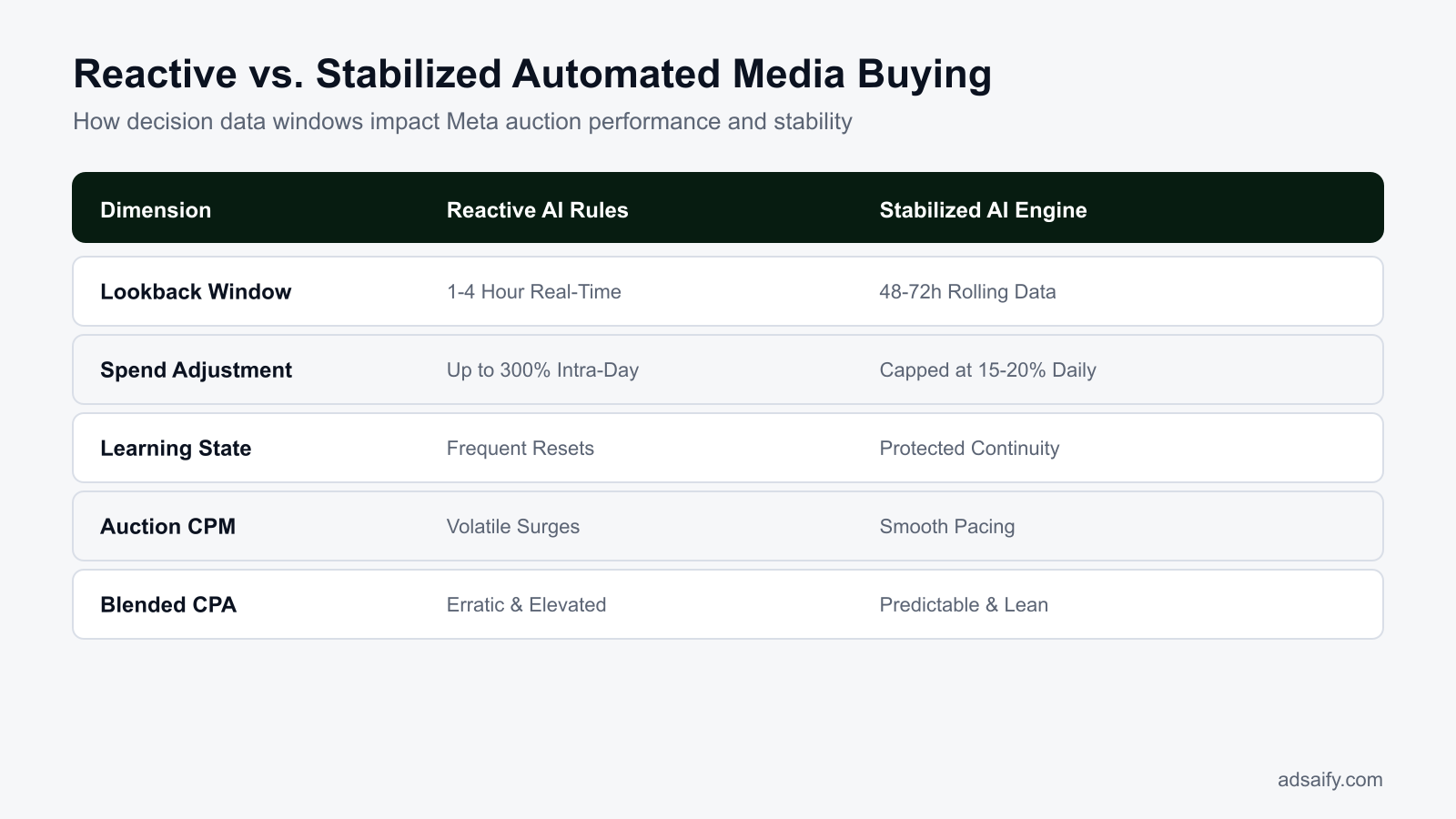
Automated media buying tools trigger budget whiplash because rule-based AI algorithms treat delayed conversion data as immediate performance failure. When automated systems make rapid optimization decisions without accounting for conversion lag, reporting latency, or normal intra-day auction variance, automated systems mistake natural attribution delays for dying campaigns and execute sudden, damaging budget adjustments.
Conversion lag, intra-day volatility traps, and reporting latency
The primary catalyst for automated budget volatility is conversion lag, which refers to the elapsed time between a user clicking an ad and completing a checkout. Many consumers click an ad at noon on a mobile device and complete the transaction in the evening on desktop. An attribution window (the timeframe during which Meta credits an ad interaction with a conversion) requires time to populate. If an automated media buying tool evaluates performance on a rolling two-hour window, that tool operates on incomplete data, seeing click costs without the corresponding revenue.
Furthermore, external tools experience reporting latency from Meta's Conversions API (a server-to-server connection that sends customer events directly to Meta). Server events, deduplication, and aggregated event modeling can take up to several hours to register in external dashboards. Simultaneously, Meta's auction experiences natural intra-day volatility in eCTR (estimated click-through rate is Meta's projection of how likely a person is to click an ad) and CPM. When naive automated rules interpret a temporary midday CPM increase as structural campaign fatigue, the rules trigger unnecessary defensive cuts. Platforms like Adsaify prevent these erratic swings by using performance rules designed around structural ad health rather than volatile hourly pacing adjustments.
| Signal or Metric | Uncalibrated AI Reaction | Real Auction Reality | Stabilization Practice |
|---|---|---|---|
| Midday ROAS drop | Cuts budget by 50% | Shoppers browse now, purchase later tonight | Evaluate metrics on a 48-hour trailing window |
| Temporary CPM spike | Pauses ad sets immediately | Auction competition surges briefly during lunch hours | Cap automated adjustments to once per 24 hours |
| Conversions API delay | Marks ad creative as fatigued | Purchases are queued in server processing pipelines | Set minimum 6-hour attribution buffers before rule triggers |
| Intra-day eCTR dip | Lowers bids aggressively | Normal user behavior shifts between work and leisure | Rely on cumulative 7-day conversion volumes |
If AI processes decisions faster than humans, why does that speed turn into a disadvantage here?
AI decision speed becomes a disadvantage when algorithms act on incomplete data feedback loops faster than physical human buying behavior unfolds. E-commerce shoppers routinely browse during working hours and complete purchases hours later at home. When automated software evaluates performance every fifteen minutes, the software evaluates partial conversion data. Speed transforms normal attribution latency into false negative signals, prompting algorithmic budget cuts right before delayed conversions register and artificially stifling delivery.
What does budget whiplash cost e-commerce stores and profit margins?
Budget whiplash costs e-commerce stores their net profit by forcing automated bidding systems into expensive auctions, cutting visibility during peak conversion hours, and disrupting warehouse fulfillment. While aggregate monthly ad spend may hit targets, the rapid day-to-day reallocation spikes customer acquisition costs and compresses profit margins across the entire catalog.
Auction Inefficiency and Blended Acquisition Spikes
When an automated campaign manager abruptly increases a daily budget by large percentages, Meta's pacing algorithm must rapidly exhaust those new funds before midnight. This sudden demand forces the delivery system out of its calibrated target audience into lower-intent, high-cost auction tiers. Cost per mille (CPM), which is the cost of delivering one thousand ad impressions, rises sharply as the system bids aggressively against competitors to secure marginal volume. Consequently, the cost per acquisition (CPA)—the total ad spend required to generate one purchase—surges.
Conversely, when automated rules detect an intraday lull and slash budgets, Meta pauses or throttles delivery just as higher-converting evening hours approach. High-intent shoppers who browse during these windows are missed entirely. Cutting spend during soft morning periods deprives the algorithm of the downstream conversion signals needed later in the day, causing blended CPA across both paid channels and organic traffic to climb.
Profit Erosion and Supply Chain Volatility
Budget whiplash produces an invisible margin leak. An account may spend exactly 10,000 TL in a week and appear stable on high-level reporting dashboards. However, net profit on ad spend (POAS)—the ratio of gross profit generated from orders directly to ad spend—collapses because the ad spend was distributed into unprofitable auction hours. Furthermore, unpredictable spend patterns destabilize e-commerce logistics. Packing teams face severe bottlenecks when an aggressive morning spend surge brings 100 orders, followed by operational downtime when an automated budget cut generates only 12 orders the next day.
Review this operational checklist to evaluate how budget volatility degrades daily store margins:
- Calculate daily contribution margin by subtracting Meta ad spend and product cost from daily gross revenue.
- Audit warehouse pick-and-pack volume day over day to detect artificial order peaks and valleys caused by budget swings.
- Compare intraday cost per acquisition against gross product margin to confirm that ad spend does not exceed breakeven thresholds during spend spikes.
- Track customer return rates from high-spend days to verify that expanded auction reach did not attract low-intent buyers.
- Check third-party shipping fulfillment surcharges incurred when order volume unexpectedly exceeds standard daily carrier capacity.
- Inspect automated rule execution logs to ensure budget updates do not coincide with natural conversion delays.
How can I measure the direct impact of this instability on my bottom-line inventory and net profits?
To measure the direct impact, export your hourly Shopify or WooCommerce order reports alongside your hourly Meta ad spend. Calculate your net profit on ad spend for each individual day by subtracting cost of goods sold, shipping fees, and ad spend from gross revenue. Compare volatile spend days against days with flat, predictable delivery; persistent dips in net profit during erratic spend days confirm that automated budget whiplash is destroying margin.
Which diagnostic metrics prove your campaigns suffer from budget whiplash?
Diagnostic metrics proving budget whiplash include high hourly spend variance, detached cost per acquisition curves, frequent rule triggers in Meta Change History, and severe attribution discrepancies. Identifying these signals across Ads Manager and store order logs confirms that automation tools are adjusting budgets faster than customer conversion cycles can justify.
Variance Analysis and Conversion Mismatch
Spend variance measures the deviation between an ad set's planned hourly delivery pacing and its live spend rate. Under normal delivery, Meta distributes a daily budget relatively evenly across waking hours according to historical audience density. Budget whiplash appears as an erratic standard deviation, where an ad set consumes 40 percent of its daily allocation in two hours, followed by near-zero spend after an automation tool throttles it.
Plotting hourly CPA against live return on ad spend (ROAS)—the gross revenue generated divided by ad spend—reveals severe correlation gaps. E-commerce platforms like Shopify often register orders hours after the initial ad click due to delayed checkouts. When automated media buying tools assess performance purely on real-time data, they mistakenly identify natural attribution lag as poor performance and cut budgets prematurely.
Auditing Change Logs and Attribution Windows
The Meta Ads Manager Change History tool reveals the footprint of external automation. By filtering activity logs to "Audience and budget updates," media buyers can count how many budget revisions occur within a rolling 24-hour cycle. When tools make repeated adjustments throughout the day, the campaign never exits the learning phase, which is the period where Meta's machine learning algorithm requires roughly 50 optimization events per week to stabilize ad delivery.
Evaluating your attribution setting is equally critical. Comparing 1-day click reporting with 7-day click attribution clarifies whether ad sets actually perform poorly or simply require longer consideration windows before purchases register.
| Diagnostic Metric | Normal Campaign Baseline | Whiplash Symptom | Underlying Operational Cause |
|---|---|---|---|
| Intraday Spend Distribution | Paced smoothly across waking hours (3%–8% per hour) | Violent spikes (>25% allocated in under 2 hours) | Aggressive automated rule scaling based on early morning conversions |
| Meta Change History Events | 0 to 2 budget adjustments per week | 4 or more budget adjustments in a single 24-hour window | Overly sensitive automation rules reacting to minor CPA fluctuations |
| Attribution Delay Ratio | 7-day click ROAS tracks within 15% of 1-day click ROAS | 7-day click ROAS is more than 40% higher than 1-day click ROAS | System penalizes campaigns before customer consideration periods complete |
| Delivery Learning Phase Status | Stable delivery marked as "Active" with steady pacing | Persistent "Learning" or "Learning Limited" status warnings | Continuous automated budget edits exceeding Meta's 20% reset threshold |
When running rules via tools like Adsaify, monitoring execution frequency ensures automated safety rules protect profit without disrupting delivery stability.
How many automated changes per day in Meta's change history should trigger concern?
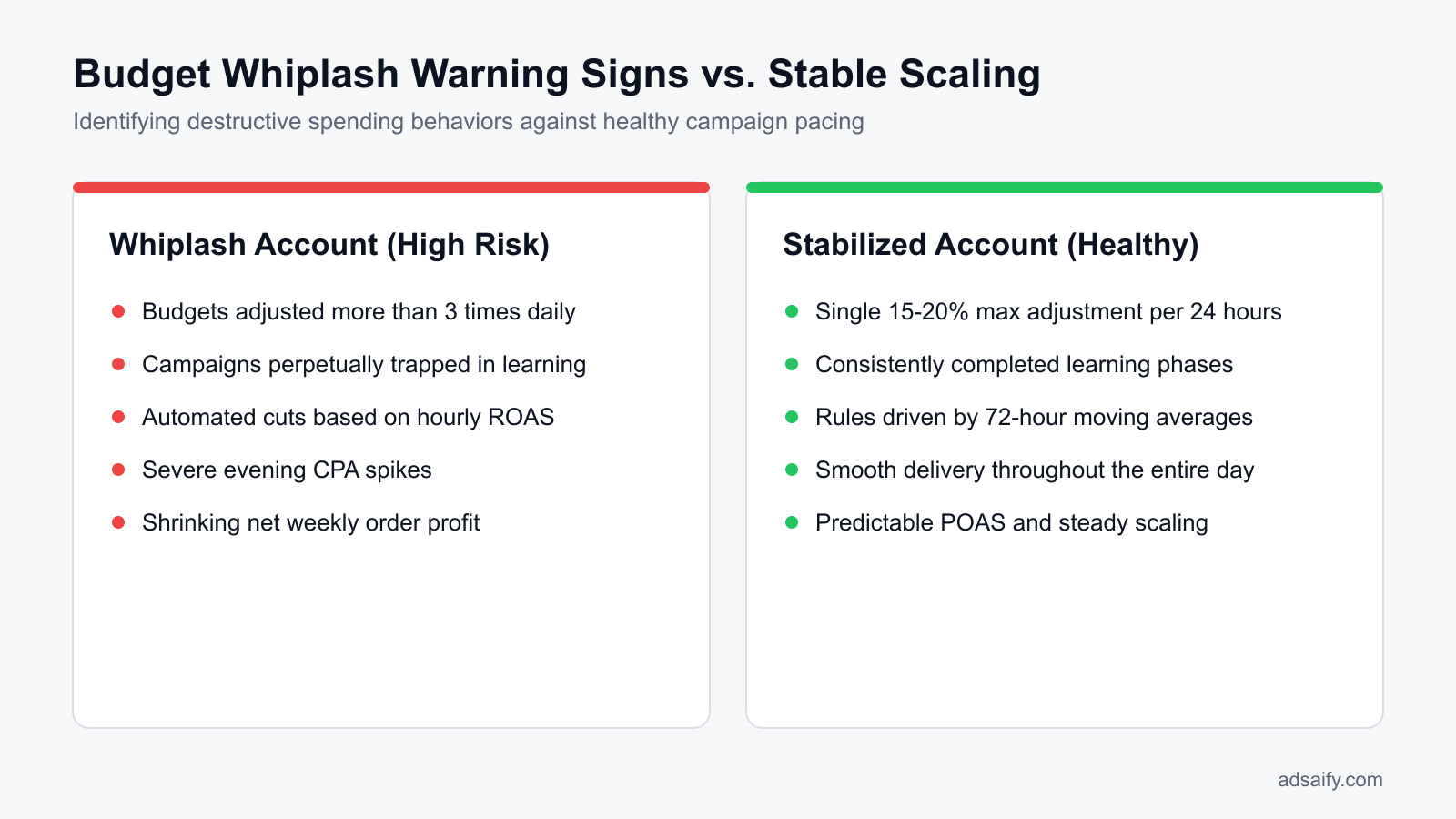
More than two automated budget changes within a single 24-hour period should trigger immediate concern. Meta's auction pacing algorithm recalibrates whenever a budget changes, and adjustments larger than 20 percent reset the learning phase entirely. When an automation tool triggers three, four, or more adjustments in a day, delivery algorithms cannot establish an auction baseline, leading directly to volatile ad pacing, inflated acquisition costs, and degraded campaign efficiency.
If you would rather not set up each of these steps by hand, try it in Adsaify: your first ad is free, so there is nothing to lose. Create a free account.
What must you audit and prepare before configuring budget stabilization?
Before configuring budget stabilization, you must audit conversion lag, rule execution intervals, campaign budgeting architecture, and financial thresholds. Quantifying how long buyers take to purchase prevents automation software from reacting prematurely. Aligning Advantage Campaign Budget or Ad Set Budget Optimization setups with validated break-even metrics ensures automated rules preserve profit margins rather than suppressing active buyers.
Audit conversion lag, automation intervals, and campaign structures
Conversion lag is the time delay between a customer first clicking an advertisement and completing a purchase. If an automated media buying tool evaluates performance on an hourly basis while customer consideration requires two days, the algorithm interprets delayed reporting as poor performance. Review the rule frequency inside your media buying platform, such as Adsaify, to ensure rules do not fire on incomplete attribution cycles. Next, examine whether campaigns use Advantage Campaign Budget (CBO), where Meta automatically distributes budget across ad sets, or Ad Set Budget Optimization (ABO), where spend is allocated manually at the ad set level. Automated rules must not adjust both ad set and campaign budgets simultaneously, which creates compounding volatility.
Calculate financial baselines and operational thresholds
Setting automated parameters requires precise mathematical guardrails. Return on ad spend (ROAS) is total revenue generated divided by total advertising cost. Break-even ROAS is the minimum return on ad spend required to cover product costs, shipping, and transaction fees without losing money. For example, if a store operates on a 50 percent gross margin, the break-even ROAS is 2.0. Operating safeguards require defining a floor ROAS, which is the non-negotiable metric threshold below which the system must stop spending or pause underperforming assets to prevent capital destruction.
Pre-configuration stabilization checklist
- Verify average click-to-purchase latency in analytics attribution path reports.
- Inspect active automated rules to confirm execution frequencies do not evaluate intraday metrics.
- Separate Advantage Campaign Budget scaling structures from Ad Set Budget Optimization testing campaigns.
- Calculate the current break-even ROAS based on net margins and product costs.
- Establish a strict floor ROAS threshold for automated safeguard mechanisms.
- Document baseline cost per acquisition across 1-day and 7-day click attribution windows.
Where is the most reliable place to verify if my brand's conversion lag exceeds 24 hours?
The most reliable place to verify conversion lag is inside Meta Ads Manager by selecting the Columns menu, clicking Customize Columns, and selecting Compare Attribution Settings for 1-day click versus 7-day click. Alternatively, review the Path Exploration or Time Lag reports in Google Analytics 4. If the 7-day click view records more than twenty percent of total purchases compared to the 1-day click view, customer decision time exceeds twenty-four hours, requiring automated budget managers to extend their data evaluation periods accordingly.
How to fix and stabilize AI budget whiplash step by step?
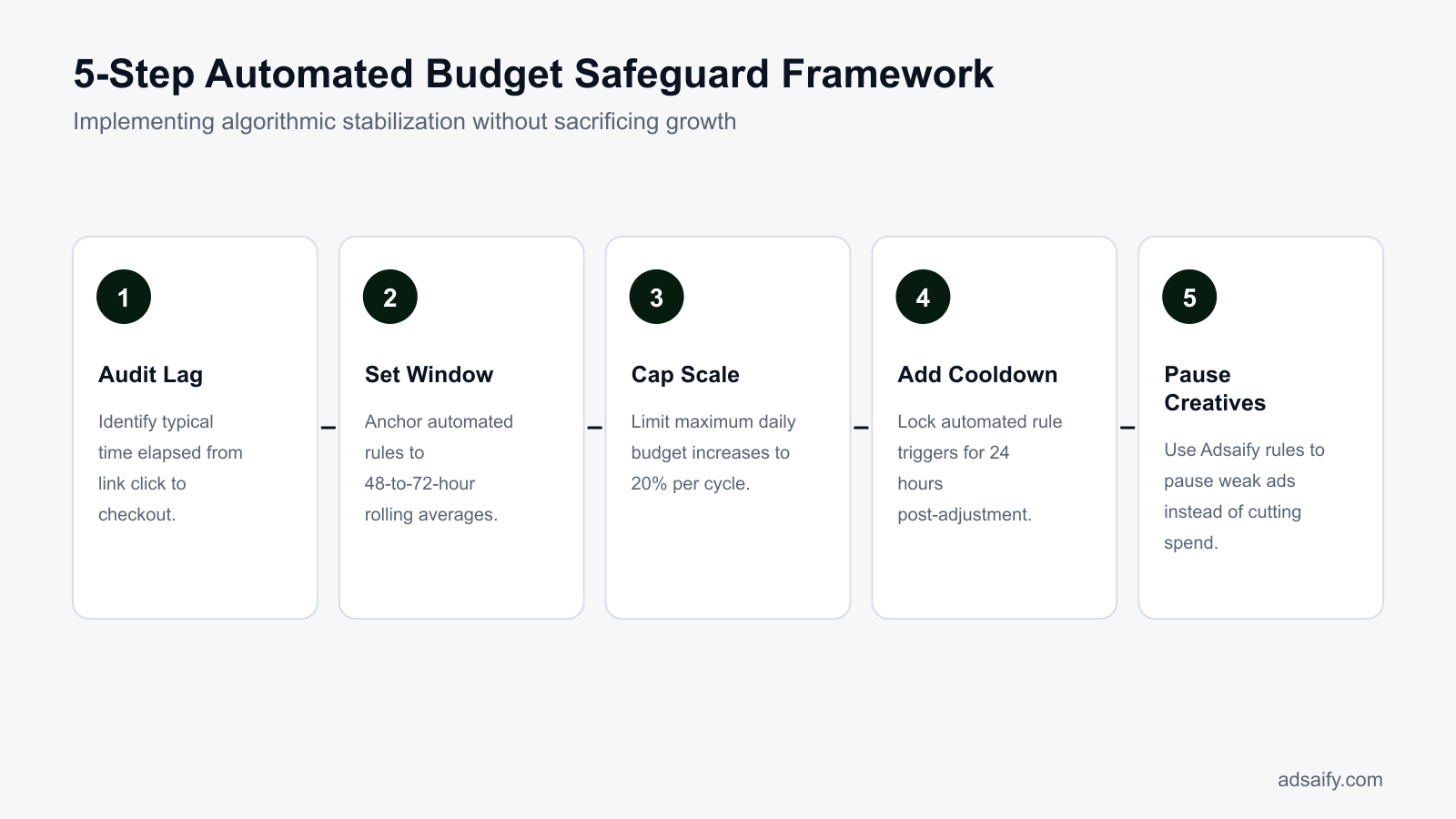
To fix and stabilize AI budget whiplash, anchor automated rules to multi-day rolling performance metrics, enforce strict scaling caps, and mandate execution cooldowns. Automated tools must analyze forty-eight to seventy-two hours of attribution data, limit budget changes to under twenty percent, and pause poor creatives instead of slashing overall ad set funding.
- Evaluate multi-day performance — The automation engine reviews attribution metrics across a 72-hour rolling window, proceeding to adjustment calculations only if data volume meets statistical significance.
- Check cooldown status — The system verifies that no budget adjustments occurred in the previous 24 hours, terminating the workflow if a cooldown is currently active.
- Apply incremental scaling cap — The engine calculates a budget increase capped between 15% and 20% of current spend, applying the increase only when performance exceeds target thresholds.
- Identify fatigued assets — The tool scans ad-level performance metrics, routing underperforming creative assets directly to automated pause rules.
- Lock daily evaluation schedule — The platform executes approved adjustments at a single daily checkpoint, ending automated execution until the subsequent reporting window.
Step 1 to Step 3: Rolling metrics, scaling caps, and cooldowns
First, adjust the evaluation window of your automated rules from same-day metrics to a 48-to-72-hour rolling average. Rolling averages smooth out natural intraday performance fluctuations and allow delayed attribution to populate. Second, limit individual budget increases to a maximum cap of 15% to 20% within a single cycle. Raising budgets by larger increments can reset Meta's learning phase, which causes bidding volatility. Third, configure a mandatory 24-hour cooldown period between budget modifications. Cooldown periods ensure that the delivery algorithm stabilizes at the new expenditure level before software evaluates subsequent adjustments.
Step 4 and Step 5: Creative pauses and scheduled evaluation checkpoints
Fourth, instead of lowering the overall ad set budget when efficiency declines, configure automated rules in your Adsaify dashboard to pause individual underperforming creatives. Pausing an underperforming creative removes inefficient spend while maintaining campaign-level bid history. Fifth, lock automated rule triggers to run at consistent daily checkpoints—such as early morning hours—rather than continuously across volatile overnight periods. This ensures optimizations operate on stable, consolidated data sets.
Why is pausing an underperforming creative safer than slashing the entire ad set budget?
Pausing an underperforming creative removes the precise asset draining spend while preserving the ad set's algorithmic stability and accumulated delivery history. When automated tools slash an ad set budget, Meta interprets the sudden drop as a structural campaign modification, which frequently forces the entire ad set back into the learning phase. Disabling only the failing creative keeps profitable ad variations active, maintains auction efficiency, and stabilizes average cost per acquisition without disrupting ongoing machine-learning delivery.
Worked example: How a 2,000 TL daily spend store eliminates budget whiplash
A 2,000 TL daily spend store eliminates budget whiplash by replacing intraday volatility triggers with multi-day smoothing rules and strict daily expansion caps. Restricting campaign modifications to a maximum twenty percent increase every twenty-four hours prevents Meta's auction pacing algorithms from entering rapid resetting loops, thereby protecting conversion margins and preserving bid stability.
The anatomy of an algorithmic budget spiral
Consider an example of an e-commerce footwear brand running an Advantage+ sales campaign in Meta Ads Manager with an initial baseline budget of 2,000 TL per day. By 10:30, the store registers three early purchases, showing an intraday ROAS (return on ad spend, calculated as revenue divided by ad spend) of 4.0. An unconstrained automated rule reacts immediately to this incomplete morning signal, raising the daily budget to 4,500 TL at 11:00.
Meta's delivery system responds by aggressively entering higher-cost ad auctions to liquidate the newly allocated funds before midnight. Consequently, CPM (cost per mille, representing the cost per one thousand ad impressions) surges from 180 TL to 310 TL within two hours. As performance naturally cools during the afternoon, conversion rates drop. The automated manager detects the dip and slashes the budget down to 1,000 TL at 16:00. This drastic mid-day reduction resets delivery pacing entirely, leaving the store with 2,800 TL spent by midnight at an unprofitable 0.9 ROAS.
Applying controlled stabilization pacing
To prevent this scenario, the brand configures structured pacing guardrails using Adsaify automation rules to control account scaling logic systematically:
- Lookback window adjustment: The optimization trigger evaluates a rolling three-day attribution window rather than same-day morning metrics, ensuring changes require a sustained 2.5 ROAS threshold.
- Scaling frequency cap: The account restricts budget increases to exactly one adjustment per twenty-four-hour cycle, executing strictly at 00:00 midnight.
- Maximum scaling threshold: Increases cannot exceed twenty percent of the active daily budget, capping the first day's increase at exactly 2,400 TL.
Over the subsequent five days, predictable auction pacing allows the ad set to maintain efficient bid tiers. With automated daily increments locked at twenty percent, daily ad spend safely expands from 2,000 TL to 3,500 TL while holding a profitable 2.8 ROAS across the scaling cycle.
Does the 24-hour stabilization rule apply equally across both small and large daily budgets?
The twenty-four-hour stabilization rule applies across all budget sizes, but its tolerance thresholds differ significantly. Smaller budgets, such as 500 TL daily, absorb twenty percent shifts smoothly because auction impact is negligible. However, accounts spending 50,000 TL daily create massive ripples inside ad delivery pools; for enterprise accounts, scaling caps should tighten to ten or fifteen percent every forty-eight hours to protect machine learning stability and maintain consistent delivery margins.
How do you measure whether budget stabilization was successful?
Marketers measure budget stabilization success by tracking delivery pacing smoothness, ad set machine learning status, cohort profit margins, and creative lifespan. A stabilized ad campaign demonstrates an even hourly spend curve across twenty-four hours, stays out of algorithmic learning resets, maintains predictable profit thresholds, and avoids sudden performance degradation on top ads.
Key performance indicators of budget stabilization
Reviewing ad delivery requires analyzing specific diagnostic indicators inside Meta Ads Manager and backend e-commerce reporting:
- Hourly spend pacing score: Inspect the Delivery breakdown by hour. A stabilized campaign displays a predictable bell curve aligned with regional shopping habits, avoiding aggressive midday expenditure spikes.
- Machine learning health: Monitor the ad set Delivery column. Stabilized campaigns successfully exit the "Learning Phase" after reaching fifty optimization events and avoid dropping into "Learning Limited" status.
- POAS stability: POAS (profit on ad spend, defined as gross profit divided by ad spend) reflects blended margins. Track rolling seven-day attribution windows to ensure net profitability remains steady during scaling.
- Winning creative longevity: Track the creative frequency and conversion rate of top-performing assets. When budget spikes stop, winning ads avoid immediate algorithmic fatigue, sustaining steady efficiency for multiple weeks.
| Metric Indicator | Unstable Delivery (Whiplash) | Stabilized Delivery (Controlled) |
|---|---|---|
| Hourly Spend Curve | Abrupt spikes spending over 40% of budget in 3 hours | Gradual delivery matching normal audience activity |
| Delivery Column Status | Frequent resets into "Learning" or "Learning Limited" | Sustains "Active" status continuously |
| CPM Volatility | Day-to-day fluctuations exceeding 50% variance | CPM variances held within a predictable 15% range |
| Creative Lifespan | Top ads burn out and drop efficiency within 5 days | Winning ads produce stable ROAS for several weeks |
| 7-Day POAS Trend | Severe swings between heavy profit and severe loss | Consistent profitability aligned with target margins |
Brands using Adsaify configure automated rules to monitor these exact boundaries, automatically pausing ads that breach loss thresholds while protecting active ad sets from erratic pacing interventions.
Can I increase budget more aggressively once my ad set has fully exited the learning phase?
Exiting the learning phase does not remove auction sensitivity. Even after an ad set displays "Active" status, an immediate budget increase above twenty percent will destabilize delivery algorithms. Meta recalculates target bid distributions whenever significant capital enters the ad set. To maintain auction stability and protect profitability, you should continue applying disciplined twenty percent adjustments spaced at least twenty-four to forty-eight hours apart, regardless of whether the learning phase has completed.
Want to see this in your own account? Enter your website address and Adsaify drafts the campaign for you. The first ad is free. Try it now or log in.
What weekly routine prevents budget whiplash from returning?
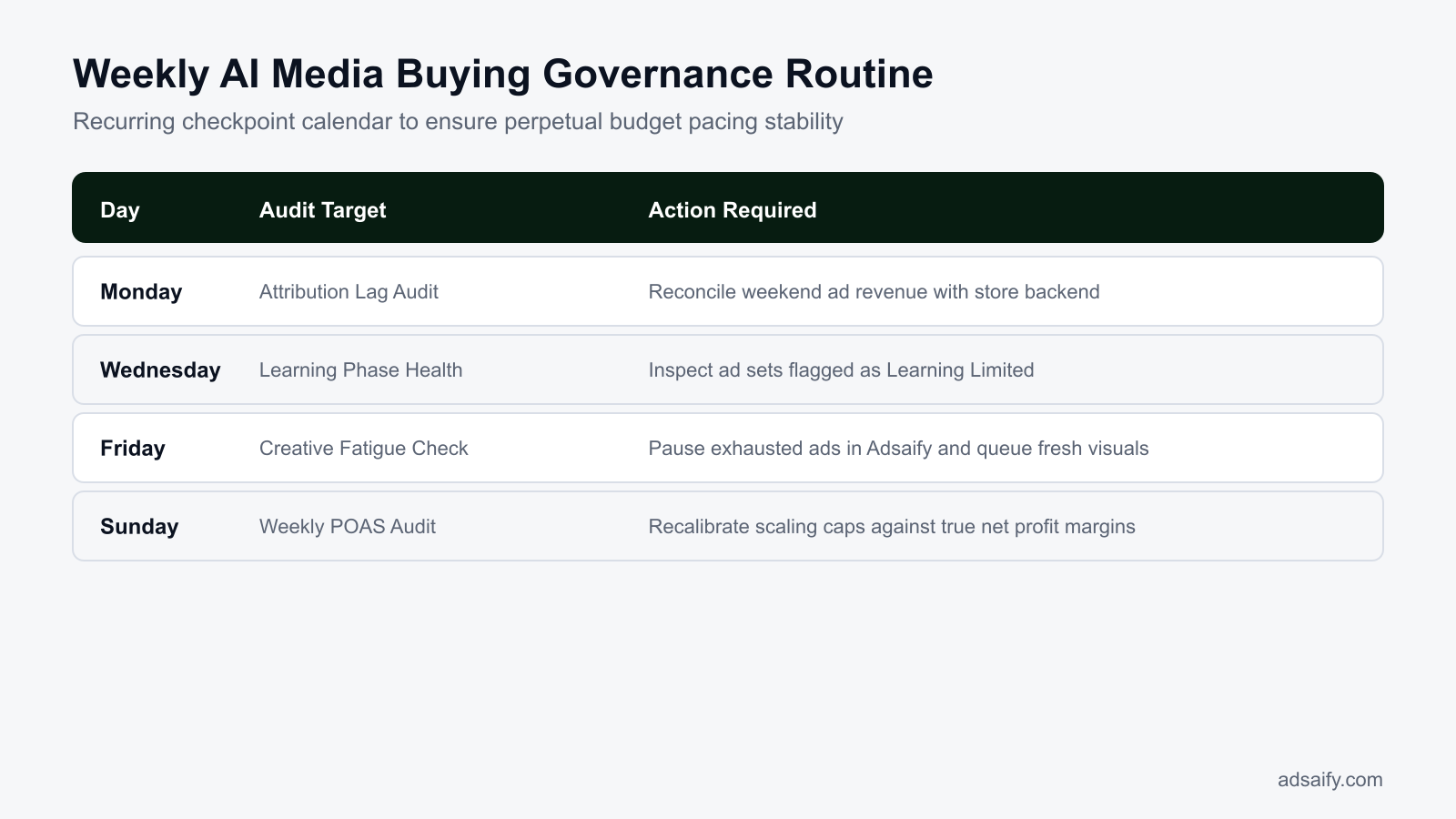
A structured weekly maintenance routine prevents budget whiplash by continuously aligning Meta automated optimization rules with verified commercial performance rather than volatile short-term ad metrics. By auditing delayed conversions, recalibrating automated pause thresholds, adding fresh ad creative, and reconciling platform attribution with backend bank receipts, media buyers maintain stable algorithmic delivery across campaigns.
Algorithmic stabilization requires strict operational cadence. When media buyers fail to audit attribution delay—known as conversion lag, which is the time elapsed between an ad impression and an eventual transaction—automated rules penalize campaigns prematurely. Furthermore, shifting product profit margins demand regular threshold updates in automation tools like Adsaify, while continuous creative replenishment prevents Meta's auction algorithm from starving fatigued ad sets of daily delivery.
- Daily: Inspect total spend pacing inside Meta Ads Manager to verify no automated budget increase pushed ad sets beyond pre-set upper financial thresholds.
- Daily: Review automated execution logs to confirm automated rules did not misfire due to temporary server or tracking signal interruptions.
- Weekly: Conduct a Monday conversion lag audit by comparing weekend reporting with 7-day post-click sales data before adjusting ad set status.
- Weekly: Recalibrate automated pause and scaling thresholds according to weekly changes in product cost of goods sold and net profit margins.
- Weekly: Introduce two to four newly generated visual creatives into testing ad sets to replenish creative fatigue before auction costs climb.
- Weekly: Cross-check Meta reported purchase conversion value against actual e-commerce bank receipts to verify true ROAS (return on ad spend is total revenue divided by ad spend).
- Monthly: Audit the blended CPA (cost per acquisition is ad spend divided by purchases) across all campaigns to redefine baseline rule boundaries.
Does tweaking automation rule thresholds weekly disrupt Meta's machine learning?
Adjusting external automation rule conditions does not reset Meta's campaign learning phase because the adjustments alter third-party governance logic rather than core ad set settings. Meta resets learning only when significant edits occur directly within Meta Ads Manager, such as modifying campaign bids, creative assets, targeting, or changing budgets by more than twenty percent. Updating condition values in your automation software simply shifts when safeguard actions trigger, keeping algorithmic delivery stable without initiating the learning phase again.
What are the 5 most common automated budget mistakes and how to fix them?
The most common automated budget mistakes occur when performance marketers configure automation rules using volatile real-time data, conflicting governance tiers, and unrestricted scaling parameters. These configuration errors induce budget whiplash by forcing Meta's machine learning delivery system into premature spending cutbacks or aggressive budget expansions before the algorithm establishes statistically reliable conversion patterns.
Mistake 1: Building rules triggered by hourly data slices
Evaluating campaigns on intraday hourly metrics triggers violent budget fluctuations because Meta ad delivery fluctuates naturally across different hours of the day. The exact fix is to enforce a lookback window of 48 to 72 hours so automated rules make scaling or pausing decisions based on aggregated, statistically sound performance data.
Mistake 2: Running competing automation rules simultaneously at campaign and ad set levels
Applying automated rules to both CBO (Advantage Campaign Budget distributes budget across ad sets dynamically) and ABO (Ad Set Budget Optimization allocates fixed budgets per ad set) creates conflicting algorithmic directives. The exact fix is to select one governance tier; run scaling rules exclusively at campaign level or pause rules at ad set level, never simultaneously.
Mistake 3: Omitting hard budget scaling caps
Uncapped automated scaling rules can double or triple campaign budgets rapidly during momentary conversion spikes, sending campaigns into erratic auction environments. The exact fix is to enforce a strict daily ceiling of no more than twenty percent budget increases within any 24-hour window to keep the delivery system within stable learning boundaries.
Mistake 4: Panicking during zero-conversion hours and applying manual overrides
Manual edits made during midday performance lulls interfere with automated logic, confusing Meta's conversion rate predictions and triggering severe bidding whiplash. The exact fix is to respect a mandatory 24-hour algorithmic cooldown period, letting automated tools like Adsaify execute rule parameters without reactive human interference.
Mistake 5: Slashing entire ad set budgets instead of shutting down underperforming ads
Reducing budget on an entire ad set penalizes high-performing ads alongside failing ones, collapsing delivery across the entire audience segment. The exact fix is to point automated pause rules directly at the ad creative level, disabling individual underperforming ads while allowing healthy creatives to maintain ad set momentum.
Mistake 6: Optimizing rule logic without attribution window lookback buffers
Scaling or pausing ad sets before Meta's attribution window completes leads to flawed decisions, as delayed conversions arrive hours after automated actions execute. The exact fix is to integrate a 24-hour attribution buffer into automation conditions to ensure rules evaluate finalized transaction data rather than partial reporting streams.
What happens if I combine CBO with ad set level automated rules simultaneously?
Combining Advantage Campaign Budget with ad set level automated rules triggers systemic auction instability and severe budget whiplash. When Meta's algorithm shifts budget toward an ad set identified as having high potential, an independent ad set rule may simultaneously throttle that same ad set due to delayed attribution. This structural conflict forces the delivery system to recalibrate bid targets continuously, degrading audience reach, resetting optimization learning, and driving up blended acquisition costs across the account.
When does budget stabilization fail and what are its inherent limits?
Budget stabilization fails when foundational business factors break, because algorithmic budget controls only regulate ad distribution, not purchase intent. If an ad account lacks conversion volume, suffers from broken checkout tracking, offers uncompetitive pricing, or runs fatigued creatives, automated budget rules cannot compensate for underlying funnel friction and will throttle spend to zero.
Why technical bugs and uncompetitive offers override pacing rules
Budget stabilization rules in Meta Ads Manager evaluate quantitative metrics like ROAS (return on ad spend, the ratio of gross revenue to ad spend) and CPA (cost per acquisition, the ad spend required to generate one purchase). When an e-commerce website experiences broken payment gateways, missing shipping zones, or slow server response times, conversion rates plummet regardless of ad quality. Automated rules detect the resulting CPA spikes and reduce ad spend. In this scenario, budget stabilization operates correctly, but it cannot revive profitability because the root failure exists entirely on the website.
Similarly, budget pacing cannot overcome poor product-market fit or uncompetitive retail pricing. If a competitor offers the identical product at a lower price point or with superior shipping terms, Meta's auction mechanics face lower user engagement. Automated budget pacing prevents financial losses by throttling spend, but media buyers cannot stabilize campaign scaling until the commercial offer matches market expectations.
How conversion volume thresholds and creative fatigue limit automation
Meta's delivery system requires approximately 50 conversion events per ad set within a seven-day window to exit the Learning Phase (Meta's calibration period during which the delivery system explores optimal audience delivery). In low-volume ad accounts generating fewer than 50 purchases weekly, data density remains too thin for automated rules to distinguish between natural performance variance and systemic failure. Budget stabilization rules triggered by single-day fluctuations in low-data environments often starve ad sets of impressions before machine learning can calibrate.
Creative fatigue creates another hard limit. Over time, audience saturation drives up frequency, depressing click-through rates and increasing acquisition costs. Platform tools like Adsaify automate campaign launch structures and apply automated protection rules to pause deteriorating ads, but automated rules do not generate and swap new creative assets into running campaigns on their own. Advertisers must monitor asset health and manually upload fresh visual creatives to restore conversion velocity.
Before relying on automated budget stabilization, ensure your operational foundation meets these prerequisites:
- Audit the technical checkout flow weekly to verify that payment gateways and discount codes process orders without errors.
- Verify Meta Pixel and Conversions API tracking health in Events Manager to eliminate dropped purchase events.
- Maintain at least 50 weekly purchases per ad set before applying aggressive automated scaling logic.
- Compare product pricing and delivery terms against direct market competitors to protect conversion rates.
- Produce fresh creative concepts routinely to replace declining ads identified by your rules.
- Test automated account workflows with a free campaign draft by visiting the Adsaify demo start page.
What should I do to stop budget swings if my store gets fewer than 50 purchases a week?
To stop budget swings on low-volume accounts generating fewer than 50 conversions weekly, shift your campaign optimization event up-funnel to Add to Cart or Initiate Checkout to aggregate sufficient statistical volume. Alternatively, switch from dynamic automated rules to fixed daily ad set budgets with narrow manual pacing, or consolidate multiple fragmented campaigns into a single broad Advantage campaign budget structure. This consolidation aggregates conversion events, giving Meta's delivery algorithm enough data to calibrate bids without triggering wild spend adjustments.
Glossary of key terms in automated media buying and budget pacing
Automated media buying relies on specialized terminology to describe how machine learning algorithms allocate ad spend, evaluate performance data, and manage pacing risks. Understanding these concepts enables media buyers to configure precise automated rules, diagnose system anomalies, avoid volatile budget fluctuations, and align campaign spending parameters with genuine business profitability metrics.
- Budget Whiplash: The destructive operational cycle where automation tools swing ad spend wildly based on short-term data blips.
- Conversion Lag: The elapsed time gap between a user's initial ad click and their final completed checkout.
- Learning Phase: Meta's algorithmic calibration period requiring roughly 50 optimization events per ad set within a seven-day window.
- Rolling Average Window: A moving evaluation timeframe, typically 48 to 72 hours, used by automated rules to smooth out temporary performance volatility.
- POAS (Profit on Ad Spend): The ratio of gross product profit to ad spend, measuring true financial health after subtracting cost of goods sold.
- ROAS (Return on Ad Spend): The ratio of total gross revenue generated to gross advertising spend, representing top-line marketing efficiency.
- CPA (Cost Per Acquisition): The total advertising cost required to generate a single specified conversion action, such as a completed purchase.
- Attribution Window: The defined timeframe in Meta Ads Manager during which an ad click or view is credited with driving a conversion.
- Advantage Campaign Budget (CBO): Meta's automated budget setting that distributes a single campaign-level budget across multiple ad sets dynamically.
- Creative Fatigue: The performance decline that occurs when target audiences repeatedly see the same ad, leading to rising acquisition costs.
- Bid Cap: An auction control setting in Meta Ads Manager that specifies the maximum bid an advertiser permits Meta to place for ad impressions.
How does shifting from ROAS to POAS change my automated budget rules?
Shifting from ROAS to POAS alters automated budget rules by tying spend adjustments to gross margin rather than top-line revenue. Instead of scaling campaigns when gross sales spike—which can disguise unprofitable sales on heavily discounted inventory—a POAS rule increases budget only when net gross profit covers advertising and product costs. This prevents automation tools from pouring capital into low-margin products and protects operational cash flow during sales events.
Protect Your Capital with Disciplined AI Meta Campaign Management
To eliminate budget whiplash in automated Meta advertising, establish operational discipline across your campaigns in four clear steps. First, freeze all erratic scaling rules and return your active ad sets to baseline daily budgets. Next, cap all future automated or manual budget increases to a maximum threshold of 15% to 20% every 48 hours. Third, expand the lookback evaluation window on all automated triggers to at least three to seven days to absorb standard conversion attribution delays. Finally, separate creative testing from budget scaling to protect auction stability.
Today, open your Meta Ads Manager, review your active automation rules, and ensure none of them make budget decisions using same-day performance data. If you want a platform that drafts structured campaigns with responsible budget suggestions and safe performance rules, register an account on Adsaify to create your first ad campaign without volatile scaling triggers.
Want to see this in your own account? Enter your website address and Adsaify drafts the campaign for you. The first ad is free. Try it now or log in.
Frequently Asked Questions (FAQ)
1. What is the safest maximum daily budget scaling limit for AI ad managers?
The safest maximum daily budget scaling limit for AI ad managers is 15% to 20% every 24 to 48 hours. Meta ad delivery systems enter the learning phase when budget adjustments exceed 20%, which triggers unstable bidding and cost per acquisition spikes. Increasing spend within this threshold protects campaign stability while allowing the algorithm to find conversions predictably.
2. Should I immediately kill and rebuild a campaign suffering from budget whiplash?
You should not immediately kill and rebuild a campaign experiencing budget whiplash. Rebuilding resets all conversion history and forces the ad set into a brand new learning phase. Instead, lock the current daily budget at a sustainable baseline, disable conflicting automated scaling rules, and allow Meta delivery algorithms 48 to 72 hours to stabilize auction bidding performance.
3. Can Meta's native Advantage+ campaign budget automation also cause whiplash?
Meta's native Advantage+ campaign budget can cause budget whiplash if ad sets have wildly disparate audience sizes or volatile conversion signals. Advantage+ campaign budget automatically distributes spend across ad sets in real time. If one ad set registers a sudden, temporary spike in purchases, the system abruptly shifts capital away from steady ad sets, destabilizing account performance.
4. What is the minimum historical data lookback window for automated budget rules?
The minimum historical data lookback window for automated budget rules is three to seven days, excluding the current day. Real-time or same-day reporting on Meta often suffers from conversion attribution delays. Setting automated evaluation rules across at least a 72-hour window prevents the system from making erratic budget cuts based on delayed purchase reporting data.
5. What safeguards does Adsaify use to prevent campaign budget whiplash?
Adsaify safeguards campaigns by applying controlled automation rules that focus on measured performance actions, such as pausing underperforming ads, rather than executing erratic budget swings. Adsaify drafts campaign budgets and publishes to the user's Meta ad account while keeping daily spend predictable, preventing algorithmic shock and avoiding the erratic bidding shifts associated with unconstrained scaling scripts.
6. How do you adjust AI rules for high-ticket niches with extended conversion lag?
To adjust AI rules for high-ticket niches with extended conversion lag, lengthen the rule evaluation lookback window to 7 or 14 days and optimize for higher-funnel conversion milestones. High-ticket sales cycles naturally take days or weeks from click to close. Basing automated decisions on intermediate actions like leads or qualified calls avoids premature budget cuts while sales conclude.
7. Should automated AI tools slash budgets during typical weekend ROAS dips?
Automated AI tools should not slash budgets during typical weekend ROAS dips if those fluctuations reflect recurring consumer buying cycles. ROAS (return on ad spend) measures generated revenue per advertising dollar. Cutting budgets on scheduled low-conversion days creates bidding whiplash when Monday demand returns. Account managers should evaluate multi-day weekly averages instead of daily troughs.
8. How many days after implementing budget stabilization will metrics improve?
Metrics typically stabilize within three to five days after implementing strict budget controls and pausing aggressive scaling rules. Meta auction algorithms require approximately 50 conversion events per ad set per week to exit the learning phase. Once spend remains predictable, conversion rates and cost per acquisition normalize as bidding volatility settles across the audience pool.
How can you try this with Adsaify?
The quickest way to apply the steps in this article to your own account is to try them. Adsaify analyses your business from your website address, drafts the campaign with an audience, ad copy, creative and a budget suggestion, and publishes it to your own Meta ad account once you approve.
- Your first ad is free: there is nothing to lose by trying.
- Your own ad account: the campaign runs in your Meta account and you stay in control.
- Images and video: generate ad creatives with AI or promote an existing Instagram post.
Create a free account and try your first ad · Already have an account? Log in.