Short answer: When scaling Meta ad spend, the algorithm expands delivery into lower-intent audiences that easily add items to cart but drop off before purchase. This intent drift inflates cart abandonment and depresses ROAS. To fix it, anchor campaign optimization strictly to Purchase events, eliminate checkout friction, and enforce ROAS guardrails through disciplined scaling.
You raise your daily Meta ad spend expecting revenue to follow, but your e-commerce dashboard reveals an unsettling pattern. Add-to-cart events climb rapidly, yet checkout completions stagnate. Shoppers browse products, select variants, and proceed partway through the funnel, only to vanish before entering payment details. Instead of profitable scaling, your store accumulates hundreds of abandoned carts while customer acquisition costs climb.
This breakdown occurs because Meta's machine learning shifts delivery into broader, cheaper audience pockets to fulfill aggressive budget pacing. These marginal prospects carry curiosity rather than transactional commitment, skewing pixel signals toward low-friction actions. Leaving this dynamic unaddressed burns working capital, creates false demand signals, and misleads attribution models, ultimately destroying overall store profitability.
This guide establishes how to diagnose and resolve spend-driven abandonment at its source. You will learn how to distinguish traffic mismatch from checkout friction, audit your technical setup before raising budgets, and configure bidding safeguards that prioritize genuine transactional intent. By adopting disciplined monitoring routines and tracking core conversion metrics, you can scale Meta ad accounts without sacrificing margins.
Key Takeaways
- Aggressive budget scaling forces Meta algorithms into low-intent segments that add to cart but fail to buy.
- Always set conversion optimization to Purchase rather than Add to Cart or Initiate Checkout events.
- Unexpected shipping fees and forced account registration multiply abandonment under heavy ad traffic.
- Scale budgets in gradual increments while using automated pause rules to protect baseline ROAS.
What Causes Cart Abandonment to Surge Abruptly When Scaling?
Cart abandonment surges during scaling because Meta delivers impressions to progressively colder audiences once high-intent pockets are exhausted. While low budgets capture immediate buyers, higher daily spend forces the delivery system to target peripheral users who browse casually, add items on impulse, and abandon checkout when confronted with friction or total costs.
How Audience Saturation Triggers Checkout Abandonment
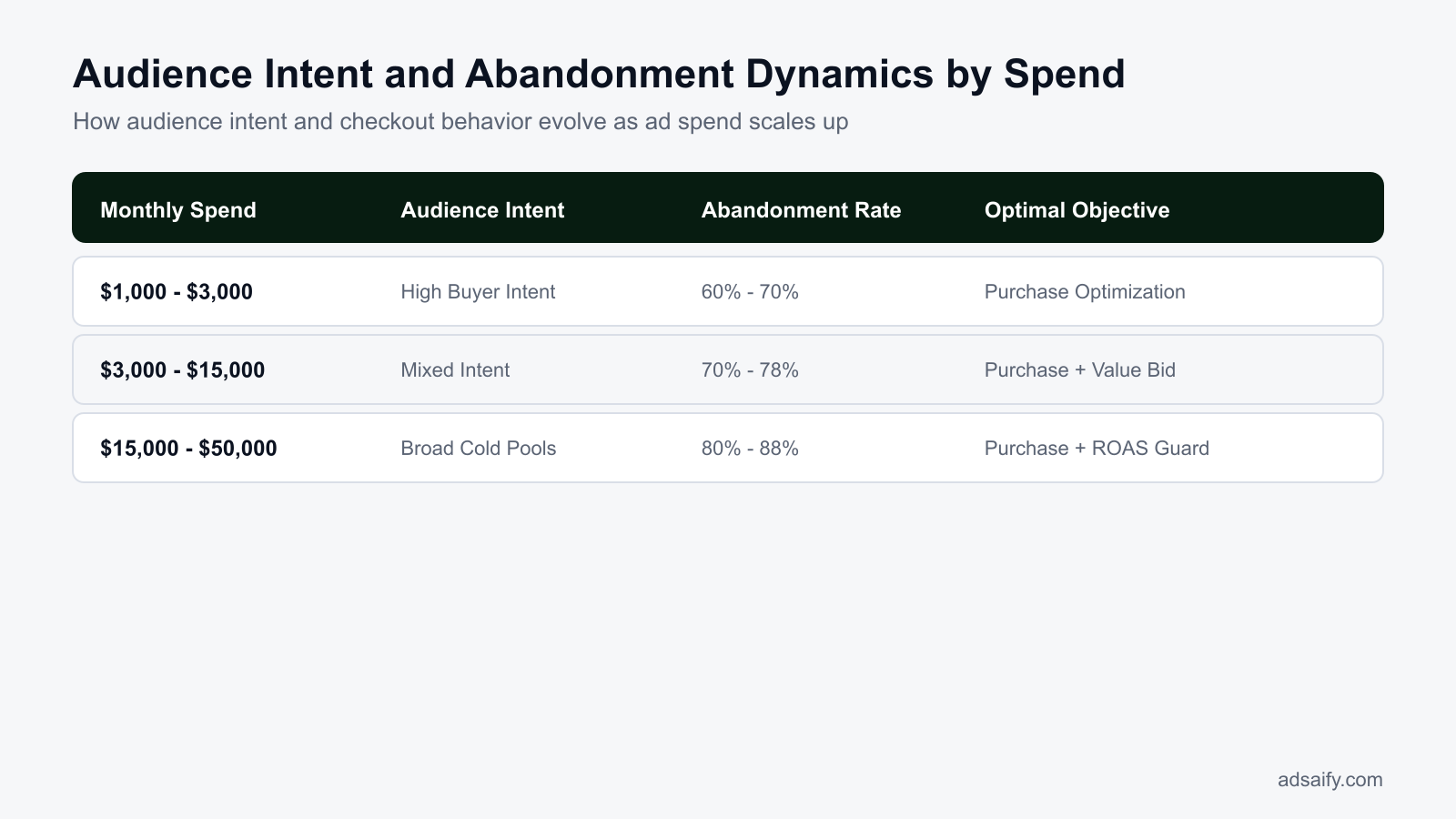
Cart abandonment rate is the percentage of shoppers who add products to a shopping cart but exit the store before completing the checkout transaction. When an advertiser operates at modest spends, such as $1,000 per month, Meta's auction mechanics match ad delivery with hyper-focused segments composed of active, high-intent buyers who are ready to purchase immediately.
Scaling monthly ad spend past $10,000 breaks through this narrow pocket. Meta must enter broader auction segments, displaying ads to colder prospects who possess only mild curiosity. These users readily click attractive creatives and trigger an "Add to Cart" action as a bookmarking behavior, yet they lack the commitment required to enter payment details. A sharp divergence between surging add-to-cart volume and stagnating purchase events is the classic early warning indicator that Meta's algorithm is targeting low-conviction traffic.
A Concrete Scaling Example: Specialty Footwear Brand
For example, consider an independent leather footwear brand running Meta campaigns inside Meta Ads Manager. At an initial budget of $1,000 per month, the store maintained 120 adds to cart and 40 purchases, yielding a manageable cart abandonment rate of 66.6%. The store owner decided to aggressively scale the campaign budget to $10,000 per month within the Ad Set budget settings without altering the landing page or creative strategy.
After scaling, the campaign generated 1,800 adds to cart but only 220 purchases, causing cart abandonment to spike to 87.7%. The cost per acquisition climbed steeply because Meta expanded into marginal audiences seeking casual inspiration rather than footwear. In this situation, advertisers can use Adsaify to review automated rules that pause underperforming ad sets when the ratio between cart additions and purchases deteriorates significantly.
Which exact metrics should I compare to detect an abnormal spike in cart drop-offs?
To detect abnormal abandonment spikes, compare the ratio of Adds to Cart (Total) against Purchases (Total) alongside the ratio of Checkouts Initiated to Adds to Cart inside Meta Ads Manager. Calculate your drop-off percentage by dividing completed purchases by adds to cart and subtracting that figure from 100%. If your baseline cart abandonment jumps by more than 10 to 15 percentage points while Outbound Click-Through Rate remains steady, your traffic has degraded into low-intent browsers.
Why Does the Meta Algorithm Drift Toward Lower-Intent Users at Scale?
The Meta algorithm drifts toward lower-intent users at scale because its pacing engine must spend the entire allocated budget within twenty-four hours. To hit delivery targets, the auction seeks out cheaper, available impressions from habitual window shoppers whose shallow browsing behaviors generate misleading engagement signals without translating into completed transactions.
Pacing Mechanics and False Signals in the Meta Auction
Meta Ads Manager uses a delivery pacing engine designed to exhaust your daily ad budget smoothly across 24 hours. When you rapidly raise budgets, the auction encounters bidding friction in premium ad inventory. To guarantee full budget spend, the delivery system shifts toward lower-cost auctions featuring casual users who frequently click and trigger superficial pixel events.
The Meta Pixel is a tracking code placed on an e-commerce website that logs user actions such as page views, cart additions, and purchases. Frequent online window shoppers often register "Add to Cart" events across dozens of stores without purchasing. Meta's machine learning models interpret these actions as positive engagement, unintentionally training the ad delivery algorithm to hunt for more users who add items to baskets but never buy.
Creative Misalignment and Pricing Surprises
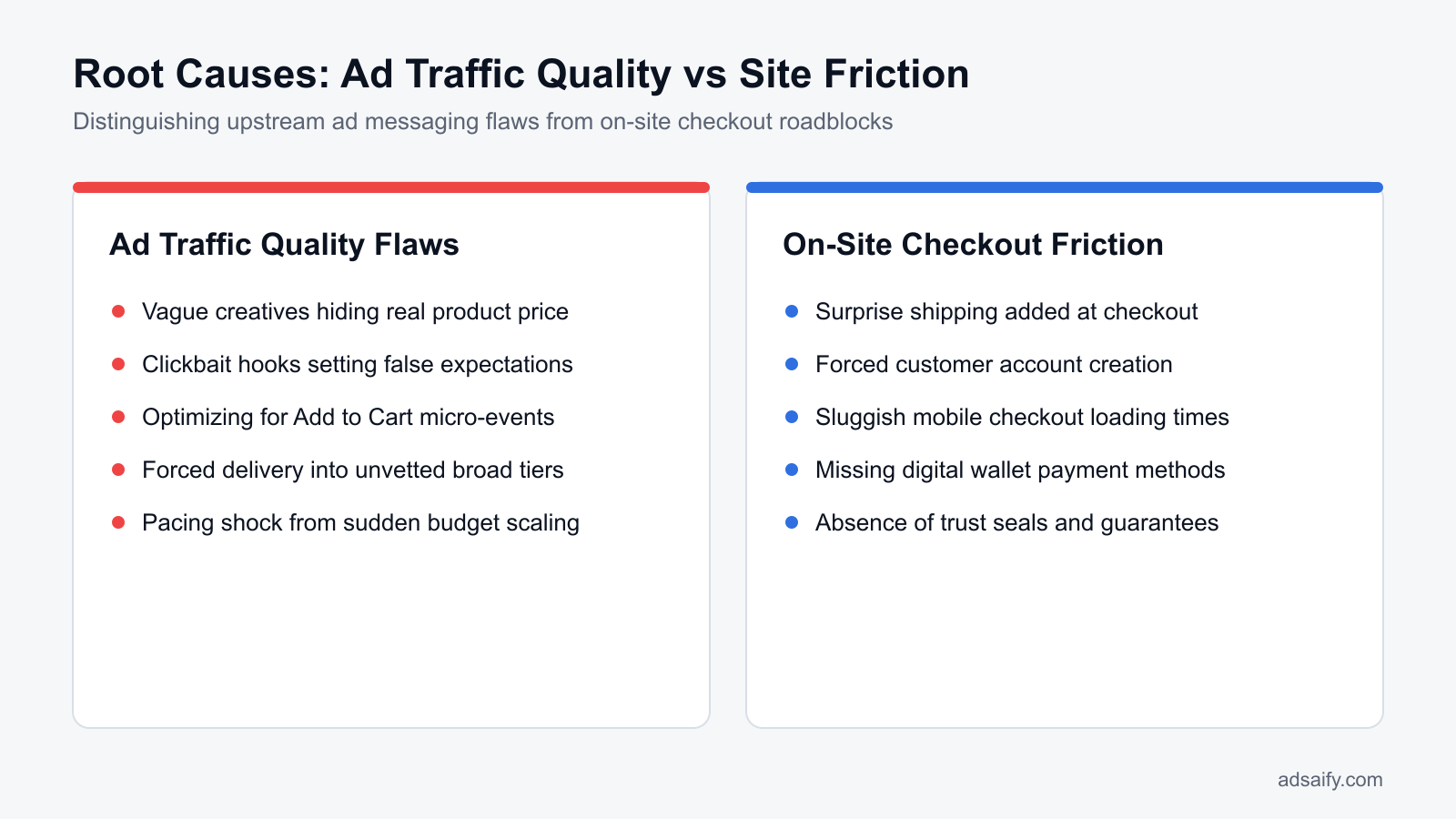
Intent drift also accelerates when creative messaging fails to qualify the user before the click. Vague ad creatives that hide product pricing, product specifications, or shipping terms attract curiosity-driven clicks. When these cold users reach the final checkout screen and encounter shipping fees, taxes, or the real product price, they immediately bounce.
| Auction Characteristic | Low-Spend Baseline | Scaled Delivery Drift |
|---|---|---|
| Primary Audience Reached | High-intent, immediate buyers | Broad, casual window shoppers |
| Add-to-Cart Motivation | Genuine purchasing intent | Casual bookmarking and wishlisting |
| Creative Transparency Impact | Tolerates vague teaser ads | Requires explicit upfront pricing |
| Shipping Fee Sensitivity | Moderate acceptance of fees | Instant abandonment at checkout step |
Does choosing Add to Cart as the optimization event make this intent drift worse?
Yes, selecting Add to Cart as the conversion event dramatically accelerates intent drift at scale. Meta gives you precisely what you ask for: people likely to add an item to a cart, not people committed to finishing a transaction. While this event generates rapid data points for the pixel, it trains the algorithm on non-purchasing window shoppers. When scaling budgets, you should register at Adsaify to structure campaigns optimized strictly for the Purchase conversion event to protect profitability.
How Does Unchecked Cart Abandonment Harm E-Commerce Growth and Profit?
Unchecked cart abandonment harms e-commerce profitability by wasting media spend on uncommitted visitors, inflating effective customer acquisition costs, and corrupting Meta conversion data. As ad spend scales, paying for clicks that do not finalize transactions erodes gross margins, misdirects delivery algorithms toward window shoppers, and drags blended returns below break-even thresholds.
How Abandonment Inflates CPA and Corrupts Meta Pixel Signals
CPC (cost per click) is the amount an advertiser pays each time a user clicks an ad in Meta Ads Manager. CPA (cost per acquisition) is the total ad spend divided by the number of completed purchases generated. When Meta CPC remains fixed but cart completion collapses, effective CPA surges. For example, with a $1.00 CPC, a store converting 3% of clicks into purchases pays $33.33 per acquisition, whereas dropping to a 1% conversion rate increases CPA to $100.00. Furthermore, Meta optimizes campaigns using the standard AddToCart and InitiateCheckout events. When higher budgets attract passive browsers who add items without buying, the Meta Pixel receives misleading conversion signals, training delivery algorithms to find more low-intent users instead of paying customers.
The Collapse of Blended Margin and Retargeting Efficiency
ROAS (return on ad spend) is the total revenue generated by advertising divided by the total advertising spend. Contribution margin is the remaining revenue after deducting all variable costs, including ad spend, cost of goods, shipping, and payment gateway fees. High cart abandonment quickly drags blended ROAS below the store's contribution margin threshold, producing net financial losses despite top-line revenue growth. Simultaneously, website Custom Audiences built from AddToCart events in Meta Ads Manager fill with non-buyers. Retargeting these bloated audiences exhausts secondary advertising budgets on traffic that will never convert. To protect profits, advertisers can use automation rules in Adsaify to pause ad sets when performance metrics fall below defined targets.
- Audit Meta Ads Manager conversion events to confirm the standard Purchase event records accurately.
- Calculate your store break-even ROAS based on gross product margins and transaction fees.
- Exclude users with session durations under thirty seconds from custom retargeting audiences.
- Set automated rules to pause ad sets whenever cost per checkout exceeds baseline targets.
- Compare desktop and mobile checkout drop-off rates inside web analytics to identify usability leaks.
- Review payment gateway error logs for transaction declines or technical API failures.
How can I tell if the abandonment stems from ad targeting issues or my website's checkout experience?
Compare the drop-off metrics across your traffic channels in Google Analytics. If the cart-to-purchase conversion rate declines exclusively on Meta paid campaigns while your organic search and direct traffic maintain their baseline conversion rates, the problem stems from ad targeting and low audience intent. Conversely, if your checkout abandonment rate climbs uniformly across all channels, your website suffers from technical friction, unexpected shipping fees, broken promo code fields, or payment gateway failures.
How to Diagnose Whether Abandonment Stems from Ad Traffic or Site Friction?
To diagnose cart abandonment sources, compare conversion drop-offs between Meta ad traffic and non-paid channels inside your web analytics. When abandonment spikes strictly within paid Meta campaigns, ad audience targeting is delivering low-intent traffic; when abandonment rises across organic, email, and direct traffic simultaneously, on-site technical friction, unexpected costs, or checkout defects are responsible.
Analyzing Channel Variance: Ad Targeting Versus Storewide Problems
A proper diagnosis begins by segmenting funnel performance by session source in Google Analytics or store analytics. If organic search, direct sessions, and email marketing retain a stable cart-to-purchase rate, for example around 40%, while newly scaled Meta campaigns drop to 10%, the problem is ad-driven. In this scenario, the Meta auction algorithm is capturing broad, unqualified traffic that lacks commercial intent. Conversely, when cart abandonment surges at identical rates across direct, organic, and paid channels at the same time, the breakdown is site-driven. Site-level causes include slow page loading speeds under traffic, broken checkout scripts, or uncompetitive shipping policies.
Isolating the Funnel Leak: Cart Page Versus Payment Step
Pinpointing the precise step where shoppers exit clarifies the exact failure point. A major drop between the AddToCart and InitiateCheckout events reveals friction on the cart page itself. This pattern typically indicates surprise cart-level fees, absent delivery timeframes, or missing trust badges. If shoppers successfully trigger InitiateCheckout but exit before the Purchase event, the friction resides inside the payment flow. This drop-off points to unexpected shipping costs revealed late, mandatory account creation barriers, or absent digital wallet payment methods.
| Funnel Drop-Off Symptom | Probable Root Cause | Primary Diagnostic Tool | Recommended Action |
|---|---|---|---|
| High drop-off between Add to Cart and Initiate Checkout | Unexpected shipping fees or missing delivery estimates | Google Analytics Funnel Exploration | Display shipping costs and delivery timelines directly on the cart page |
| High drop-off between Initiate Checkout and Purchase | Payment gateway rejections or mandatory registration steps | Shopify or WooCommerce Checkout Reports | Enable guest checkout and integrate one-click digital wallets |
| Cart abandonment increases solely on Meta paid traffic | Broad targeting drift or ad creative disconnect | Meta Ads Manager Breakdown Reports | Refine ad creative messaging to pre-qualify buyer intent and pricing |
| Cart abandonment increases across all traffic channels | Checkout script failure or site speed degradation | Payment Gateway Error Logs | Resolve technical checkout errors and optimize mobile page speed |
| Mobile checkout abandonment significantly exceeds desktop | Cluttered mobile checkout layout or form input friction | Web Analytics Device Category Breakdown | Simplify mobile forms and auto-fill address fields through browser APIs |
What technical and operational checks should I execute before attempting to scale again?
Before increasing Meta ad spend, conduct a complete end-to-end test purchase across mobile and desktop devices. Verify that all standard Meta Pixel and Conversions API events fire in Meta Events Manager without duplicates or missing parameters. Test every payment gateway option, including credit cards and digital wallets, to confirm transaction processing works. Finally, ensure cart pages explicitly display shipping costs, return terms, and estimated delivery dates so incoming traffic encounters no unexpected friction at checkout.
If you would rather not set up each of these steps by hand, try it in Adsaify: your first ad is free, so there is nothing to lose. Create a free account.
What Essential Checks Must Be Completed Before Increasing Ad Spend Again?
Before increasing Meta ad spend, advertisers must verify full pricing transparency on product pages, test frictionless mobile checkout options, confirm server-side tracking health, and compute their exact financial thresholds. Completing these checks prevents technical failures, unexpected drop-offs, and inflated customer acquisition costs from eroding profit margins as traffic volume expands.
Conducting Product Page and Payment Gateway Audits
Hidden fees discovered during checkout represent the primary friction driving abandonment. Product display pages must explicitly display shipping costs, expected delivery windows, and return policies adjacent to the primary purchase button. Furthermore, over 80 percent of Meta traffic originates on mobile devices. Stores must test guest checkout flows and verify that digital wallets, including Apple Pay and Shop Pay, render without layout shift or script errors across both iOS and Android browsers.
Auditing Event Tracking and Financial Thresholds
Scaling requires flawless data delivery and clear profitability limits. The Meta Pixel is a tracking code placed on an e-commerce website that logs visitor behavior. Conversions API (CAPI) is a server-to-server data integration that transmits web events directly from the website's server to Meta. In Meta Events Manager, audit your Purchase and InitiateCheckout events to verify that browser and server payloads share identical event_id parameters for complete event deduplication. Next, calculate your unit economics. Contribution margin is the revenue remaining per unit after deducting variable costs like product cost, shipping, and payment processing fees. Your break-even CPA (cost per acquisition) is the maximum dollar amount you can pay Meta for a customer without incurring a net loss.
Complete this pre-scaling technical audit:
- Display all shipping fees, taxes, and estimated delivery dates directly on the product display page.
- Enable guest checkout to eliminate mandatory account creation steps prior to purchase.
- Test one-click payment gateways like Apple Pay and Google Pay on multiple mobile devices.
- Inspect Meta Events Manager to verify zero duplicate Purchase events across Pixel and Conversions API.
- Calculate your maximum allowable CPA based on strict net contribution margins before raising budgets.
- Review mobile page load speeds to confirm the checkout page loads in under three seconds.
What is the exact step-by-step framework to scale ad spend up to $50k while keeping abandonment low?
The scaling framework requires establishing reliable unit economics, hardening the checkout funnel against technical drop-offs, and pacing budget increases methodically. Advertisers must align ad messaging directly with product pricing, optimize exclusively for Purchase events, and maintain automated safeguards that halt budget allocation if cost per acquisition exceeds predefined break-even levels. Consistent funnel monitoring paired with structured retargeting automations preserves conversion rates across significant spend increases.
How to Implement a Step-by-Step System to Prevent Cart Abandonment at Scale?
Implementing a cart abandonment prevention system requires optimizing Meta campaigns strictly for purchase conversions, qualifying ad traffic with transparent pricing, scaling daily budgets gradually, enforcing automated performance rules, and activating multi-channel recovery workflows. This disciplined structure filters out low-intent browsers and rapidly recaptures qualified buyers before rising acquisition costs erode profitability.
Targeting High-Intent Traffic and Qualifying Clickers
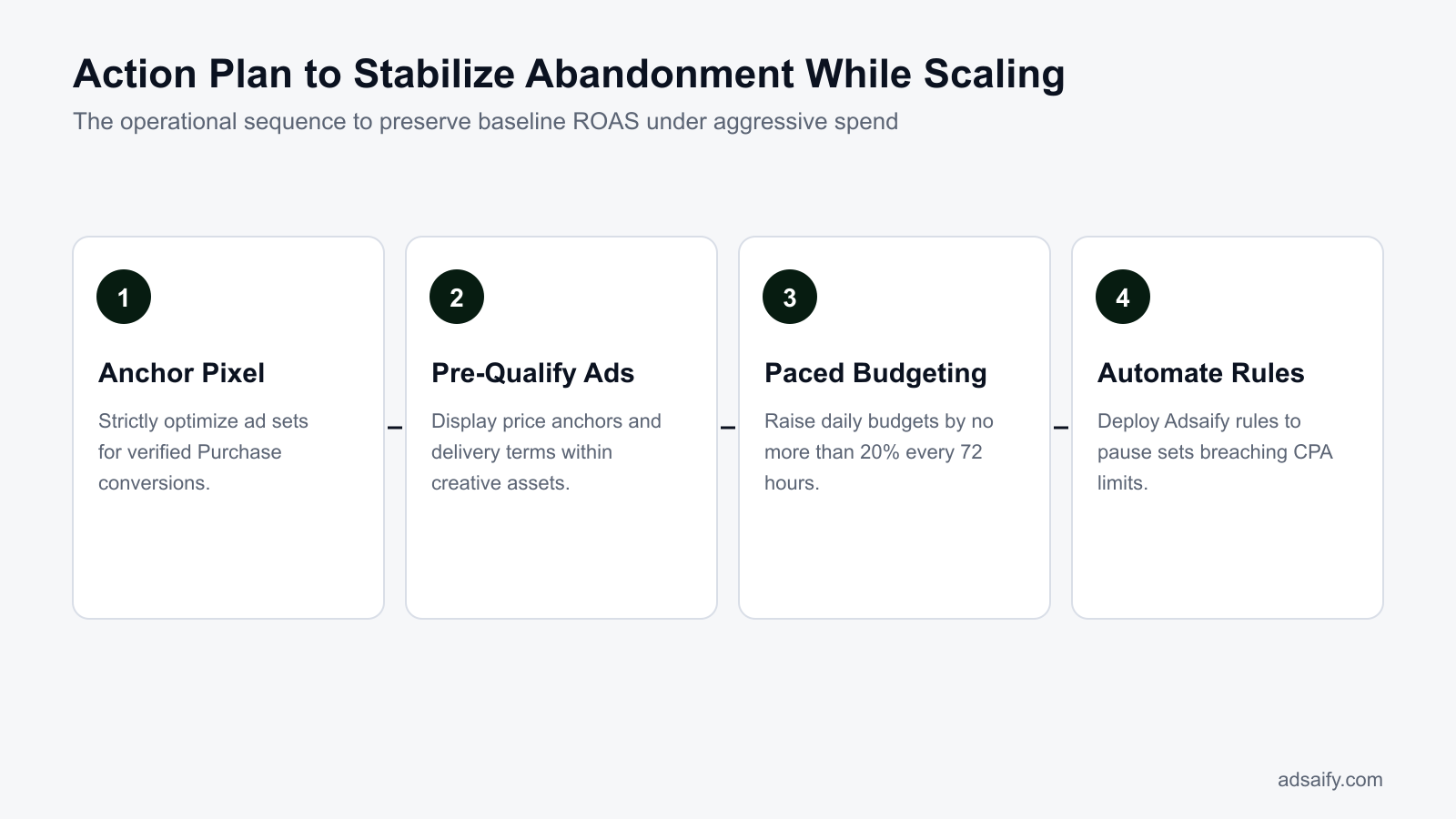
Never optimize scaling campaigns for upper-funnel micro-conversions like Add to Cart or Initiate Checkout in Meta Ads Manager. Doing so instructs the delivery algorithm to find users prone to clicking without buying. Set the conversion event strictly to Purchase. Simultaneously, pre-qualify prospects inside your creative assets by displaying exact prices, bundle options, and shipping thresholds in the copy and overlay text. Filtering casual window-shoppers before they click preserves checkout conversion efficiency.
Managing Budget Pacing and Automated Safeguards
Avoid doubling daily budgets overnight, which resets Meta's learning phase and introduces volatile bidding. Instead, increase campaign budgets by 15 to 20 percent every 48 to 72 hours, monitoring cost stability after each increment. To protect margins against sudden abandonment spikes, configure automation rules. Using a platform like Adsaify, you can set automated rules that inspect performance metrics and automatically pause ad sets when CPA exceeds your acceptable margin limit.
- Optimize for Purchase — The ad set targets the Purchase standard event, and the system proceeds to creative deployment once audience delivery stabilizes.
- Pre-qualify in Ad Creative — Ad copy displays upfront pricing and shipping details, advancing only qualified users to the landing page.
- Scale Budget Incrementally — Daily ad spend increases by 15 to 20 percent, triggering further scaling only if CPA remains below the target ceiling over 48 hours.
- Trigger Automated Guardrails — Performance monitoring rules continuously evaluate spend, pausing ad sets immediately if the acquisition cost breaches acceptable thresholds.
- Deploy Recovery Automations — Abandoned checkout flows send email, SMS, and dynamic product ads within 24 hours to recover unconverted carts.
What do the performance metrics look like in a real e-commerce scaling scenario applying this method?
In a controlled scaling scenario where daily budget grows from $500 to $2,500, a store applying this framework typically maintains cart completion rates between 35 and 45 percent. While top-of-funnel click-through rates may drop slightly due to upfront pricing filters, the conversion rate from cart initiation to completed purchase stabilizes. The multi-channel recovery sequence reclaims an additional 10 to 15 percent of abandoned checkouts, preserving net contribution margins as aggregate spend expands.
How Does a Real-World Store Navigate Spend Growth from $1k to $20k Profitably?
A real-world store navigates spend growth from $1,000 to $20,000 profitably by pre-qualifying ad audiences with explicit pricing, eliminating checkout shipping surprises, and pacing budget increases gradually. These adjustments filter out low-intent clicks, stabilize conversion rates across scaling phases, and protect profit margins against algorithm-driven cart abandonment spikes.
Diagnosing the Cart Abandonment Spike During Budget Expansion
Consider an apparel merchant selling sustainable knitwear. Operating at a baseline spend of $1,000 per month, the store generated steady sales with a 68% cart abandonment rate and an acceptable return on ad spend. ROAS (return on ad spend) is an e-commerce revenue metric calculated by dividing total revenue generated from ads by the total advertising spend. When the merchant scaled spend rapidly to $10,000 per month in Meta Ads Manager, cart abandonment spiked to 89%, driving ROAS down to an unprofitable 1.4.
Auditing the campaign revealed that the top-of-funnel video creatives focused entirely on lifestyle aesthetics without displaying price points. Meta delivered impressions to broad interest segments who clicked out of curiosity. When these shoppers added items to their carts, they encountered an unannounced $12 standard shipping fee at checkout. High-intent buyers tolerate shipping fees, but unqualified visitors abandon immediately when unexpected costs appear.
Executing the Scaling Intervention and Price Transparency Plan
The merchant implemented three specific interventions to stabilize checkout completion before expanding spend further:
- Price-anchored ad creative: The store added clear price overlays to all video assets and mentioned starting prices in the primary ad copy text, ensuring users knew product costs before clicking.
- Threshold-based free shipping: The checkout flow was updated to offer free shipping on all orders over $75, paired with a progress bar on the cart page showing how close the cart total was to the reward threshold.
- Disciplined budget pacing: Instead of doubling ad set budgets overnight, the merchant capped daily budget increases at 15% to 20% every three days, keeping delivery within Meta's optimization window. Advertisers can test new campaign configurations on Adsaify to structure budgets cleanly.
At $20,000 in monthly ad spend, the store's cart abandonment rate dropped to 71%, and blended ROAS recovered to 3.2, validating that transparent messaging protects scaling efficiency.
Which specific KPIs and attribution windows confirm that the abandonment fix is working?
To confirm that a cart abandonment fix is working, evaluate the 7-day click attribution window in Meta Ads Manager rather than 1-day view attribution. Focus on three core KPIs: Cart Completion Rate rising above 28%, Cost Per Initiate Checkout decreasing alongside a rising Purchase Conversion Rate, and the ratio of 7-day click purchases to total purchases exceeding 75%. Stable or decreasing Customer Acquisition Cost alongside expanding spend proves that real buyers are converting.
Which Metrics Measure the Success of Your Cart Abandonment Recovery Strategy?
The success of a cart abandonment recovery strategy is measured by Cart Completion Rate, Click-to-Purchase Conversion Rate, Marketing Efficiency Ratio, and the proportion of 7-day click versus 1-day view conversions. Tracking these metrics across scaling phases confirms whether ad traffic possesses genuine purchasing intent or merely registers superficial checkout events.
Core Indicators of Checkout Efficiency and Traffic Quality
Evaluating an abandonment strategy requires isolating data points that distinguish high-intent buyers from browsing traffic:
- Cart Completion Rate: Cart Completion Rate is the percentage of shoppers who complete an order after adding an item to their cart, calculated by dividing total purchases by total add-to-cart events. A healthy e-commerce benchmark sits between 30% and 45%.
- Click-to-Purchase Conversion Rate: This metric tracks the percentage of unique link clicks from cold Meta ad campaigns that culminate in a confirmed purchase, highlighting whether ad messaging aligns with the product landing page.
- Marketing Efficiency Ratio (MER): MER (Marketing Efficiency Ratio) is a blended financial metric calculated by dividing total store revenue across all sales channels by total paid advertising spend across all platforms. A rising MER confirms that paid spend drives organic and word-of-mouth momentum rather than isolated, unprofitable conversions.
- 7-Day Click Attribution Share: Comparing 7-day click purchases against 1-day view purchases inside Meta Ads Manager verifies intent. A high share of 7-day click conversions indicates that users actively decided to purchase after reviewing your offer.
Evaluating Metric Health Across Scaling Thresholds
| Metric | Unhealthy / High Abandonment | Healthy Target Benchmark | Primary Diagnosis When Failing |
|---|---|---|---|
| Cart Completion Rate | Below 20% | 30% to 45% | Unexpected shipping fees or hidden costs at payment screen |
| Click-to-Purchase Rate | Below 0.8% | 1.5% to 3.5% | Ad creatives attract bargain hunters or fail to show pricing |
| MER (Blended Revenue/Spend) | Below 2.0 | 3.0 or higher | Acquisition costs absorb operating margins during ad scaling |
| Click-to-View Purchase Ratio | Under 50% 7-day click | Over 75% 7-day click | Meta delivers to passive view-through users with low buying intent |
What recurring routine prevents cart abandonment from rebounding during aggressive budget expansions?
A weekly review routine prevents cart abandonment rebounds during budget expansions. Every Monday, compare the 7-day click Cart Completion Rate against baseline levels in Meta Ads Manager. If completion drops by more than five percentage points following a budget increase, pause scaling immediately. Audit recent ad creative comment sections for shipping complaints, test checkout page loading speeds across mobile devices, and verify that automated abandonment emails trigger within sixty minutes.
Want to see this in your own account? Enter your website address and Adsaify drafts the campaign for you. The first ad is free. Try it now or log in.
What Weekly and Monthly Routine Prevents Recurring Abandonment at Higher Spend?
A weekly and monthly routine prevents recurring cart abandonment by identifying segment-level drop-offs in Meta Ads Manager, verifying price parity between creatives and product pages, and removing technical checkout friction. Systematically auditing placement data and updating automated cost thresholds ensures scaling campaigns consistently attract buyers willing to complete checkout at current prices.
When daily budgets expand, Meta's auction distribution engine shifts impressions across placements, demographics, and inventory pools to exhaust assigned spend. Without disciplined oversight, subtle discrepancies between creative promotions and checkout totals go unnoticed, and underperforming placements quietly consume budget. Maintaining control requires a structured schedule that isolates upstream ad issues from downstream payment friction.
- Daily: Monitor automated rules configured in Adsaify to halt ad sets or ads that surpass target CPA (cost per acquisition, which is the total advertising spend divided by the number of completed purchases) thresholds before unprofitable traffic accumulates.
- Weekly: Open the Breakdown menu in Meta Ads Manager to evaluate performance across Age, Gender, and Placement (such as Instagram Stories or Audience Network) to identify placements generating high Add to Cart volume but zero Purchases.
- Weekly: Inspect active scaling creative iterations against current website inventory, confirming that advertised prices, bundle percentages, and promotional codes exactly match live landing page offers.
- Weekly: Check the ratio between Initiate Checkout and Purchase standard events in Events Manager to detect any mid-funnel conversion degradation following new site updates or app releases.
- Monthly: Perform full manual test transactions on both iOS and Android mobile devices using Safari and Chrome to check payment gateway latency, autofill usability, and form validation errors.
- Monthly: Recalibrate maximum CPA cut-off rules on Adsaify to reflect updated product margins, seasonal shipping fee changes, and revised merchant processing costs.
- Monthly: Review checkout shipping rate tiers and payment decline codes in your e-commerce store backend to verify that third-party carrier calculations have not introduced sudden delivery cost spikes.
What are the most frequent mistakes advertisers make when attempting to solve cart abandonment?
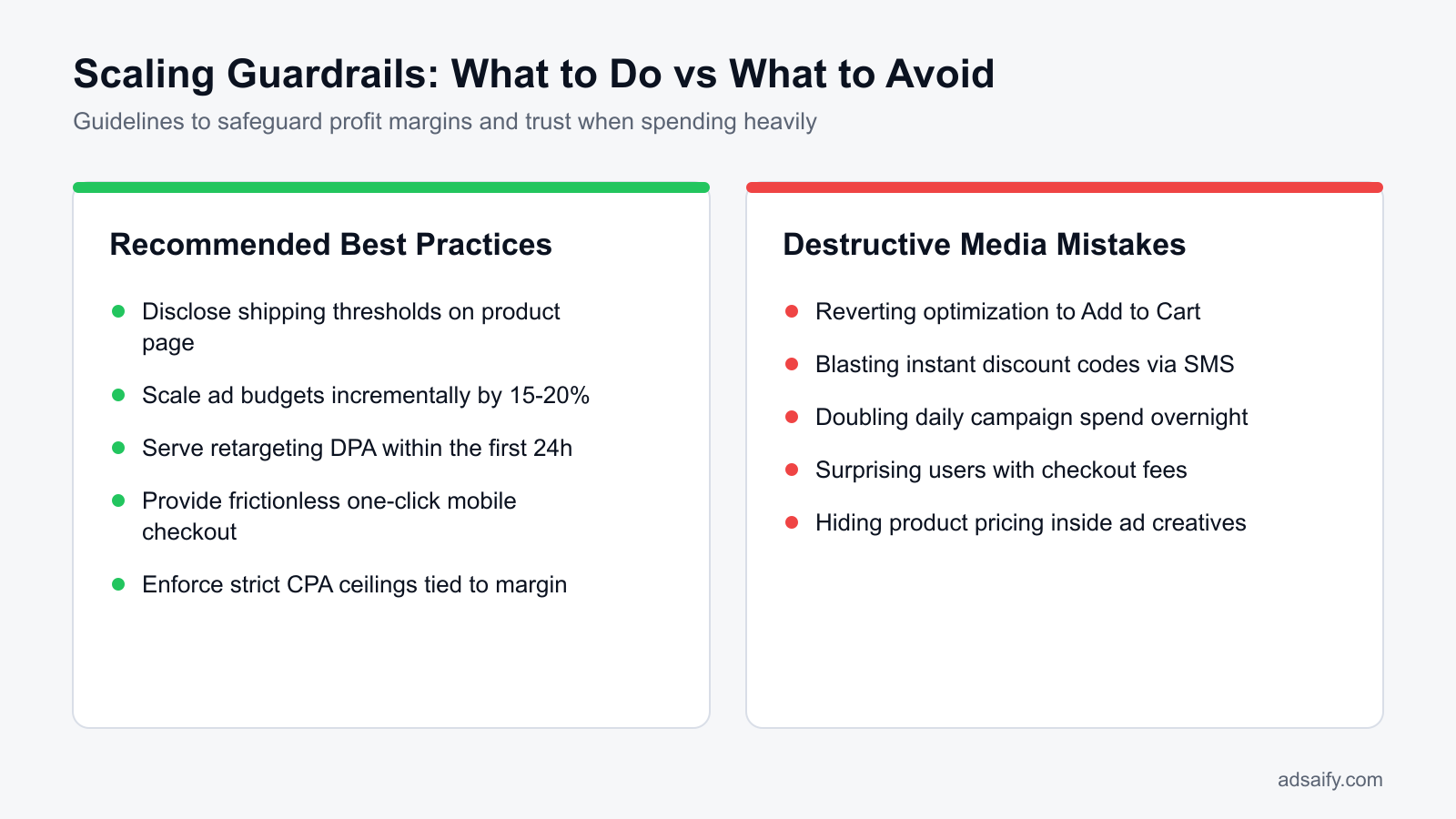
Advertisers most frequently fail by treating cart abandonment as an isolated website problem rather than an upstream audience quality issue. Common errors include immediately downgrading campaign optimization from Purchase to Add to Cart, flooding abandoning shoppers with aggressive instant discounts that destroy margins, and scaling daily ad budgets faster than Meta's delivery system can stabilize. Instead of diagnosing mismatched ad promises, hidden shipping rates, or broken mobile gateways, media buyers reactively adjust product page layouts.
What Are the Most Common Mistakes When Trying to Solve Cart Abandonment?
The most common mistakes when attempting to solve cart abandonment include downgrading optimization goals to mid-funnel events, training shoppers to wait for immediate discount emails, and aggressively raising budgets beyond algorithmic stability thresholds. These reactive actions dilute traffic intent, erode operating profit, and obscure genuine friction points such as unexpected shipping fees or mobile checkout bugs.
Switching Campaign Optimization From Purchases to Add to Cart
Switching optimization to Add to Cart forces Meta's delivery system to seek users with high behavioral tendencies to click buttons rather than users who finalize payment. This floods the store with casual window shoppers and inflates drop-offs at checkout. Keep campaign optimization set exclusively to the Purchase conversion event.
Sending Instant Deep Discount Codes via Email Automation
Delivering an immediate 15% discount code ten minutes after cart exit conditions recurring customers to abandon carts deliberately. This training habit destroys gross margins without resolving underlying intent issues. Delay discount incentives by at least twelve to twenty-four hours, relying first on plain-text customer service reminders.
Redesigning Product Pages Without Auditing Upstream Ad Messaging
Teams frequently overhaul landing page templates when cart drop-offs surge, ignoring discrepancies in the ad creative itself. If an ad showcases free shipping or a specific bundle price that is not reflected upon checkout initiation, users leave immediately. Audit creative alignment before altering storefront architecture.
Increasing Daily Ad Spend by More Than Twenty Percent Abruptly
Boosting budgets by 50% to 100% in a single day resets campaign learning and forces Meta to bid into cheaper, unvetted audience pools to meet delivery pacing. These low-intent users readily abandon checkout flows. Scale budgets incrementally by 15% to 20% every forty-eight hours to protect traffic quality.
Concealing Shipping and Handling Fees Until the Final Screen
Surprising users with high carrier fees or handling surcharges on the last payment step remains a leading cause of unrecovered checkouts. Hiding these fees creates immediate buyer remorse. Display estimated shipping thresholds clearly on the product page and cart drawer before the checkout flow begins.
Omitting Mobile-First Express Wallets at Checkout
Forcing mobile ad traffic to manually input credit card credentials, billing addresses, and phone numbers causes immense drop-off on mobile devices. Because Meta traffic is predominantly mobile, lack of frictionless options ruins conversion rates. Enable one-click express payment gateways like Apple Pay, Google Pay, and Shop Pay.
In which scenarios will advertising fixes fail to resolve severe checkout abandonment?
Advertising adjustments fail to resolve cart abandonment when fundamental commercial or technical barriers exist outside of Meta Ads Manager. If an e-commerce store charges unexpected shipping fees exceeding local industry norms, restricts payment options by omitting mobile express wallets, or suffers from sluggish checkout page latency on mobile networks, media optimization cannot compensate. Similarly, uncompetitive product pricing or poor brand trust signals will consistently cause high-intent paid traffic to abandon carts regardless of campaign structure.
When Does This Strategy Fail and What Are Its Inherent Limits?
A cart abandonment recovery strategy fails when uncompetitive retail pricing, extended shipping timelines, or technical checkout barriers undermine buyer trust. Paid advertising optimizations and algorithmic safeguards cannot overcome systemic merchandising weaknesses, missing local payment methods, or products priced higher than identical alternatives available on competing marketplaces.
Commercial and Fulfillment Constraints
If the final retail price of a product is uncompetitive against market alternatives, no amount of ad configuration or retargeting can recover abandoned carts. Shoppers frequently use the cart as a comparison tool, adding items simply to calculate total landed cost before searching alternative stores. When delivery times exceed customer expectations—such as transit windows extending beyond seven business days without express options—drop-offs at the shipping selection step become insurmountable regardless of creative quality.
Technical Infrastructure and Checkout Barriers
Technical payment gateway failures and sluggish checkout load times directly sabotage high-intent traffic. A checkout process that delays page transitions by more than three seconds, presents unexpected script errors, or lacks trusted payment methods like PayPal, Apple Pay, or regional debit protocols forces users to abandon purchases immediately. Software tools such as Adsaify automate Meta campaign creation and apply automated rules to pause underperforming ads, but software cannot resolve broken checkout code, slow server responses, or unappealing core pricing.
Audit the following operational factors to determine if cart abandonment stems from technical or commercial failures:
- Benchmark total landed pricing against top three direct competitors on identical product lines.
- Audit checkout page load latency on mobile 4G connections to ensure transitions remain under two seconds.
- Verify payment gateway API integrations across every supported card processor and digital wallet.
- Review shipping speed thresholds and eliminate unexpected handling surcharges at the delivery step.
- Test guest checkout functionality to eliminate mandatory account registration roadblocks.
- Inspect Meta Pixel and Conversions API implementations to ensure the InitiateCheckout event fires reliably.
What are the concise definitions of the technical performance terms used throughout this guide?
Performance marketing terminology defines the core metrics and mechanics governing campaign optimization, audience behavior, and checkout funnels on Meta platforms. Mastering concepts like ROAS, intent drift, and cost per acquisition provides the precise framework needed to audit account efficiency. Understanding these terms ensures e-commerce merchants can quickly distinguish between algorithmic traffic degradation and operational on-site friction when diagnosing drop-offs across their conversion funnels.
What Are the Key Technical Terms for Cart Abandonment and Scaling?
The key technical terms for cart abandonment and scaling define the financial efficiency, algorithmic behavior, and user flow metrics required to manage paid acquisition profitably. Mastering these definitions allows advertisers to systematically identify drop-off points between the initial ad impression, add-to-cart events, and finalized checkout purchases on Meta platforms.
- ROAS (Return on Ad Spend): ROAS is the financial metric calculating gross e-commerce revenue generated directly for every dollar spent on advertising.
- Cart Abandonment Rate: Cart abandonment rate is the percentage of initiated digital shopping carts that fail to convert into completed purchase transactions.
- Intent Drift: Intent drift is the algorithmic tendency of ad platforms to target lower-intent users as daily budgets scale beyond immediate high-affinity audience segments.
- CPA (Cost Per Acquisition): CPA is the aggregate media spend required to achieve one completed, verified e-commerce purchase transaction.
- AOV (Average Order Value): AOV is the average monetary amount spent by customers each time they complete an order on an e-commerce website.
- CPM (Cost Per Mille): CPM is the media cost an advertiser pays for every one thousand impressions served on the Meta advertising network.
- CVR (Conversion Rate): CVR is the proportion of total site visitors who complete a target transaction, such as completing an online order.
- Cost Per Add to Cart: Cost per add to cart is the advertising expenditure required to prompt a prospective shopper to place an item into their digital cart.
- Meta Pixel: Meta Pixel is a tracking code snippet installed on a website that measures user actions to optimize ad delivery and track conversions.
- Conversions API (CAPI): Conversions API is a server-side tool that transmits web events directly from an e-commerce server to Meta to improve tracking accuracy.
- Frequency: Frequency is the average number of times an individual unique user sees an advertisement over a defined reporting period.
How do I consolidate these metrics to evaluate my store's exact scaling health?
Consolidate these metrics by plotting cart abandonment rate alongside your Meta ad frequency and CPA within a single weekly reporting dashboard. When CPA escalates while ROAS falls below acceptable margins, examine your cost per add to cart against site-wide checkout conversion rates. This comparison immediately reveals whether performance drops stem from creative fatigue and upstream intent drift or downstream payment and pricing friction.
Scaling Profitably to $50k by Mastering Cart Abandonment Guardrails
To prevent cart abandonment spikes while scaling Meta spend, optimize campaigns strictly for purchases rather than high-funnel actions. Qualify incoming traffic by displaying product pricing directly in creative assets, and limit budget increases to fifteen percent daily increments to protect delivery stability. Ensure product pages display all shipping costs upfront to eliminate checkout surprises, and reserve a small portion of your budget for dynamic catalog retargeting to recover hesitant shoppers systematically.
Audit your active ad sets today to confirm your conversion objective and daily scaling increments. To streamline this workflow without manual campaign guesswork, create your first campaign on Adsaify for free by submitting your website address at /register. The platform analyzes your store, generates conversion-focused campaign drafts, and publishes them straight to your Meta account with automated rules ready to pause declining ads before budget is wasted.
Want to see this in your own account? Enter your website address and Adsaify drafts the campaign for you. The first ad is free. Try it now or log in.
Frequently Asked Questions (FAQ)
1. What is considered a normal e-commerce cart abandonment benchmark?
In e-commerce, the majority of shoppers who place items into a cart leave without completing a transaction. Rather than relying on a single universal percentage, merchants treat cart abandonment as a ratio of intent to friction. A baseline where most carts remain unpurchased is standard due to window shopping, price comparison, and unexpected final shipping costs at checkout.
2. Is sending immediate discount coupons via SMS good practice for abandoned carts?
Sending immediate discount coupons via SMS is generally bad practice because it trains buyers to intentionally abandon carts to trigger price cuts. Immediate automated discounts also erode profit margins without confirming whether the shopper merely needed time or technical assistance. A delay of several hours paired with a simple reminder email or customer support message protects pricing integrity better than immediate coupon delivery.
3. What is the maximum daily budget percentage increase to prevent pacing shocks?
To prevent pacing shocks in Meta campaigns, budget increases should not exceed fifteen to twenty percent within a single twenty-four-hour period. Budget pacing is the rate at which the Meta delivery algorithm spends allocated funds across daily auction cycles. Abrupt increases above this threshold reset the ad set into the learning phase, destabilizing delivery and driving broad, lower-intent traffic that inflates checkout drop-offs.
4. Does displaying prices directly in ad creatives hurt overall CTR?
Displaying product prices inside ad creatives often lowers click-through rate (CTR), which is the ratio of users who click an ad relative to total impressions. However, this drop in CTR filters out uncommitted browsers before they reach the store. The resulting traffic carries higher purchase intent, which reduces subsequent cart abandonment and prevents wasted ad spend on unqualified clicks during scaling.
5. Why should Add to Cart optimization never be used for ad spend scaling?
Add to Cart optimization instructs Meta's delivery algorithm to find users prone to clicking add-to-cart buttons rather than users who finish checkout. When ad spend scales under this objective, the algorithm prioritizes high-funnel habitual clickers and window shoppers to satisfy the goal cheaply. This artificially inflates checkout abandonment and drops overall ROAS (return on ad spend), which is revenue generated divided by advertising cost.
6. What proportion of total ad budget should be dedicated to abandoned cart DPA?
Between ten and fifteen percent of the total Meta advertising budget should be allocated to dynamic product ads (DPA), which are automated ads that display the exact catalog items a user previously viewed or carted. Allocating more than fifteen percent to cart recovery risks saturating recent visitors, fatiguing ad frequency, and starving top-of-funnel prospecting campaigns of the fresh traffic needed to maintain store growth.
7. Does folding shipping into product price reduce checkout abandonment more than surprise fees?
Folding shipping costs into the base product price significantly reduces checkout abandonment compared to displaying surprise fees at the final payment step. Unexpected shipping costs introduced late in the funnel represent friction that breaks buyer momentum. Presenting transparent pricing or free shipping directly on product pages aligns shopper expectations early, allowing users who reach the cart stage to proceed to payment with confidence.
8. Can Adsaify automated rules pause underperforming ads caused by high abandonment?
Yes, Adsaify offers automated rules that monitor campaign performance directly in the user's Meta ad account and pause underperforming ads automatically. If scaling an ad results in surging cart abandonment, deteriorating return on ad spend, or excessive acquisition costs, user-configured rules intervene to stop budget waste. However, Adsaify rules do not edit live ad copy or create replacement creatives on their own.
How can you try this with Adsaify?
The quickest way to apply the steps in this article to your own account is to try them. Adsaify analyses your business from your website address, drafts the campaign with an audience, ad copy, creative and a budget suggestion, and publishes it to your own Meta ad account once you approve.
- Your first ad is free: there is nothing to lose by trying.
- Your own ad account: the campaign runs in your Meta account and you stay in control.
- Images and video: generate ad creatives with AI or promote an existing Instagram post.
Create a free account and try your first ad · Already have an account? Log in.