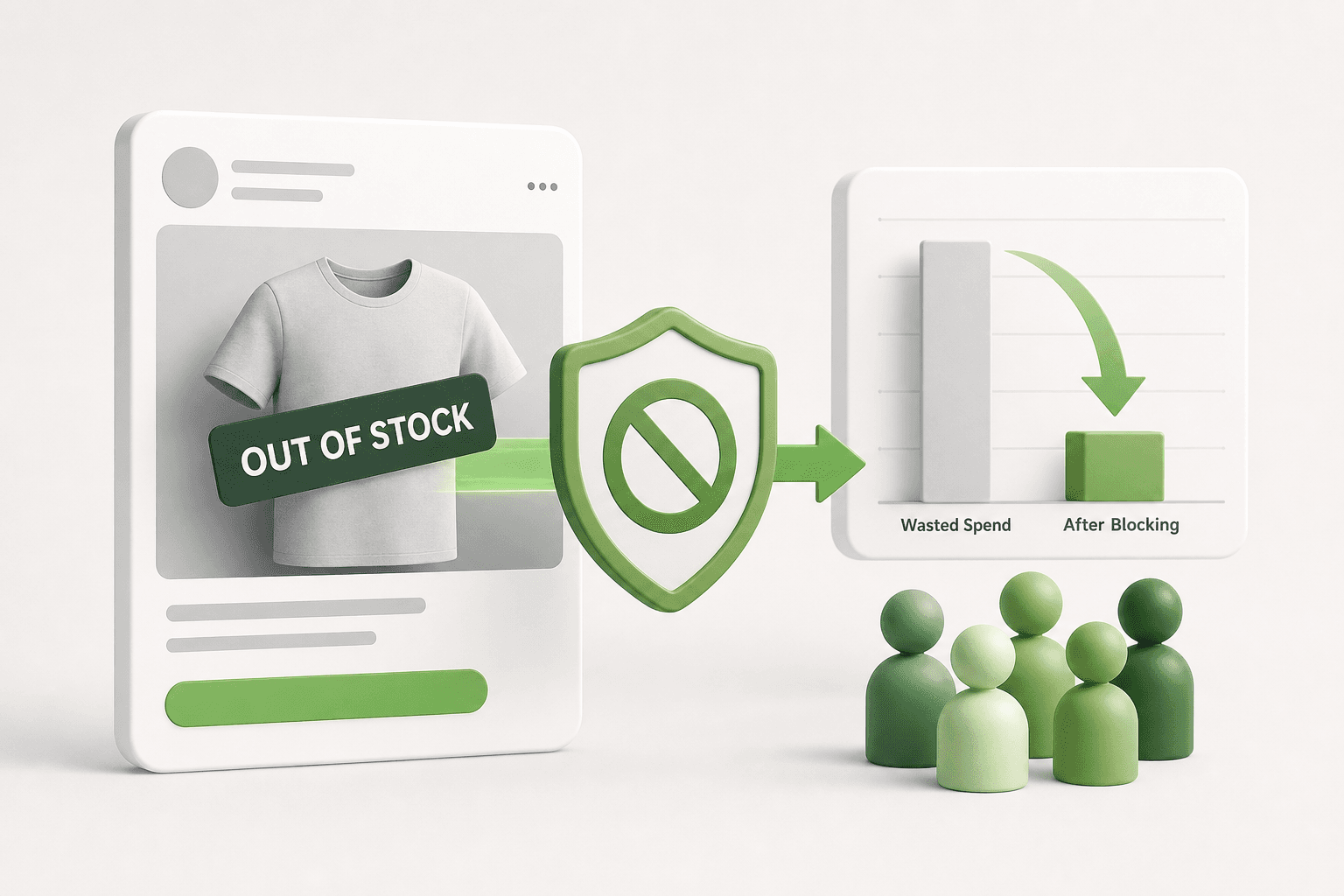

Short answer: Preventing customer cannibalization while using Meta Advantage+ Shopping Campaigns (ASC) is achievable by optimizing targeting and bidding strategies. With the right steps, you can minimize the loss of existing customers while acquiring new ones.
Your Meta Advantage+ Shopping Campaign (ASC)—an automated campaign type that uses machine learning to optimize ad creative and audience delivery across Facebook and Instagram—may show a high ROAS. ROAS (return on ad spend) is the revenue generated for every unit of currency spent on advertising. However, your total store revenue and new buyer counts remain stagnant. When you inspect order tags, you realize the system serves ads to recent purchasers who would have converted anyway through organic search or direct visits.
This cannibalization happens because the Meta delivery algorithm automatically pursues the conversions with the highest probability and lowest immediate cost. Because past purchasers and cart abandoners convert far more reliably than cold audiences, Meta ASC disproportionately allocates budget toward them unless you intervene. If left unchecked, this habit drains your budget, hides deteriorating customer acquisition trends, and ultimately starves your business of genuinely new market demand.
This article gives you the exact framework to stop cannibalization and restore true prospecting efficiency. You will learn how to audit your audience overlap, define existing customers through custom audience lists, configure an existing customer budget cap, and verify incremental sales using clear post-launch metrics.
Key Takeaways
- Review targeting settings to prevent customer cannibalization.
- Optimize bidding strategies to engage existing customers.
- Protect existing customers with retargeting campaigns.
- Continuously update strategies through performance monitoring.
What is Customer Cannibalization and How to Recognize It?
Customer cannibalization in Meta Advantage+ shopping campaigns occurs when automated ad delivery disproportionately targets past purchasers who would have bought anyway, instead of acquiring new buyers. Marketers recognize customer cannibalization when reported campaign return on ad spend appears exceptionally high, while blended revenue, overall store sales, and net-new customer acquisition rates stagnate or decline.
Defining Cannibalization in Automated Campaigns
Advantage+ shopping campaigns (ASC) are Meta's machine-learning-driven campaign type designed to automate audience targeting, placement, and creative delivery to maximize purchase volume. Customer cannibalization happens within these campaigns when Meta's delivery system directs impressions toward existing customers who already have high brand affinity and purchase intent. Instead of driving incremental growth, ad spend subsidizes transactions that organic search, email marketing, or direct navigation would have secured at zero media cost. ROAS (return on ad spend) is total attributed revenue divided by total ad spend, and CPA (cost per acquisition) is total ad spend divided by the number of purchases. While cannibalized campaigns boast an artificially high ROAS and a low CPA, the overall business experiences a worsening MER (marketing efficiency ratio), which is total store revenue divided by total marketing spend across all channels.
Identifying Traces of Cannibalization in Meta Ads Manager
Detecting customer cannibalization requires analyzing audience breakdowns rather than relying on top-line campaign summaries in Meta Ads Manager. Marketers can uncover this pattern through specific reporting views and account settings:
- Breakdown by Audience Type: Navigate to Meta Ads Manager, select the Advantage+ shopping campaign, click the Breakdown button, select Demographics, and choose By Audience Type. This splits reporting into "New Audience" and "Existing Audience" based on your configured customer lists.
- Budget Allocation Imbalance: Review the percentage of total spend consumed by existing customers. If existing customers absorb 40% or more of the budget in an account intended for scaling, cannibalization is actively occurring.
- Disproportionate Conversion Discrepancies: Compare the CPA of new prospects against existing customers. Cannibalization is evident when existing customer CPA is negligible while new customer CPA is unsustainably high, indicating the algorithm is abandoning cold prospects to hit conversion targets.
For example, an online specialty coffee roaster spending 1,500 USD daily on a single Meta Advantage+ shopping campaign observed an attributed ROAS of 4.80. However, the store's total weekly revenue remained flat at 35,000 USD. Under Meta Ads Manager, the media buyer opened the Breakdown menu and selected By Audience Type. The report showed that 68% of the daily budget (1,020 USD) was served to existing customers with an existing customer CPA of 12 USD, whereas new customer CPA reached 65 USD with only 32% spend allocation. The media buyer adjusted the "Existing Customer Budget Cap" in the campaign settings down to 5%. Over the following 14 days, the campaign's attributed ROAS dropped to 2.90, but total store weekly revenue increased to 46,000 USD because daily new customer acquisition volume grew from 7 purchases to 22 purchases. Teams looking to establish clean account structures can use Adsaify to draft structured prospecting campaigns that separate new audience acquisition from existing customer pools.
Why are my customers choosing not to shop with me?
Customers often stop buying because post-purchase friction, irrelevant post-sale messaging, or unexpected pricing changes disrupt their loyalty. When ad campaigns bombard repeat buyers with generic introductory offers rather than personalized incentives or product replenishment reminders, customers feel unvalued. Additionally, unresolved customer support tickets, slow fulfillment times, or competitor promotions offering superior loyalty rewards can quickly lead previously satisfied purchasers to seek alternatives, even if an automated ad algorithm repeatedly shows them paid impressions.
Why Does Customer Cannibalization Happen?
Customer cannibalization happens because Meta's optimization algorithm aggressively pursues the lowest cost per conversion to satisfy automated performance goals. Without strict audience limits, the delivery system targets previous purchasers who already intend to buy, rather than spending more budget to educate and convert unfamiliar prospects who require higher acquisition costs.
Incorrect Targeting Strategies and Missing Budget Caps
The primary technical driver of cannibalization is an unconfigured or misconfigured "Existing Customer Budget Cap" within Advantage+ shopping campaigns. When advertisers launch an ASC without defining past purchasers under Advertising Settings > Existing Customers, Meta treats all users as fresh prospects. The delivery algorithm discovers that past buyers click and convert at significantly higher rates, leading the system to funnel ad spend toward existing brand advocates. Even when audiences are defined, setting an excessive budget cap allows the algorithm to prioritize retention over discovery.
Competitive Pricing and Promotional Traps
Promotional strategy frequently accelerates customer cannibalization. When brands launch site-wide sales, clearance discounts, or coupon codes inside Advantage+ shopping campaigns, existing customers actively waiting to replenish staple items capitalize on the promotion. The algorithm interprets these quick purchases as a positive feedback loop, serving more discount ads to buyers who would have paid full price. Consequently, marketing margins erode while the business records no net expansion of its consumer base.
Ambiguity in Campaign Messaging and Creative Focus
Creative assets that lack educational context or clear value propositions inadvertently favor existing customers. A creative featuring only a product silhouette, an ambiguous aesthetic image, or a simple logo appeals almost exclusively to users who already recognize the brand and understand the product catalog. Cold audiences scroll past ambiguous creative because the hook fails to identify their specific problem. The Meta Pixel, which is a snippet of tracking code placed on a website to measure visitor actions, logs poor click-through rates from cold traffic, prompting the algorithm to redirect impressions toward familiar users who require zero explanation to purchase.
| Campaign Setting | Primary Delivery Focus | Cannibalization Risk | Recommended Strategic Use Case |
|---|---|---|---|
| ASC with 0% Existing Budget Cap | 100% Net-New Audiences | Very Low | Pure customer acquisition and scaling top-of-funnel reach. |
| ASC with 5% to 10% Budget Cap | Balanced Prospecting with Minor Retention | Low | Maintaining customer re-engagement while prioritizing new growth. |
| ASC Uncapped (Default Settings) | Past Purchasers and High-Intent Audiences | High | Short-term inventory liquidations where buyer identity is secondary. |
| Manual Sales Campaign with 180-Day Exclusion | Strictly Non-Purchasers | None | Precise creative testing across cold demographic segments. |
Advertisers seeking to overcome ambiguous creative messaging can use Adsaify to analyze a store URL and draft dedicated ad copy and creative concepts tailored specifically to unfamiliar prospects.
Am I misdefining my target audience?
You are likely misdefining your target audience if your custom audience definitions exclude recent purchasers but omit website visitors, email subscribers, or offline customer lists. Meta relies strictly on the audience sources defined in your account settings under Existing Customers. If your customer list is not uploaded or your Meta Pixel is missing purchase events, the algorithm categorizes past buyers as new prospects, skewing your delivery and generating false acquisition metrics across your active campaigns.

What Are the Costs of Customer Cannibalization?
Customer cannibalization in Meta Advantage+ Shopping Campaigns costs advertisers money by spending paid ad spend on shoppers who would have purchased anyway. This misallocation reduces overall revenue margins, artificially inflates blended customer acquisition costs across the business, and degrades long-term brand loyalty by bombarding existing loyal buyers with redundant introductory discount offers.
How does cannibalization reduce customer revenues and profit margins?
Return on ad spend (ROAS) is total attributed revenue divided by total ad spend. When an Advantage+ Shopping Campaign targets an audience containing past buyers, Meta claims attribution for orders that would have arrived naturally through organic search, direct website visits, or automated email flows. The business effectively pays a platform commission on organic transactions. Furthermore, if the ad creative includes introductory promotional codes, the merchant suffers a double loss: paying ad auction fees for the impression while simultaneously giving away product margin to an existing customer who was prepared to pay full retail price.
Why does customer acquisition cost increase when cannibalization occurs?
Customer acquisition cost (CAC) is the total marketing spend divided by the number of new customers acquired. When cannibalization dominates an ad account, the in-platform CAC metric reported by Meta Ads Manager appears artificially low because existing customers convert easily at minimal impression volume. However, the true blended new-customer acquisition cost (nCAC)—calculated by dividing total ad spend strictly by verified first-time buyers—rises significantly. The marketing budget is consumed by retargeting warmth rather than funding net-new prospecting, which restricts top-of-funnel customer growth.
How does cannibalization decrease brand loyalty?
Repeatedly serving top-of-funnel conversion ads to existing customers damages brand perception. When long-time buyers continuously see generic discovery ads, product introductory videos, or aggressive new-buyer discounts in their Instagram feeds, they experience ad fatigue. Over time, this trains loyal customers to delay routine purchases until a paid retargeting ad provides a cheaper offer, eroding brand equity and reducing overall customer lifetime value.
What is a concrete example of the financial impact of cannibalization?
For example, consider an online specialty coffee brand with a 3,000 USD monthly ad budget running an Advantage+ Shopping Campaign with no customer exclusions. Meta reports a 4.0 ROAS generating 12,000 USD in revenue. However, reviewing post-purchase order data in the store database reveals that 60 percent of those transactions came from subscribers who ordered every month. The campaign generated only 4,800 USD from net-new customers while consuming the full 3,000 USD budget, yielding an actual new-customer ROAS of 1.6 rather than the reported 4.0. To fix this, the merchant applied an existing customer budget cap of 5 percent, which redirected ad spend toward cold prospecting and restored legitimate customer growth.
What happens if I ignore the cannibalization issue?
If an advertiser ignores customer cannibalization in Meta Advantage+ Shopping Campaigns, the ad account will report deceptive ROAS figures while overall business revenue stagnates. The algorithm continues to allocate budget to high-intent past purchasers to secure cheap platform conversions. Over time, top-of-funnel customer discovery collapses, cash flow tightens due to unneeded merchant discounts, and customer lifetime value declines as repeat buyers learn to wait for paid retargeting promotions before purchasing.
What Steps Should I Take to Prevent Customer Cannibalization?
To prevent customer cannibalization in Meta Advantage+ Shopping Campaigns, you must configure existing customer accounting, enforce strict budget caps on repeat buyers, select incremental bidding models, and tailor creative messaging strictly for new audiences. These actions restrict the algorithm from harvesting easy repeat conversions and compel Meta to pursue incremental, net-new prospects.
How do you optimize targeting settings in Meta Ads Manager?
An existing customer budget cap is a setting in Meta Advantage+ Shopping Campaigns that limits the maximum percentage of the campaign budget spent on existing customers. To use this control, open Meta Ads Manager, navigate to Advertising Settings at the ad account level, and locate the Existing Customer Definition section. Populate this section with your Custom Audiences, including your historical customer customer-relationship management (CRM) list and a website pixel audience tracking the Purchase event over the past 180 days. Once configured, open the settings of your Advantage+ Shopping Campaign and set the Existing Customer Budget Cap to zero percent, or at most five percent if you intentionally allow light retargeting.
How should bidding strategies and campaign messaging be adjusted?
Meta's default bidding strategy prioritizes conversion volume, which encourages the delivery engine to seek out past buyers. If customer cannibalization persists despite audience definitions, consider testing a Cost per Result Goal or minimum ROAS floor to prevent the algorithm from bidding aggressively on low-hanging retargeting impressions. Alongside bidding, craft creative messaging exclusively for uninformed prospects. Address cold objections, explain unique value propositions, and avoid showing universal discount codes that tempt existing buyers. Marketers who want to test fresh prospecting concepts can use Adsaify to analyse a website URL and generate new-customer ad copy and visual assets for testing.
What is the step-by-step workflow to eliminate cannibalization?
- Audit current audience distribution — Check the Breakdown menu in Meta Ads Manager by audience type to determine what portion of current conversions comes from existing customers.
- Upload comprehensive customer lists — Export all historical customer emails and phone numbers from your e-commerce platform and create a Custom Audience inside Meta Audiences.
- Define existing customers in account settings — Assign both the CRM customer audience and the 180-day Pixel purchase audience inside the Advertising Settings menu.
- Apply existing customer budget cap — Open the Advantage+ Shopping Campaign settings and reduce the existing customer budget cap threshold to zero percent.
- Tailor ad creatives for acquisition — Replace promotional discount creatives with angle-driven creative assets designed specifically for first-time brand discoverers.
- Evaluate net-new customer acquisition — Compare platform reporting against first-time buyer counts in your e-commerce platform after two weeks to verify that new-customer volume has increased.
Which targeting settings should I change?
To eliminate customer cannibalization, navigate to the Advertising Settings in Meta Ads Manager and define your existing customers using purchase custom audiences and CRM customer lists. Next, open your Advantage+ Shopping Campaign settings, locate the Existing Customer Budget Cap, and reduce the allowed percentage to zero percent or a single-digit threshold. Finally, ensure your account-level exclusion lists are updated regularly to prevent Meta's machine learning algorithm from classifying recent purchasers as new prospects.
If you would rather not set up each of these steps by hand, try it in Adsaify: your first ad is free, so there is nothing to lose. Create a free account.
What Should I Prepare and Check Before Applying the Solution?
To prepare for fixing customer cannibalization in Meta Advantage+ Shopping Campaigns (ASC), advertisers must audit their existing customer reporting, build up-to-date custom audience lists for existing buyers, and define baseline acquisition benchmarks. Advertisers verify Meta Pixel and Conversions API tracking accuracy, segment past purchasers inside Account Quality, and inspect audience overlap before editing campaign settings.
Review Current Campaign Data and Existing Customer Share
Meta ASC (Advantage+ Shopping Campaign is an automated campaign type in Meta Ads Manager that uses machine learning to optimize ad delivery across Facebook and Instagram) aggregates prospecting and retargeting into a single budget. Before making modifications, an advertiser must assess how much spend is already absorbed by previous buyers. In Meta Ads Manager, navigate to the campaigns table, select the active ASC, click the "Breakdown" dropdown menu, and choose "Audience Segment" to display performance split between "New Customers" and "Existing Customers". Review the CPA (cost per acquisition is the total ad spend divided by the number of purchases) and ROAS (return on ad spend is gross revenue generated divided by ad spend) for both segments over the prior 30 days to measure baseline performance.
Update Target Audience Definitions and First-Party Lists
Meta determines which users count as existing customers based on definitions established in the ad account settings. First-party data is data collected directly from customers via websites, mobile applications, or internal point-of-sale systems. If past purchaser lists are stale or incomplete, Meta ASC misclassifies previous buyers as new prospects, masking true cannibalization. Navigate to "Audiences" in Meta Business Suite, prepare a clean CSV file of all purchasers from the last 365 days, and create a Customer List Custom Audience. Then open "Ad Account Settings", select "Advantage+ Shopping Campaigns", and link both the custom list and the Meta Pixel Purchase event (180-day retention) to define the account's existing customer pool.
Conduct Competitive Analysis and Setup Verification
Examine how competitors structure offers between acquisition and retention by inspecting the Meta Ad Library. When competitors offer aggressive introductory discounts, running an unsegmented ASC often serves introductory pricing to retained customers who would pay full price. Advertisers can explore automated campaign drafting through Adsaify, which analyzes a business website URL to identify core product messaging, budget baselines, and audience structures suitable for clean acquisition. Complete this verification checklist prior to adjusting campaign delivery:
- Export historical CRM transaction records covering at least the past 365 days.
- Verify that the Meta Conversions API (CAPI is a server-side tool that shares customer events directly from a server to Meta Ads Manager) records Purchase events with deduplication.
- Confirm that existing customer lists are assigned inside Meta Ad Account Settings under Advantage+ Shopping.
- Document the trailing 30-day ratio of existing customer spend inside the ASC breakdown view.
- Identify whether introductory promo codes are being redeemed disproportionately by past purchasers.
- Establish a target cap for existing customer spend, such as 5 percent or zero percent.
How can I start the data analysis?
Start the data analysis by opening Meta Ads Manager, selecting your active Advantage+ Shopping Campaign, and applying the "Breakdown" filter by "Audience Segment". Compare the purchase count, CPA, and ROAS between new and existing customers across the last 30 days. If the existing customer segment consumes more than 10 percent of the total budget while delivering cheap conversions, the campaign algorithm is cannibalizing organic and retention sales instead of finding incremental buyers.
What Is a Detailed Worked Example to Prevent Customer Cannibalization?
A detailed worked example to prevent customer cannibalization in Meta Advantage+ Shopping Campaigns involves capping existing customer budget limits, segmenting first-party purchaser data into custom audiences, and running dedicated remarketing in a separate manual campaign. This structural separation stops the automated algorithm from inflating returns by repeatedly showing acquisition ads to past buyers.
Sample Campaign Settings for a Direct-to-Consumer Brand
For example, an online footwear retailer operates with a 1,000 USD daily ad budget. In the previous setup, the retailer allocated the entire 1,000 USD to a single ASC without customer budget limits. Upon reviewing the audience breakdown, the marketing team discovered that 650 USD per day went to past purchasers, producing an apparent 4.5x ROAS, while true first-time buyer volume stagnated. To resolve this, the retailer creates a dual-campaign structure: an ASC campaign dedicated strictly to customer acquisition with an existing customer budget cap set to 0 percent, and a standard Manual Sales Campaign allocated 150 USD per day dedicated to repeat purchases.
Steps to Create Target Audiences and Implement the Budget Cap
To implement this setup in Meta Ads Manager, complete the following sequential actions:
- Open Meta Ads Manager, navigate to "Audiences", and build a custom audience titled "All Buyers - 365 Days" using an exported customer email and phone list.
- Create a second Website Custom Audience selecting the Meta Pixel "Purchase" event set to the maximum window of 180 days.
- Navigate to "Ad Account Settings", select "Advantage+ Shopping Campaigns", and define both audiences as the account-level "Existing Customers".
- Return to Campaigns, edit the primary ASC, locate the "Budget & Schedule" section, check "Existing Customer Budget Cap", and set the value to 0 percent.
- Create a separate Manual Sales Campaign named "Retention - Manual Sales", target the "All Buyers - 365 Days" audience, and exclude purchasers from the last 14 days to prevent immediate over-saturation.
Bidding Strategies and Expected Outcomes
The ASC utilizes the "Highest Volume" bidding strategy (a bid strategy that aims to maximize conversions from the available budget without manual bid limits) to find cold prospects across Meta inventory. The dedicated retention campaign uses a "Cost per Result Goal" or "Highest Volume" with creative tailored specifically to cross-selling complementary shoe-care kits and new seasonal footwear styles. After applying these changes, the retailer monitors blended CAC (customer acquisition cost is total acquisition marketing spend divided by first-time customers acquired) and the percentage of first-time purchasers in the e-commerce store backend. In this example, the ASC ROAS drops from an artificial 4.5x to a realistic 2.2x, but net-new customer acquisition rises from 12 orders per day to 34 orders per day on the same overall spend.
What should the sample campaign settings look like?
The sample campaign settings should feature an Advantage+ Shopping Campaign set to Highest Volume bidding, with the Existing Customer Budget Cap enabled and configured between 0 and 5 percent. In Ad Account Settings, ensure all CRM lists and 180-day purchase Pixel events are mapped to Existing Customers. Run a separate Manual Sales campaign targeting past purchasers with dedicated retention creative, keeping acquisition and retention budgets strictly segregated.
What Are the Most Common Mistakes and How to Avoid Them?
The most common mistakes that cause customer cannibalization in Meta ASC (Advantage+ sales campaigns) are failing to define an existing customer audience, leaving the existing customer budget cap unrestricted, and relying purely on blended ROAS. Advertisers can avoid these errors by verifying custom audience definitions, applying rigid budget caps, and auditing performance breakdowns inside Meta Ads Manager.
Incorrect audience selection
Customer cannibalization occurs primarily when Meta ASC cannot distinguish past buyers from new prospects. In Meta Ads Manager, under Campaign Settings, advertisers must configure an Account-Level Existing Customer Audience. The most frequent error is selecting an incomplete Custom Audience, such as only tracking 30-day website purchasers through the Meta Pixel, while neglecting offline customer lists, email subscribers, or 180-day purchase data. When the definition is too narrow, past buyers outside that short window are treated as new prospects. Meta ASC then targets those high-intent past buyers because they convert easily, artificially inflating campaign results while starving real prospecting efforts of ad spend.
Neglecting bidding strategies
Advantage+ sales campaigns run on highest volume bidding by default, which incentivizes the delivery algorithm to harvest the cheapest conversions available. Without guardrails, the algorithm serves impressions to returning customers who would have purchased organically or through retention channels. Advertisers frequently neglect to set an Existing Customer Budget Cap within the campaign creation workflow. When this cap is left at 0% or omitted, the algorithm often allocates a heavy share of the budget to returning customers. Setting a strict cap—for instance, capping existing customer spend at 5%—forces the system to seek net-new acquisition. Alternatively, tools like Adsaify can analyze a business website URL to draft structured campaigns with clear budget suggestions, which can help prevent unintended budget allocation to existing buyers.
Lack of campaign tracking
Another major mistake is evaluating Meta ASC purely on blended Return on Ad Spend (ROAS, the revenue generated divided by ad spend) in the default reporting view. High blended ROAS often masks heavy customer cannibalization. Marketers frequently forget to use the Breakdown menu in Meta Ads Manager to select "Demographics & Delivery" and filter by "Audience Type". Failing to inspect this breakdown leaves advertisers blind to whether their revenue comes from new customers or returning buyers.
| Configuration Element | Cannibalization Risk Setting | Correct Preventative Setting | Visible Symptom in Reporting |
|---|---|---|---|
| Existing Customer Definition | Meta Pixel Purchase event (last 30 days only) | Customer list CSV upload plus 180-day Pixel Purchasers | New customer acquisition cost appears artificially low |
| Existing Customer Budget Cap | Disabled or set above 15% | Enabled and set between 0% and 5% | Over 20% of conversions come from existing buyers |
| Reporting Verification | Reviewing only account-level blended ROAS | Segmenting by Breakdown > Audience Type weekly | Stable ad account ROAS paired with declining total business revenue |
| Audience Exclusions | No retention campaign exclusions applied | Excluding recent buyers from standard prospecting sets | Multiple campaigns targeting the same email subscriber base |
How can I identify my mistakes?
To identify your campaign mistakes, open Meta Ads Manager, select your Advantage+ sales campaign, and click the Breakdown button above the reporting table. Choose "Audience Type" to view the split between new and existing customers. If your existing customer spend exceeds your intended cap, or if new customer acquisition cost is rising while existing customer volume dominates the total count, your audience lists or budget limits are improperly configured.
How to Measure Whether the Fix Worked and What Should I Do Next?
To measure whether an anti-cannibalization fix worked in Meta ASC, monitor the audience breakdown metrics to verify that existing customer spend stays below your cap. A successful fix demonstrates stable or increasing net-new customer acquisition without relying on returning buyers. Advertisers should then scale prospecting spend, refine exclusion lists, and deploy dedicated retention campaigns.
Performance tracking metrics
Evaluating an anti-cannibalization fix requires shifting attention from overall account ROAS to new-customer metrics. In Meta Ads Manager, track New Customer ROAS (ncROAS, calculated as revenue from new customers divided by total ad spend) and New Customer Acquisition Cost (nCAC, total ad spend divided by first-time purchasers). Directly after applying an Existing Customer Budget Cap, overall blended ROAS typically declines because the algorithm can no longer harvest easy conversions from existing customers. This decline is normal. The metric to validate is whether first-time purchases and net-new customer revenue increase over a two-to-four-week evaluation window.
Analysis of campaign results
Analyze your results by pairing Meta Ads Manager data with third-party verification, such as your e-commerce platform analytics (for example, Shopify or WooCommerce first-time customer reports). Navigate to your Meta ASC reporting tab, click Breakdown, and select Audience Type. Verify that the "Existing Customers" row reflects an expenditure equal to or lower than the cap percentage you established. Compare your new customer volume against pre-fix levels. If the volume of net-new customers is flat or down, the creative messaging may lack broad appeal, meaning the ads were previously resonating only with people already familiar with your brand.
Recommendations for future strategies
Once customer cannibalization is constrained, adopt a segmented account architecture. Run your Meta ASC strictly for net-new prospecting, and create a separate manual sales campaign dedicated solely to customer retention, upselling, and repeat purchases. This manual retention campaign allows you to tailor distinct ad copy and promotions specifically for past buyers. To save time when adjusting strategies, you can register at Adsaify to draft structured campaigns, generate ad copy variations, and apply automated rules that pause underperforming ad sets when efficiency drops.
- Verify that the Existing Customer Budget Cap in Meta ASC is active and set between 0% and 5%.
- Refresh your offline customer list in Meta Audiences at least once every thirty days.
- Open the Breakdown menu in Meta Ads Manager weekly to inspect the Audience Type distribution.
- Cross-reference Meta new-customer metrics with first-time customer orders in your e-commerce back end.
- Launch a dedicated manual conversion campaign specifically targeting past purchasers with upsell offers.
- Produce fresh creative concepts designed specifically for cold prospects unfamiliar with your brand catalog.
Which metrics should I use to measure success?
Measure success by tracking New Customer CAC, New Customer ROAS, and the percentage of spend allocated to existing customers. In Meta Ads Manager, use the Audience Type breakdown to confirm existing customer spend matches your budget cap. Outside of Meta, track total first-time buyer volume in your store platform. Success is proven when net-new customer acquisition rises at an acceptable acquisition cost, regardless of blended ROAS fluctuations.
Conclusion
To prevent customer cannibalization in Meta Advantage+ Shopping Campaigns (ASC), first define your existing customer audience accurately inside Meta Ads Manager using customer lists and purchase pixel events. Next, configure the existing customer budget cap within your Meta ASC campaign settings to restrict how much budget Meta can spend on repeat buyers. Finally, set up distinct manual campaigns for retention or retargeting if repeat buyers require dedicated messaging, ensuring your automated prospecting campaigns focus primarily on acquiring net-new customers.
Audit your active Meta Advantage+ Shopping Campaigns today by checking the existing customer budget cap percentage in your campaign settings. If the budget cap is set to zero or unconfigured, Meta will naturally serve ads to people who already know your brand. Update your customer definition list right away, set an explicit cap—such as five percent—and monitor whether your net-new reach increases over the coming week.
Want to see this in your own account? Enter your website address and Adsaify drafts the campaign for you. The first ad is free. Try it now or log in.
Frequently Asked Questions (FAQ)
1. How common is customer cannibalization?
Customer cannibalization occurs frequently in automated advertising campaigns when algorithms prioritize conversions over incrementality. Because past purchasers convert at higher rates, Meta Advantage+ Shopping Campaigns naturally allocate delivery toward existing customers unless advertisers explicitly establish guardrails. Without defining audience exclusions or applying strict existing customer budget caps, brands often spend substantial portions of their acquisition budgets on shoppers who would have purchased anyway.
2. How effective are retargeting campaigns?
Retargeting campaigns are highly effective at converting engaged prospects and retaining past purchasers because they reach warm audiences. However, their true effectiveness depends on incrementality—measuring whether an ad caused a sale that would not have happened organically. When isolated from acquisition campaigns, retargeting allows advertisers to use custom messaging, control bid strategies, and avoid paying unnecessary ad delivery costs for habitual buyers.
3. What if my audience is small?
If your audience is small, broad targeting combined with strict exclusions yields the best stability in Meta campaigns. Relying on tiny custom audiences can cause ad fatigue and raise CPM (cost per mille, the cost per thousand impressions). Instead, define your small customer list solely for exclusion purposes, and allow Meta's machine learning algorithm to search for new prospects across wider geographic and demographic parameters.
4. How can I optimize my targeting settings?
To optimize targeting settings, clearly segment new prospects from existing purchasers within Meta Ads Manager. Upload updated customer lists, define custom audiences based on recent website purchase events, and assign them to your account's customer definition. In Meta Advantage+ Shopping Campaigns, apply an existing customer budget cap, or build standard manual sales campaigns with strict audience exclusions to guarantee budget flows toward acquiring net-new shoppers.
5. How can I acquire more customers without increasing my costs?
Acquiring more customers without increasing costs requires improving conversion rates, creative quality, and targeting efficiency rather than expanding budget. Test diverse creative angles that address customer objections, improve website loading speed, and optimize product pages to lift conversion rates. Additionally, tools like Adsaify can analyze a business website URL to draft tailored campaigns, suggest balanced budgets, and automate rules to pause underperforming ads quickly.
6. Why is campaign tracking important?
Campaign tracking is important because it reveals the true source of your sales and prevents wasted ad spend. Accurate tracking using the Meta Conversions API and UTM (Urchin Tracking Module) parameters helps you distinguish between new customer acquisition and repeat customer purchases. Without granular tracking, an automated campaign may show high reported returns while silently cannibalizing organic or direct traffic from your existing customer base.
7. How can I increase communication with my existing customers?
You can increase communication with existing customers by utilizing owned marketing channels rather than paid social ads. Email newsletters, automated SMS sequences, loyalty programs, and personalized post-purchase follow-ups keep existing buyers engaged at negligible additional distribution costs. Reserving paid Meta ad budgets primarily for net-new prospect discovery while nurturing past buyers through owned channels protects profit margins and prevents expensive paid customer cannibalization.
8. What are the best methods for competitive analysis?
The best methods for competitive analysis involve inspecting public transparency tools and studying competitor marketing funnels. Use the Meta Ad Library to view active ad formats, messaging angles, and promotional offers run by competitors in your niche. Additionally, review competitor product catalogs, pricing structures, and customer reviews to identify unmet buyer needs, allowing you to craft differentiated ad creatives that attract fresh audiences.
How can you try this with Adsaify?
The quickest way to apply the steps in this article to your own account is to try them. Adsaify analyses your business from your website address, drafts the campaign with an audience, ad copy, creative and a budget suggestion, and publishes it to your own Meta ad account once you approve.
- Your first ad is free: there is nothing to lose by trying.
- Your own ad account: the campaign runs in your Meta account and you stay in control.
- Images and video: generate ad creatives with AI or promote an existing Instagram post.
Create a free account and try your first ad · Already have an account? Log in.