Short answer: When you scale Meta ad spend rapidly, CPM (cost per mille) spikes because the delivery algorithm bids aggressively within a constrained audience pool to spend the higher budget. To fix this auction saturation, advertisers must expand audience breadth, introduce distinct creative angles, and manage budget increments systematically.
Every media buyer knows the frustration of finding a winning campaign, increasing the daily budget, and watching performance unravel within forty-eight hours. You raise spend on a profitable ad set from $100 to $400 per day expecting proportional sales growth, but delivery costs immediately surge. CPM (cost per mille) is the price an advertiser pays for every one thousand ad impressions delivered across Facebook and Instagram feeds. When this metric suddenly doubles from $15 to $35, your acquisition costs spike, return on ad spend deteriorates, and yesterday's profitable campaign rapidly turns cash-negative.
This sudden price surge occurs because Meta's automated bidding system forces ad sets into higher-cost auctions when attempting to fulfill enlarged budgets inside restricted audience pockets. The delivery algorithm bids aggressively against competing advertisers to secure immediate visibility, exhausting the cheapest, high-intent prospects first. If left unaddressed, unchecked CPM inflation destroys account profitability, triggers rapid ad fatigue, and forces performance marketers to abandon viable offers under the mistaken assumption that consumer demand has dried up.
This guide provides a comprehensive framework to diagnose, stabilize, and prevent auction inflation while scaling spend on Meta platforms. You will discover how to evaluate account health prior to budget shifts, resolve creative audience overlap, implement structured horizontal and vertical scaling sequences, and study a practical worked scenario scaling from $1,000 to $15,000. By applying these diagnostic routines and pacing rules, you can expand ad spend predictably while maintaining healthy impression costs.
Key Takeaways
- CPM spikes during budget scaling stem from auction saturation and constrained audience density.
- Increasing budgets without diversified creative angles immediately inflates frequency and display costs.
- Horizontal scaling and broad targeting force the algorithm to bid across distinct auction sub-pockets.
- Adsaify automated rules detect abnormal cost spikes early to protect profit margins from burning out.
What is a CPM scaling spike and how can you detect it?
A CPM scaling spike is an immediate, sharp increase in cost per thousand impressions (CPM) that occurs when an advertiser raises daily ad spend faster than Meta's ad delivery system can optimize. Performance marketers detect a CPM scaling spike inside Meta Ads Manager by tracking daily CPM, click-through rates, and acquisition costs alongside rising frequency.
Detecting early warning signs in Meta Ads Manager
CPM (cost per thousand impressions) measures the auction cost to display an ad one thousand times. When an ad set budget jumps abruptly, Meta's auction bid pacing recalibrates to ensure full budget delivery within the 24-hour cycle. This sudden push often forces parallel deterioration across secondary performance metrics:
- CPC (cost per click) inflation: CPC represents the dollar amount billed each time a user clicks an ad link. When impression costs spike without an increase in user engagement, CPC climbs in direct proportion.
- CPA (cost per acquisition) deterioration: CPA measures the aggregate advertising cost required to generate a single conversion event, such as a purchase or lead. Elevated impression and click costs inevitably drive CPA past profitable break-even targets.
- Baseline cost jumps of 50% or more: If raising spend by 50% to 100% causes CPM to surge by 50% or higher above the historical 7-day average, the ad set is experiencing an acute scaling spike rather than routine market fluctuation.
Monitoring reporting columns and trend breakdowns
To identify an emerging CPM scaling spike before campaign profitability collapses, navigate to the Campaigns or Ad Sets tab in Meta Ads Manager. Select the Columns dropdown menu, choose Customize Columns, and ensure the following metrics are active: CPM, Frequency (the average number of times each distinct person saw your ad), Reach, CPC (Cost per Link Click), and Cost per Result. Next, open the Breakdown menu and select Time > Day. Review daily trendlines to spot sudden cost spikes that coincide precisely with calendar days where budget modifications took place.
For example, consider a direct-to-consumer apparel brand running an ad set with a stable $100 daily budget, achieving a $15 CPM, a $1.20 CPC, and an average purchase CPA of $24. If the media buyer suddenly scales that ad set budget to $250 per day, the daily breakdown might reveal that the CPM jumps to $32 within 48 hours, pushing CPC to $2.60 and CPA to $53. In this scenario, the advertiser can use Adsaify to set automated rules that flag or pause ad sets whenever CPA drifts beyond acceptable risk thresholds.
Does a CPM spike only happen when I double my ad budget?
A CPM spike does not only happen when doubling an ad budget. While doubling ad spend guarantees an auction recalibration, a CPM spike can occur after budget increases as small as 25% if the target audience is narrow or saturated. Any budget adjustment that outpaces an ad set's creative capacity, conversion volume, or audience availability triggers aggressive auction bidding and higher CPM values.
Why does Meta's ad auction algorithm raise CPM at higher budgets?
Meta's ad auction algorithm raises CPM at higher budgets because the delivery system must spend larger sums within a fixed 24-hour window. To fulfill that expenditure, the algorithm bids aggressively, exhausts the most affordable audience pockets, enters costly auctions against enterprise competitors, and suffers lower quality scores from repetitive ad exposures.
Pacing mechanisms and audience liquidity exhaustion
Meta allocates daily budgets across a 24-hour delivery schedule using an automated pacing system. At modest budget levels, the algorithm restricts bids to the highest-intent, lowest-cost segments within an audience. When a daily budget expands significantly, the delivery system cannot find enough low-cost inventory to fulfill the target spend. Consequently, the algorithm expands outward into broader, less responsive segments while increasing maximum bid values to win available ad impressions before midnight.
Enterprise competition and creative fatigue
As spend climbs, Meta enters your ad assets into higher-tier competitive auctions against enterprise brands running multimillion-dollar campaigns with broad brand-awareness objectives. Simultaneously, showing identical creative assets to the expanded pool leads to ad fatigue. Meta's Total Value auction formula combines the advertiser bid with estimated action rates and ad quality. When creative fatigue drives down click rates and negative feedback increases, Meta applies an ad quality penalty that directly inflates the CPM required to secure ad placement.
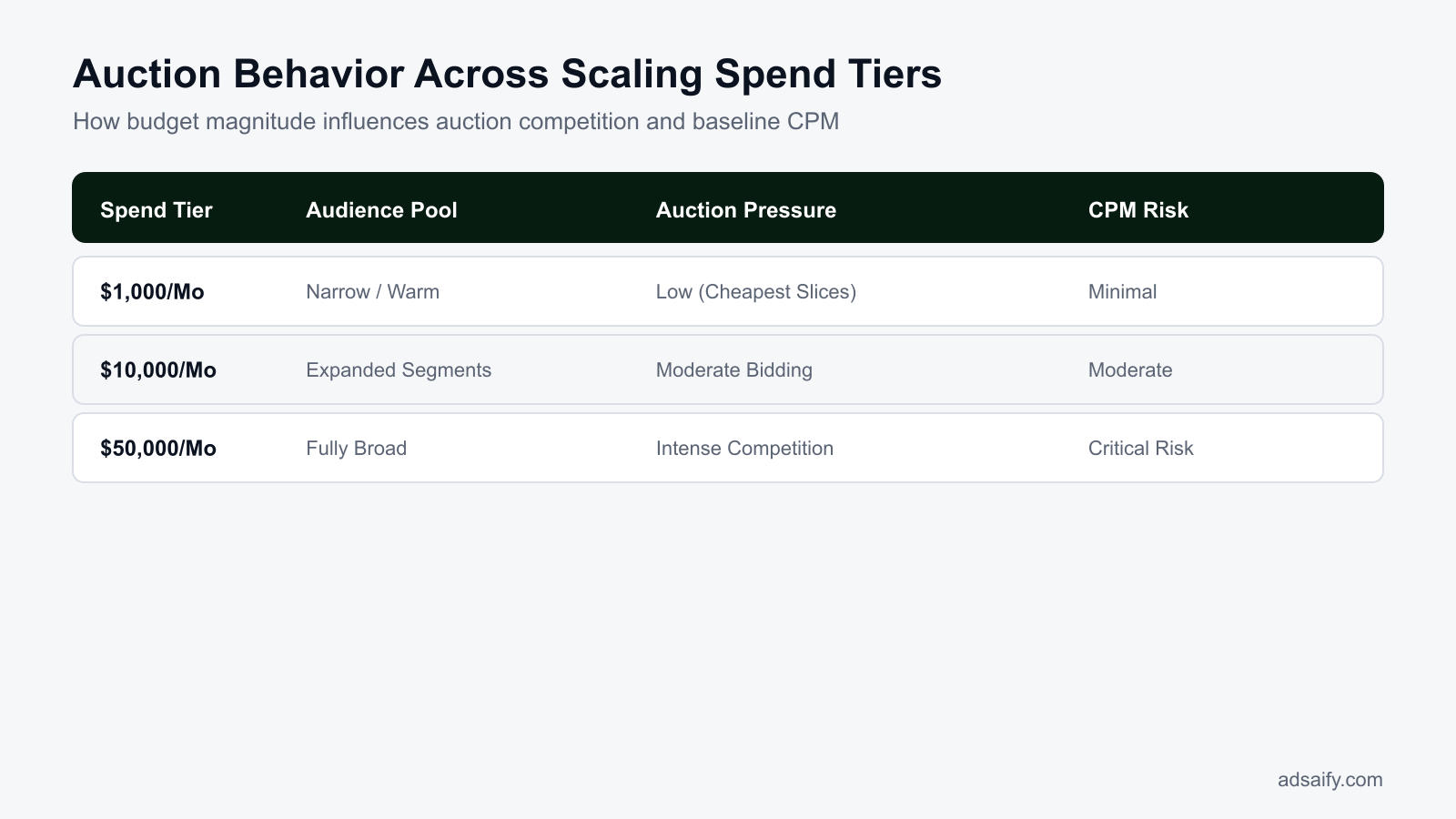
| Auction Factor | Moderate Daily Spend ($50–$100) | Aggressively Scaled Spend ($500+) |
|---|---|---|
| Targeting Depth | Restricted to cheapest, highest-intent audience slices. | Forced into peripheral, lower-intent audience pockets. |
| Auction Competitors | Direct niche competitors with similar low-bid limits. | Enterprise advertisers with higher bid tolerances. |
| Pacing Urgency | Relaxed pacing across standard peak usage windows. | Aggressive delivery pacing to spend budget in 24 hours. |
| User Creative Fatigue | Low ad frequency keeps negative feedback minimal. | Rapid frequency accumulation lowers ad quality scores. |
Why is the algorithm forced to enter more expensive auctions?
The algorithm is forced to enter more expensive auctions because every ad audience contains a finite volume of cheap, high-converting impression opportunities each day. Once an advertiser's higher daily budget exhausts those immediate opportunities, the delivery system must win impressions among less engaged users or outbid competing enterprise advertisers for premium placements to exhaust the assigned daily budget completely.
What are the financial consequences of unmanaged CPM spikes?
Unmanaged CPM (cost per mille, measuring the price per one thousand impressions) spikes directly erode advertising profitability by inflating acquisition costs and shrinking traffic volume. When auction costs rise without matching gains in conversion rates, profit margins collapse, turning profitable ad accounts cash flow negative and capping scalable revenue growth.
Traffic erosion and soaring acquisition costs
When Meta increases CPM rates during scaling, cost per click automatically follows an upward trajectory. CPC (cost per click: the fee paid every time a user clicks on an ad) is mathematically tied to impression pricing; if CPM doubles while user click interest remains flat, the cost per incoming visitor doubles as well. As a direct consequence, the same daily ad spend drives half as many potential buyers to the store. This traffic contraction accelerates CAC (customer acquisition cost: total advertising spend divided by the number of acquired customers) past break-even limits. If a store maintains a break-even ROAS (return on ad spend: gross revenue generated divided by ad spend) threshold of 2.5x, a 60% surge in CPM without proportional conversion gains drops realised ROAS below 1.6x, forcing the advertiser to operate at a net loss on every purchase.
Order stagnation and inventory cash flow risks
As monthly ad spend scales toward $50,000, unaddressed CPM inflation leads to acute capital inefficiency. Instead of purchasing incremental market reach and customer volume, additional ad dollars merely pay for increasingly expensive auction bids. Conversion volume plateaus while total spend climbs, generating severe margin compression across core retail inventory. E-commerce businesses rely on steady inventory turnover and predictable contribution margins to replenish stock; when customer acquisition absorbs the gross profit generated by sales, free cash flow contracts sharply, stalling further advertising operations.
- Audit break-even ROAS targets inside your financial spreadsheet before increasing budgets.
- Monitor CPC movements inside Meta Ads Manager alongside raw impression costs daily.
- Establish automated pause rules to cut ad sets where acquisition costs exceed target thresholds, using tools like Adsaify to protect daily margin.
- Calculate net contribution margin after deducting platform fees, fulfillment costs, and marketing spend.
- Track outbound click volume to verify that higher spend produces proportional site visits.
- Cap daily spend increments whenever marginal customer acquisition cost outpaces marginal order value.
Does an increasing CPM directly hurt my conversion rate too?
An increasing CPM does not technically alter website conversion rate, because conversion rate measures on-site visitor behavior rather than ad auction pricing. However, an unmanaged CPM spike often pushes Meta to deliver impressions to broader, less qualified audience segments to fulfill high spending budgets. That lower-intent traffic reaches product landing pages with weaker buying motivation, which causes conversion rates to decline as a direct downstream consequence of auction misallocation.
How can you diagnose the exact cause behind your CPM spike?
Diagnosing a CPM spike requires cross-referencing Meta Ads Manager delivery metrics, creative diagnostic rankings, and broader market conditions. Performance marketers determine whether auction costs stem from audience saturation, creative fatigue, algorithm penalties, or external seasonal shifts by isolating frequency, click-through rates, and ad relevance scores inside ad reporting breakdowns.
Separating creative fatigue from audience saturation
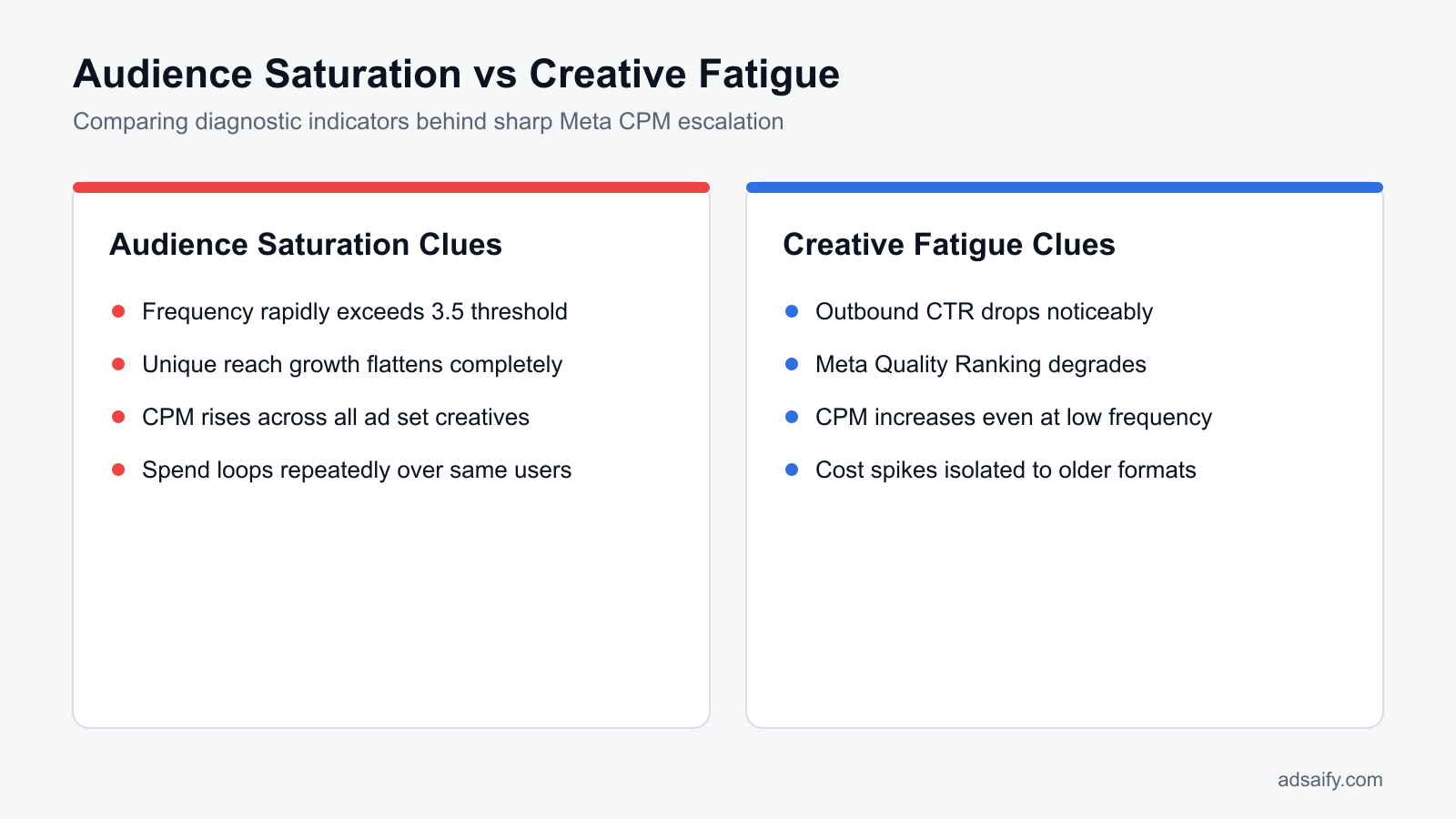
To pinpoint the root cause of high auction costs, marketers first assess frequency (the average number of times each unique user sees an ad) alongside CTR (click-through rate: the percentage of impressions that generate a click). When frequency climbs above 2.5 within a seven-day window while CTR steadily decreases, creative fatigue is occurring; the targeted group has repeatedly seen the same creative asset and stopped engaging. Conversely, if frequency remains low while CPM elevates instantly upon budget increases, audience saturation within a narrow target size or intense advertiser competition for that segment is driving clearing prices up.
Evaluating ad relevance diagnostics and auction seasonality
Meta Ads Manager provides Ad Relevance Diagnostics within the ad-level reporting columns, evaluating Quality Ranking, Engagement Rate Ranking, and Conversion Rate Ranking against competing advertisers. If Meta scores an ad in the bottom 20% for quality or engagement, the algorithm applies an auction penalty that inflates CPM to discourage poor user experiences. When diagnostics show average rankings yet costs climb account-wide, broader market dynamics, such as seasonal holiday retail peaks, are causing general inflation. Testing net-new angles becomes necessary when internal scores drop; advertisers can use Adsaify to analyze their offer and generate completely distinct creative concepts for systematic isolation testing.
| Diagnostic Metric Pattern | Primary Root Cause | Auction Mechanism | Immediate Corrective Action |
|---|---|---|---|
| High Frequency (>3.0), Declining CTR | Creative Fatigue | Low engagement reduces ad relevance value in bids | Deploy fresh visual assets and hook variations |
| Low Frequency (<1.5), Rapid CPM Surge | Audience Saturation | Aggressive bids exhaust cheap inventory in small pools | Broaden demographic targeting or switch to Advantage+ |
| Quality Ranking Below Average (Bottom 20%) | Ad Experience Penalty | Meta levies bid tax for negative user feedback signals | Rewrite copy, refine claims, and improve creative clarity |
| Account-wide CPM Spike, Stable CTR & CVR | Market-Wide Seasonality | Macro advertiser demand increases clearing prices | Implement strict bid caps or reduce non-core spends |
If my creative quality is high but the audience is narrow, will CPM still spike?
Yes, CPM will inevitably spike if the target audience is narrow, regardless of creative quality. Meta uses an auction system that prices impressions based on supply and demand. When you force higher ad spend into a small pool of users, Meta exhausts the cheapest available impressions almost immediately. To maintain delivery velocity, the algorithm bids aggressively against competing advertisers for the remaining high-demand impressions, driving clearing auction prices up.
If you would rather not set up each of these steps by hand, try it in Adsaify: your first ad is free, so there is nothing to lose. Create a free account.
Which account and creative checks must be completed before scaling?
Before scaling Meta ad spend, advertisers must complete pixel and server tracking audits, verify audience size adequacy, and build a reserve creative pipeline. Ensuring tracking reliability via Meta Conversions API prevents optimization loss, while maintaining broad target audiences and four to six distinct creative angles prevents rapid ad fatigue and artificial CPM spikes.
Audience Size and Event Quality Audits in Meta Events Manager
A successful budget scale requires robust tracking signals and sufficient audience volume. Advertisers must inspect Meta Events Manager to confirm that the Meta Pixel and Conversions API (CAPI, a server-side tool that sends web events directly from a server to Meta) maintain an Event Match Quality score above 6.0 out of 10 for the Purchase event. High event match quality provides Meta's delivery algorithm with clean conversion data to locate cost-effective buyers. Furthermore, targeting pools in Ad Set settings must be large enough to absorb aggressive spending; for example, scaling a campaign to a $1,500 daily budget requires broad audiences or Advantage+ audience settings exceeding 2,000,000 people to prevent immediate frequency saturation.
Creative Pipeline Preparation and Angle Diversification
Rapidly increasing spend accelerates ad fatigue, causing CPM (cost per mille, which is the cost per one thousand ad impressions) to climb when audiences see identical creatives repeatedly. Performance marketers must prepare a reserve pipeline of four to six distinct conceptual angles—such as direct product demonstrations, founder stories, user reviews, and objection-handling hooks—split across 9:16 vertical video and 1:1 square image formats. Advertisers can utilize Adsaify to analyze a website URL and pre-draft alternative audience angles and creative hooks, ensuring secondary concepts stand ready for deployment before scaling begins.
- Verify that the Purchase event shows an Event Match Quality score above 6.0 in Meta Events Manager.
- Confirm server-side event deduplication between the browser pixel and Conversions API.
- Expand target audiences in Ad Set settings to broad parameters with at least 2,000,000 estimated users.
- Assemble a reserve creative pipeline containing four to six distinct conceptual marketing angles.
- Format all upcoming creative assets in both 9:16 vertical and 1:1 or 4:5 aspect ratios.
- Establish historical baseline metrics for CPM, frequency, and cost per acquisition before raising spend.
How many fresh creative assets should I keep ready before scaling?
An advertiser should keep between eight and twelve validated, distinct creative assets ready in reserve before scaling ad spend. This reserve should comprise four to six varied marketing angles split across vertical video (9:16) and feed images (1:1 or 4:5). Having these pre-built assets ensures that when frequency climbs and CPM increases on active winning ads, the advertiser can immediately introduce fresh variations into the campaign without pausing scaling momentum.
How do you systematically scale ad spend without triggering CPM spikes?
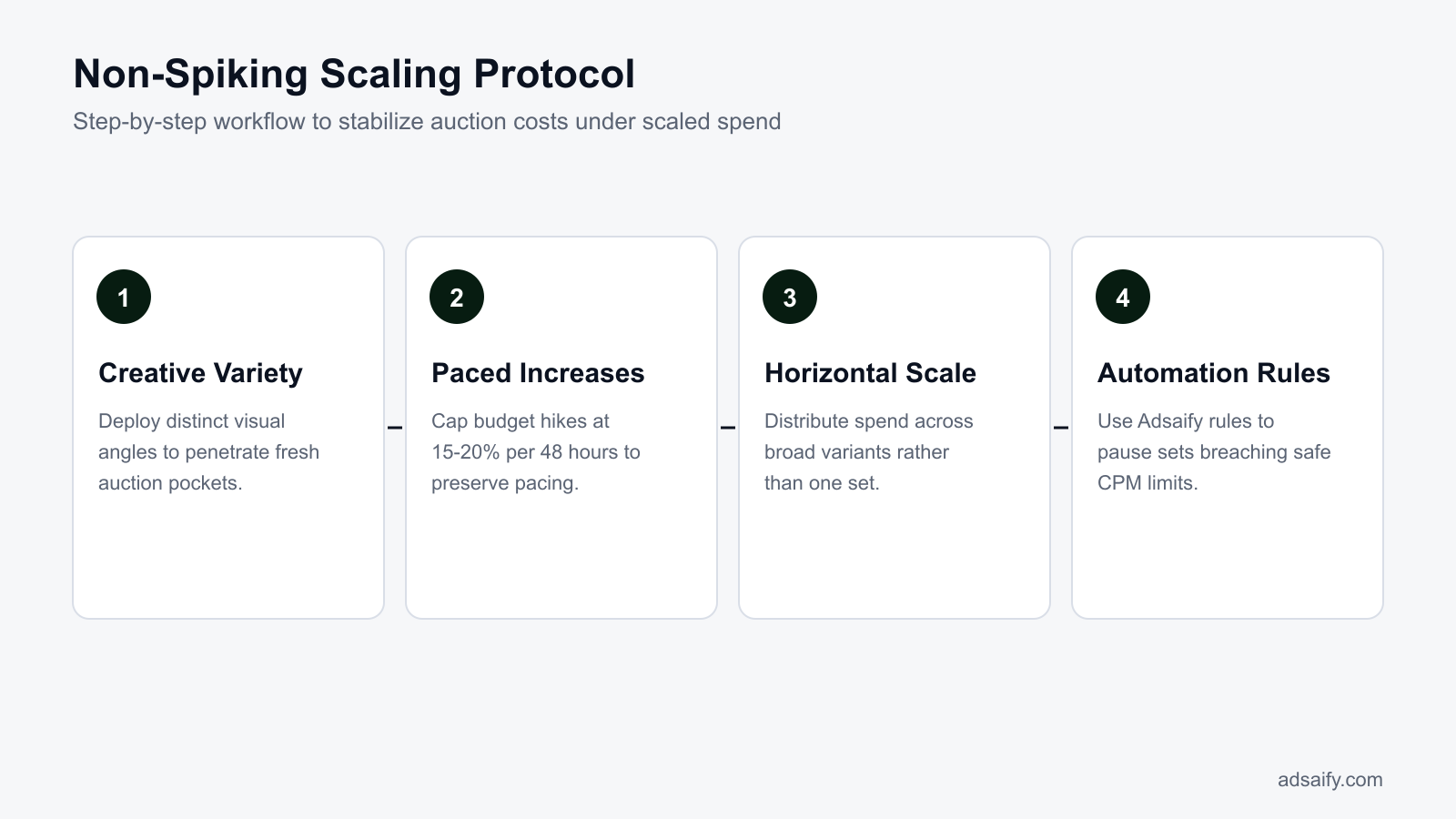
Advertisers systematically scale Meta ad spend without triggering CPM spikes by combining disciplined vertical budget increases, horizontal audience expansion, and automated bid controls. Raising daily budgets by no more than 15 to 20 percent every 48 hours preserves auction stability, while distributing proven creatives across broad audiences prevents bidding congestion in single ad sets.
Vertical Budget Management and Bid Strategy Controls
Vertical scaling involves increasing the daily budget of existing campaigns or ad sets within Meta Ads Manager. To prevent auction shocks, advertisers must limit budget increases to 15% to 20% every 48 hours. Aggressive budget shifts reset the ad set learning phase and trigger Meta's pacing algorithm to bid indiscriminately in expensive auction tiers. When managing volatile auctions, performance marketers apply Cost Cap or Minimum ROAS (return on ad spend, calculated as gross revenue divided by ad spend) bid strategies under Ad Set Optimization and Delivery. Bid controls instruct Meta to withhold spend if auction conditions cannot deliver results within profitability thresholds, effectively capping CPM inflation.
Horizontal Scaling and Safeguard Automation
Horizontal scaling diversifies budget allocation across multiple ad sets or campaigns rather than concentrating capital in a single target group. Marketers take proven winning creatives and launch them into fresh demographic segments, lookalike pools, or broad Advantage+ audience targets. This approach acquires incremental reach without exhausting individual pockets of users. Additionally, media buyers can configure Adsaify automation rules to monitor performance thresholds and automatically pause underperforming ads or halt aggressive spend increases whenever CPM values spike abnormally above historical baselines.
- Establish baseline metrics — The media buyer calculates historical 7-day average CPM and conversion cost benchmarks to set threshold parameters for scaling.
- Execute vertical budget increment — The campaign daily budget is raised by 15% to 20% in Meta Ads Manager, starting a 48-hour calibration window.
- Assess auction stability — The performance marketer monitors ad set metrics for 48 hours to confirm that frequency and CPM remain stable.
- Deploy horizontal audience expansion — Proven creatives are duplicated into new broad target sets if the primary ad set exhibits rising CPM trends.
- Trigger automated safety pauses — Automation rules halt scaling actions or pause unprofitable ad variations if auction CPM spikes 30% beyond historical targets.
Will the algorithm still destabilize if I increase budgets twice a day by 10%?
Yes, increasing budgets twice a day by 10 percent will frequently destabilize Meta's delivery algorithm. Although 10 percent appears conservative, multiple budget edits within a single 24-hour window reset intraday auction pacing calculations. Meta's delivery system requires 24 to 48 hours to recalibrate bid strategies across changing audience liquidity pools. Frequent adjustments force the algorithm to bid aggressively for rapid impressions, which inevitably drives up CPM and disrupts conversion efficiency.
What is a practical worked example of scaling ad spend from $1,000 to $15,000?
A practical worked example of scaling monthly ad spend from $1,000 to $15,000 involves breaking audience saturation by moving from narrow lookalikes to broad targeting, while deploying diversified creative formats. This transition prevents auction bidding penalties, stabilizing CPM (cost per mille, measuring cost per one thousand impressions) while maintaining acceptable profit margins.
Baseline performance and auction friction at scale
For example, an e-commerce brand selling ergonomic office footrests operated at a baseline budget of $1,000 per month within a single ad set targeting a 1% lookalike audience in Meta Ads Manager. In this initial state, the campaign produced a stable $12 CPM and a 3.8 ROAS (return on ad spend, calculated as gross revenue divided by advertising cost). When the brand rapidly forced spend upward to $5,000 per month inside the same ad set, the auction algorithm exhausted the narrow pool of low-hanging converters. Consequently, CPM spiked to $26, frequency doubled within ten days, and ROAS collapsed to 1.9.
The creative and structural corrective pivot
To resolve the auction bottleneck, the brand rebuilt its setup into an open broad targeting structure, removing detailed interest filters and lookalike parameters to expand total auction inventory. Rather than relying on a single static product photo, the team deployed three distinct creative formats simultaneously:
- A short UGC (user-generated content, creator-style organic video) review highlighting physical posture improvement.
- A static comparison graphic contrasting the ergonomic footrest against traditional hardwood floor sitting.
- A 15-second problem-solution video displaying lower back pain relief during desk work.
Marketers can also use Adsaify to analyze a store website and generate structured campaign drafts when expanding creative variations. By giving Meta distinct creative angles, the delivery engine matched each ad variation to different consumer segments, preventing internal ad competition.
Performance stabilization at $15,000 monthly spend
With diverse assets fueling broad targeting, monthly spend scaled incrementally to $15,000. CPM normalized at $15—only slightly higher than the baseline figure despite a fifteen-fold budget expansion. Broad distribution lowered bid tension, allowing ROAS to rebound to 3.2, ensuring the brand generated profitable, scalable revenue.
Was the spend scaled daily or weekly in this practical walkthrough?
The ad spend was scaled using weekly budget increments of 15% to 20% rather than aggressive daily increases. Meta's delivery system resets learning phases or triggers auction bid volatility when daily budgets increase by more than 20% in a single adjustment. Applying budget increases every five to seven days allowed the delivery algorithm to stabilize attribution data, observe conversion feedback loops, and distribute impressions across auction tiers without inflating CPM.
Which key metrics verify whether your CPM scaling fix succeeded?
You can verify that a CPM scaling fix succeeded by monitoring normalized CPM, unique outbound click-through rate, reach velocity, and Marketing Efficiency Ratio. These four metrics collectively confirm whether Meta distributes impressions to fresh, responsive audience segments at competitive auction prices without wasting capital on internal audience repetition or degraded conversion volume.
Core diagnostics: CPM, reach velocity, and engagement
Normalized CPM tracking requires keeping CPM inflation within 25% of baseline levels while spend multiplies. If your historical baseline is $12, a healthy scaled CPM should stabilize below $15. Simultaneously, you must track unique outbound CTR (click-through rate, measuring the percentage of unique individuals who click an external link leading off Meta platforms). A steady unique outbound CTR above 1.2% indicates that message resonance remains intact across broader audience layers. Meanwhile, reach velocity tracks the speed of new unique profiles entering your attribution window relative to impressions, ensuring the ad account is not trapped in an artificial frequency loop.
Evaluating blended profitability with MER
At the business level, MER (Marketing Efficiency Ratio, calculated as total store revenue divided by total paid ad spend across all channels) verifies net blended profitability. Because in-platform Meta attribution models often suffer from cross-device tracking gaps, verifying that overall store profit margins scale alongside ad spend ensures your scaling efforts produce true financial expansion rather than inflated in-platform figures.
| Metric Tracked | Healthy Scaled State | Compromised Scaled State | Recommended Action |
|---|---|---|---|
| Normalized CPM | Under 25% increase from baseline | Over 50% increase from baseline | Broaden audience parameters and add distinct visual angles |
| Unique Outbound CTR | Maintains baseline or exceeds 1.2% | Drops below 0.8% | Refresh ad hooks and test new value propositions |
| Reach Velocity | Expands linearly with ad spend | Plateaus while frequency climbs | Eliminate overlapping ad sets and reduce audience exclusions |
| Marketing Efficiency Ratio | Stable blended net revenue margin | Declining overall store profit | Audit post-click conversion rates and landing page load speeds |
Is the strategy successful if CPM stays stable but CTR begins to decline?
No, the strategy is not successful if CPM stays stable while CTR begins to decline. A falling CTR signals creative fatigue or audience mismatch, meaning users are ignoring the ad even though impressions remain cheap. Over time, Meta's auction penalizes ads with dropping engagement by lowering their total auction value score, which ultimately forces CPM to spike or conversion rates to drop. A declining CTR requires immediate creative variation.
Want to see this in your own account? Enter your website address and Adsaify drafts the campaign for you. The first ad is free. Try it now or log in.
What weekly and monthly routine prevents recurring CPM inflation?
A structured routine prevents recurring Meta ads CPM (cost per thousand impressions) inflation by consistently introducing fresh creative concepts, eliminating audience overlap, and adjusting bid constraints. Advertisers maintain stable auction costs by rotating hooks weekly, auditing ad set delivery midweek, updating cost controls monthly against margin shifts, and applying automated performance rules.
Meta auction costs rise naturally when ad sets exhaust receptive audience cohorts or encounter aggressive competitor bidding. To keep CPMs stable while scaling spend, advertisers must deploy a structured operational schedule in Meta Ads Manager:
- Weekly (Monday): Deploy at least two brand-new hook variations into testing ad sets to discover novel entry points before creative fatigue increases auction clearing costs.
- Midweek (Wednesday): Open the Meta Ads Manager Inspect tool to evaluate auction overlap and audience saturation metrics, ensuring scaling ad sets are not competing against one another.
- Midweek (Thursday): Review creative frequency and first-time impression ratio inside Ads Manager reporting columns to identify fatigued visual assets before delivery costs surge.
- Weekly (Friday): Calibrate automated performance rules inside Adsaify to automatically pause underperforming ad variations and protect account efficiency from weekend auction volatility.
- Monthly: Audit Cost Cap and Minimum ROAS (return on ad spend) constraints against current product margins to prevent Meta bidding algorithms from bidding above profitable levels.
- Monthly: Consolidate fragmented audience segments into broad targeting groups to grant the Meta delivery engine maximal liquidity and reduce bidding penalties.
- Monthly: Deactivate permanently exhausted creative assets across historical campaigns to prevent algorithmic delivery leakage toward decayed post IDs.
Do I need to shoot completely new videos weekly or are variations enough?
You do not need to shoot completely new video concepts every week because iterative variations are usually sufficient to suppress CPM inflation. Systematically swapping the first three seconds—the visual hook, headline overlay, or audio opener—creates a functionally distinct creative in Meta auction systems. Test two to three hook iterations against a proven body narrative before producing entirely new studio footage. Reserve net-new concept shoots for monthly production cycles when audience resonance across existing angles begins to plateau.
What are the most common scaling mistakes and how can they be fixed?
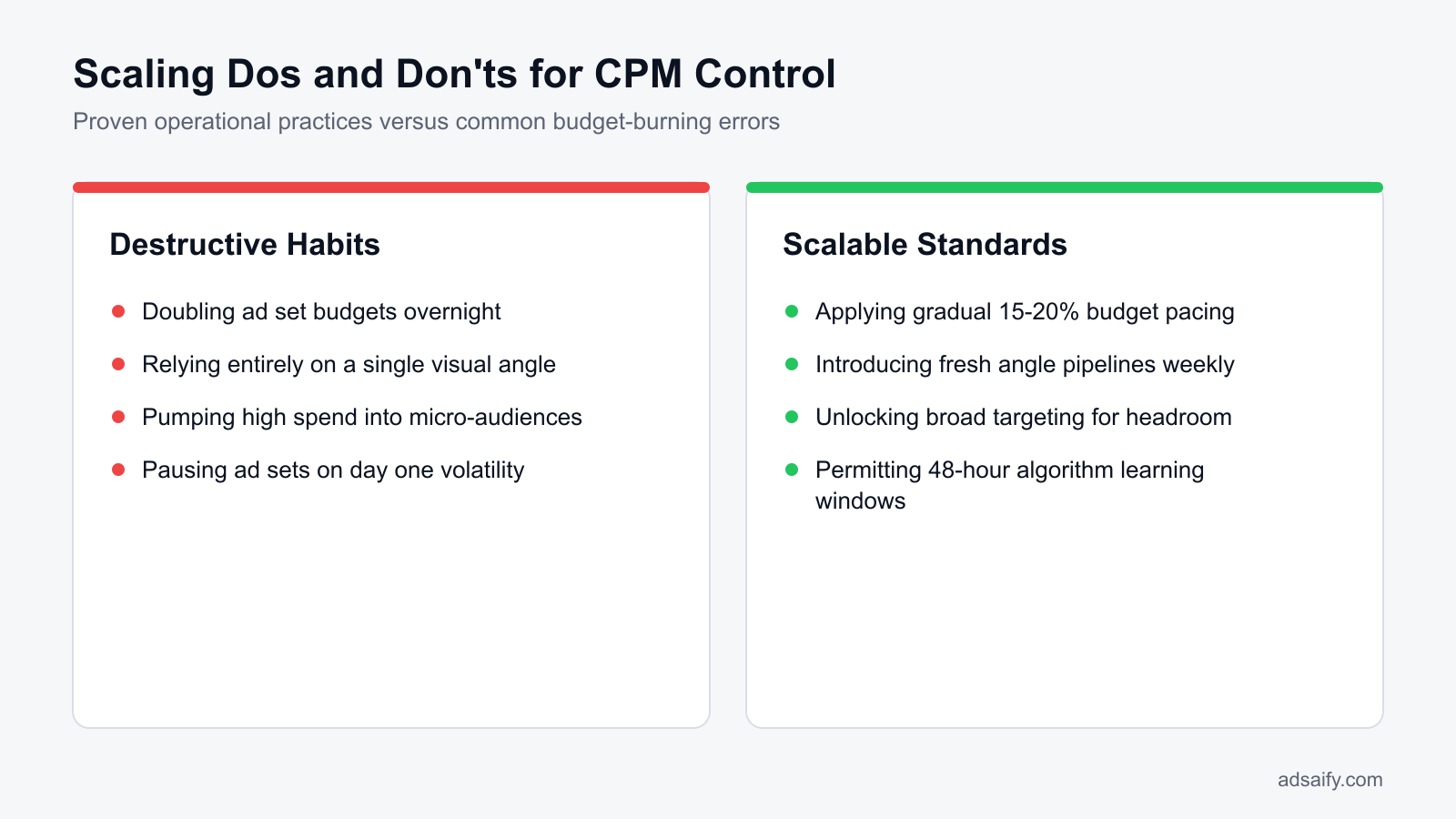
Common Meta ads scaling mistakes include rapid budget increases, over-relying on single winning creatives, restricting delivery within narrow audiences, and making emotional mid-flight campaign adjustments. Performance marketers prevent sudden CPM inflation by scaling budgets incrementally in stages, expanding creative variety, adopting broad demographic targeting, and granting the delivery algorithm 48 hours to recalibrate auction entry prices.
Abruptly doubling daily budgets
Raising daily budgets aggressively shocks the auction algorithm, forcing the ad set back into the learning phase and causing Meta to bid on higher-priced impressions. Fix this by applying staged pacing protocols, scaling active budgets by no more than 15% to 20% every 48 hours to preserve delivery efficiency.
Funneling all budget into one historical winning creative
Concentrating total campaign spend into a single high-performing ad saturates that creative's audience pocket, driving up frequency and triggering sharp CPM spikes. Fix this by deploying a modular creative angle matrix that continuously rotates diverse hooks, visual formats, and messaging pillars.
Trapping spend inside rigid, micro-interest target groups
Forcing higher spend into narrow interest groups limits auction liquidity, exhausting low-cost bids and driving up placement expenses. Fix this by migrating delivery into creative-led broad audiences where Meta algorithms match varied ad angles to relevant consumer subsets automatically.
Panicking and killing ad sets within hours of a CPM jump
Terminating campaigns during temporary intraday cost spikes prevents Meta auction pacing from balancing costs over a complete daily window. Fix this by enforcing a 48-hour observation rule, or let an automated rule inside Adsaify pause ad sets only when multi-day performance criteria fail.
Neglecting audience overlap across simultaneous scaling campaigns
Running duplicate targeting configurations across multiple campaigns causes internal auction overlap, forcing your ad sets to bid against each other. Fix this by reviewing the Meta Audience Overlap tool and merging redundant ad sets into consolidated structures.
Scaling campaigns during unmeasured conversion lag windows
Attribution delays of up to 72 hours can make newly scaled campaigns appear inefficient on day one, provoking erroneous manual changes. Fix this by monitoring 7-day click attribution windows and measuring blended customer acquisition costs before adjusting scaling velocity.
Why is pausing an ad set on the first day of a CPM spike often a mistake?
Pausing an ad set on the first day of a CPM spike is often a mistake because Meta daily auction delivery fluctuates based on intraday competition, user behavior patterns, and reporting delays. Immediate pausing interrupts the learning algorithm while it gathers clearing-price data across varied hourly tranches. Premature intervention locks in temporary anomalies as permanent losses. Performance marketers should wait at least 48 hours to evaluate blended metrics, allowing auction pacing to normalize before determining whether the cost increase reflects true creative fatigue.
When will this scaling fix fail and what are its inherent limitations?
Systematic Meta ad scaling fixes fail when external market pressures, audience size constraints, or post-click conversion funnels undermine campaign efficiency. While auction mechanics can be managed through horizontal scaling and creative diversification, underlying economic saturation, holiday competition, and static landing page conversion rates will still disrupt overall account profitability.
External seasonal pressures and market capacity limits
Macro seasonal events such as Black Friday, Cyber Monday, and the broader fourth quarter (Q4) create unavoidable baseline spikes in CPM (cost per mille, which measures the cost per 1,000 ad impressions). During high-volume holiday periods, enterprise advertisers enter Meta's ad auction with massive budgets, driving up clearing prices across every inventory placement regardless of creative quality or bidding strategy.
Similarly, brands operating in hyper-specialized business-to-business sectors or localized geographic regions face restricted TAM (total addressable market, meaning the total market demand for a product or service). When an advertiser targets a small audience pool, expanding ad spend exhausts potential prospects rapidly, forcing Meta to enter higher auction tiers and repeatedly deliver impressions to the same unresponsive users.
Post-click deficiencies and creative production boundaries
Controlling auction costs does not guarantee commercial success if the post-click experience underperforms. Even when Meta Ads Manager displays stable CPM and high CTR (click-through rate, the percentage of ad impressions that lead to clicks), flawed landing page copy, slow mobile page speed, or poor checkout design reduce CVR (conversion rate, the percentage of visitors who purchase). When CVR drops, CPA (cost per action) rises regardless of CPM stability.
Furthermore, automated systems have technical boundaries. For example, Adsaify provides automated campaign rules that pause declining ad sets when efficiency drops, but the platform does not automatically replace or refresh fatigue-ridden creatives in an active ad set. Creative production remains an operational requirement: marketing teams must design, test, and upload fresh angles on an ongoing basis. Advertisers can explore automated creative generation options by setting up an account at Adsaify's registration page.
Pre-scaling operational checklist
Review this operational checklist before increasing Meta ad spend:
- Audit mobile landing page speed to confirm load times remain under two seconds.
- Verify total addressable audience size exceeds five hundred thousand active users.
- Prepare at least four distinct creative angles before initiating budget increases.
- Inspect historical auction overlap within Meta Ads Manager inspect tools.
- Establish automated pause rules to prevent runaway spend on deteriorating ad sets.
- Track blended revenue metrics alongside in-platform ROAS (return on ad spend) indicators.
Can I still lower CPM with broad targeting if my product belongs to a hyper-niche market?
Broad targeting can temporarily reduce CPM in a hyper-niche market by giving Meta's delivery system access to cheaper inventory, but it usually harms overall conversion performance. When targeting broad audiences without strict demographic or interest parameters, the ad auction algorithm distributes impressions to untargeted users who will never purchase your specialized product. Consequently, while Meta Ads Manager reports lower CPM, conversion rates collapse and actual customer acquisition costs rise dramatically.
What key terminology defines Meta ad scaling and CPM management?
Meta ad scaling and CPM management rely on technical metrics, auction principles, and operational methodologies that govern ad distribution efficiency. Understanding these core terms allows media buyers to diagnose audience exhaustion, control impression pricing, expand daily ad spend sustainably, and optimize delivery algorithms without inducing artificial ad auction competition.
- CPM (Cost Per Mille): A standard advertising metric representing the cost an advertiser pays for every one thousand impressions delivered by Meta.
- Auction Saturation: An account condition where budget expansion exceeds immediate audience demand, forcing Meta to bid aggressively for marginal impressions.
- Horizontal Scaling: The strategic practice of increasing total account spend by launching additional ad sets, audiences, or creative angles rather than raising the budget of a single ad set.
- Vertical Scaling: The process of expanding ad spend by directly raising the daily budget of an existing, profitable ad set or campaign.
- Creative Angle: A distinct messaging framework or narrative hook tailored to address a specific customer pain point, desire, or objection.
- Creative Fatigue: The performance decline that happens when target audiences see the same ad asset repeatedly, leading to reduced engagement and higher impression costs.
- First-Time Impression Ratio: A Meta Ads Manager metric that measures the percentage of daily impressions served to individuals who have never seen the ad before.
- Learning Phase: The initial calibration period during which Meta's algorithm requires approximately fifty optimization events per week to stabilize ad delivery.
- Auction Overlap: An internal account conflict occurring when multiple ad sets from the same advertiser compete against each other in the same ad auction.
- Conversion Rate (CVR): The percentage of users who complete a desired purchase or conversion action after clicking an ad.
- Cost Per Action (CPA): The average monetary cost incurred by an advertiser to generate a single conversion event.
Can I use both horizontal and vertical scaling simultaneously in the same account?
Advertisers can effectively combine vertical and horizontal scaling within the same Meta ad account by applying each strategy to different campaign structures. Vertical scaling suits stable, broad-audience Advantage+ campaigns where budgets are increased by ten to twenty percent every few days. Simultaneously, horizontal scaling should be deployed in separate testing campaigns to validate fresh creative angles, which can later be graduated into the primary vertical scaling campaigns.
Sustaining High ROAS by Mastering CPM Dynamics at Scale
To manage CPM spikes when scaling Meta ad budgets, systematically pace your scaling and creative output. First, limit vertical budget increases to no more than 15% to 20% every 48 hours to preserve auction stability. Next, monitor ad quality scores and auction overlap before adjusting bid strategies. If CPM rises abruptly, introduce fresh visual variations to relieve audience fatigue instead of altering core targeting parameters. Finally, activate automated rules to pause any ad variations that exceed your maximum acceptable cost thresholds.
Open your Meta Ads Manager today, identify your fastest-scaling ad set, and check its CPM trend over the last seven days against your target ROAS. If delivery costs have climbed by more than 25%, deploy two new visual creative angles or set an automated pause rule to protect your scaling margins before increasing daily spend further.
Want to see this in your own account? Enter your website address and Adsaify drafts the campaign for you. The first ad is free. Try it now or log in.
Frequently Asked Questions (FAQ)
1. What is an acceptable CPM increase threshold when scaling daily budgets?
CPM (cost per mille) is the price an advertiser pays for one thousand impressions. When scaling ad spend vertically, an acceptable CPM increase typically sits between 15% and 25%, provided that conversion rates and ROAS (return on ad spend) remain stable. If CPM surges beyond 30% without a proportional conversion lift, the delivery algorithm is likely overbidding in hyper-competitive audience pockets.
2. Does switching to a Cost Cap bid strategy instantly solve a sudden CPM spike?
Switching to a Cost Cap bid strategy limits bids to your target cost per acquisition, which prevents Meta from entering expensive auctions. However, Cost Cap does not instantly lower CPM across existing delivery; instead, Meta restricts ad delivery, frequently causing ad sets to underdeliver or stop spending entirely if the cap is set too low for current market dynamics.
3. Does switching to broad targeting always guarantee lower auction CPMs?
Switching to broad targeting usually lowers CPM by expanding the addressable auction pool, but it does not guarantee cheaper costs. If ad creative relevance is low, Meta penalises the ad set with poor ad quality rankings, driving CPM up. Broad targeting only sustains lower CPMs when visual hooks and messaging resonate strongly across a large demographic audience.
4. Can Adsaify automated rules pause campaigns when CPM exceeds a target limit?
Adsaify automated rules can monitor Meta ad performance and pause campaigns, ad sets, or specific ads when CPM or acquisition costs exceed your chosen limit. While Adsaify does not create replacement ads automatically when a rule triggers, setting an automated rule ensures that runaway auction costs do not drain your budget when scaling campaigns aggressively.
5. How quickly can fatigued CPM metrics recover after introducing fresh creatives?
Fatigued CPM metrics typically begin recovering within 24 to 48 hours after launching fresh creatives into an ad set. The Meta auction algorithm requires roughly 50 optimisation events to calibrate delivery, but early engagement signals from new video hooks or visuals immediately recalibrate the expected click-through rate, reducing artificial auction penalties and dampening elevated CPMs.
6. Do CPM scaling spikes behave differently in Advantage+ Shopping Campaigns?
Advantage+ Shopping Campaigns (ASC) handle budget scaling differently because Meta automatically balances budget between retargeting and broad prospect audiences. When you scale ASC budgets quickly, Meta frequently exhausts cold prospects and aggressively bids on past visitors, causing a sharp CPM spike. Setting an existing customer budget cap inside ASC helps prevent this auction inflation.
7. Is it ever safe to bypass the 48-hour wait rule when vertically scaling budgets?
Bypassing the 48-hour wait rule is rarely safe during vertical scaling because Meta needs at least two days to stabilise auction bids and complete the learning phase. Accelerating budget adjustments faster than 48 hours resets auction calibration, triggers wild bidding volatility, and frequently induces immediate CPM spikes as the algorithm overcompensates to meet higher daily targets.
8. Should I modify the ad copy or the visual hook first when diagnosing a CPM surge?
Advertisers should modify the visual hook before altering ad copy when diagnosing a CPM surge. In the Meta auction algorithm, early visual engagement directly drives user retention and expected interaction rates. A refreshed 3-second hook immediately improves user quality scores, whereas body copy adjustments primarily influence on-page click-through conversion after the user has already engaged.
How can you try this with Adsaify?
The quickest way to apply the steps in this article to your own account is to try them. Adsaify analyses your business from your website address, drafts the campaign with an audience, ad copy, creative and a budget suggestion, and publishes it to your own Meta ad account once you approve.
- Your first ad is free: there is nothing to lose by trying.
- Your own ad account: the campaign runs in your Meta account and you stay in control.
- Images and video: generate ad creatives with AI or promote an existing Instagram post.
Create a free account and try your first ad · Already have an account? Log in.