Short answer: Creative fatigue occurs when the same ad content is shown repeatedly, leading to viewer disengagement. To solve this problem, it is essential to regularly produce new content and analyze your target audience.
Many advertisers on Meta platforms face a common challenge: creative fatigue. This issue arises when the same advertisements are displayed to users repeatedly, resulting in diminished engagement and effectiveness. You might notice that your click-through rates drop or that your audience stops responding to your ads altogether, leaving you frustrated and unsure of how to revive your campaign's performance. Creative fatigue often stems from a lack of fresh content, poor audience targeting, or simply the natural wear-out that occurs when users see the same message too many times. If left unaddressed, this fatigue can lead to wasted ad spend and a significant decrease in your return on ad spend (ROAS), ultimately harming your brand’s visibility and profitability. The longer you wait to tackle this issue, the more it can erode your campaign's overall success. In this article, you will learn how to identify and diagnose creative fatigue, prepare for effective solutions, and implement strategies to rejuvenate your ad campaigns. We will cover detailed steps to recognize the signs of fatigue, analyze its causes, and explore best practices to refresh your creative content. By the end, you will have a comprehensive plan to not only solve the problem but also prevent it from recurring in the future.Key Takeaways
- Creative fatigue negatively impacts ad performance.
- Regular content refresh is necessary.
- Audience analysis reduces fatigue.
- AI tools can assist in content production.
What is Creative Fatigue and How to Recognize It?
Creative fatigue occurs when Meta displays the same advertisement to an audience too many times, causing people to lose interest in the creative asset. As visual familiarity grows, engagement drops sharply, which reduces delivery efficiency and causes key advertising performance metrics to deteriorate across Meta Ads Manager.
The Operational Impact on Ad Delivery
Frequency is the average number of times each unique user sees an advertisement. When an ad set repeatedly serves identical media, the target audience experiences banner blindness and simply scrolls past the message. Click-through rate (CTR) is the percentage of impressions that result in an ad click. As creative fatigue intensifies, CTR declines, which signals to the Meta delivery system that the creative asset is no longer relevant. Consequently, Meta increases the cost per click (CPC)—the price an advertiser pays for each user interaction—and raises the overall cost per acquisition (CPA), which is the total advertising expenditure required to secure a conversion.
Diagnosing Fatigue with a Worked Example
Consider an online boutique leather goods store experiencing performance drops while running a conversion campaign. For example, with a 1,500 TL daily budget allocated to a single product photo in Meta Ads Manager, the campaign initially generated steady sales at an acceptable return. Over three weeks, the Frequency metric in the Columns reporting menu increased from 1.3 to 3.9 within a custom audience of 120,000 users. As ad repetition climbed, the outbound CTR dropped from 2.4% to 0.7%, while the cost per purchase rose from 50 TL to 145 TL. Quality Ranking is a Meta diagnostic metric that compares the perceived quality of an ad against competing ads targeting the same audience. The advertiser observed the Quality Ranking fall from "Average" to "Bottom 20% of ads", confirming creative fatigue. The business resolved the issue by introducing three fresh video assets displaying the product in use, which restored the outbound CTR and stabilized costs.
How can I recognize creative fatigue?
To recognize creative fatigue, navigate to Meta Ads Manager, select the Performance and Clicks preset, and review trends over the last 7 to 14 days. Look for a rising Frequency metric above 2.5 coupled with a continuous decrease in Outbound Click-Through Rate. If your Cost Per Result simultaneously increases while Meta's Quality Ranking falls into the bottom tier, the creative asset has fatigued and needs replacement.
What Causes Creative Fatigue?
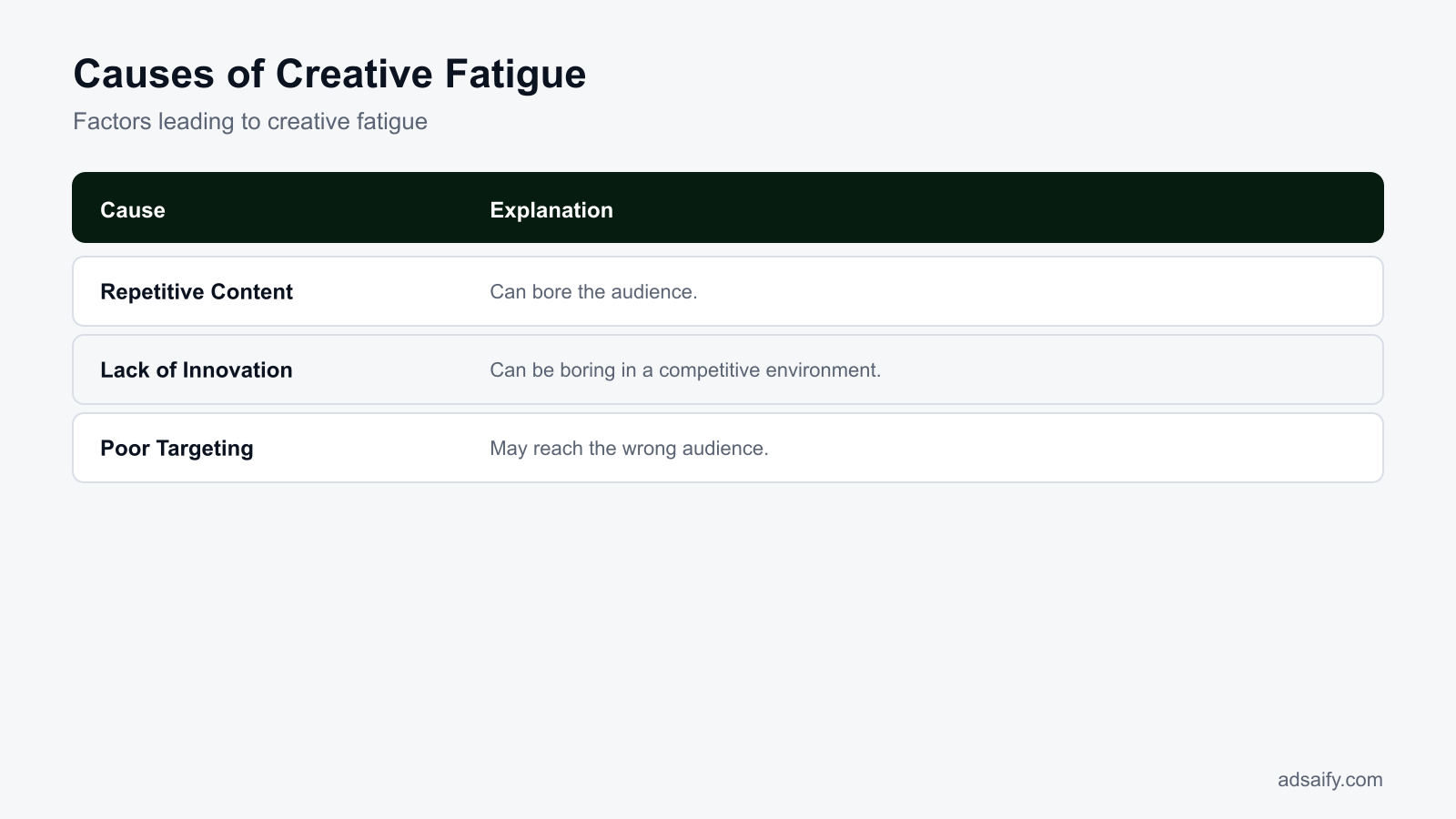
Creative fatigue is caused by displaying repetitive content that bores target audiences, failing to produce innovative variations within a competitive auction environment, and restricting delivery through excessively narrow audience targeting. When advertisers saturate a fixed audience without cycling new visual concepts, user responsiveness inevitably collapses across Meta platforms.
Repetitive Content and Auction Competition
Repetitive content causes audiences to disengage because human attention requires novelty to notice commercial messaging in social feeds. When an ad uses the same headline, visual hook, and color palette for months, users develop cognitive resistance and stop reading the copy. In competitive auctions, competing advertisers constantly introduce dynamic formats such as Reels, user-generated video, and interactive carousels. If an account relies on static image posts without exploring fresh concepts, competitors capture the auction's top engagement signals. Advertisers looking to streamline concept generation can use Adsaify to draft new ad copy and generate image or video variations directly from their website address.
Targeting Constraints and Audience Saturation
Targeting choices directly accelerate how quickly creative fatigue develops. When an advertiser selects a very narrow geographic area, a tiny custom audience, or excessive detailed targeting exclusions, the available pool of impressions shrinks. Because the delivery system must spend the daily budget within that limited group, Meta forces the same visual asset onto the same individuals multiple times per week.
| Fatigue Cause | Primary Meta Ads Setting | Observed Symptom | Recommended Strategic Action |
|---|---|---|---|
| Audience Exhaustion | Audience Size in Ad Set | Frequency climbs above 3.5 in under seven days | Expand audience parameters or switch to Advantage+ audience |
| Format Monotony | Creative Format in Ad Level | Low outbound CTR despite high impressions | Introduce short-form video and multi-card carousels |
| Visual Stagnation | Media Asset Selection | Low Quality Ranking in Ad Diagnostics | Test new hooks, color contrasts, and creator perspectives |
| Excessive Budget Density | Daily Budget in Ad Set | Rapid cost per acquisition increase on small pools | Lower daily spend or combine overlapping ad sets |
Why do I get bored of seeing the same ad repeatedly?
Audiences experience boredom with repeated advertisements due to sensory adaptation, a cognitive process where the human brain stops noticing recurring, non-essential visual stimuli. When Meta serves an identical image or video repeatedly, the surprise value disappears entirely. Because the advertisement no longer provides new information, an emotional hook, or entertainment, users perceive the creative as intrusive clutter and instinctively scroll past it.
What is the Cost of Creative Fatigue?
The cost of creative fatigue in Meta ads is wasted media spend, elevated acquisition costs, reduced profit margins, and brand erosion. When target audiences see identical ads repeatedly, click-through rates decline, driving up cost per click, which directly suppresses return on ad spend and weakens auction competitiveness against rivals running fresh assets.
Reduced Conversion Rates and Escalating Cost Per Acquisition
Creative fatigue lowers conversion rates because audiences repeatedly ignoring an asset become increasingly unlikely to convert. In Meta Ads Manager, CPA (cost per acquisition) is total ad spend divided by attributed conversions. When CTR (click-through rate, the percentage of impressions resulting in clicks) drops, Meta increases CPM (cost per mille, the cost per one thousand impressions) to offset weak engagement. Consequently, traffic costs rise, elevating CPA above sustainable targets and lowering overall profit margins.
Loss of Competitive Advantage in Ad Auctions
Meta distributes ad inventory through an auction based on total value, which combines the advertiser's bid, estimated action rates, and user ad quality scores. When creative fatigue sets in, user engagement drops, directly damaging ad quality rankings. Competitors who consistently upload fresh, high-relevance creatives capture higher estimated action rates. Even if your bid remains competitive, rivals win prime placements at lower costs, taking market share across Instagram and Facebook feeds.
Negative Effects on Brand Image and Audience Sentiment
Repeatedly serving identical video hooks and static banners frustrates consumers browsing social platforms. Excessive exposure triggers audience irritation, prompting users to click "Hide ad" or report repetitive creative. These negative feedback signals degrade the asset's quality score in Meta Ads Manager. Furthermore, annoyed prospects often leave negative comments directly on active ads, harming brand credibility and discouraging other prospective buyers who read the comment section.
Checklist for Assessing Creative Fatigue Costs
- Audit Meta Ads Manager campaigns where frequency exceeds 3.5 over fourteen days.
- Compare current CPA against your thirty-day baseline to quantify wasted ad spend.
- Inspect ad-level comment sections to detect negative sentiment and user complaints.
- Review ad quality rankings under custom column presets for below-average status ratings.
- Calculate ROAS (return on ad spend, calculated as revenue divided by ad spend) degradation across fatigued ad sets to determine lost revenue.
- Configure automated rules in tools like Adsaify to pause ads exceeding maximum CPA thresholds.
What are the consequences of creative fatigue?
The primary consequences of creative fatigue are inflated advertising expenses, diminished campaign scalability, and customer irritation. As audience responsiveness drops, Meta's delivery algorithm bids higher in ad auctions to secure conversion events, causing acquisition costs to surge. Unchecked fatigue drains marketing budgets on unresponsive users, trains prospects to scroll past your brand, and forces ad accounts into learning limited status when ad sets fail to generate sufficient weekly conversion volume.
How to Diagnose the Cause of Creative Fatigue?
To diagnose creative fatigue, compare real-time engagement and delivery metrics against historical performance benchmarks inside Meta Ads Manager. Evaluating rising frequency against declining click-through rates, monitoring audience feedback scores, and reviewing competitor creative tactics reveals whether performance drops stem from asset saturation, narrow audience targeting, or compelling external market offers.
Analyze Performance Data in Meta Ads Manager
Performance diagnosis begins inside Meta Ads Manager by customizing reporting columns to inspect delivery trends over time. Outbound CTR (outbound click-through rate) is the percentage of impressions that result in clicks leading users off Meta-owned properties to your website. Check the "Inspect" tool at the ad set level to view the First Time Impression Ratio, which is the percentage of daily impressions seen by an individual for the first time. If the First Time Impression Ratio drops steadily below 50 percent while frequency climbs and outbound CTR decreases, the asset is suffering from creative fatigue.
Examine Audience Engagement and Quality Rankings
Meta measures user reception through ad relevance diagnostics, available under custom column settings in Meta Ads Manager. These diagnostics compare your ad against competitors targeting the identical audience across three metrics: Quality Ranking, Engagement Rate Ranking, and Conversion Rate Ranking. A Quality Ranking categorized as "Below Average (Bottom 20%)" indicates users actively skip or hide the ad. Additionally, inspect the comments section on Instagram and Facebook ad posts; a rising volume of negative remarks or repetitive emoji responses signals that the target audience is exhausted by the messaging.
Conduct Competitive Analyses in the Meta Ad Library
Fatigue can also arise because competitors introduce more compelling creatives to the same audience. The Meta Ad Library is a public database displaying all active ads running across Facebook and Instagram technologies. Search for direct competitors to see their launch dates and creative formats, such as short-form video or user-generated content. If a competitor has run specific variations for several months, those formats are likely converting. Comparing your fatigued creative against active competitor angles highlights message stagnation and visual obsolescence.
| Fatigue Symptom | Diagnostic Metric | Underlying Cause | Corrective Step |
|---|---|---|---|
| High frequency, falling CTR | Frequency and Outbound CTR | Audience saturation from creative overexposure | Deploy fresh visual variations and new hooks |
| Rising CPM, stable CTR | CPM and Quality Ranking | User penalties from ad hides and negative reports | Replace opening messaging to improve user reception |
| Lower conversion, stable CTR | Conversion Rate and ROAS | Offer fatigue or landing page messaging mismatch | Align ad hook directly with landing page headline |
| Rapid drop in video retention | 3-Second Video Plays | Hook fatigue on the opening visual sequence | Test three distinct 3-second opening video variations |
Which data should I check?
To diagnose creative fatigue, check frequency, outbound CTR (click-through rate), CPM (cost per mille), first-time impression ratio, and Meta ad quality rankings. Frequency measuring above 3.0 alongside declining outbound CTR indicates direct asset saturation. Check the first-time impression ratio under the delivery breakdown menu; a figure dropping below 50 percent confirms the ad mostly touches repeat viewers. Finally, verify the ad quality ranking to identify rising negative feedback.
If you would rather not set up each of these steps by hand, try it in Adsaify: your first ad is free, so there is nothing to lose. Create a free account.
What Should I Prepare Before Applying the Fix?
To effectively address creative fatigue in Meta ads, marketers should prepare by generating new content ideas, redefining the target audience, and reviewing competitive ads. This groundwork ensures that the new strategies are relevant, appealing, and informed by both market trends and audience preferences, ultimately leading to more engaging ad campaigns.Generate New Content Ideas
Generate diverse content ideas by brainstorming themes that resonate with your audience. Use tools like Google Trends to identify popular topics in your industry. Collaborate with your team or utilize online forums to gather insights. Create a content calendar that outlines potential ad themes and formats, ensuring a steady flow of fresh concepts.Redefine Your Target Audience
Review your current audience targeting settings in Meta Ads Manager. Analyze demographic data, interests, and behaviors to identify potential new segments. Consider creating different audience personas based on their purchasing behavior and engagement levels. This will help ensure that your ads are reaching the right people with the right message.Review Competitive Ads
Explore ads run by your competitors using the Meta Ads Library. This tool provides insights into the creatives, copy, and targeting strategies employed by similar businesses. Analyze which ads perform well and why, and consider incorporating successful elements into your own campaigns while maintaining your unique brand voice.- Brainstorm new content themes with your team.
- Analyze audience insights in Meta Ads Manager.
- Explore Meta Ads Library for competitor ad examples.
- Create a content calendar for new campaigns.
- Identify high-performing ad formats and styles.
- Gather feedback from your audience on past campaigns.
- Set clear goals for your new ad campaigns.
How can I find new content ideas?
To find new content ideas, start by analyzing audience feedback and engagement metrics. Use social listening tools to monitor discussions around your brand and industry. Explore trending topics on social media platforms. Additionally, consider hosting brainstorming sessions with your team to generate fresh perspectives and innovative concepts that can captivate your audience.How to Solve Creative Fatigue?
To solve creative fatigue in Meta ads, marketers should create new ad copies and visuals, segment the target audience, and utilize AI tools for content production. These steps help refresh the campaign's creative elements, ensuring that the ads remain engaging and effective in capturing audience attention.Create New Ad Copies and Visuals
Develop new ad copy and visuals that reflect updated messaging and branding. Use A/B testing to evaluate different versions of your ads. Focus on creating compelling headlines, clear calls-to-action, and eye-catching images or videos that resonate with your target audience. Ensure that the new creatives align with the insights gathered from your audience and competitive analysis.Segment the Target Audience
Utilize the audience segmentation options in Meta Ads Manager to tailor your ads for different groups. Create custom audiences based on previous interactions, website visits, or demographic data. By targeting specific segments, you can deliver more personalized ads that address the unique interests and needs of each group, reducing the chances of creative fatigue.Use AI Tools for Content Production
Leverage AI tools like Adsaify to streamline the content creation process. These tools can generate ad copy, suggest audience targeting, and even create visuals based on your brand guidelines. Automating parts of the creative process helps maintain a consistent flow of fresh content while freeing up time for strategic planning and analysis.- Identify Creative Elements — Review current ad performance to pinpoint which elements need refreshing.
- Gather Insights — Analyze audience feedback and competitor ads to inform new creatives.
- Create New Content — Develop new ad copies and visuals based on gathered insights.
- Segment Audiences — Use audience segmentation features in Meta Ads Manager to target specific groups.
- Implement AI Tools — Utilize AI tools to assist with content generation and campaign management.
- Launch New Campaigns — Publish updated ads and monitor performance closely.
- Review and Optimize — Regularly assess ad performance and make adjustments as necessary.
How often should new content be produced?
New content should ideally be produced every few weeks to keep your ads fresh and engaging. However, the frequency can vary based on your audience's response and campaign performance. Regularly analyze metrics to determine the optimal timing for refreshing your creatives, ensuring that your ads remain relevant and effective in driving engagement.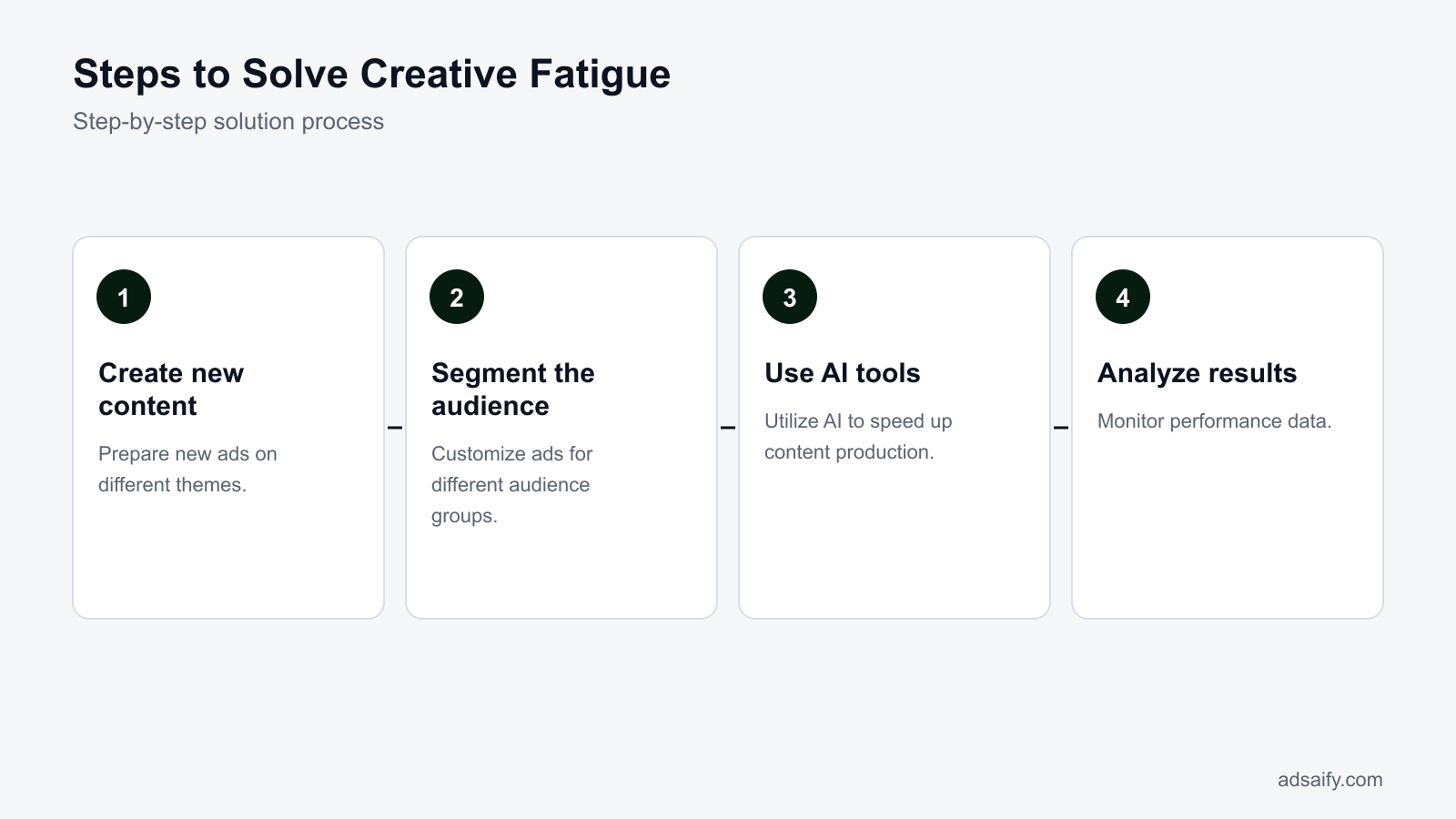
How to Solve Creative Fatigue with a Detailed Example?
To solve creative fatigue in Meta ads, a structured approach involves creating a sample campaign. This includes identifying new content, selecting a fresh target audience, and analyzing the results post-implementation. By following these steps, marketers can revitalize their ad performance and enhance engagement.Creating a Sample Campaign
For example, consider a local coffee shop named "Brewed Awakenings" that has been running Meta ads with a daily budget of 500 TL. The shop has experienced declining engagement and click-through rates, indicating creative fatigue. 1. **Identify New Content**: The first step is to generate new visual content. Brewed Awakenings could create a series of images featuring seasonal drinks and customer interactions. These images should be vibrant and showcase the café's atmosphere. Additionally, including user-generated content, like customer photos tagged on Instagram, can enhance authenticity. 2. **Target Audience**: The shop's previous campaigns targeted a broad audience of coffee lovers aged 18-45. For the new campaign, Brewed Awakenings can narrow down the audience to: - Location: Limit to a 10 km radius around the café. - Interests: Focus on people interested in "Coffee Culture," "Artisan Food," and "Local Events." - Behaviors: Target users who frequently visit cafés or engage with food and beverage pages on Meta. 3. **Analyze Results**: After implementing the new campaign for two weeks, Brewed Awakenings should analyze the results using Meta Ads Manager. Key metrics to evaluate include: - **Click-Through Rate (CTR)**: Look for an increase from the previous 1.5% to at least 2.5%. - **Cost Per Click (CPC)**: Monitor if the CPC decreases from 1.50 TL to around 1.00 TL, indicating better engagement. - **Conversion Rate**: Track if the number of in-store visits increases, aiming for at least a 10% uplift compared to the prior campaign.How is a sample campaign created?
A sample campaign is created by defining clear objectives, identifying new creative content, and selecting a precise target audience. Marketers then set a budget, launch the campaign in Meta Ads Manager, and monitor performance metrics to assess effectiveness.How to Measure Whether the Fix Worked?
To measure whether the fixes for creative fatigue were effective, marketers should monitor key performance metrics, check conversion rates, and evaluate audience engagement. This structured approach allows for a comprehensive understanding of the campaign's success.Monitoring Performance Metrics
Marketers should focus on specific performance metrics to gauge the success of the new campaign. Key metrics include: - **Click-Through Rate (CTR)**: A higher CTR indicates that the new creatives are resonating with the audience. - **Cost Per Acquisition (CPA)**: Assess if the CPA decreases, suggesting improved efficiency in turning clicks into conversions. - **Return on Ad Spend (ROAS)**: Monitor for an increase in ROAS as a sign of effective ad spend.Checking Conversion Rates
Conversion rates are crucial in determining if the campaign successfully drives desired actions. For Brewed Awakenings, this could mean: - Tracking the number of customers who redeem a promotional offer linked to the ad. - Monitoring online orders or reservations made through the café's website after clicking the ad.Evaluating Audience Engagement
Audience engagement metrics provide insights into how well the content resonates with the target audience. This can be assessed through: - Comments and shares on the ads, indicating increased interaction. - The number of new followers gained on the café's social media pages after launching the campaign.| Metric | Before Fix | After Fix |
|---|---|---|
| Click-Through Rate (CTR) | 1.5% | 2.5% |
| Cost Per Click (CPC) | 1.50 TL | 1.00 TL |
| Conversion Rate | 5% | 10% |
| Return on Ad Spend (ROAS) | 3x | 5x |
How can I track success?
Success can be tracked by monitoring performance metrics such as CTR, CPC, and conversion rates in Meta Ads Manager. Regularly reviewing these metrics helps identify trends, allowing marketers to adjust strategies and ensure ongoing effectiveness of the campaigns.Want to see this in your own account? Enter your website address and Adsaify drafts the campaign for you. The first ad is free. Try it now or log in.
What Routine Should I Follow to Prevent Recurrence?
Establishing a routine to prevent creative fatigue in Meta ads is crucial for maintaining performance. Regular evaluations help ensure ads remain fresh and relevant. A proactive approach includes weekly reviews of content, audience analyses, and the development of innovative content to keep your campaigns engaging and effective.- Daily: Check ad performance metrics like CTR (click-through rate) and CPC (cost per click) to identify any immediate issues.
- Weekly: Conduct content reviews to assess the effectiveness of your creatives and make necessary adjustments.
- Weekly: Analyze audience engagement to understand which demographics respond best to your ads.
- Monthly: Review campaign objectives and KPIs (key performance indicators) to ensure alignment with business goals.
- Monthly: Develop new ad creatives, experimenting with different formats and messaging to avoid redundancy.
- Quarterly: Conduct a comprehensive analysis of audience segments to refine targeting strategies.
- Quarterly: Assess your overall ad budget and ROI (return on investment) to optimize future spending.
How often should I conduct reviews?
Conduct reviews weekly to ensure your ads remain effective and engaging. Daily checks on performance metrics can help you catch immediate issues, while monthly and quarterly assessments provide a broader view of your campaign effectiveness. Regular evaluations will help you stay ahead of creative fatigue and maintain optimal ad performance.What Are the Most Common Mistakes and How to Fix Them?
Understanding common mistakes in Meta advertising can help marketers avoid pitfalls that lead to creative fatigue. Addressing these issues promptly ensures campaigns remain effective and engaging.Incorrect audience targeting
Incorrect audience targeting leads to wasted ad spend and low engagement rates. If your ads are shown to users who are not interested in your product, they are unlikely to convert. To fix this, refine your audience settings in Ads Manager by utilizing Custom Audiences and Lookalike Audiences. Regularly update your audience based on engagement data and customer feedback.Using repetitive content
Using the same creatives repeatedly can lead to ad fatigue, causing audience disengagement. When users see the same ad multiple times, they may start ignoring it. To fix this, develop a content calendar that includes a rotation of different ad formats and messaging. Use A/B testing to determine which creatives resonate best with your audience.Ignoring performance data
Ignoring performance data can lead to missed opportunities for optimization. If you don’t analyze metrics such as ROAS (return on ad spend) and conversion rates, you may continue investing in underperforming ads. To fix this, regularly review performance data in Ads Manager. Set up automated reports to stay informed on key metrics and adjust your campaigns accordingly.Overlooking ad placement options
Not utilizing all available ad placements can limit your reach and effectiveness. For instance, ads may perform better on Instagram Stories compared to the Facebook Feed. To fix this, explore different placements in the Ads Manager during campaign setup and optimize based on performance data.Failing to refresh creatives
Failing to refresh creatives can lead to audience fatigue and declining engagement. If the same visuals and messaging are used for too long, users may stop responding. To fix this, establish a schedule for regularly updating your creatives, incorporating new images, videos, and copy to keep the content dynamic.Neglecting competitor analysis
Neglecting to analyze competitors can result in outdated strategies. Understanding what works for others can provide insights into audience preferences and trends. To fix this, regularly review competitor ads and strategies, using tools like Facebook Ad Library to gather insights and adapt your own campaigns.Not testing ad variations
Not testing ad variations limits your understanding of what works best. Without testing, you may miss out on higher-performing creatives. To fix this, implement A/B testing for different ad variations, analyzing which elements (headlines, images, calls to action) drive better performance.How can I fix the mistakes?
To fix common mistakes in Meta ads, start by refining audience targeting and regularly updating your creatives. Utilize performance data to inform decisions and implement A/B testing to discover what resonates with your audience. Establish a routine for competitor analysis and ensure you’re exploring all ad placements to maximize reach and effectiveness.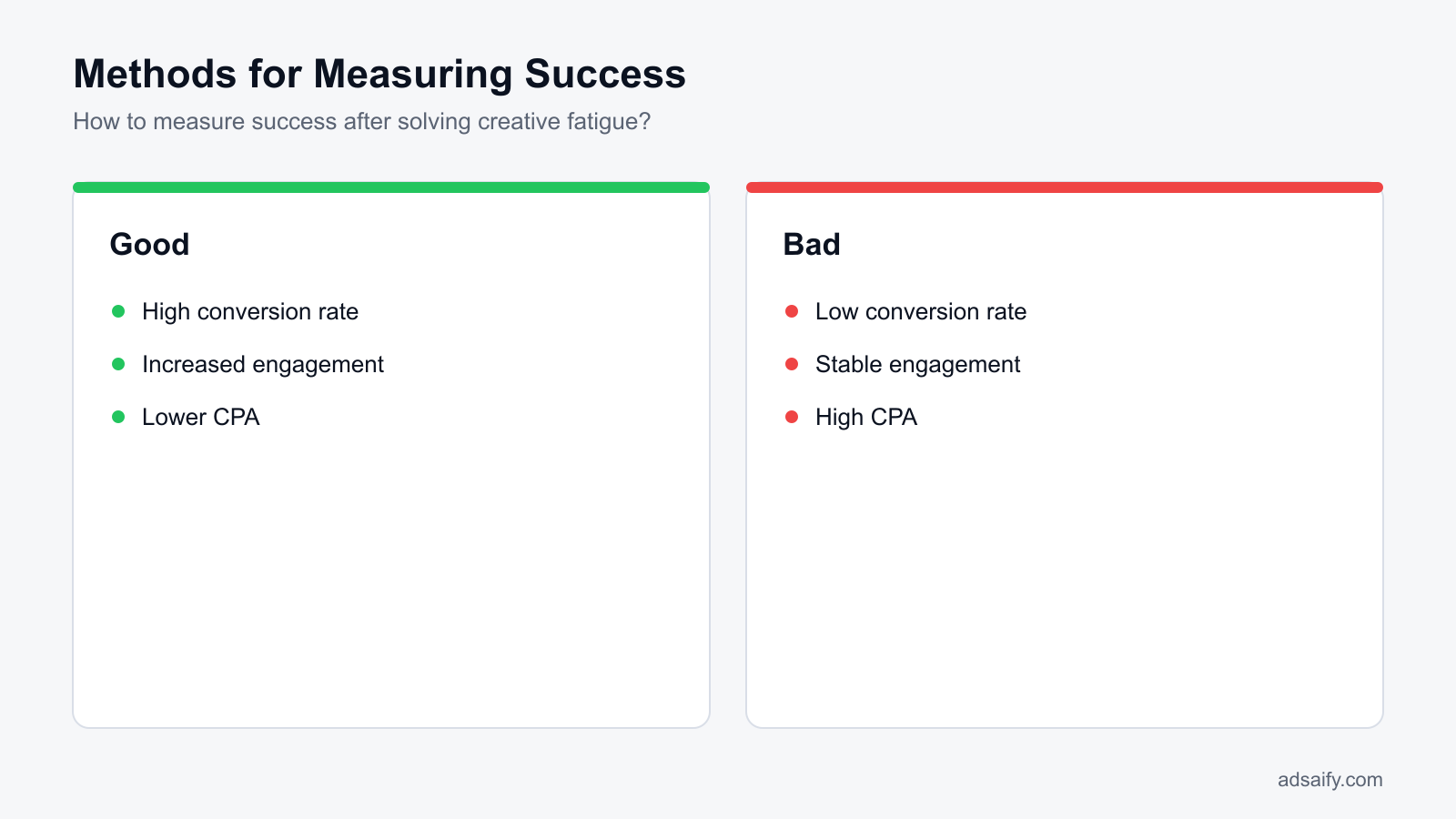
What to Do When the Fix Doesn't Help?
When the solutions to creative fatigue do not yield the expected results, marketers should explore alternative strategies. This can involve testing different ad formats, targeting new audiences, or revisiting the overall campaign objectives. If in-house adjustments fail, seeking expert advice or reassessing the competitive landscape may provide fresh insights and strategies.Try a Different Strategy
If the initial fix does not alleviate creative fatigue, consider shifting your approach. This could mean changing the ad format from a static image to a video or carousel. In Meta Ads Manager, navigate to the "Ad Set" section and select a different format under the "Ad" tab. Utilize A/B testing to compare new strategies against existing ones. For example, if your current ads are primarily image-based, create a video ad that highlights your product's features in an engaging way. Monitor performance metrics such as click-through rate (CTR) and engagement to determine which strategy resonates better with your audience.Seek Expert Advice
If internal efforts to combat creative fatigue are ineffective, consider consulting a performance marketing expert. They can provide insights based on industry benchmarks and advanced strategies. Look for professionals with a proven track record in managing Meta ad campaigns. Platforms like LinkedIn or specialized marketing forums can be valuable resources for finding experts. Prepare specific questions or data points to discuss, such as your current ROAS (return on ad spend) and audience performance metrics, to get the most out of the consultation.Reassess the Competition
Understanding your competition is crucial when creative fatigue persists. Take time to analyze competitors’ ad strategies by using tools like Facebook Ad Library, which allows you to view active ads from any Facebook page. Look for trends in their creative formats, messaging, and targeting. Are they using more video content? What are their calls to action? This analysis can inform your own strategy, helping you differentiate your ads and potentially reinvigorate audience interest.- Test different ad formats to find what works best.
- Consult with a performance marketing expert for fresh insights.
- Analyze competitors’ ads for inspiration and strategies.
- Review audience insights to identify new segments to target.
- Adjust your campaign objectives based on performance data.
- Implement A/B tests to refine your approach continuously.
- Consider seasonal trends that might affect audience engagement.
- Explore new platforms or ad placements to reach wider audiences.
What are the alternative solutions?
Alternative solutions to creative fatigue include exploring new advertising platforms beyond Meta, such as TikTok or LinkedIn, which may offer untapped audience segments. Additionally, leveraging user-generated content can provide fresh perspectives and authenticity. Collaborating with influencers or brand ambassadors can also introduce new creative elements and engage your audience differently.What Are the Key Terms?
Understanding key terms is essential for navigating the landscape of Meta advertising effectively. Creative fatigue refers to the boredom that arises from repetitive content, leading to decreased engagement. Familiarity with metrics like CPA (Cost Per Acquisition) helps marketers assess the effectiveness of their ads in acquiring customers. The target audience is the specific group that the ad is designed to reach, impacting overall campaign success.- Creative Fatigue: Boredom from repetitive content that leads to decreased engagement.
- CPA (Cost Per Acquisition): The cost incurred to acquire a customer through advertising.
- Target Audience: The specific group of consumers targeted by an advertisement.
- CTR (Click-Through Rate): The percentage of people who click on an ad after seeing it.
- ROAS (Return on Ad Spend): A metric that measures the revenue generated for every dollar spent on advertising.
- A/B Testing: A method of comparing two versions of an ad to determine which performs better.
- Ad Set: A group of ads within a campaign that share the same targeting and budget settings.
- Engagement Rate: A metric that measures the level of interaction (likes, shares, comments) with an ad.
- Audience Insights: Data that provides information about the demographics and behaviors of your target audience.
- Facebook Ad Library: A tool that allows users to view all active ads from any Facebook page.
- Automation Rules: Predefined actions set to optimize ad performance based on specific criteria.
- Ad Creative: The visual and textual elements of an advertisement.
Where can I learn these terms?
To learn these key advertising terms, consider online resources such as Meta’s Business Help Center, which provides comprehensive guides and tutorials. Additionally, marketing courses on platforms like Coursera or HubSpot Academy can offer structured learning pathways. Engaging with industry blogs and forums can also enhance your understanding of these concepts in real-world applications.Conclusion: Overcoming Creative Fatigue
To combat creative fatigue, regularly refresh your ad creatives, update your target audience, and leverage AI tools for efficiency. Implementing diverse strategies, such as A/B testing and audience segmentation, will keep your campaigns engaging. A concrete next step is to explore Adsaify's features by registering for a free trial to streamline your ad creation process today.
Want to see this in your own account? Enter your website address and Adsaify drafts the campaign for you. The first ad is free. Try it now or log in.
Frequently Asked Questions (FAQ)
1. How long does creative fatigue last?
Creative fatigue can last from a few weeks to several months, depending on the frequency of ad exposure and audience engagement. When audiences see the same ad repeatedly, their interest can wane, leading to decreased performance. Regularly refreshing content is essential to mitigate this issue.
2. In which industries is creative fatigue more common?
Creative fatigue is more common in industries with high competition and frequent ad exposure, such as e-commerce, retail, and travel. These sectors often rely on visual content that can become repetitive, making it crucial to innovate and refresh ad creatives to maintain audience interest.
3. How much time should I spend on creating new content?
Spending 10-20% of your total ad campaign time on creating new content is advisable. This allocation allows for regular updates while maintaining a focus on performance analysis and optimization. Consistent content refreshment helps keep your audience engaged and minimizes creative fatigue.
4. How effective are AI tools?
AI tools are highly effective for creating and managing ad campaigns, as they streamline the process of generating ad copy, targeting audiences, and suggesting budgets. For instance, Adsaify can analyze your business and draft tailored campaigns, making ad management more efficient and data-driven.
5. How can I update my target audience?
Updating your target audience can be done by analyzing performance metrics and demographic data from previous campaigns. Consider segmenting your audience based on interests, behaviors, or location. Utilize insights from tools like Adsaify to refine your targeting and reach new potential customers.
6. What strategies should I implement to prevent creative fatigue?
To prevent creative fatigue, implement strategies such as rotating ad creatives regularly, utilizing A/B testing to identify successful formats, and diversifying content types. Additionally, consider audience segmentation to tailor messages and keep your campaigns fresh and engaging.
7. What should I do for more engagement?
To boost engagement, focus on creating compelling visuals, interactive content, and clear calls-to-action. Utilize storytelling techniques and user-generated content to make ads relatable. Regularly analyze engagement metrics to refine your approach and optimize for better audience interaction.
8. How can I create innovative content?
Creating innovative content involves brainstorming unique ideas, experimenting with different formats, and staying updated on industry trends. Collaborate with creative teams, leverage user feedback, and utilize AI tools like Adsaify to generate fresh ad concepts that resonate with your audience.
How can you try this with Adsaify?
The quickest way to apply the steps in this article to your own account is to try them. Adsaify analyses your business from your website address, drafts the campaign with an audience, ad copy, creative and a budget suggestion, and publishes it to your own Meta ad account once you approve.
- Your first ad is free: there is nothing to lose by trying.
- Your own ad account: the campaign runs in your Meta account and you stay in control.
- Images and video: generate ad creatives with AI or promote an existing Instagram post.
Create a free account and try your first ad · Already have an account? Log in.